
LSAT 69 LG Explanations
Full explanations for every question from the logic games section of LSAT 69.
Archived Logic Games explanations
Logic Games are no longer part of the LSAT. LSAC removed the Logic Games section beginning with the August 2024 LSAT. If you are studying for the current LSAT, you can skip this section.
These explanations remain available for students, tutors, and readers using old-format PrepTests. For current guidance, see Logic Games and the current LSAT.
Table of contents
Game 1: Manuscripts
Game 1 Setup
This is the first logic game from Section II of LSAT 69, the June 2013 LSAT. A researcher is studying seven manuscripts (F, G, H, P, L, S). You must place them in order. This is a linear game.
This game can be a little difficult if you use the traditional method of ‘not’ rules to show where variables can’t go.
I used a new type of diagram the second time through that made it much simpler.
The first two rules are straightforward:
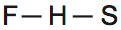

It’s the rules involving M and L that are difficult. First, they’re a bit hard to understand. They really mean that L is fifth or later, and M is third or earlier.
Second, those rules are confusing to represent. Here’s the traditional way to draw these rules:

I’ve also drawn the final rule. H can’t go fifth.
That’s how I drew the diagram when I first I did this game, and it felt slow. I kept forgetting the rules for M and L.
A Better Diagram
Your diagrams should be clear and easy to read. Here’s how I drew it the second time I did the game, and it was a lot easier:
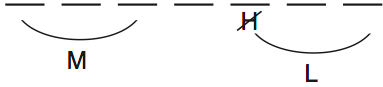
The arcs show where M and L can go. I’ve left the final rule as a not rule: H can’t go fifth.
Now we have a simple diagram that includes three rules, and only two separate rules to remember.
Game 1 Main Diagram
These diagrams show the rules the researcher uses to determine the ages of this logic game’s manuscripts (F, G, H, P, L, S).
Refer to this diagram when solving this game. Copy it on your own page, and on each question make a new version of it in order to follow along with my explanations. You’ll learn much more if you draw along.
The setup section explains how to build this diagram.
Main Diagram
Rules

Question 1
For list questions, go through the rules and use them to eliminate answers one by one.
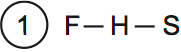
Rule 1 eliminates C. The order is F-H-S.
Rule 2 eliminates A. P has to come right after G.
Rule 3 eliminates D. L has to come fifth or later.
Rule 4 eliminates B. H can’t be fifth.
E is CORRECT. It violates no rules.
Question 2
I skipped this question at first. I wanted to develop examples that proved some letters could be third.
I eliminated C and D using that method, using the correct answer to question 1 and a scenario from question 4.
However, I got nowhere after that. It’s easier to solve this question with logic.
We know M has to go in one of the first three spaces, so M probably affects who can go third.
If we place S third, then F and H have to go in spaces 1 and 2, because of the first rule.
There’s no space left to put M 3rd or earlier. If S went third, we’d have to put F, H, S and M in the first three spaces.
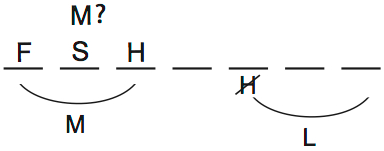
A is CORRECT.
When you’re stuck on a question, I recommend simply trying to draw. I figured out the logic of this question by putting S third, putting FH before, and looking at my diagram.
It took me maybe 7 seconds to draw that scenario. That’s a lot more productive than staring at my page, thinking ‘I don’t know what to do’.
That’s what I did at first, and what most students do. If you’re stuck, try drawing an answer. You’ll learn as you draw.
Question 3
For local rule questions, you should always draw the new rule. Here’s what we get:
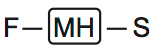
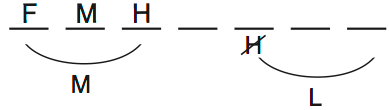
Then ask yourself what other rules are affected. We know M has to go third at the latest. So there are only two ways to place F-MH. Here’s the diagram with M second:
Here’s the diagram with M third. I also placed F, S and L:
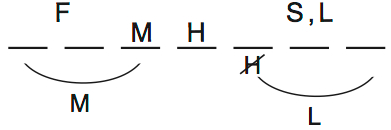
F goes somewhere before M. S must come after H, and L comes fifth at the earliest.
This second diagram doesn’t work. We still have to place GP, and there isn’t a spot with two open spaces.
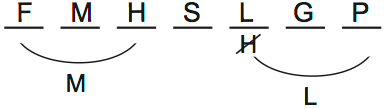
That leaves the first diagram, with FMH in the first three spaces. That scenario eliminates A-D.
E is CORRECT. This scenario proves it:
Question 4
I found it easiest to solve this question by eliminating wrong answers, using scenarios.
You can eliminate E because the correct answer on question one placed S fourth.
I waited to solve question 5 before I did this question. That let me eliminate A and D.
Here’s the diagram from question five:
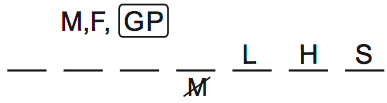
The commas indicate that the first four variables can go in any order, as long as M doesn’t go fourth.
So this diagram proves that F or P could go fourth. A and D aren’t right.
We’re left with B and C. This diagram proves G can go fourth:
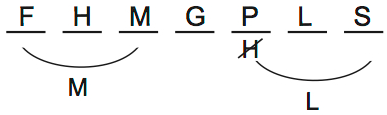
C is CORRECT. Let’s make a diagram that shows what happens if you try to put H fourth.
The first rule gives us the order F-H-S. So F is somewhere in the first three spaces, and S is somewhere in the last three.
Rules 3 and 4 tell us that M is somewhere in the first three spaces, and L is somewhere in the last three.
So I put FM before H, and LS after H.
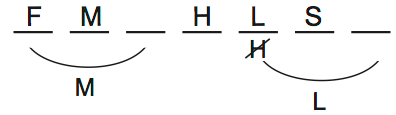
It doesn’t matter what order you put FM and LS in, or where you put them. The rules don’t say anything about that. When you’re to build a ‘could be true’ scenario, you can place variables anywhere, as long as you obey the rules.
So we could also have had M in 1, F in 3, H in 4, for example. As long as it’s not illegal, go for it. There are usually multiple possible scenarios.
However, this scenario won’t work. No matter where we put FM or LS, we can’t place GP in this scenario. GP needs two open spaces.
Question 5
Answering this question quickly depends on your ability to see all the rules and how they interact.
First, draw the new rule:
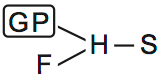
I don’t quite know how to describe the process of getting the next deduction. Insight would be the right word, but that’s not a very practical. I’ll try to break it down.
M can only be in the first three places. L can only be in the final three places. This is very restrictive. When a game gives you restrictive rules, you must always keep them in mind.
The number 3 is important.
H now has three things in front of it. That means H can’t be in the first three places. That means M is in front of H, since M is in the first three places.
We get this new diagram:
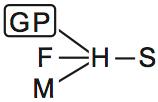
L is the only one left out. L has to be in the final three places. H has four things in front of it. Therefore H is also in the final three places.
So, H, L and S are in the final three places.
But H can’t go fifth. And H goes before S. So L goes fifth, H goes sixth, and S goes seventh.
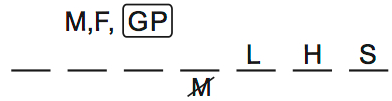
M, F and GP fill the first four spots. The only restriction is M can’t go fourth.
In practice, I often get these deductions by starting to draw diagrams. If you keep all the rules in mind when you draw diagrams, you will spot these hidden points of restriction.
So don’t worry that you don’t have any magic insight for making deductions. I usually don’t have it either. Instead, I draw, and figure things out by drawing.
D is CORRECT. L has to go fifth, not seventh.
Game 2: Petri Dishes
Game 2 Setup
This is the first logic game from Section II of LSAT 69, the June 2013 LSAT. There are six petri dishes which must be placed in a refrigerator. The dishes, labeled 1 through 6, must be placed on three shelves: the bottom shelf, the middle shelf, and the top shelf (B, M, T).
This is a grouping game. The first question of each game usually shows a good way to draw the diagram.
Here, though, the first question puts the bottom on the top, and the top on the bottom of the diagram. That’s confusing.
I reversed it, so that the bottom is on the bottom:
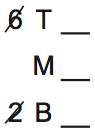
I’ve added the second rule to this diagram. 2 is always above 6. I drew it separately as well:

The first rule, I just memorized. There are at most three variables on a shelf. You could draw something like ‘3 MAX’ if it helps you remember.
Here are the third and fourth rules:


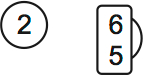
These boxes are like reversible suitcases. The order of the variables doesn’t matter. The boxes mean that 6 and 5 are always one group apart, and 1 and 4 are never in the same group.
Pay attention to the variables 1 and 4. They need two open groups. This is a three group game. Often, the questions will artificially fill one of the groups.
Then there will only be two groups left, and 1 and 4 must be split between those two groups.
The number 3 has no rules. I represent that by drawing a circle around 3:

A very small deduction
There’s one tiny deduction. Not even really a deduction, more of a fact. Since 6 and 5 go beside each other, one of them always has to be in the middle group.
Why? Well, they can be top and middle, or bottom and middle. Those are the only two possibilities. Here’s a drawing to help you visualize it:
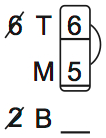
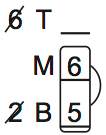
So one of 5 or 6 is always in the middle. You can add this to the diagram if it helps you remember:
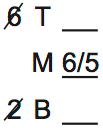
Of course, you won’t actually draw this 6/5 when making diagrams. Usually a question will place 5 or 6 anyway. This note on the main diagram is just a reminder, assuming you figured out the deduction in the first place.
Memorize the rules, if you can
And that’s it. There’s no magic in this game. No amazing deductions that will let you solve everything.
There are just three main rules. Remember them, and this game is easy. Forget them and it’s hard.
It’s possible to memorize those three rules without much difficulty. The key is not rushing to start the questions. Spend some time on the setup.
I always read the rules once before drawing anything. I read them again while I draw. I read them once more to make sure I made no mistakes. Finally, I read them again to eliminate answers on the first question.
So I read the rules four times. This process might take me 20 seconds more than someone who reads the rules 1-2 times. You read faster each time you reread.
It is worth it. I can almost always memorize the rules effortlessly by doing this.
I mean c’mon, the rules are just a few facts. Read them four times, and you’d remember most of the rules too. So why don’t you?
I guarantee you’ll go much faster through the questions when you memorize the rules. And make less mistakes. All from 20 seconds more reading.
Game 2 Main Diagram
These diagrams show the rules used by this logic game to determine how to store petri dishes (1, 2, 3, 4, 5, 6) in the refrigerator (T, M, B).
Refer to this diagram when solving this game. Copy it on your own page, and on each question make a new version of it in order to follow along with my explanations. You’ll learn much more if you draw along.
The setup section explains how to build this diagram.
Game Diagram
Rules
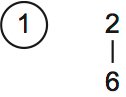


Question 6
For list questions, go through the rules and use them to eliminate answers one by one.
Rule 1 eliminates A. Only three dishes max per shelf.
Rule 2 eliminates C. 2 has to be above 6.
Rule 3 eliminates E. 6 and 5 have to be beside each other, vertically.
Rule 4 eliminates D. 1 and 4 can’t be on the same shelf.
B is CORRECT. It violates no rules.
Question 7
Whenever a question gives you a new rule, you should draw it. Then combine the new rule with existing rules.
We know 6 and 5 have to be one group apart. So if 6 is on the bottom, 5 is in the middle:
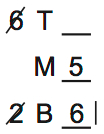
The vertical line by 6 indicates that shelf is full.
Only two groups are open now. We know 1 and 4 are in different groups, so they’re split across top and middle:
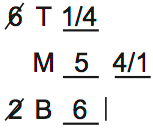
There are two dishes left, 2 and 3. The middle shelf can’t have four dishes (rule 1), so at least one more dish is on top.
So one of 2/3 definitely goes on top, and the other one can go top or middle:
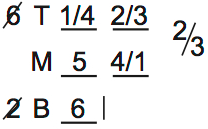
The hovering 2/3 indicates it can go in either open group.
The question asks who could go on the fifth shelf.
We know five has to be on the middle shelf. So the answer has to be D or E.
1 or 4 also has to be in the middle.
So E is CORRECT.
Question 8
1, 2 and 3 fill up an entire shelf. That means 6 and 5 must go on other shelves.
In fact, 1, 2 and 3 must be on the top shelf, since 2 must be above 6.
Remember that 5 and 6 either go top and middle, or bottom and middle. On this question, top is full. So that means 6 and 5 take bottom and middle.
The middle and bottom shelves are reversible:
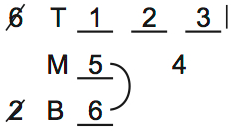
4 can go on either the middle or bottom shelf.
C is CORRECT.
Question 9
Remember that deduction about 6 and 5? It’s surprisingly important this game. They go top and middle or bottom and middle.
Here are the two ways we can place 6 and 5:
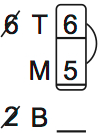
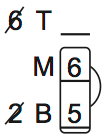
So the middle shelf always has someone.
If one shelf has no dishes, that means that the other two shelves each have three dishes.
That’s because the first rule says each shelf has max three dishes, and there are six dishes to place between two shelves.
So, the middle shelf always has dishes, and each shelf has three dishes.
Therefore the middle shelf has three dishes.
B is CORRECT.
Question 10
When a question gives you a new rule, draw it.
5 is alone on the bottom shelf and there are two dishes on the middle shelf:
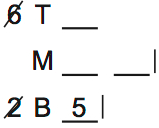
The vertical lines mean those shelves are full.
We know 6 is one above or below 5. And 2 is above 6. So 6 is in the middle and 2 is on top:
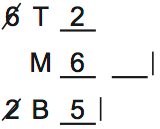
We know 1 and 4 have to be in different groups. There are only two groups left, since 5 is alone on the bottom:
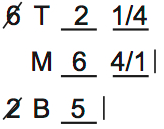
Finally, only the top group has space left for 3:
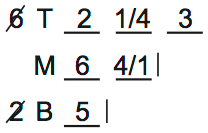
We’re looking for two dishes that must be on the top shelf. That’s 2 and 3.
C is CORRECT.
Question 11
Remember that one of 5 or 6 always has to be in the middle. See the setup for the explanation of this deduction.
In this question, only one dish is stored in the middle. So it has to be 5 or 6.
2 has to be above 6. 2 can’t go in the middle on this question, so 2 has to go in the top group:
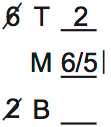
1 and 4 have to be split between the two other groups:
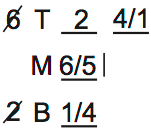
The question asks for two dishes that could be the only ones on the top shelf. We know that 2, and one of either 1 or 4 has to be on top.
A is CORRECT.
Practice Exercise – Fill out the Scenarios
You could draw a few scenarios on this question, but it’s not necessary. We already have enough information to answer the question, and it would be a lot of drawing to fill in the full placements for 6/5 and 3.
But, as a practice exercise, you might find it useful to draw the possibilities. They are:
- 6 middle, 5 is on the bottom or top.
- 6 bottom, 5 middle.
3 can go on the bottom or the top. Unless 5 is on top, then 3 has to go on the bottom, because shelves can have max three dishes (rule 1).
If you’re not sure why these restrictions exist, draw these scenarios for practice, while referring to the rules.
Game 3: Game 3
Game 3 Setup
This is the third logic game from Section II of LSAT 69, the June 2013 LSAT. A company is operating vending machines in four schools: Ferndale, Gladstone, Hafford, and Isley (F, G, H, I). The company has to deliver juice and snacks (J, S) to each of the four schools.
This game is a mix of grouping and linear. More importantly, it’s one of those rare games where you can figure out almost everything before starting.
This game type used to be common, but it’s rare on the modern LSAT. Now, games tend to test your memory of the rules, not your ability to combine rules up front.
However, up-front-deduction games still happen often enough that you should practice them multiple times. Once you get good at making up-front deductions, these are the easiest games on the test.
Base Diagram
First, we’ll set up the game like the first question does:
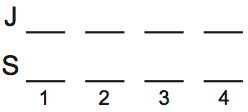
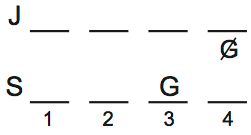
I’m going to skip the first rule, and draw rules two and three. Always start with rules that are definite:
Next, the fourth rule. The first juice and the final snack are always the same. Here’s a diagram to help you visualize it. The two spots by marked by an X will always be the same variable:
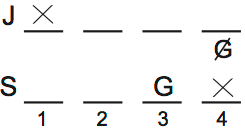
Now, let’s go back to the first rule. F is earlier than H, in the snacks row. That makes snacks pretty restricted. Three rules affect the snacks row.
The final spot is particularly restricted. All three snack rules affect that spot. Who can go last?
- Not G, G goes third.
- Not F. F has to go before H.
So only H and I can go last in the snack row. Whenever a game offers only two possibilities, you should make two diagrams.
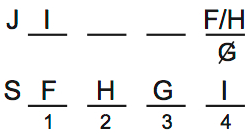
First Scenario – Isley First And Last
Let’s start with I:
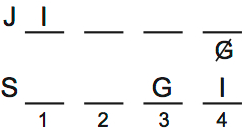
F and H are the only snacks left. Rule 1 says that in snacks, F has to go before H:
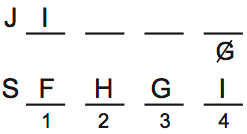
Finally, the last juice can only be F or H. I is already first, and G can’t be the last juice (rule 2):
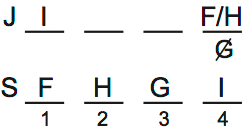
It may seem obvious that only F/H can go last, but it’s always worth drawing every deduction.
Second Scenario – H First And Last
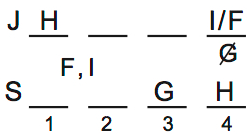
Next, let’s do the diagram where H is the last snack:
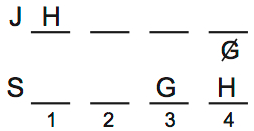
F and I are the other two snacks. They can go in either order:
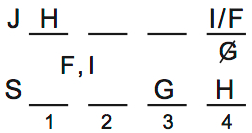
The final juice is I or F. That’s because G can’t be last (rule 4) and H is first.
So there are only two diagrams. They cover all the rules. This makes the game very easy to solve.
With each diagram, you just have to remember which juices are left to place: G, and one of the two juices from the final space.
How To Make Deductions
I want to talk about how to make these diagrams. It’s easier than it looks. I just added rules one by one.
Once I added a rule, I stopped to think about what spot was the most restricted.
- Were there any spots where only two variables could go?
- If only two variables were left, did I know their order?
Once you make a deduction, stop and think again. Are there any new spots that are restricted, or where there only two variables left to place?
Each deduction you make further restricts the game. Re-examine the game whenever you make a deduction.
Game 3 Main Diagram
These diagrams show the rules used by this logic game to determine what order the schools (F, G, H, I) receive deliveries of juice and snacks (J, S).
Almost all questions will refer to these two scenarios. Draw them yourself, and make sure you know how we arrived at them.
If I say a question can only use scenario 1, I’ll expect you to know I’m referring to one of these.
If you don’t understand how I got these diagrams, try to draw them yourself. Reread the rules first, and follow along with the explanations in the setup. Don’t move on until these scenarios make sense.
Main Diagram
First Scenario – Isley First And Last
Second Scenario – H First And Last
Question 12
For list questions, go through the rules and use them to eliminate answers one by one.
Rule 1 eliminates C. F has to be earlier than H in snacks.
Rule 2 eliminates B. G can’t be the fourth juice.
Rule 3 eliminates D. G has to be the third snack.
Rule 4 eliminates E. The first juice and last snack must be the same.
A is CORRECT. It violates no rules.
Question 13
H is the fourth juice for this question. That has to be the first scenario from the setup. In scenario 2, only F or I can be the fourth juice.
Here’s scenario one again:
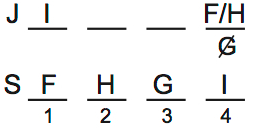
Put H fourth, like the question says:
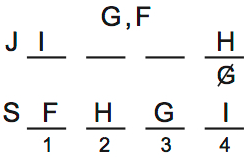
G and F are the only juices left to place.
D is CORRECT. H is the second school for snacks in this scenario.
All the other answers don’t have to be true, or can’t be true.
Question 14
I is the third juice in this question. We have to use the second scenario, because in the first scenario, I is always the first juice.
Here is the second scenario diagram again:
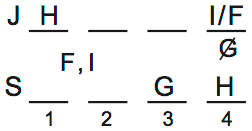
Now let’s put I third:
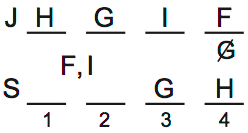
F and I are the only items left to place, in snacks.
C is CORRECT. F can be before I in snacks.
The other answers contradict the diagram.
Question 15
Isley can only be the first snack in the second scenario. Here it is again:
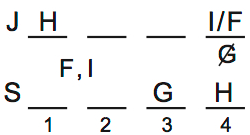
Now let’s place I first, like the question says:
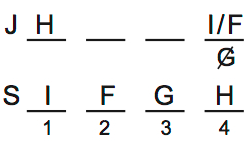
A is CORRECT. F could be the second juice, if I goes last.
B-D are wrong because H must be the first juice in this scenario. E is wrong because H has to be the last snack in this scenario.
Question 16
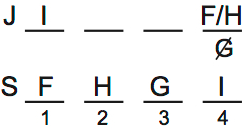
The best way to solve this ‘could be true’ question is to look at both scenarios and see whether the answer is possible in either. Here are the two scenarios again:
Scenario 1
Scenario 2
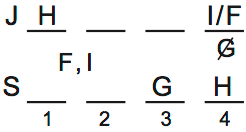
A is wrong because F is before G in the snack row in both scenarios.
B is wrong. In the first scenario, I is before G in juices. In the second scenario, I is before G in snacks.
C is wrong. In the first scenario, I is before H in juices. In the second scenario, I is before H in snacks.
D is CORRECT. I could be before F in both rows in the second scenario. Here’s one way it could look:
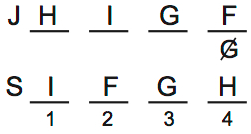
E is wrong. In the first scenario, H is before I in snacks. In the second scenario, H is before I in juices.
Question 17
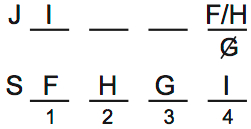
Let’s look at where G can go in the juice row, in both scenarios. Here are the two scenarios again:
Scenario 1
Scenario 2
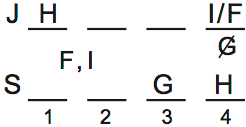
Based on these two scenarios, G can only go 2nd or 3rd. I’ll recap why this is.
The rule says G can’t go fourth, so that’s out. G also can’t be the first juice.
Why? If G was the first juice, rule 4 says they would have to be the fourth snack. But Rule 3 says G must be the third snack, not the fourth.
The key to answering rule substitution questions is to figure out the full effects of a rule, and rephrase the rule to describe those effect another way.
B is CORRECT.
This question would have been hard to answer without scenarios. I take that as evidence you were supposed to figure out the scenarios.
Game 4: Paralegals
Game 4 Setup
This is the fourth logic game from Section II of LSAT 69, the June 2013 LSAT. There are five paralegals: Frank, Gina, Hiro, Kevin and Laurie (F, G, H, K, L). They are assigned to one of three cases: Raimes, Sicoli or Thompson (R, S, T).
This is a grouping game. Above all else, you have to remember the rules. If you remember them, there’s not much to this game.
Actually, why don’t you go reread the rules before you read my explanations?
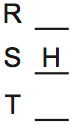
I drew the last rule first – H is with S. You should always start with the most definite rules:
Next, I drew two versions of the main diagram to show the first rule. Either F is with R and K is with T, or they both aren’t:
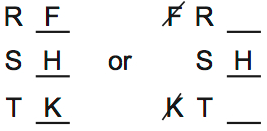
I didn’t always use these not rules when I made local diagrams. But I glanced at this diagram when drawing and reminded myself of the rule.
The second rule is a bit unique. One, but only one, of F or G is alone. I prefer just to memorize that.
It’s not hard to memorize one out of three rules. That’s why it’s so important to draw as many rules as you can directly on the diagram.
That said, I did draw something when I did this game. It was just a placeholder to help me remember:

Finally, L is random. The circle indicates that L has no rules:

Only Two Groups To Be Alone In
That’s it. Not much to say about these rules. Remember that each group needs at least one person.
A few questions place variables alone in a group. Variables can only be alone in groups R or T, since H is already in group S.
So when a question tells you someone is alone, there are only two possibilities. Whenever there are only two possibilities, you should make two diagrams: One with the person alone in R, the other with the person alone in T.
Drawing both diagrams lets you find different deductions for each diagram. The LSAT makers expect you to draw two diagrams when there are only two possibilities.
Game 4 Main Diagram
These diagrams show the rules used by this logic game to determine which paralegals (F, G, H, K, L) are assigned to each case (R, S, T).
Refer to this diagram when solving this game. Copy it on your own page, and on each question make a new version of it in order to follow along with my explanations. You’ll learn much more if you draw along.
The setup section explains how to build this diagram.
Main Diagram
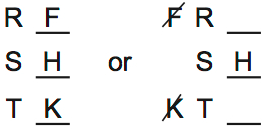
Rules


Question 18
For list questions, go through the rules and use them to eliminate answers one by one.
Rule 1 eliminates A. If F is with R, K needs to be with T.
Rule 1 also eliminates E. F is with R, so K should be with T.
Rule 2 eliminates C. One of F or G has to be alone.
Rule 3 eliminates B. H has to be with S.
D is CORRECT. It violates no rules.
Question 19
This is a tricky question. We’re looking for a group that can’t go with S. The answers list people that are with S. That part is clear.
The hard part is that you also have to consider the people not with S. Some of the hardest logic games questions involve unseen letters.
There’s a simple trick to fixing this. Draw the unseen variables. Here’s what my page looked like:
A: F, H, K G, L
B: F, H, L K, G
C: G, H, K F, L
D: G, H, L F, K
E: H, K, L F, G
The two letters on the right are those that are with R and T, alone.
Once I drew those, I noticed that E had F and G in other groups. That means both F and G would be alone, which violates rule two.
E is CORRECT.
Question 20
As with all local rule questions, you should draw the new rule, even if it seems simple. T has exactly two people:
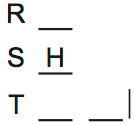
Then look at the diagram, and think how it affects existing rules.
You know one of F or G is alone. In this new diagram, they could only be alone in group 1.
So we get two diagrams, one with F in R, and one with G in R.
Let’s start with F’s diagram. If F is with R, K must be with T (rule 1):
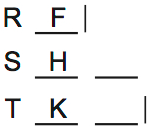
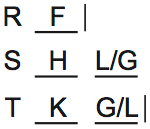
G and L fill the other two spots. One in group 2, one in group 3. There are no rules for them in this situation, they are interchangeable:
For the next scenario, put G alone. Since F is not with R, K can’t be with T (rule 1):
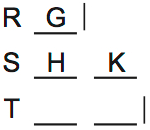
We have to place L and F. T is the only open group, so both L and F go there:
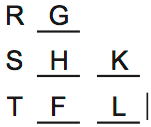
A is CORRECT. There’s no problem with having G alone in R.
Question 21
This question says G and L are the only two people in one group.
There are only two possible diagrams. GL can’t be alone in group S, because H is already there.
So GL can only be alone together in R or T.
Let’s try putting them in R:
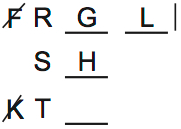
F and K are left to place. K can’t go with T, since F isn’t with R (rule 1).
F has to be alone, since G isn’t alone (rule 2). So F goes with T, and K goes in group S:
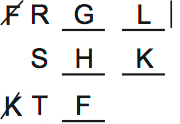
Now let’s try putting GL alone in group T:
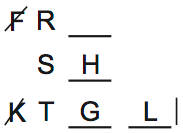
So far so good. Now we have to place F and K.
We have to place F alone, since G isn’t alone (rule 2).
Hmm, that won’t work. F would have to go in R to be alone. But rule 1 says that if F is in R, K has to go in group T.
K can’t go in T. It’s full because we put GL there.
So only the first diagram works, with GL in R.
C is CORRECT.
Question 22
If you got question 21, then you could also have solved question 22. In question 21, I tried to put GL alone in group T. It didn’t work.
Go back and look at question 21 for the explanation.
D is CORRECT.
You can also solve this question by eliminating wrong answers. This scenario proves that either G or L could be alone in group T:
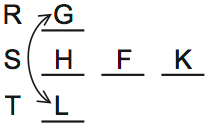
G and L are reversible, since no rules say which group G and L should go in. So A and B are wrong. Note that I’ve used a different diagram for reversibility. Sometime I draw arrows or arcs, as they’re easier than writing: G/L, L/G. Go with what works.
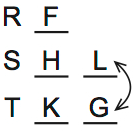
This diagram proves C and E wrong. Once again, G and L are reversible.
Question 23
K has to be alone for this question.
R and T are the only groups where K can be alone. H is already in group S.
Remember that, along with K, one of F or G must be alone.
So, two groups, R and T. K goes in one, and one of F/G in the other.
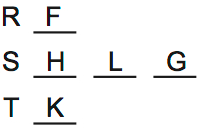
Let’s try putting K in group T.
We have to place one of F/G in the other group. It’s got to be F, because of rule 1. If K is in T, F must go in R:
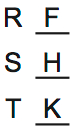
L and G are left, we can put them in group S. This diagram works:
Now let’s try putting K in group R:
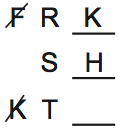
F or G must go in T. It doesn’t matter which one. L and the other F/G go in S:
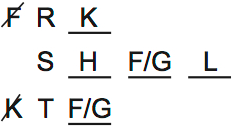
That diagram works too. So either K or F can be in group R, when K is alone.
B is CORRECT.

Leave a Reply