
LSAT Preptest 19 LG Explanations
Full explanations for every question from the logic games section of LSAT Preptest 19.
Archived Logic Games explanations
Logic Games are no longer part of the LSAT. LSAC removed the Logic Games section beginning with the August 2024 LSAT. If you are studying for the current LSAT, you can skip this section.
These explanations remain available for students, tutors, and readers using old-format PrepTests. For current guidance, see Logic Games and the current LSAT.
Table of contents
Game 1: Factory Inspections
Game 1 Setup
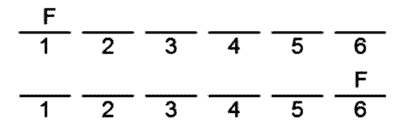
This is a linear game. We can split the game into two scenarios: One where F is first, and the other where F is second. This makes it easier to visualize the possibilities when the questions give new rules.
The next two rules can be combined. J is before Q. And Q is right in front of R. So J is in front of QR.

The box around QR shows that they must be beside each other, in that order.
The final rule lets us add a bit more detail to our scenarios. We can see what happens if G goes in 3, and what happens if G doesn’t go in 3.
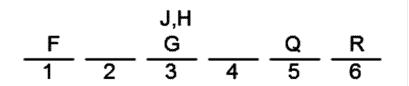
If G is in 3, Q is in 5. So R must be in 6. That means F can only go in 1. J and H can go in 2 or 4. J is before Q no matter where it goes
For our other scenarios, we’ll add in a rule that says G doesn’t go in 3.
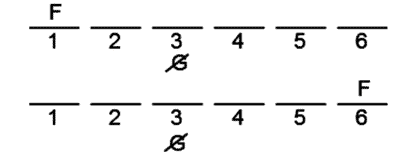
Some people wonder why I do this. It’s simple. It’s valuable to know what happens when G is in 3: almost everything falls into place.
But you can’t just draw that scenario alone. You also need to put the not G under 3 in the other scenarios because it’s very, very easy to forget about the rule. The not G reminds you that you already drew a scenario for what happens when G is in 3.
Game 1 Main Diagram
The setup section explains how to build this diagram.
Main Diagram
Scenario 1

Scenarios 2 and 3


H is random. I tend to circle random variables.

Question 1
For list questions, you should test each rule against the answer choices. Eliminate them one by one.
A is wrong because J needs to be before QR.
B is CORRECT.
C is wrong because Q needs to be right in front of R.
D is wrong because F needs to be in 1 or 6.
E is wrong because if G is in 3 then Q must be in 5.
Question 2
For must be true questions, scan the answers first. They’ve hidden the right answer at the bottom.
E is correct because J and Q have to be before R. R can be in 3 at the earliest.
This scenario proves A wrong:

This scenario proves B and D wrong:
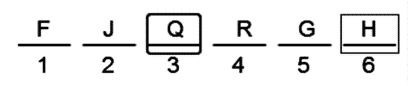
This scenario proves C wrong:
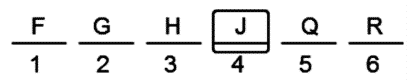
Question 3
Look at your rules for this question. 5 is pretty far over to the right. We can’t put J there, because QR has to come after. There’s only one spot after 5, so that doesn’t work.
C is CORRECT.
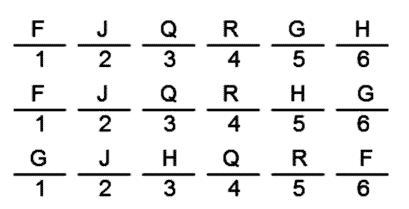
The following scenarios shows that G, H and R could all be in spot 5. This disproves A, B and E.
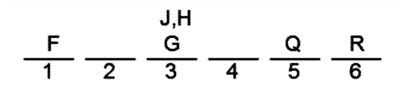
Scenario 1 from our setup proves that Q could go in 5. This disproves D:
Question 4
We know A and B are wrong. If G is in 3, then Q has to be in 5.
D is wrong because it puts R in front of J. Always eliminate easy choices like A, B and D first. Now we can consider C and E more closely.
This next scenario proves that E works:

E is CORRECT. C doesn’t work. Watch what happens if you put H in 3 and G in 5. There’s no space to put QR except 1 and 2…but then J couldn’t come before them.

Question 5
This question gives us a new rule, which we can add to our existing rule:

F can only go in 1 or 6. So this bloc has to go in 4, 5, 6
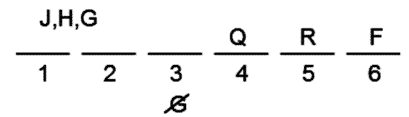
J, H and G go in any order. Except G can’t be in 3. Why? Then Q would have to be in 5.
So H or J goes in 3. If you make a deduction like that on a local rule question, it will be the correct answer 90% of the time.
It’s true here. D is CORRECT. Only H or J can go in 3.
Answers A through C are all things that could be true, but don’t have to be.
E can’t be true: Q must go in 4.
Question 6
There are two ways to put H and G as far apart as we
can. They can go in 2 and 6:

F must then go in 1, and J must go before Q and R.
Or we can put H and G in 1 and 5:

F must go in 6, and J must go before QR.
That means F, G and H can all be in space 1. D is CORRECT.
Question 7
Another new rule to add to our existing rule:
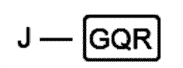
A is wrong because G needs QR after it now. If G goes in 5 is too late, there’s no space afterwards for both Q and R.
B forces G to go in 3. If H is in 6, then F is in 1. That means J – GQR goes in the middle like this:

This doesn’t work because. If G is in 3 then Q must be in 5.
C is CORRECT. This scenario proves J could go in 2:

D is no good. If Q is on day 4, then G is on day 3. The rules say that if G is on day 3 then Q must be on day 5.
E is wrong because J, G and Q all come before R. The earliest R can go is 4.
Game 2: Theatre Workshops
Game 2 Setup
This is a linear game. There are only four variables, but they each have to go twice.
There are only three rules.
Variables have to go besides themselves. So if you put S Monday, you also have to put S Tuesday.
You can never have day without any workshop at all. At most you can have two workshops per day.
- P and R begin no earlier than after the second day of lighting. Some people find this rule confusing. It just means P and R come after L is done. So if the second day of lighting is on Tuesday, the P and R can start on Wednesday or afterwards.
- It always makes sense to start with the most restricted rule when setting up a diagram.
Here, the most restricted rule clearly is the rule about L, P and R. You can’t put L in that many places. If L goes on Thursday, there’s no space for P and R to go afterwards.
The latest we can put L is on Tuesday and Wednesday.
This is scenario 1, which I’ve drawn below.
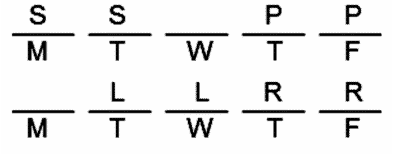
L goes on Tuesday and Wednesday. P and R have to go on Thursday and Friday, after L. S has to go on Monday and Tuesday. Otherwise no one would go on Monday.
The second scenario is more open ended. We put L on Monday and Tuesday.
We can put P and R anywhere on Wednesday, Thursday or Friday…except we can’t put them both on Wednesday and Thursday.
Why not? Well, then there’s no space for two S to go on Friday so nobody can go on Friday. So we have to have (at least) one of P and R on Friday. I’ve drawn two diagrams below to illustrate all this.
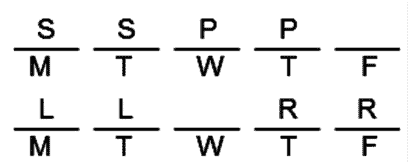
Note that P and R are interchangeable.
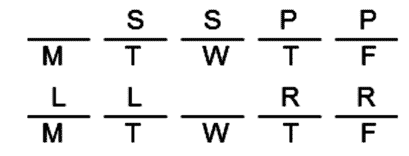
We can also put P and R on Thursday and Friday, as I’ve drawn above. S goes Wednesday.
Notice that in every scenario, both P and R go on Thursday. This has to be true, since the earliest they can start is Wednesday.
This is the key deduction of the game, so I’ll say it again: P and R always go on Thursday. Always. They can only go W-T or T-F.
Game 2 Main Diagram
The setup section explains how to build this diagram.
Main Diagram
Scenario 1
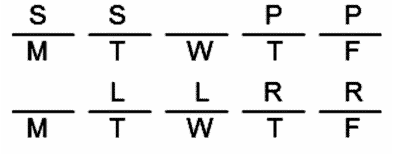
(P and R are interchangeable in all of these)
Scenario 2
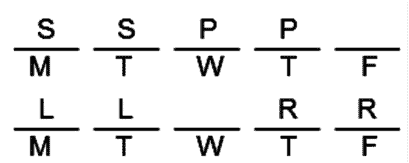
Scenario 3
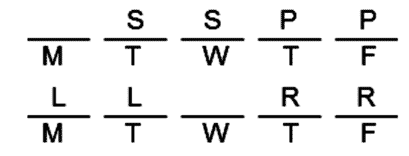
Question 8
Whenever you see the first question is a general question instead of a list question it’s a strong sign that you should have made many deductions in the setup.
A is wrong. Both P and R are always on Thursday. They can only go Wednesday-Thursday or Thursday-Friday.
B is CORRECT. It’s possible to have only one session on Friday. The following scenario proves it:
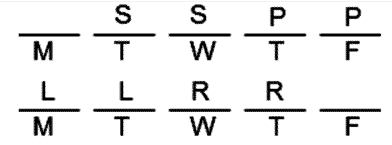
C is wrong. R has to go after L. And L can finish on Tuesday at the earliest.
D is wrong. Staging can never go on Thursday. Only P and R can go on Thursday. They have to go after L, and there’s only two ways to do that: W-T or T-F.
E can’t be true. If both P and R were on W-T, then no one could go Friday.
Question 9
This is another general question. That makes two in a row. It’s a strong sign that we should have made many deductions.
A is wrong because L always has to be in front of R.
B is wrong because Thursday always has to have both P and R. This is the key deduction of the game.
C is CORRECT. L would be on T and W. S could go on M and T. P and R would go on T and F. It’s the first scenario:
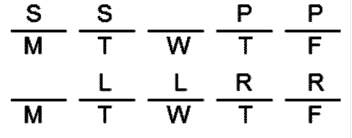
D is wrong because P and R always have to be on Thursday. We can never have S on Thursday. This is true in all scenarios.
E is wrong because L has to come before P. Here they’re on the same day.
Question 10
If P is on Wednesday, then L must go earlier, on Monday and Tuesday.
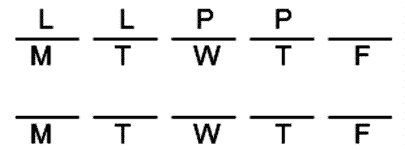
Always draw local rule questions. Then check if the deductions you make are the right answer. They usually are: A says L is on Monday. A is CORRECT.
B doesn’t have to be true. R could be in session on Thursday and Friday.
C can’t be true since P and R are always in session on Thursday.
D could be true but it doesn’t have to be. Staging could be in session on Tuesday and Wednesday if Rehearsals was in session on Thursday and Friday.
E could be true but it doesn’t have to be true. Staging could be in session on Monday and Tuesday instead. Production has already got Wednesday covered.
Question 11
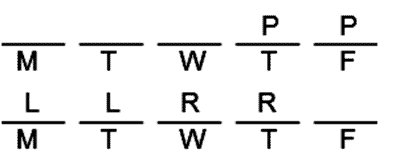
If P is alone on Friday then R has to go on Wednesday and Thursday. L goes on Monday and Tuesday.
S could go anywhere in the first three days.
A is CORRECT. Lighting can’t be in session on Tuesday and Wednesday. Rehearsals has to go in session on Wednesday.
B has to be true, not false. There’s no other place to put R. We need to leave P alone in Friday for this question.
C could be false. Staging has no rules and can go anywhere in the first three days.
D could be true if Staging is in place on Monday and Tuesday.
E could be true if Staging were on Tuesday and Wednesday.
Question 12
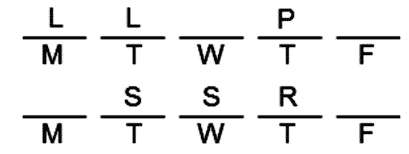
If L is alone on Monday, then S will have to go on Tuesday-Wednesday.
At least one of P and R will go on Friday, but it doesn’t matter which one. They’re interchangeable.
A can’t be true. Rehearsals can never be on Tuesday. It has to come after lighting.
B can’t be true. Staging has to be on Wednesday too. It’s the only way to leave L alone on Monday.
C is CORRECT. We could put both production and rehearsals on Thursday and Friday, leaving staging the only thing on Wednesday.
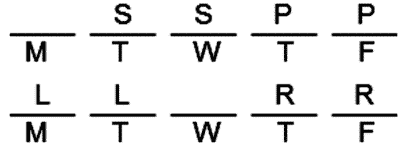
D can’t be true. Staging can never be in place on Thursday. P and R always fill up T.
E can’t be true. Staging can never be in place on Thursday. P and R always fill up T.
Game 3: Two Boats
Game 3 Setup
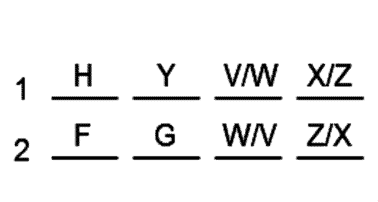
This is a grouping game. We can make many deductions before starting. There are only 3 adults and each boat has at least 1 adult. So the boats can only have either one or two adults.
Each boat has four people. X and Z are in different boats. We can add that on to our main diagram
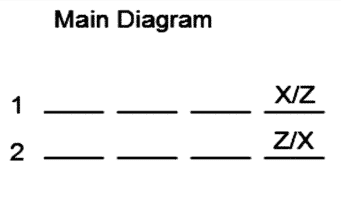
The second and third rules are both conditional statements. You can use the second rule to create a separate scenario. It’s important to draw the scenario because it involves adults, which are a limited variable.
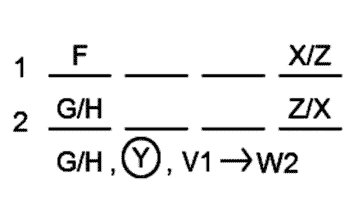
See what happens if you put F in boat 2:
First, the second rule says G has to go in boat 2 as well. If we put F and G in 2, we must put H in 1: H is the only other adult. We already have one of X or Z in 1 and the other in 2. That leaves two spots in boat 1 and one spot in boat 2. We can’t put both V and W in boat 1 because if V is in boat 1, W goes in boat 2. (rule three)
So only Y can fill the empty space in boat 1. Then, V and W are interchangeable between boats 1 and 2.
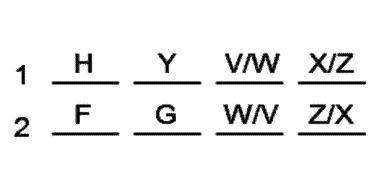
For the other scenario, let’s see what happens when F is in boat 1. We have to put G or H in boat 2 because boat 2 needs an adult. Apart from that, we can’t deduce much.
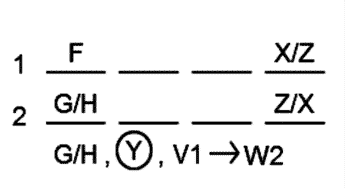
Rules: X and Z apart. If F is in boat 2, G is in boat 2. If V is in boat 1, W is in boat 2. Each boat has an adult
Game 3 Main Diagram
The setup section explains how to build this diagram.
Main Diagram
Question 13
This is a list question. Take each rule and use to eliminate the answer choices.
A is wrong because all the adults are in boat 1.
B is wrong because X and Z are not in boat 1. That means they are both in boat 2…but they aren’t allowed to go together.
C is correct
D is wrong because V and W are both in boat 1.
E is wrong because F is in boat 2, without G. If F is in boat 2 then G has to go in boat 2 as well.
Question 14
If F is assigned to boat 2 then we can use the scenario we drew for the main setup.
F causes G to be in 2. We need an adult in boat 1, so H goes there. V and W can’t both go in 1, so one of them has to go in the free space in boat 2. That leaves Y and the other of V and W to go in boat 1.
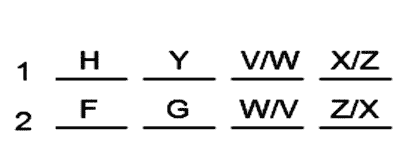
This is a could be true question. None of answer choices A through D could be true.
A is wrong because Y has to be in boat 1 and F has to be in boat 2.
B is wrong because G has to be in boat 2 and H has to be in boat 1.
C is wrong because G and Y have to be in different boats.
D is wrong. V and W cannot be together in boat 1 and there is no room for them to be together in boat 2.
E is CORRECT. X and Z are interchangeable so Z could go in boat 1 with Y.
Question 15
If F goes in boat 2 then there are three children in boat 1. It makes sense to re-use the scenario from question 14 and see if it helps on this question.
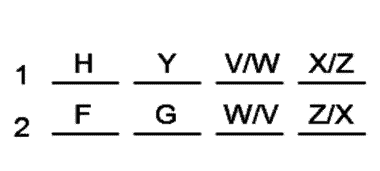
There is one other scenario that works. We could put F in boat 1 and both of the other adults, G and H, in boat 2. One of Z and X are in each boat and one of V and W are in each boat. Y will have to go in boat 1.
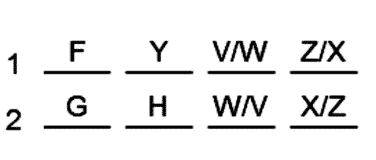
Now we look at both scenarios to see what could be true. Remember that we are looking for two people together in boat 2, not in boat 1.
A is wrong because when F is in boat 2, G is in boat 1.
B is wrong because G is in boat 2 in both scenarios whereas Y is in boat 1.
C could be true in the scenario when F is in boat 1 and H is in boat 2. V & W are interchangeable in that scenario. C is CORRECT.
D is wrong. V and W cannot both be together in boat 2 because there is no space.
E is wrong because Y must go in boat 1 in both scenarios.
Question 16
If G is assigned to boat 1 we have to put F in boat 1 too. (the contrapositive of the second rule)
H goes in the second boat because each boat needs an adult.
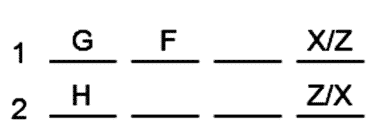
When you make a deduction like this, on a must be true question, check the answers to see if your deduction is the right answer. It usually is.
A is CORRECT. H has to be in boat 2.
The LSAT is testing whether you’re smart enough to look immediately to the answers when you make a deduction. Many students waste time trying to figure out everything that could be true.
Do yourself a favor and always check to see if your deduction is the right answer before trying other options.
B could be true but it doesn’t have to be true. V and W tend to be interchangeable.
C must be false as we need two adults in boat 1.
D must be false because we have to have two adults in boat 1 and one adult in boat 2.
E must also be false because we can only put one adult in boat 2. So there must be three children in boat 2.
Question 17
V and W can only be put together in boat 2. If they’re both in boat 1 then that’s a violation of the third rule.
We have to put F in boat 1. If F goes in boat 2 then G goes there too. Then there’s no room for V and W.
One of G and H (the adults) must go in boat 2. That fills up the boat with one adult, VW, and one of X and Z.
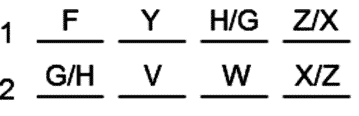
In boat 1, we have to put F, Y, one of G and H and then one of X and Z.
A doesn’t have to be true. H and G are interchangeable.
B is CORRECT. Both F and Y have to go in boat 1.
We can see quickly that C, D and E don’t have to be true because they include X and Z. Those two variables are always interchangeable and so they can’t be correct for a “must be true” question. X and Z can always switch boats.
Question 18
This question looks difficult. How do we figure out everything that happens when H in a different boat than Y? But you don’t need to…
You can do this question faster by considering the past scenarios. When F is in boat 2, we know that H and Y both have to go in boat 1. So to put H and Y in different boats you have to put F in boat 1.
That’s A. A is CORRECT.
I can’t emphasize how important it is to check if the deductions you make are the correct answer. Many logic games questions can be solved very quickly.
Question 19
The only adults that can be alone in boat 1 are F and H. Why? Because if we put G as the only adult in boat 1 then F has to go in boat 2. That doesn’t work: if F is in boat 2 then G is in boat 2 also (second rule).
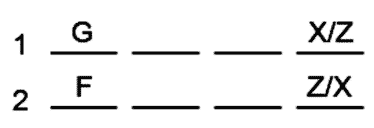 (no good. F2 ➞ G2)
So we know that the answer is B. G has to be assigned to boat 2, while F or H is alone in boat 1. B is CORRECT.
The scenario where F is in boat 2 proves all the other answer choices wrong.
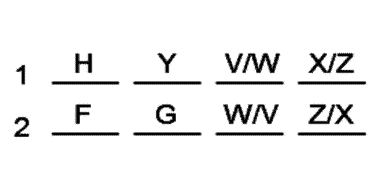
There is only one adult assigned to boat 1 in that scenario, but F is assigned to boat 2. A is wrong.
C is wrong because H is assigned to boat 1 in that scenario.
D is wrong because V can be assigned to boat 1 or 2 in that scenario.
E is wrong because Z could be assigned to boat 1 or 2 in that scenario
Game 4: Student Panels
Game 4 Setup
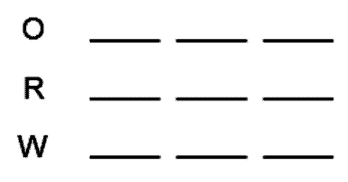
This is a grouping game. We have nine people that to put on three tanels: Oceans, Recycling and Wetlands. We can make a few deductions by combining the rules, but not many. Since we can’t do much up front, we’ll have to refer to our rules frequently on individual questions. On this sort of game you must internalize your rules.
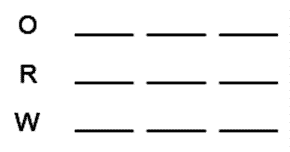
Here is what the Main Diagram should look like:
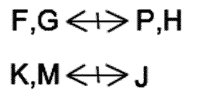
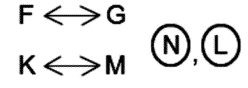
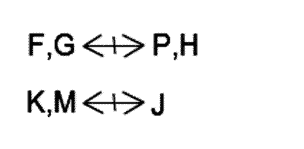
We can draw the first two rules as two variables connected by arrows. Meaning: if you have F, then you need G and if you have G you need F. The arrows go both ways.
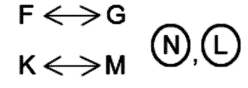
I’ve also drawn circles around N and L to show that they are the random variables. They have no rules.
Next we are told that F can’t be with P and G can’t be with H. Since F is always with G, this means that F also isn’t with P and H.
We can do the same thing with the rules about K, M and J. Since M is always with K, that means that J can’t be with M either. I’ve drawn a double sided arrow with a line in the middle to show that these things can never go together.
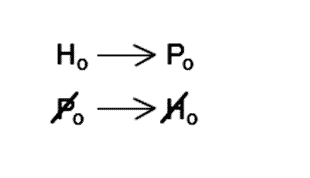
The last rule is a conditional. If H is in the oceans, then P has to be in the oceans. The contrapositive is: if P is not in the ocean then H is not in the ocean. Remember this rule well: it’s going to come up a lot.
That’s pretty much it. You could draw some scenarios, but they don’t tend to be useful in this game.
Game 4 Main Diagram
The setup section explains how to build this diagram.
Main Diagram

Question 20
The fact that the first question is a list question tells us we might do alright even without having many deductions.
A is wrong because K and M are on different panels.
B is wrong because F and G are on different panels
C is wrong because H is in oceans, but Paul is not in oceans.
D is wrong because J is with K.
E is CORRECT.
Question 21
For a local rule question you should always draw the new rule. Then see what deductions you can make by combining it with other rules. If M and P are in wetlands, then K has to be in wetlands too. M and K always go together.
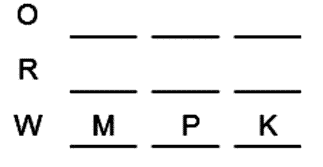
Since P is not in the oceans that means H can’t go in the oceans. Hmust go in R instead. This leaves F and G. We know that F and G can’t go with H. F and G have to go in the oceans.
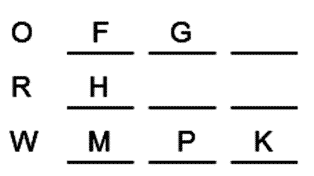
This leaves only the random variables, (N and L) along with J. There are no rules left for J; it can now go anywhere.
A is CORRECT. H can’t be in the oceans because P is not in the oceans. H must go in R.
B is wrong because J can go either in O or in R.
C is wrong because K has to be assigned in W, with M.
D is wrong because W is full: there’s no room for L.
E is wrong because N could also be assigned to R.
Question 22
This is a general question. You have to think about our rules. The question is testing whether or not you knew to combine rules in the setup.
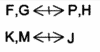
F can’t go with H because G can’t go with H. F and G always go together. So A is wrong.
B is wrong for the same reason. F can’t go with P and G is always with F. Therefore G can’t go with P.
C is CORRECT.
D is wrong because if F went with Marcus we would need to put K and G there as well. That’s four people. We can only fit three on a panel.
E is wrong because M and K are always together and K can’t go with J.
Question 23
This is another local rule question. Draw the rule. M always goes with K. So if K and P were in recycling, then M is in recycling too. Since P is not in O, that means H can’t go in O. So H goes in W.
Since F and G can’t go with H they must go in oceans. This leaves only K and our random variables N and L to place.
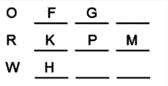
A is wrong because F needs to go in O. It can’t go with H in W.
B is wrong because the recycling panel is full of K, M and P. There is no room for G.
C is wrong because P is not an O. So H can’t go into O.
D is CORRECT. There are no rules for Jennifer now that K and M are already placed.
E is wrong because there is no room to put Lisa in the recycling panel.
Question 24
B through E all involve the random variables. L and N are not likely answer choices for a “must be true” question. That doesn’t mean you can eliminate them for certain without trying, but you should look elsewhere first.
A is CORRECT. It doesn’t have L or N. G has to go with F and K has to go with M. G and K lead to four variables. K, N, G, F – that’s too many to put in once spot.

Leave a Reply