
LSAT Preptest 20 LG Explanations
Full explanations for every question from the logic games section of LSAT Preptest 20.
Archived Logic Games explanations
Logic Games are no longer part of the LSAT. LSAC removed the Logic Games section beginning with the August 2024 LSAT. If you are studying for the current LSAT, you can skip this section.
These explanations remain available for students, tutors, and readers using old-format PrepTests. For current guidance, see Logic Games and the current LSAT.
Table of contents
Game 1: Airplane Seats
Game 1 Setup
This is a grouping game. We have to decide how to put seven travelers into nine plane seats. There will always be two empty plane seats.
We can arrange this vertically, with three rows: F, M, and L. We’ll draw some rules directly on the main diagram.
O is in the last row. P is beside R and an empty seat. R is behind N. This means we have to put N in the first row and P and R in the second row. We can’t put P and R in the last row because there has to be an empty seat beside P. (If O, P and R were all in the last row, there would be no empty seat)

(The variables on the right have to go in those rows)
There are a couple scenarios we can draw in this game. But the game depends mainly on clearly understanding the rules.
Nobody else can go in the second row so everybody else goes in row 1 or row 3. That’s U, S and T.
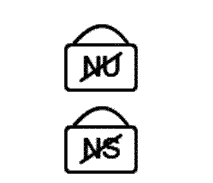
We know that N can’t go beside U and N can’t go beside S.

That means that if U and S are in the first row then they are one seat away from N.
So we could have, for example, N in seat 1 and one of U and S in seat 3. The other U and S would be in the last row.

T would either be in the second or last row. Severalf variables are interchangeable. U or S could be in 1 and N could be in 3 instead.
It doesn’t really matter: there are no rules about that kind of ordering. N and U/S just have to be apart from each other.
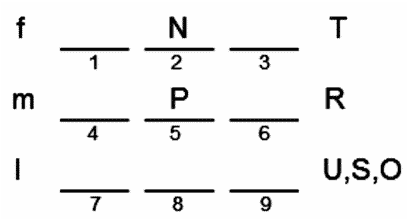
The other possibility is that U, S and O are all in the last row. Then we could have N in seat 2 and T in 1 or 3.
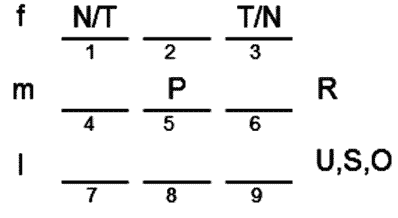
 Or
Or
We could also have N in seat 1 and T in seat 3, or vice versa. 
That’s pretty much it. These scenarios aren’t essential. I’ve just drawn them to give you an idea of how the game can go. Make sure to look over all the rules as the game depends on your knowing them.
Game 1 Main Diagram
Main Diagram
The setup section explains how to build this diagram.
This is a grouping game. Seven passengers (Norris, Oribe, Paulsen, Rosen, Semonelli, Tan, and Underwood) will be assigned one of nine seats, split amongst the front, middle, and last rows.
Scenario 1
Scenario 2
Scenario 3

Question 1
A is CORRECT. N has to be in the top row and could be in seat 2 if both U and S are in the last row. S can be in 8.
B is wrong because Oribe has to be in the last row. He can’t be in row 2.
C is wrong because Paulsen has to be in seat 5.
D is wrong because Rosen has to be beside Paulsen in 4 or 6.
E is wrong because U will be beside N if U goes in 2.
Question 2
If S and U are in separate rows then we must split them between the first and last rows. This means that we have to put N in 1 or 3 and then S or U in the other spot. I doesn’t matter which goes where, but they have to be separate.
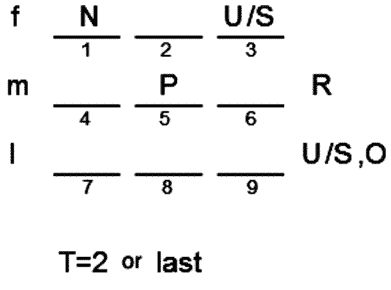
A is CORRECT. If N were in seat 2 then N would be beside U or S.
B is wrong because P always has to be assigned to seat 5.
C is wrong because R can always be assigned to seat 4 or 6.
D is wrong because T can always go beside N in the first row.
E is wrong because U can be assigned to seats 1 or 3 or in the last row. The only restriction is that U can’t be beside N.
Question 3
This is the scenario where U, S and O are in the last row. If U and S were together in the first row then they would be beside N. So they have to be in the last row. T will go in the first row.
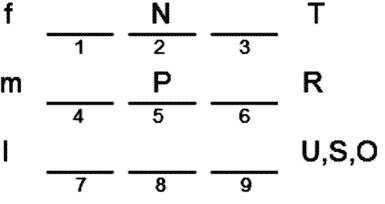
The empty spaces are in rows 2 and 1.
A is wrong because O is with S and U in the third row. There is no space for an unassigned seat.
B is wrong because R is always beside P on one of the ends and not beside an unassigned seat.
C is wrong for the same reason as A. S, U and O are all in row 3.
D is CORRECT. T could be beside an unassigned seat if we put N in seat 1 and T in seat 3 or vice versa.
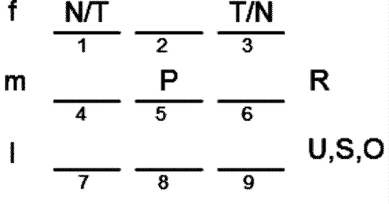
E is wrong for the same reason that A and C are; U, S and O are all in row 3.
Question 4
We need to put T in seat 2 for this question. If we put T in the last row, T will have to be with O and one of U and S. We can’t put both U and S in the first row: one of them would be beside N.
If we put T in seat 2 it would be beside N and an unassigned seat.
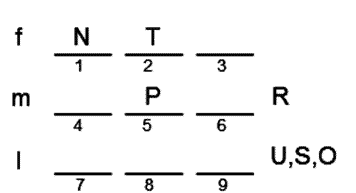
A is CORRECT.
B must be false. R is always on one of the end seats and beside P.
C is doesn’t have to be true. O and S can go in any order in the last row.
D is wrong because O and T can’t be in the same row for this setup.
E is wrong because S and U can go in either order in the last row.
Question 5
Oribe is always in the last row. To put Oribe beside an unassigned seat we must only have 2 people in the last row. It must be one of U and S. That means that the other of U and S are in the first row, along with T. I’ve drawn one way it could work but there are many possible ways.
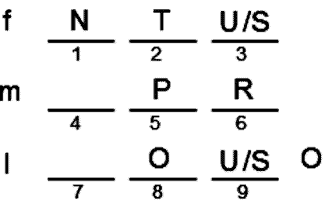
A is wrong. Oribe could be assigned to seat 8 but could also be assigned to seat 7 if U or S were in seat 9.
B is the CORRECT. We have to put T between N and U/S.
C could be true but doesn’t have to be. U could also go in seat 1 or one in seat 3, or could even go in the last row.
D could be true but R could go in seat 4 and then seat 6 would be unassigned.
E could be true but we could also fill seat 9 as in the diagram I drew above.
Game 2: Library Budget Cuts
Game 2 Setup
This is an in-out grouping game, with two twists. First, only five of the eight variables are selected. Second, we need exactly two of M, L and R. That rule is key to the game. It’s so important that you simply have to memorize it. If you have L and M, you can’t have R. If you have R, you need L or M but not both. And so on. If you don’t remember this, the game is twice as hard, and much slower.
Memorizing key rules is an underappreciated part of logic games success. Few people do it, but it’s not really any harder than remembering a phone number for a few minutes. And it can get you into law school.
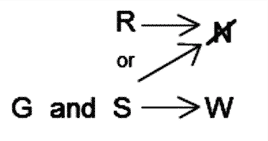
We can combine the rest of the rules. Start by drawing the first rule.

We can connect this with the second rule. If we have N then we don’t have S. The contrapositive is if we have S then we don’t have N. Likewise if we have R, we don’t have N. So we can draw it like this.
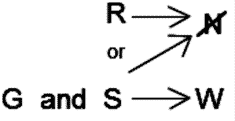
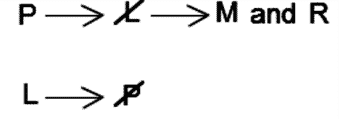
The third rule goes on its own. P leads to not L, L leads to not P. It’s worth thinking about how this works with the final rule. If we don’t have L we must have M and R.
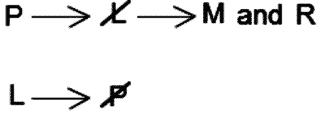
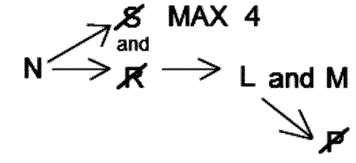
The contrapositive of the larger diagram above is interesting. If we don’t have W we also don’t have one of S and G. That’s two missing out of eight, and we need five total.

We also are missing one of N and R. And we’re always missing one of L and P. That is four missing, if W is out. We don’t have enough.
Therefore, we can deduce that we always have to have W. There’s no way to get five variables in otherwise. Here’s the contrapositive diagram we can draw.
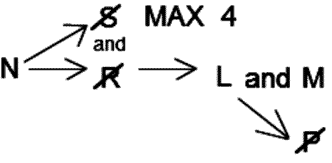
(We could have four from this diagram with S, R, L and M in)
Game 2 Main Diagram
Main Diagram
The setup section explains how to build this diagram.
This is an in-out grouping game. 5 areas of expenditure must be reduced out of 8 total, including G, L, M, N, P, R, S, and W.
Question 6
As with all list questions, choose a rule and use it to eliminate answer choices.
A is CORRECT.
B is wrong because you can’t have L and P together.
C is wrong because you can’t have N and R together.
D is wrong because if you have G and S, you need W as well.
E is wrong because you can’t have all three of L, M and R.
Question 7
This is a trick question, because W always has to be reduced. The local rule adds nothing. But, you might not have figured that out the first time through. It doesn’t matter. This question can be solved just like another list questions: apply the rules one by one.
A is wrong because you need two of L, M and R. Only M is there.
B is wrong because it has all three of L, M, and R.
C is wrong because L and P can’t go together.
D is wrong because we need two of L, M and R.
E is CORRECT.
Question 8
If P is reduced then L isn’t reduced. And if L isn’t reduced then we need both M and R. Therefore, B is CORRECT.

Question 9
If L is reduced, P isn’t reduced. And if S is reduced, N isn’t reduced.
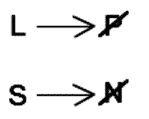
These deductions eliminate all the wrong answers. P is in B and E so they’re wrong. N is in C and D so they’re wrong. Therefore, A is CORRECT.
Question 10
If R isn’t reduced, we need L and M. If we have L then we don’t have P. So we can say that we definitely don’t have P and R and that we definitely do have L and M.
That means we need three more out of G, W, N and S. We know that we can’t N and S together; we can only have one of them.
We therefore need both G and W.
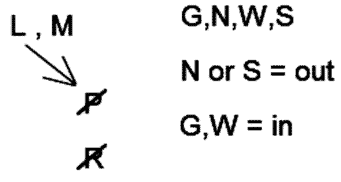
A is CORRECT as G has to be reduced.
B could be true but it could be S that is reduced instead.
C must be false. L causes P to be out.
D could be true but it could be N that’s reduced instead.
E must be false. W is always reduced.
Question 11
If M and R are reduced that means that L is not reduced. You can only have two of M, L, and R. And if R is reduced then N is not reduced.
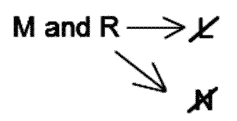
Therefore, C is CORRECT. L and N can’t be reduced.
Question 12
We know from the setup that W has to be reduced.
But this can be a difficult question if you didn’t make that deduction beforehand.
To speed things up you can go through your past answer choices to see who doesn’t have to be reduced.
The correct answer to question 6 (A) proves that P doesn’t have to be reduced. So D is wrong.
The correct answer to 11 (C) proves that N doesn’t have to be reduced so C is wrong.
The correct answer to 11 (C) also proves that L doesn’t have to be reduced so B is wrong.
The correct answer to question 7 (E) doesn’t have G. So A is wrong.
E is CORRECT. W always has to be reduced.
If you’re not sure about this, you can look back at the setup. If W is out, one of S is G are out. We need five people but we always are missing one of N and R and one of L and P. That’s four missing.
So without W there aren’t enough variables to get the five we need.
Game 3: Strand of Beads
Game 3 Setup
This is a sort of pattern game. It’s a fairly rare type. You can’t really set up scenarios. Instead, it’s the sort of game where you have to know all the rules very well. There aren’t too many rules, so take the time you need to learn them all. It will pay off by allowing you to go through the questions faster.
We’ll set it up as a row of eight numbered slots.

The first rule is fairly straight forward. If you have P and Y in any order then R is on the either side.
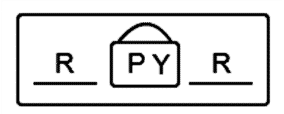 (The top handle means PY is reversible)
The second rule is also easy. You can have two Gs beside each other, although you don’t have to. But you can’t have any other letters of the same type beside each other.

G doesn’t have to go beside itself, but it’s the only variable that can. The fourth rule is simple. O cannot be beside R in either order.

There is not much you can deduce. The last important thing is that you need to have every color in this string of eight. So if in one question mentions colors 1-9, then you need all colors to be represented in beads 1-8 and also in 2-9.
Look over the rules and commit them to your short term memory and you’ll be ready to master this game.
Game 3 Main Diagram
Main Diagram
The setup section explains how to build this diagram.
This is a pattern game. A strand of beads will have green, orange, purple, red, or yellow beads on it based on certain rules.

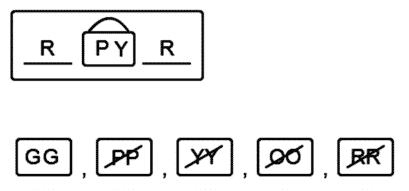

Question 13
This question is a standard list question. Just use all the rules and eliminate the answers that violate the rules.
A is wrong because red is beside orange.
B is wrong because there are two Rs beside each other.
C is CORRECT.
D is wrong because orange is beside red.
E is wrong because there is no O in the string of eight beads.
Question 14
For all local rule questions, draw the diagram. O is in 4.
Then look for deductions. O and R can’t go beside O. So we can’t have R or O in 3 and 5.

A is wrong. O is beside O.
B is wrong. R is beside O.
C is wrong because you can’t have two purples together.
D is correct
E is wrong. If you have yellow and purple you need red beside it, in spot 4. There is an O in number 4.
Question 15
This is another local rule question. Draw the diagram.
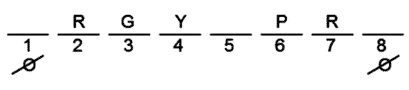
We know that we need all the colors. The color that we’re missing is orange. We can’t have orange in slot 1 beside R. We can’t have orange in slot 8 either; that’s also beside R. So orange must go in slot 5. C is CORRECT.
A and E could be true, but don’t have to be true. B and D can’t be true. We need to put orange in slot 5, not green. And we can’t put orange in slot 8.
Question 16
If the first and second beads are purple and yellow, then the third must be red.

There’s no obvious deduction that comes from that rule. So you should think of what rules apply to P, Y and R.
My first thought was that there might be something involving yellow and purple. So I looked for an answer choice that had those options. E says yellow and purple. Here’s what happens if we try to put them in slots 5 and 6.

We have to put a red in slot 4 because yellow and purple need to be preceded by red. That puts two reds together, which can’t be true. E is CORRECT.
All of the other answers could be true. They don’t place anything directly next to PYR. They all help us achieve all five colors and also none of them directly violate any rules.
It’s extremely important to think about the answer choices before trying them. This could have been a very long question. The worst thing to do is to get caught staring blankly at a bunch of choices, without a plan for what to do next.
Question 17
The first and fourth beads are purple, the second and fifth are yellow so that means that the third and sixth must be red.

We’ve got nine beads. We need to fit all the colors in. Right now we’ve only got purple, yellow and red. We need green and orange. We can’t put orange in slot 7 beside red. So we have to put orange in slot 8 and green in slot 7.

This is a could be true question.
A is wrong because the seventh bead can’t be orange; it would be beside red.
B is wrong because the eighth bead has to be orange. We need at least one orange in the row. And orange can only go in 8.
C is wrong for the same reason as B. We need orange in spot 8.
D is wrong because since we need orange in spot 8. So we can’t have an R beside orange in spot 9.
E could be true. We’ve already got all of our eight colors in spots 2-9. So 9 could be yellow as it doesn’t violate any rules. E is CORRECT.
Question 18
This is another local rule question. Draw it.
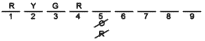
We know we can’t have O and R in spot 5. This unfortunately doesn’t give us the answer; none of the answers put O and R in spot 5.
So we’ll have to think a bit deeper. We’ve already got yellow, green and red. We need purple and orange. The right answer will prevent us from having purple and orange in our chain.
A could be true because we could have purple in spot 7. Then all of our colors would be filled.
B could be true because we could put orange in 7 to have all of our eight colors.
C could be true because we could put green in 7 to have all of our eight colors.
D can’t be true. Here’s what happens if we put purple and yellow there in 6 and 7.

We need to put red after purple and yellow. And then we can’t put orange beside red. So there’s no place to put orange in the first 8 spots. D is CORRECT.
E could be true as we could have yellow, orange and purple in spots 5, 6 and 7. This doesn’t violate any rules and all of our five colors are included in the first eight.
Game 4: Student Panels
Game 4 Setup
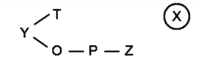
This game is an interesting mixture of pure sequencing and grouping. We can make the standard sequencing diagram that tells us what order the songs go in.
But we’re also told who can sing the songs. This adds a new factor.
We’ll start with the sequencing rules. Y is earlier than T and O.

O is before P and Z.

I put X with a circle around it because X is random. It can go anywhere; first, last or in the middle.
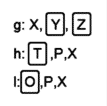
The three rules that follow tell us who can sing which songs. I found it useful to draw these.
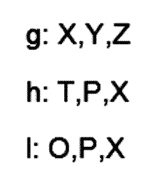
You should look for songs that can only be sung by one person. Only G can sing Y and Z, only H can sing T and only L can sing O. I highlighted these in my diagram by putting a box around them.
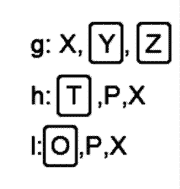
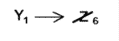
You can combine this with the last rule to make an interesting deduction. We know that the person singing first has to be different from the person singing last. George is the only one with two unique songs. Y and Z can’t be in first and last: only G can sing them.
Y goes earlier than Z so this tells us that if Y is first then Z can’t be the last. Likewise, if Z is last then Y can’t be first. This is going to be one of the major elements of the game.
Game 4 Main Diagram
Main Diagram
The setup section explains how to build this diagram.
This is a blend of ordering and grouping games. Three vocalists (George, Helen, and Leslie) perform two songs each for a total of six consecutive songs (O, P, T, X, Y, and Z).
Question 19
This question is a list question. Just use all the rules one by one and eliminate the answers that violate the rules.
A is wrong because T has to be after Y, not before it.
B is wrong because Z has to be after Y, not before it.
C is tricky to eliminate. Only G can sing Y and Z. This answer has G singing the first and last song, which violates the final rule.
D is wrong because O has to be before P.
E is CORRECT.
Question 20
For this question you should look at the list of who can sing which songs.

Anyone can sing X, so A and E are not CORRECT.
B is wrong because only Leslie can sing O, not Helen.
C is correct, only Helen can perform T.
D is wrong because both Helen and Leslie can sing P.
Question 21
For this question you should look at the ordering diagram.
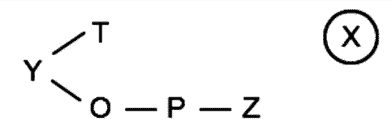
We can see that T and Z are at the end of the chains so they could both go last. X is random so X can also go last.
So, X, T and Z are in the right answer. D is CORRECT.
All of the answers have three letters, so we know only three songs could go last. Y, O and P are in all of the wrong answers. They can’t go last because they all have songs that come after them.
Question 22
If X is performed first, then Y is performed second. Everything else has to go after Y. (T, O, P and Z)

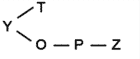
That means that D is CORRECT.
E is wrong. If we put Y third then there is no space to put T, O, P and Z after Y.
A and B are wrong because there are really no restrictions on who can sing X. Since anyone can sing X, it’s very easy to make the last person different from the first. The last song could be P or Z.
C is doesn’t have to be true. T could go before P: P would be fifth, Z would be sixth.
Question 23
This is tricky to eliminate. You can try going through the ordering rules…but all of the answer choices obey those rules.
Getting this right depends on the deduction that Y can’t go first if Z is sixth. Only G can sing Y and Z. The same singer can’t sing the first and the last song.
If Y went first and Z went sixth then G would sing both the first and last songs.
B is CORRECT because Y can’t be in first if Z is in sixth.
Question 24
Several of the wrong answers can be eliminated with the deduction from question 23: if Y goes first then Z can’t be sixth. George would sing both the first and sixth songs if that were true.
A is wrong because if we put T, X and O in 2, 3 and 4 then Z will have to be last (P also has to go before Z). If Y is first, Z can’t be last.
B is wrong because O has to be before Z.
C is CORRECT. It could be true, as the following diagram shows.

D is wrong because it puts P and Z in front of O. O has to be before P and Z.
E is wrong because X and T go before Z. That means Z would be last (those are the only variables that could go after Z). We can’t have Z last since Y is first.

Leave a Reply