
LSAT Preptest 21 LG Explanations
Full explanations for every question from the logic games section of LSAT Preptest 21.
Archived Logic Games explanations
Logic Games are no longer part of the LSAT. LSAC removed the Logic Games section beginning with the August 2024 LSAT. If you are studying for the current LSAT, you can skip this section.
These explanations remain available for students, tutors, and readers using old-format PrepTests. For current guidance, see Logic Games and the current LSAT.
Table of contents
Game 1: Student Dormitories
Game 1 Setup
This is a type of grouping game. There is a certain deduction which lets you solve most things. Otherwise the game is quite difficult.
Follow along closely and you’ll see how this game can become quite easy.
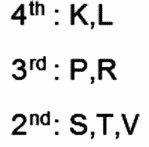
We have seven students. They are fourth year, third year and second year. It’s a very good idea to draw a diagram showing the students’ years. Notice that Yer students have letters further along in the alphabet.

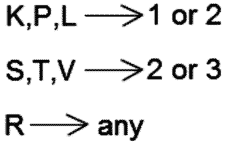
Student’s can be in single, double or triple rooms. The first two rules deal with this. If you are a fourth year student you cannot be in triple. You can only be in a single or a double.
If you are a second year student, you cannot be in a single.
The third year students can be in any room except…P acts like a fourth year student. The fourth rule P is always with K (K is fourth year).
Here’s are the rooms each student can go in.
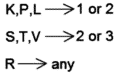
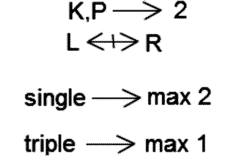
The next two rules are about grouping. Lee and Robin can’t be together and K and P have to be together. K and P can’t go in a triple, because K is fourth year. Two people clearly can’t go in a single, so K and P are in a double. 3
So we know there is always one double, K and P.
There are, at most, two singles because S, T, and V can’t be in singles. So, only R and L can be in singles. This is very, very important. There are only two possible singles: R and L.
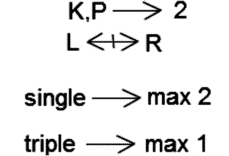
Any answer choice that has more than two singles is wrong, and that’s a lot of them. As for triples, there can only be one triple at most because S, T and V along with R are the only ones that can go in the triple. There are four of them but you can only fit three in a triple.
These deductions about the numbers of singles and triples will eliminate many wrong answers. They take a hard game and make it easy.
Game 1 Main Diagram
Main Diagram
The setup section explains how to build this diagram.
This is a grouping game. Fourth years Kim and Lee, third years Pat and Robin, and second years Sandy, Terry and Val must all be assigned to a room. Each room can contain up to three students.
Question 1
This is not a list question. It is a strong sign that the LSAC was expecting you to make many deductions. You were expected to have deduced the limits on the total numbers of singles and triples.
A is wrong. We can’t have two triples; there are not enough students who can have triples.
B is wrong. We can only have two singles, at most.
C is CORRECT. We could have K and P in a double, two of the second year students in a double, V and L in a double and R in a single.
D and E are both wrong because we can’t have more than two singles.
Question 2
There are two possible scenarios if R is in a single. We could put S, T and V in a triple together, or we could split them into doubles with L. S, T and V can only be in doubles or a triple.
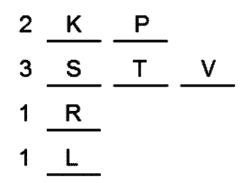
There are no more scenarios. We need to find something that could be true.
A can’t be true. We either have two doubles with second years, or no doubles with second years.
B could be true, in the first scenario. B is CORRECT.
C can’t be true: K and P always have to be in a double, not a triple.
D can’t be true: we either have two singles or one single.
E can’t be true: we either have one double or three.
Question 3
A is wrong; we know from the last question that Lee could share a single but doesn’t have to. The second scenario above proves that wrong.
B is CORRECT. Pat is always with K. K can’t be in a triple so they must be in a double.
C, D, and E are all proved wrong by the previous question.
In question 2, we’re told that Robin could be alone in a single so C isn’t right.
D could be true but we also have the scenario from question 2 where S, T and V are in a triple and L is in a single.
E is wrong because R (a third year student) is assigned to a single in Question 2.
Question 4
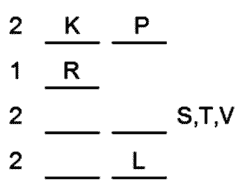
If R is assigned to a triple, then the game becomes pretty restricted. There are two other students that go with R. K and P are always assigned to their own double. L can’t go with R either, so two second year students go with R.
The second year students can’t be in a single, do we need another double. L and the other second year student go there. It looks like this.
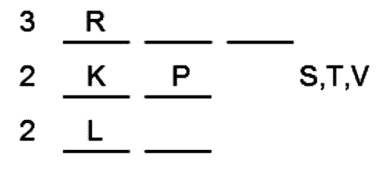
A must be false because Lee is assigned to a double in this setup.
B must be false because R and L can’t go together. Therefore, L has to go in a double with one second year student. The other two second years go in a triple with R.
C is CORRECT. There are no singles. There is only a triple and two doubles.
D is wrong because there are no singles. (Second year students can’t be assigned to singles.)
E is wrong because we can’t have more than two singles, ever.
Question 5
This is a local rule question. It is worth drawing. We have T and V in two separate doubles.
K and P are in a double; this is always true.
That’s six people. So the only remaining thing we can have is a single. It looks like this.
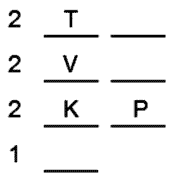
A must be true: one room is a single. A is CORRECT.
We can tell all the remaining answer choices are wrong just by looking at it our diagram. There are no other possibilities.
B is wrong because we can’t have two singles
C is wrong because we have three doubles, not two.
D and E are wrong because we have no triples at all.
Question 6
This is a general could be true question.
A is wrong because both the fourth year students can’t be in singles. K is always with P in a double.
B is wrong because K has to go with P, who is not a fourth year student. L clearly can’t go with them in a double, that would be three people.
C could be true and is CORRECT. We could see that in the scenario from question 4, where L is in a double with a second year student.
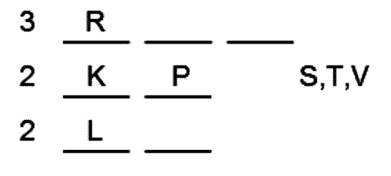
D is wrong because Lee can’t go with R and Lee also can’t go with P. P is always in a double with K. R and P are the only third year students.
E is wrong because P is always with K and K can’t go in a triple.
Game 2: Colored Light Bulbs
Game 2 Setup
This is a type of pattern game: it’s fairly rare. There are only three spots to place light bulbs and there are nine light bulbs total. There are three light bulbs of each color. It is possible in theory to have all bulbs be the same color (though the rules will limit this).
The first step should be to draw our three rules.
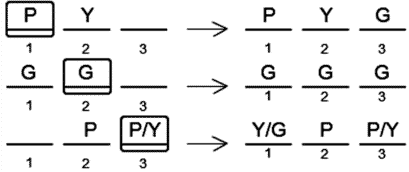
These three diagrams show the three separate rules. I’ve drawn the sufficient condition in a box, and placed the necessary condition on the diagram.
Rule 1: P is in leads to Y in 2. Rule 2: G in 2 leads to G in 1. Rule 3: P or Y in 3 leads to P in 2.
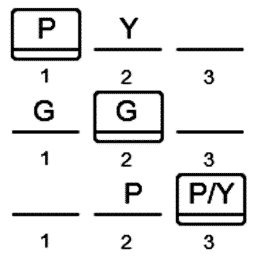
To be clear: the three lines are three separate scenarios.
Next, we have to see if we can combine any of these rules. Look at the first one; P is in slot 1 and Y is in slot 2. What can we put in slot 3?
Well, The third rule tells us that if P or Y is in 3, then P is in 2. So we can’t put P or Y in 3 in the first rule. We have to put G there.
The third rule also lets us make the same deduction about the second rule. If G in 1 and in 2 then 3 must also be G. Why? If P or Y were in 3 then 2 would have to be P, not G.
The only restriction in the third rule is that spot 1 can’t be P. That would make 2 yellow, not P. So the first slot is Y or G in the third scenario.
Here’s what that looks like. Remember, these three diagrams show what happens when the first, second and third rules apply:
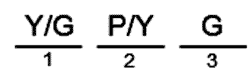
You can also draw what the diagram would look like if no rules were triggered. This doesn’t end up being useful, but it may help to understand the game.
In the third spot, only G doesn’t trigger a rule. In the second spot P and Y don’t trigger rules. And in the first spot Y and G don’t trigger rules.
So placing any of these variables in these spots causes nothing to happen. Anything else causes one of the three rules above to come into play.
Game 2 Main Diagram
Main Diagram
The setup section explains how to build this diagram.
This is a pattern game. Each of three sockets will be lit up by a colored bulb that is either green, purple or yellow.

Question 7
This is a list question. Take each rule and use it to eliminate scenarios.
A is wrong because if G is in 2 then 3 can’t be yellow. If 3 were yellow then 2 would have to be P, not G.
B is wrong because if P is 1 then the first rule says that Y has to be in 2, not G.
C is wrong because the first rule says that if P is 1 then 2 is yellow, not purple.
D is CORRECT.
E is wrong because if yellow is 3, then P is in 2, according to the third rule.
Question 8
This tells us that light 1 is yellow. We should think about which of our rules affect spot 1. Only the second rule causes something to happen in spot 1. If G goes in 2 then G also goes in 1. So G can’t go in 2.
A is CORRECT. None of the other answer choices trigger any rules that affect spot 1.
Question 9
Two of our rules give us scenarios where only one sequence is possible. If P goes in 1 then Y is in 2. That forces G into 3; if 3 were P or Y then spot 2 would have to be P.
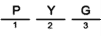
A is CORRECT. If light 1 is purple then 2 has to be yellow and 3 has to be green.
The other scenario where everything is settled is the second rule: if G goes in 2 then G has to be 3 for the same reason. But this isn’t among the answer choices.
Question 10
If there are no green bulbs then we know the third bulb is purple or yellow. That triggers the third rule: the second bulb has to be purple.
We saw in our set up that this means the first bulb has to be yellow or green. If the first bulb were purple, the second bulb would have to be yellow instead of purple.
We’re not using any green bulbs, so the first bulb has to be yellow.
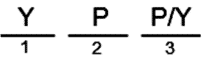
There are only two possibilities. We can either put P or Y in the third spot. B is CORRECT.
Question 11
Here we are asked to make everything a different color. The first scenario works. If light 1 is green and light 2 is purple then that triggers no rules. We could make the third bulb Y, which is a different color from the first two. That does trigger the third rule, but it’s already true: P is in the second spot. A is CORRECT.
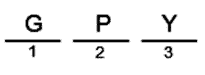
B is wrong because the third color is purple. If we put purple in spot 3 then that triggers rule 3 and forces 2 to be purple, too.
C is also wrong because of rule 3. If yellow is in line 3 then purple is in line 2. But purple is already in spot 1 in this answer choice.
D is wrong because of rule 2. If green is in light 2 then green must be in light 1
E is wrong because of rule 3. If P is in light 3 then P also has to be in light 2.
Game 3: Witness Interview
Game 3 Setup
This game has elements of sequencing. It also has a big wild card: two full days will be taken up by the hostile witnesses.
We have the six days of the week, from Monday through Saturday. Each day is separated into morning and afternoon. That’s twelve total spaces. We have six non-hostile witnesses to interview and four hostile witnesses. So we are always going to have ten spaces full and two spaces empty.
One thing that often confuses people from the opening paragraph is the part that says the only witnesses that will be interviewed simultaneously are Q and R.
That tells us two things. Most people get that none of the other witnesses are interviewed at together
But it also means that Q and R are always interviewed at the same time. So what I said earlier wasn’t quite true. We don’t always have ten spaces full, we always have nine full, since Q and R take just one space.
The first rule just tells us that X is on Thursday morning. This is a big dividing facto. Hostile witnesses can’t go on Thursday because X is already there.
Here’s how we draw the basic diagram without any other rules.
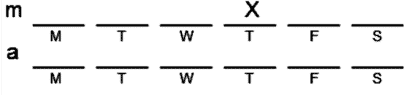
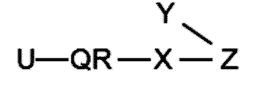
Next, Q is interviewed before X. This really means that Q and R are interviewed before X.

U is interviewed before R, meaning U is interviewed before QR.

And lastly, Z is after X. Y is before Z. It looks like this:
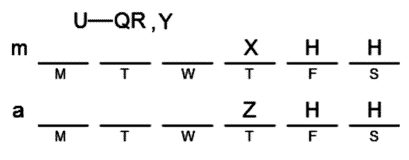
The game looks pretty open ended. You should figure out what the most limiting factor is. The hostile witnesses take up two full days: let’s try putting them in Friday and Saturday and see what happens.
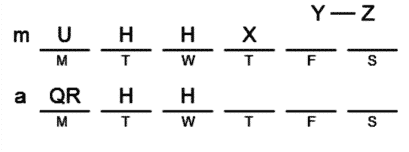
We know Z has to go after X. The only space left after X is on Thursday afternoon. So that’s where we have to put Z. Then U, QR and Y are all before X. We don’t know which order so we can just draw it like this:
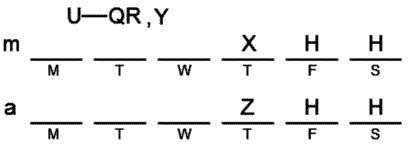
That’s one scenario.
Next, we should see what happens if the non-hostile witnesses are interviewed before X. There are two scenarios and they look pretty similar.
The hostile witnesses take up four of the six spaces before X. U and QR both have to go before X , so U and QR must fill the other two spaces.
If you put the hostile witnesses on Monday and Tuesday, U and QR go on Wednesday. If you put the hostile witnesses on Tuesday and Wednesday then U and QR go on Monday.
Either way, that forces Y to go after X. Z will always go after X and Y: that is one of the rules. So these two scenarios look like this:
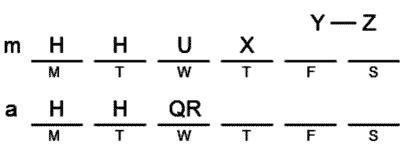
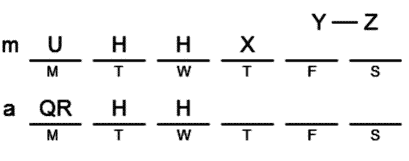
One important deduction is that in these scenarios, hostile witnesses are always interviewed on Tuesday. So if hostile witnesses go before X, they must always be on Tuesday.
Game 3 Main Diagram
Main Diagram
The setup section explains how to build this diagram.
This is a sequencing game. Each morning and afternoon from Monday to Saturday, witnesses Q, R, U, X, Y, Z will be interviewed. They are all interviewed separately apart from Q and R, who are interviewed together. Two full consecutive days are blocked off for interviews with hostile witnesses.
Scenario 1
Scenario 2
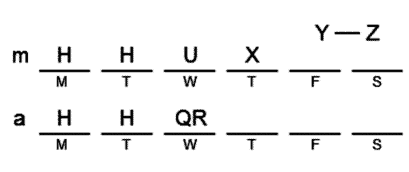
Scenario 3
Question 12
As with all list questions, take one rule and use it to eliminate answer choices. Don’t forget that Q has to go with R.
A is wrong because U is after Q and R.
B is wrong because Q and R are not together.
C is wrong because X is before Q and R.
D is CORRECT.
E is wrong because X is before Q and R.
Question 13
Since we’ve got non hostile witnesses on Tuesday and Wednesday, the hostile witnesses must be on Thursday and Friday. We’re in scenario 1.
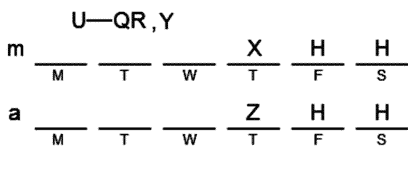
We just have to apply our ordering rules.
A is wrong because Q is not with R.
B is wrong because R is not with Q.
C is wrong because X has to go on Thursday, not Wednesday.
D is CORRECT.
E is wrong because Z has to be after X. Here Z is on Tuesday and before X.
Question 14
Y is interviewed after X. So we are in the second and third scenarios. Those are where the hostile witnesses are on Monday/Tuesday or Tuesday/Wednesday. We deduced in the setup that in both of those scenarios the hostile witnesses are on Tuesday.
B is CORRECT.
Question 15
R is interviewed after Y so we must be in the first scenario: U, QR and Y are all before X. Otherwise, U and QR are on one side of X and Y are on the other side. In this scenario hostile witnesses have to be interviewed on Friday. E is CORRECT.
Question 16
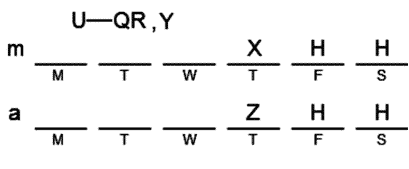
If there are no interviews on Wednesday and Monday morning then hostile witnesses must be interviewed on Friday and Saturday. Note that no interviews mean no interviews of any type; no hostiles and no non-hostiles.
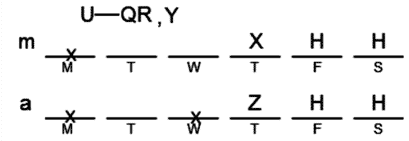
There is not much we can say about the order of U, QR and Y. We know Y is before X. Z has to go on Thursday, because Friday and Saturday are full of hostile witness interviews.
A is wrong because Q could be interviewed on Wednesday morning while U could be interviewed on Tuesday.
B is wrong because Y could be interviewed on Wednesday morning.
C is wrong because Y could be interviewed after U, on Wednesday morning.
D is wrong because Y could be interviewed on Wednesday morning, and U-QR could go in the two spaces on Tuesday.
E is CORRECT. Z has to go before Friday because Friday and Saturday are full on non hostile witnesses.
Question 17
If Z is interviewed Saturday then the hostile witnesses must be on either Monday/Tuesday or Tuesday/Wednesday.
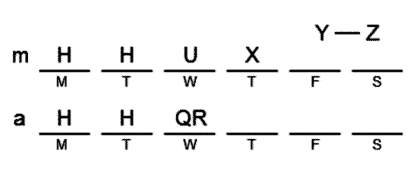
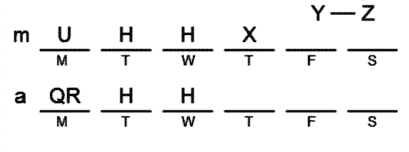
A is CORRECT. Either Tuesday/Wednesday or Monday/Tuesday can have hostile witnesses.
B can’t be true. If hostile witnesses are on Friday, then they are also on Saturday. That’s where Z is.
C can’t be true because R is always before X.
D can’t be true. The hostile witnesses are always on Tuesday if they come before X.
E can’t be true. In both possible scenarios the spots before X are full of hostile witnesses plus U and QR.
Game 4: New Advertisements
Game 4 Setup
This is a type of linear game, but it has elements in common with grouping. We’re not just concerned with how the variables are ordered. We’re also concerned with which variables can go with each other. There are four different weeks and each has two variables. I find it easiest to arrange vertically like this:
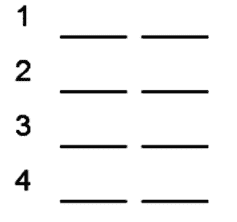
There are eight spots but only seven variables, so one, and exactly one, of the variables will repeat. When considering the rules, think about who can repeat.
For example, J can’t repeat. The first rule says that when J is advertised then H is advertised right before. That means that if you had two Js then you would need two Hs.
So J can’t repeat. We will come back to this rule later. I didn’t find it useful to draw the rule separately. Instead I use it to make a deduction on our main diagram.
The second rule is one you should simply commit to memory. The product advertised in two weeks has to be in week 4 and cannot be in week 3. If you want, you can write a mark next to your diagram that says “not 2” beside 3 and “2” beside 4 or something to that effect.
There is no single set format that is going to be correct for this unique style of rule.
Instead, it’s just something you need to be aware of. However you remember it, you will be much more effective on this type of game if you keep it in your mind.
The third rule is interesting. If you have G then you need J or O in the same space.

Lastly, O goes in week 3.
Let’s go back to the rule where J has H right before it. Where we can put J? We can’t put J in spot 1 because there is no space to put H before it.
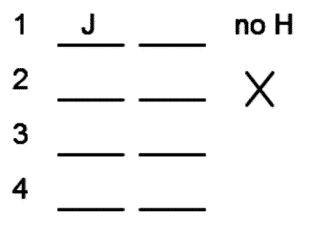
Now what about spot 3 with O? Here is what it would look like:
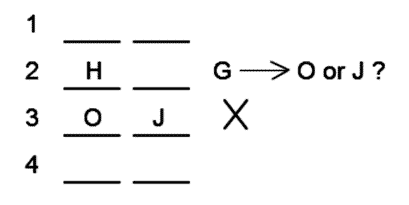
We can see that O and J are together and that H is in spot 2. O and J can’t repeat, since they are in spot 3. The third rule says that G needs to go with J or O; G has nobody to go with. This doesn’t work either.
We can try J in spot 4. Here’s what that would look like:
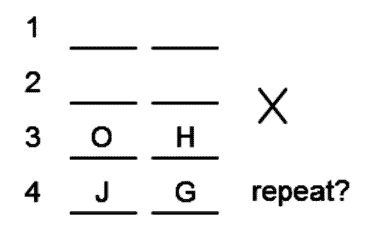
We have J and G together because G goes with J or O. H is in spot 3 because H goes before J. This looks ok…except that the person who repeats has to be in the fourth row.
Who can we repeat? If we repeat J then we have to repeat H, so that doesn’t work. If we repeat G then we have to repeat one of O or J as well. (G has to go with O or J). So this doesn’t work either.
It turns out that the only place J can go is in spot 2. It’s a very important deduction and here is what it looks like:
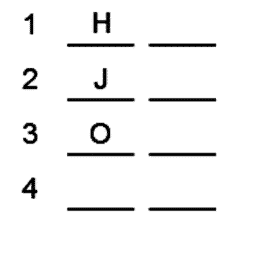
J is always in 2. H is always in 1 because it goes before J. O is always in 3. K goes in 1 or 2.
J, O, and G can’t repeat. H and K could repeat. K has to go in 1 or 2, but it could go elsewhere too. Likewise, there’s nothing to stop H from going in spot 4 as well as spot 1.
If you can split a game into two separate scenarios then you should always try and see what happens. Look for something that can only be one of either two ways and see what happens in both situations.
In this case, G can only go with J or O. We know that J is in 2 and O is in 3. So it’s worthwhile to find out what happens when G goes in either of those spots.
Let’s try putting G in spot 2. We know that K has to be in either spot 1 or 2. So if J and G are in 2 then K must go in spot 1. Here is what it looks like:
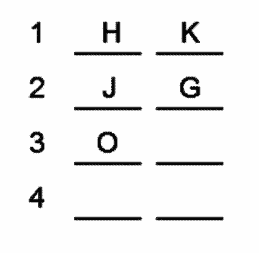
We have to fill the fourth row and the empty space in the third row. We have L and M left and K and H are repeatable. We’ve already satisfied all of the rules for K and H, so either could go in 4 as well. L and M can’t be the repeated variables here. They only have space to go in 3 and 4, and variables in 3 can’t repeat.
Here is what the complete diagram looks like, when G goes with J:
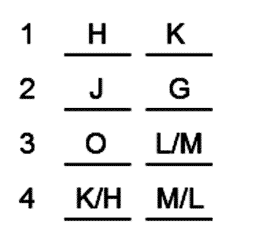
Now we should see what happens if we put G in 3 with O instead. This one is a bit more open ended. In fact, nothing much happens at all.
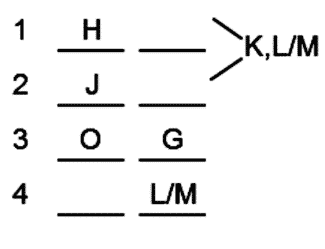
We now have H in 1, J in 2, O and G in 3. We must put K somewhere in the first two rows. That means we’ll have to have one of L and M in the last row and the other L and M is going to go in the first row.
The repeated variable could be: H, K or the L/M that was in the first row. It’s very open ended. Just know that when O and G are together in 3, a lot more can happen.
Notice that I’ve drawn most rules directly on the diagram. That’s how I prefer to do things. It’s a lot easier to remember the rules if they’re drawn right in front of me. It also prevents me from forgetting deductions. The greatest problem I see on logic games is that people will make a good deduction then forget it 20 seconds later.
Game 4 Main Diagram
Main Diagram
The setup section explains how to build this diagram.
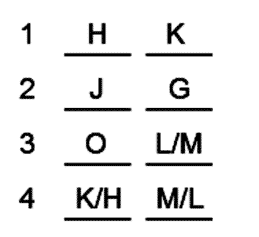
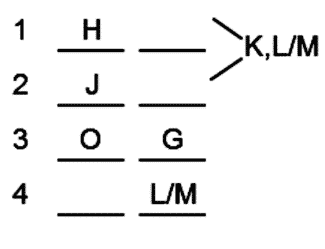
This is a linear game with grouping elements. Each of seven products (G, H, J, K, L, M, and O) will be advertised across a four-week period, for one week each. Two products will be advertised per week, and one product will be advertised in two different weeks.
Question 18
As with all list questions, take the rules one at a time and use them to eliminate answer choices.
A is wrong because J is in 1. There is way to put H before J.
B is CORRECT.
C is wrong because G is with M. G needs to be with J or O.
D is wrong because K is not in week 1 or 2.
E is wrong because H has to go before J, not with J.
Question 19
Look for variables that are in more than one rule. O is in two rules: G has to go with O or J, and O is in week 3 (and can’t repeat). If J goes there too, then J can’t repeat. G has nobody to go with. C is CORRECT.
A, B, D and E all involve random variables. L/M and K and H are, to some extent, random. You just have to obey the rules that H is before J and K is in 1 or 2. They are very easy to place and not good candidates for right answers here.
H and K can go together in week 1. H and M could go together in the last week. K and L could go together in the last week. L and M could go together in the last week.
Question 20
We deduced in the setup that J has to be in week 2. B is CORRECT.
If J goes in week 1 then we can’t put H before it.
If J goes in week 3 then O and J are together and can’t repeat. G has nobody to go with.
If J is in week 4 then we would have to put G beside it. Week 4 has to repeat…but neither G nor J can repeat. They both require a second variable (J needs H before it, G needs J or O with it).
Question 21
L and M are interchangeable. You can eliminate answers D and E right off the bat.
A is CORRECT. G is the only variable that requires another variable to be with it. You can only repeat one variable, so you can’t place G and O together twice (for example.)
The only way to have G repeat would be to put G with O, and with J. But if G goes in 3 with O, G can’t repeat. Nothing that goes in 3 can repeat.
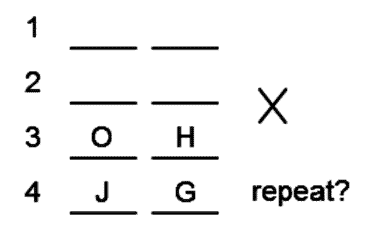
B is wrong because H can go in the fourth row as long as it also goes in row 1, before J.
C is wrong. K can go in the fourth row as long as K is also in row 1 or 2.
Question 22
If L is advertised during two weeks that means we have to put L in week 4. Then L is also going to be in rows 1 or 2. K also has to be in 1 or 2 (fourth rule). It looks like this:
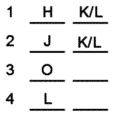
G has to go with O or J so we have to put G in with O in row 3. That leaves M to go in row 4. E is CORRECT.
Question 23
The most likely candidate for this sort of question is one of the random variables L or M. They have no rules so it makes sense that they could go in any week.
A is wrong. H can’t repeat if it goes in week 3. Therefore H couldn’t go before J. We saw in the setup that J has to go in week 2.
B is wrong. If J goes in week 1 then there is no room to put H before it.
C is wrong. If K goes in week 3 then K can’t repeat and therefore K can’t go in 1 or 2.
D is CORRECT. We can see from the scenarios for Question 22 that L can be in 1, 2 and 4. If you look at the correct answer for Question 18 (B) you’ll see that L is in week 3. So L can go in all four weeks.
(Looking at previous questions is a very important skill for logic games)
E is wrong because O can only go in week three. Whatever is in week 3 cannot repeat.
Question 24
A is wrong because G has to go with J or O, not H.
B is wrong because H has to be before J, not with J.
( The variable that repeats has to go in spot 4. If H and J went in spot 4, then H would also go in spot 3. But anything in spot 3 can’t repeat. )
C is wrong. We saw in the setup that H has to go in 1, in front of J. Anything with O in 3 can’t repeat. If you’re not sure about this, re-read the setup. There’s too much to repeat here.
D is wrong because if K goes with O in row 3 then K can’t repeat. But K must go in 1 or 2.
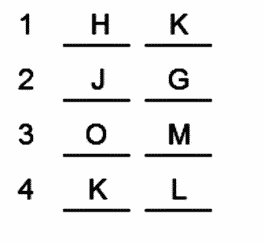
E is CORRECT because there are no rules about M. M can go pretty much anywhere. The correct answer, B, from Question 18 showed that L could go in week 3 and M could go in week 4. We can just switch these and put M in week 3 with O.

Leave a Reply