
LSAT Preptest 22 LG Explanations
Full explanations for every question from the logic games section of LSAT Preptest 22.
Archived Logic Games explanations
Logic Games are no longer part of the LSAT. LSAC removed the Logic Games section beginning with the August 2024 LSAT. If you are studying for the current LSAT, you can skip this section.
These explanations remain available for students, tutors, and readers using old-format PrepTests. For current guidance, see Logic Games and the current LSAT.
Table of contents
Game 1: Seven Sponsors
Game 1 Setup
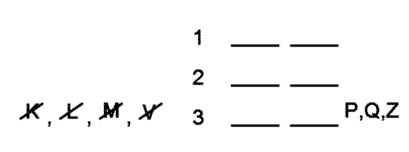
This is a grouping game. We’ve got three tables and seven people. Each table has to have at least two people. So two tables have two, and one has three (2 +2 + 3 = 7). Here is how we should draw the main diagram:

A third person will go to one of the three tables.
The next rule that I would draw is the last rule. L should sit at the same table as V. Since L is getting honors, this effectively makes V someone who gets honors as well.

This why you should always read over the entire game rules before you start. Because now when I diagram who is getting honors and who is giving a speech, I can include V in the list of those with honors, since V acts the same.
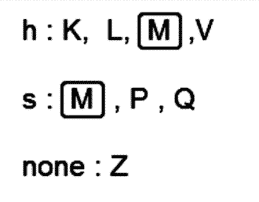
It’s very important in this sort of game to include that kind of diagram on who does what. I’ve listed out who is in each group and have also put a square around M, who has both honors and a speech.

Z has no rules.
An important deduction is that only P, Q and Z can go in table 3. K, L, M and V all can’t go there because they are receiving honors.

Note that tables 1 and 2 are completely interchangeable. It doesn’t whether someone is at table 1 or 2, they are both the same. Only 3 has special rules.
Game 1 Main Diagram
Main Diagram
The setup section explains how to build this diagram.
This is a grouping game. Each of seven sponsors (K, L, M, P, Q, V, and Z) will be seated at one of three tables. K, L, and M are receiving honours, and M, P, and Q are giving speeches.

Question 1
A is wrong because L can’t be seated at table 3. L receives honors.
B is wrong because M can’t be at table 3. M receives honors.
C is wrong because L and V have to be together.
D is CORRECT.
E is wrong because table 3 just has one person. Every table needs at least two.
Question 2
This question is easy if you made the deduction that there are only three people who could be seated at table 3. P and Q can go because they only give speeches and don’t receive honors. Z can go because there are no restrictions on Z.
C is CORRECT.
Question 3
K and M are at different tables. They need to be at tables 1 and 2. They both receive honors and can’t be at table 3.
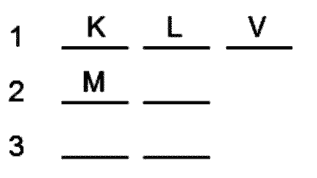
L and V go together, either table 1 or table 2. I’ve drawn a diagram of how this could go, but it’s just one option.
Tables 1 and 2 are interchangeable, so everything could be reversed. K and M could be switched. Or L and V could go in table 2 with M instead.
One of P, Q and Z will also go at in the empty place in tables 1 and 2.
A doesn’t have to be true because L could be at table 2 instead of table 1.
B can’t be true. L and V are going to be with one of either K or M.
C could be true but doesn’t have to be true. L and V can be with K instead of M.
D could be true but doesn’t have to be. There could be two at table 1 but you could also have three people, as I drew above.
E is CORRECT. Three people sit at either table 1 or 2. There can only be one table with three, so table 3 has to have just two.
Question 4
There are two possibilities, if Q is at table 1 with two other people. We could put Q, K and M at table 1 and then put L and V at table 2. Or we could put Q, L and V at table 1 and put K and M at table 2.
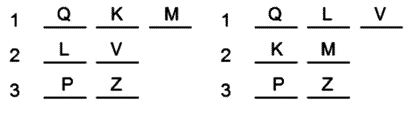
P and Z have to go in table 3. Only P, Z and Q can Nlly go there. We need to put at least 2 people at all tables.
A can’t be true because L and V are with K. We would only have M left to place with Q.
B is CORRECT as you can see from the 1st diagram.
C can’t be true. If L, M and V were all together then only K would be left to go with Q.
D can’t be true. P and Z have to fill up table 3.
E can’t be true. P and Z have to fill up table 3. Q is at table 1.
Question 5
Only P, Q and Z can sit at table 3. This question allows only one of P and Q sit at table 3. That means that Z must be the other person at table 3.
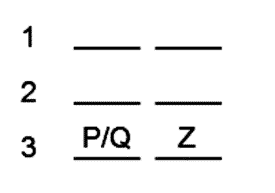
E is CORRECT. Notice how they put it all the way at the bottom.
When you make a deduction on a local rule question, check the answers to see if they’ve hidden the correct choice at the bottom.
There are no other rules regarding K, M, P as long as they are not at table 3. They can all be at table 1. Q could be at table 1 if P goes to table 3.
Question 6
Three sponsors are at table 2 and two of them have honors. We could put L and V there along with one of K and M. Or we can put K and M at table 2 and put L and V in spot 1.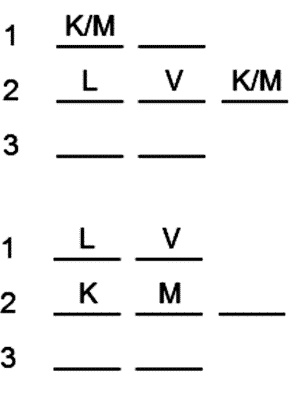
A is wrong because we can’t put both K and M at table 1. They both receive honors. Only L would be left to receive honors in table 2.
B is CORRECT. You can put K and Z at table 1 if L, V and M are at table 2.
C is wrong. V always has to go with L.
D and E are wrong because only P, Q and Z can go in table 3. So if we put two of P, Q and Z in table 2 then there is only 1 left to go into table 3
Question 7
This question may seem hard to understand. They’re asking which answer choice makes it impossible to obey the rules.
All the answer choices are restrictions. Four of them will work with the existing rules and one of them doesn’t. A is fine for example. We see in many of our scenarios that we just have two people seated in table 1, such as in Question 6. So A doesn’t wreck the game.
B is CORRECT. P and Q both give speeches. This rule would force them to be at table 1 and 2. Only Z would be left to go in table 3. We need at least two people at each table.
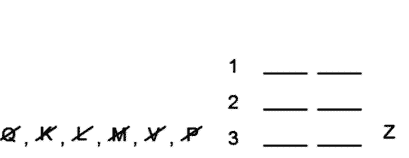
C is wrong. We have seen many scenarios where P and Q are at table 3 and M is at table 2. We just put Z in 1 or 2 and make sure to keep L and V together.
D is possible. In Question 1 the correct answer (D) has three people at table 1.
E is possible. The correct answer in Question 1 (D) shows that table 1 has L and V and a third person.
Game 2: Medical Training
Game 2 Setup
This game mixes linear and grouping. We must place three nurses and three psychologists in four different sessions. Sessions are taught by one nurse and one psychologist.
Each session is taught by both a nurse and a psychologist. That means that we have eight spots within to be filled by six people. There will be repetition, but everyone has to go at least once.
I set this up horizontally. You can do it vertically too. It’s arbitrary.
I didn’t write numbers under my diagram. Nlly I would for an explanation, though I don’t use them in my own diagrams (it’s faster without them).
But in this case I felt that numbers would make the explanation confusing and cluttered. There are only four spaces, so it’s pretty easy to tell which is first, second, third and fourth.

I inserted the second rule directly in the diagram. Leopold teaches day 3. It doesn’t mean that Leopold only teaches day 3. But Leopold is definitely there on day 3.
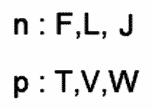
The next thing you should do is draw the list of who is a nurse and who is a psychologist. It will be essential to know this list or at least be able to refer to it quickly.

Nurses are early in the alphabet, and psychologists are late in the alphabet.
Most of the rules have to do with the nurses. The next rule is that T is not with F or L. We draw that like this:

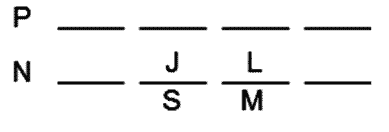
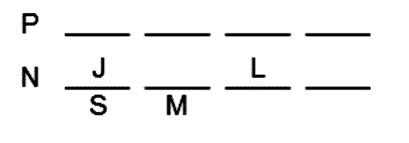
The last two rules are useful in combination. J is only in session S. Session M comes after session S.
Think about where you can put S and M. We can try putting S in 3 and M in 4, but there is a conflict. We already have Leopold in 3. Johnson has to go in S. But Johnson and Leopold are both nurses. They can’t both go in 3.
We can put S and M in 2 and 3. It looks like this:

We can also put S an M in 1 and 2 which looks like this:

We can’t put them any other way: S always has to go before M. As we saw above, we can’t put S and M in 3 and 4. So there are only two possibilities and only two places J can go.
I did not write out the rule about J being in S. I like to represent this type of rule directly on my diagram as much as possible. It’s much easier to remember that way, and it lets you visualize the game more effectively.
The only rule about psychologists is that T doesn’t go with F or L. Otherwise, they can be placed anywhere. Most answers involving psychologists will be wrong.
Game 2 Main Diagram
Main Diagram
The setup section explains how to build this diagram.
This is a mix of linear and grouping games. Four training sessions (M, O, R, and S) are scheduled for four days, and are each taught by one nurse and one psychologist. There are three nurses (Fine, Johnson, and Leopold) and three psychologists (Tyler, Vitale, and Wong).

Question 8
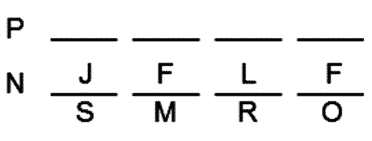
This question gives us a local rule right away. R is the only day that Leopold is scheduled. That means that R has to be number 3, since Leopold can’t go anywhere else.
If R is number 3 then M and S will have to go in 1 and 2. (there’s no space for them elsewhere)
O will go in 4. Which nurses can we put in M and O? We can’t repeat J or L so we’re going to have to put F in both M and O. It looks like this:
The psychologists can be placed anywhere, as long as F and L don’t go with T.
A is wrong. T and F can’t be together.
B is CORRECT. F has to go in day 2. Wong has no rules and therefore could be in day 2.
C is wrong because Johnson has to be in day 1, not day 2. (on this question)
D is wrong because Johnson has to be in day 1, not day 2. (on this question)
E is wrong because Leopold has to be in day 3 only (on this question), not day 2.
Question 9
A is inCORRECT. There are no rules about O. We could put O in day 1, S in day 2, M in day 3 and R in day 4.
B is CORRECT. If you put S in day 3 then J, a nurse, has to go there. But L, a nurse, is already in day 3.
C can be tricky to eliminate if you forget the Leopold can go twice. They have to go on day 3 but can go on day 1 as well.
D and E are wrong because there are no rules about Vitale or Wong. It’s very easy to put them anywhere.
This diagram proves both D and E could be true:
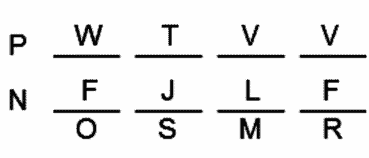
Question 10
A is wrong. If M is in day 4 then S is in day 3. That forces J and L to be in day 3 together.
B is wrong because F can never be with T.
C is wrong because Johnson can only be in S, not O.
D is CORRECT. There are no rules about Fine and Wong and it’s easy to put them together. The following diagram proves this is possible:
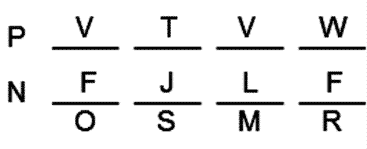
E is wrong because S has to have Johnson, not Fine.
Question 11
If S is scheduled for day 2 then M must be scheduled for day 3. It looks like this:
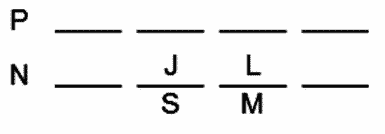
So we know that B is CORRECT. Leopold has to be teaching session M because M is on day 3.
Question 12
If O and R come one after the other, they have to go in 3 and 4. This is the only way to fit in S and M. S and M have to go together and they can’t go in 3 and 4. It looks like this:
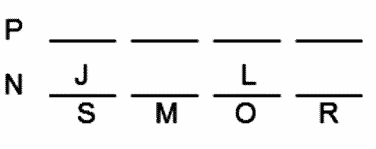
A is wrong because both F and L are both nurses. We can’t have two nurses teaching on the same day.
B is CORRECT. The diagram below proves that B can be true:
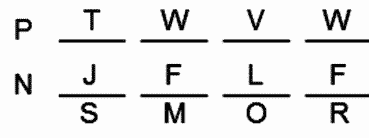
C is wrong because J has to be in day 1, not day 2.
D is wrong because J has to be in day 1, not day 2.
E is wrong because L can never go with T.
Question 13
A is CORRECT. This diagram proves that it can be true:
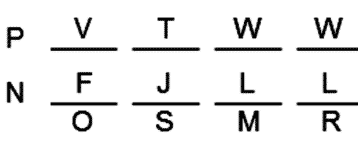
B is wrong. We can’t put S in fourth, because M has to go after. (Johnson shows where S is. )
C is wrong because Johnson only teaches once.
D is wrong because Johnson can only teach once.
E is wrong because 3 has to be L, not F. Also, Johnson is missing.
Question 14
If O goes on day 3 then R has to be on day 4. That’s the only way to fit in S and M. It looks like this:
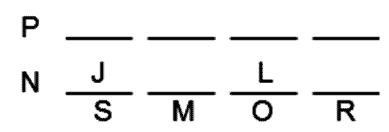
A is CORRECT. R is on day 4.
B is wrong. S can’t be on day 4, because M comes after.
C, D and E could be true but they don’t have to be true. There is only one rule about F, and none about V: they’re very easy to place. Leopold has to go on 3, but can go any other day as well.
Game 3: Six Paintings
Game 3 Setup
This is a highly unusual game. There are six paintings. They are either oils or watercolors. And they are either from the 19th century or from the 20th century. Each painting of each type has to be directly beside another of the same type.
Meaning: we’ve got to be able to draw a line either sideways or vertically to connect them. 3 is connected to: 2 and 6. 2 is connected to: 1, 5 and 3.
They only tell us three things: 2 is 19th century, 5 is 20th century and 3 is an oil painting. The diagram looks like this:

One of either 2 or 6 has to be an oil painting, one of either 1 or 3 has to be 19th century and one of either 4 or 6 has to be 20th century.
You can write all of this down if it helps you. I found this game much easier to simply visualize. Imagine a line leading from the O. It has to connect with another O, in 2 or 6.
An example of something we couldn’t do would be putting the only other O go in 4 or 5. There is no connection between 3 and 4/5.
Make sure you understand how this diagram works. Try some more examples if you’re unsure. Every question depends on being able to manipulate it.
Game 3 Main Diagram
Main Diagram
The setup section explains how to build this diagram.
This is a strange game with some grouping attributes. Six paintings (each of which is an oil (O) or a watercolor (W), and from the 19th or 20th centuries) are arranged on a wall.

Question 15
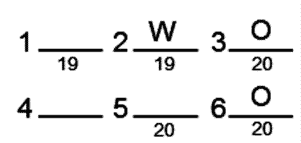
If all of the 19th century paintings are watercolors then we know that 2 is a watercolor.
We have to put an oil painting beside or below the oil painting in number 3. Since 2 is now a watercolor, 6 has to be O.
6 has to be 20th century, too. If 6 were 19th century it would have to be a water color, not an O.
So 6 is 20th century and it’s an oil painting. Painting 1 has to be 19th century so that painting 2 has another 19th century beside it.
3 is 20th century, otherwise it would be a watercolor. It looks like this:
A is can’t be true. Painting 1 has to be 19th century.
B can’t be true because painting 3 has to be oil. If it were 19th century it would be a watercolor.
C could be true but doesn’t have to be.
D could be true. But the 20th century paintings can also be watercolors, so this doesn’t have to be true.
E is CORRECT.
In this sort of question, focus on what has to be true. Make a deduction and then see if it’s the right answer.
Question 16
There are only two water colors. We must place them together.
You can use a very simple test. Take A: put your fingers on spot 1 and 5, or just look at them. Can you draw a line horizontally or vertically to join them?
No, you can’t. They’re diagonal from each other. So we can’t put the only two watercolors there because they are not connected. Likewise, we can’t put them in 1 and 6, 2 and 4 or 4 and 6. 4 and 5 are connected so D is CORRECT.
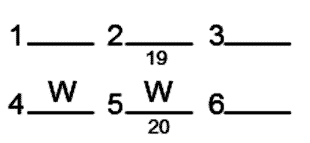
I highly recommened physically touching your diagram if it helps you figure things out faster. Some people just stare at this question blankly, when it can be answered in 10 seconds. Touching the diagram can snap you out of that.
Question 17
We have three Os and three Ws There are a few ways we can arrange this. We could have the whole top row be O and the whole bottom row be W. Or we can have the top right and bottom right be O. Or vice-versa. Here’s what those cases look like:
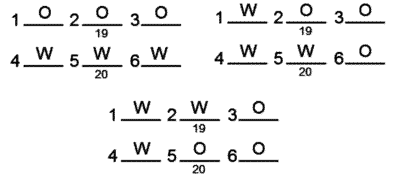
There are other ways to arrange it, those are just examples.
But we mustn’t make 4 an oil painting. If we did there would be no way to connect those two Os. Here’s what that would look like:
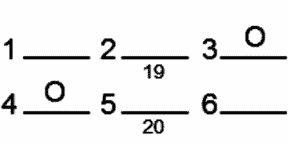
You only have one O left to place. There’s no way to connect the Os in 3 and 4 using just one O. If you put it in 2, then 2 and 3 are connected but 4 isn’t.
So the C is CORRECT. Painting 4 is a water color. All of the others could be true. The diagrams above show examples. But they don’t have to be true.
Question 18
We already have an oil painting and a 19th century painting on our diagram. This question tells us that there is exactly one more of each. They must all be connected.
The oil painting is going to have to be in 2 or 6 because that’s the only way to connect it with the current oil painting. The 19th century painting will either have to be in 1 or 3.
Just use this chart.
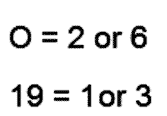
(Don’t forget that some paintings are already 19ths and oils.)
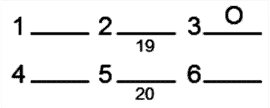
A says that painting 1 is 19th century and O is 6. That’s fine.
B says that 2 is an oil painting. That’s fine. And we already knew it was a 19th century.
C also fits the chart. 3 can be one of the 19ths.
D fits the chart. We already know that 2 is a 19th century, and 1 can be as well.
E says that 2 is an oil painting and 4 is a 19th century painting. It looks like this:
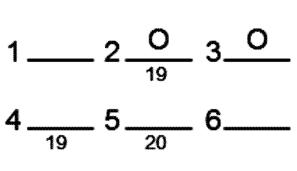
We’ve got a problem: our 19th century paintings aren’t connected. So E is correct; it must be false.
Question 19
A is CORRECT as it could be true. This diagram shows what it could look like:
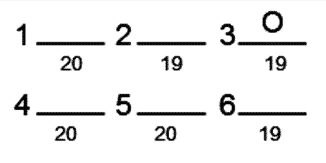
B is wrong because the 20th century painting in 1 is not connected to those in 5 or 6. (There’s already a 20th century painting in 5)
C is wrong because the 19th century painting in 6 is not connected to those in 1 or 2. (There’s already a 19th century painting in 2)
D is wrong because the 19 century painting in 4 is not connected to those in 2 or 3. (There’s already a 19th century painting in 2)
E is wrong because the 19th century paintings in 4 and 6 aren’t connected to each other or the painting in 2.
Game 4: Two Teams of Jugglers
Game 4 Setup
This is a grouping game. It can be a little bit hard: it depends on rules for people who aren’t in the game.
It’s also hard because there are six spaces, but seven jugglers. We can’t say for certain which rules apply at all times.
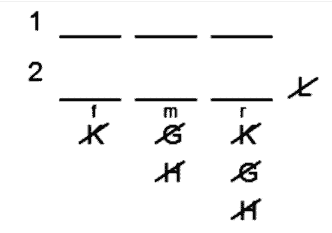
There are two teams, team 1 and team 2, and three positions front, middle and rear. It looks like this:
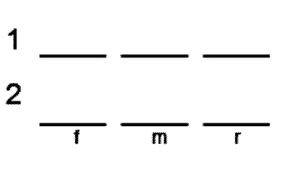
The first two rules I drew on the diagram. K can’t be in the front or rear. G and H can’t be anywhere but in front.
So I’ve drawn them underneath where they can’t go, with lines through them. (We can’t say for sure that G and H will be in front, for example, because not everyone has to be in.)
L can’t go on team 2. I drew that directly onto the diagram too.
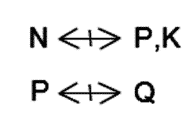
The last rule is tells us who can’t go with each other. N can’t go with P and K. P can’t go with Q.
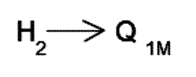
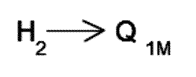
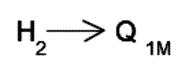
There is one more rule. If H goes on team 2 then Q is on team 1, in the middle spot. It’s worth drawing this to see what it looks like.
We know that P and K can’t go on team 1. P can’t go with Q, and K can only go in middle spots. Q already filled the middle spot on team 1.
N can only go on team 1. N can’t go with K and P, and at least 1 of K and P will be on team 2. (only 1 person can be out)
L can only go on team 1, always. G can only go on team 1, because G can only go in front spots. H filled the front spot on team 2.
That covers all the variables. Only K and P could be put on team 2, everyone else can’t. So both K and P must be in, and on team 2. K goes in the middle.
On team 1, one of L and N has to go in r. Any of L, G or N can go in f.

For all games I list out all the variables. For this game I find it useful to list them ordered by rules. Here’s how I drew them:

G and H are together (they can’t only go in front), NKP are together (N can’t go with K and P) and then Q (Q can’t go with P). I often referred to this when trying to figure out who was left and could be put in and what rules applied to them.
Game 4 Main Diagram
Main Diagram
The setup section explains how to build this diagram.
This is a grouping game. Each of six jugglers (G, H, K, L, N, P, and Q) is in the front (f), middle (m), or rear (r) position. One of each juggler type is assigned to team 1 and team 2.




Question 20
A is wrong because K and N can’t go together.
B is wrong because K can’t go in the rear.
C is wrong because L can’t go in team 2.
D is wrong because Q and P can’t go together.
E is CORRECT.
Question 21
We drew this diagram in the setup.
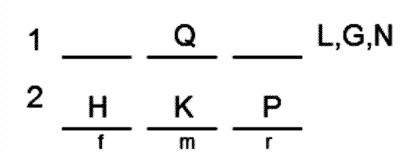
(The explanation below is the same given in the setup)
If H is in 2 it has to go in the front. H in 2 puts Q in line 1.
Since Q can’t go with P, P would have to go in team 2. K would have to go in team 2 also because K Nlly has to go in the middle and Q is in the middle on team 1.
Since P or K would have to be on team 2 then N has to go on team 1. N can’t go with either of them.
G would have to go on team 1 because H has filled the front spot on 2.
L can only ever go in 1.
Of all the variables, only K and P can go in 2, so both K and P have to be in. K goes in the middle.
We will have two of L, G and N in team 1.
Answers A, B and C are wrong because K is in the middle on team 1. Q has to go there.
D is wrong because this puts G in the rear position when it needs to be in the front.
E is CORRECT. Putting L, Q and N in row 1 doesn’t violate any rules. Row 2 is already set.
Question 22
I found this to be a hard question. You have to think of the people who aren’t included.
For example, A has N, P, H and Q not in. Is there a way to add three of them to team 2 without breaking rules? (No)
A is wrong because we can’t put H in team 2 without putting Q in the middle of row 1. K is already there. But if we don’t put in H, we would need to put N and P together on team 2.
B is wrong. Team 2 would have to be N, H and Q (L can’t go in team 2.) If H is on team 2 then Q is on team 1.
C is wrong because the four people we could use for team 2 are P, N, H and G. We can’t put more than one of H and G. That leaves P and N, but they can’t go together.
D is wrong it puts Q and P on the same team.
E is CORRECT. The four people that could go on team 2 are G, L, P and H. We could put G in f, P in m and L in r. That obeys all the rules.
Question 23
We need G in the front of the team 1. We could put H in the front of team 2 and put Q in the middle of team 1. Then we could put K and P in the second team. N or L would go in the third spot of team 1. This is the same diagram from the setup.
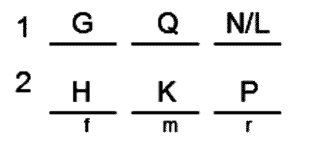
Is there any other way of doing it? We’d have to leave H out, because if H goes on team 2, everything else falls into place. H can’t go in team one because G is in the only spot where H is permitted.
If H isn’t in, every other variable must be in. L can’t go in team 2. So the four people left that can be placed on team 2 would be three out of N, P, K and Q.
That doesn’t work. P can’t go with Q. N can’t go with P or K. No three of those people can go together.
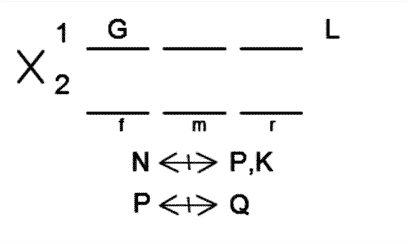
This scenario is the only one that works: H has to be in.
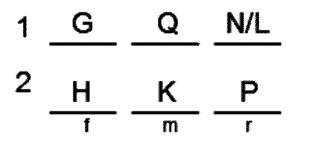
A is wrong because H has to be in 2, not 1.
B is wrong because K has to be in 2, not 1.
C is wrong because K and P have to be in 2, not 1.
D is wrong because L and N can’t be in team 1 together. There is only space for one of them.
E is CORRECT. We always have Q and we could have L.
Question 24
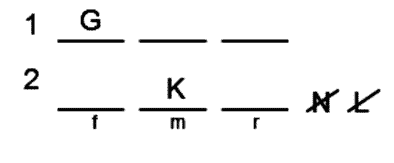
G is on team 1 and K is on team 2. To eliminate the first three answers is pretty easy. H can never be in the rear position, L can never be in team 2 and N can’t go with K. None of them can go in the rear position in team 2.
We’re left with just D and E. It’s pretty easy to prove that P could be there. In the last setup we saw that happen.
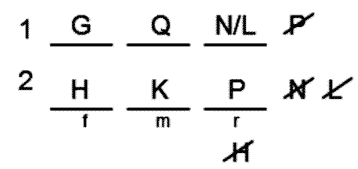
But you may wonder why we can’t put Q there. Let’s look at what would happen.
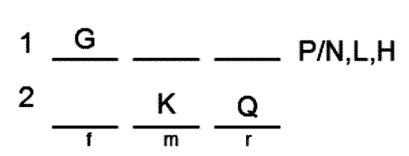
We couldn’t put P on team 2 because P can’t go with Q. We couldn’t put N on team 2 because N can’t go with K. We couldn’t put L on team 2 because L never goes there.
And we couldn’t put H on team 2 because if H were there then Q would go in the first team. There’s nobody else left.
E is wrong because there is nobody we can put in that front spot on team 2.
D is CORRECT.

Leave a Reply