
LSAT Preptest 24 LG Explanations
Full explanations for every question from the logic games section of LSAT Preptest 24.
Archived Logic Games explanations
Logic Games are no longer part of the LSAT. LSAC removed the Logic Games section beginning with the August 2024 LSAT. If you are studying for the current LSAT, you can skip this section.
These explanations remain available for students, tutors, and readers using old-format PrepTests. For current guidance, see Logic Games and the current LSAT.
Table of contents
Game 1: Appetizers and Main Dishes
Game 1 Setup
This is one of my favorite game types. It’s a grouping game where if you combine the deductions, you can pretty much figure everything out in advance.
We have seven flavorings that are going to be split between a main dish and an appetizer. The appetizer can have, at most, three flavorings.
I always recommend reading all the rules before writing anything. Sometimes it makes the most sense to draw the last rule first. Ginger is with nutmeg and F is not with nutmeg. We can combine those to say that F doesn’t go with either N or G.
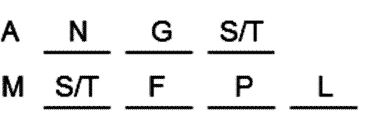
And S is not with T. The two variables with no rules are P and L. Here’s what it looks like:
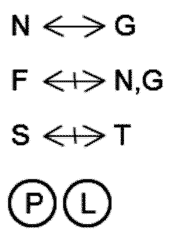
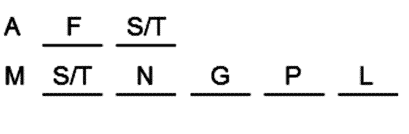
S and T are always apart, and F is always apart from N and G. We only have two groups. We therefore always need at least two flavorings in the appetizer. The first rule tells us there are at most three. So there are only two scenarios in terms of numbers: Appetizer has two or three.
Here’s what it looks like with two spaces into the appetizer. You can’t put N and G there because then S and T would have to be together in the main dish. So we have to put F and S/T in A. N and G go in the main dish and P, L and S/T fill the other two places.
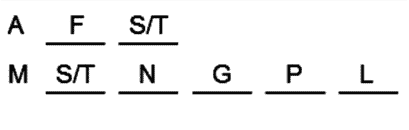
There is no other way to do it when the appetizer only has two spots.
There are a couple other ways that things can go, if we put three flavorings in the appetizer.
I highly recommend drawing out separate scenarios. It helps you think through the game. It also lets you can refer to them as you go through the game.
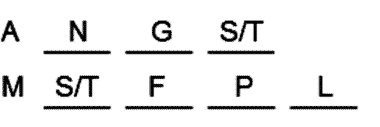
We can first try putting N and G in the appetizer along with T/S. You’re always going to have one of T and S in both the appetizer and the main dish. In the main dish we put the other T/S, along with F, P and L.
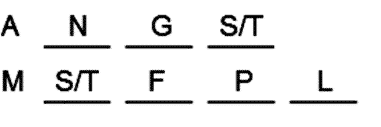
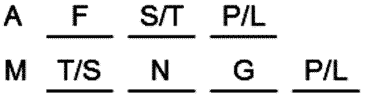
The other possibility is if we put F in the appetizer instead of N and G. One of T and S always goes there.
One of P and L fills the last spot. In the main dish, we put the other T and S as well as N, G and the other P and L.
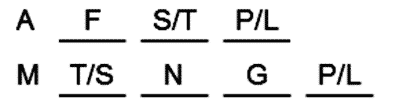
Those are all of the possibilities. We’re going to call them scenarios 1, 2 and 3.
Game 1 Main Diagram
Main Diagram
The setup section explains how to build this diagram.
This is a grouping game. There are two recipes, an appetizer (A) and a main dish (M). Between the two recipes, seven flavourings (fenugreek, ginger, lemongrass, nutmeg, paprika, saffron, and turmeric) must be used once each
Scenario 1

Scenario 2
Scenario 3
Question 1
A is wrong because there must always be at least four ingredients in the main dish, thanks to the first rule (max three in the appetizer).
B is wrong because it puts F with N.
C is wrong because there is no S and T. That means that S and T are together in the appetizer, which can’t happen.
D is CORRECT.
E is wrong because S and T are together.
Question 2
The appetizer doesn’t have F so we know we’re in scenario 2.

We see the appetizer has to include ginger instead (A is correct). Lemongrass and paprika are in the main dish (B and C are wrong). S and T are interchangeable. (D and E are wrong)
Question 3
A is CORRECT. It could be true, as in our first scenario.

B can’t be true because it would leave S and T together in the main dish.
C can’t be true because nutmeg needs ginger.
D can’t be true because nutmeg needs ginger.
E can’t be true because we can have, at most, three ingredients in an appetizer.
Question 4
For this question, look through the scenarios and see which ones have lemongrass and nutmeg together. Those are scenarios 1 and 2.
G and N are only in the main dish in one scenario (A and C are wrong). Saffron and Turmeric are interchangeable. (D and E are wrong).
Only Lemongrass has to be in both. B is CORRECT.
(If we put L and P both in the Appetizer, then there would only be one space left. There would be no room to keep S/T and F/N separate)
Question 5
Games often has a final question that changes a rule.
This tends to scare people but it really doesn’t have to. All it means is that we no longer need N and G together. Otherwise, this is just a list question like the first question. You should just take each remaining rule and use them to eliminate answer choices.
A is wrong because S and T would be together in the appetizer.
B is wrong because F and N would be together in the appetizer. That violates rule 2.
C is CORRECT.
D is wrong because it puts S and T together.
E is wrong because it puts F and N together.
It turns out the rule change didn’t affect anything!
Game 2: Seven Singers
Game 2 Setup
This is a linear game. We’ve got the standard seven spaces as a setup.

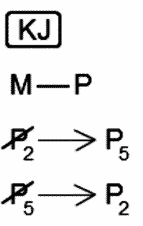
The rules are simple. You can put K and J in a box to show that K is right before J. Draw a line to show that M is before P. Lastly, we can show that if P is not in 2 then it’s in 5 and if it’s not in 5 then it’s in 2. (It’s just another way of saying: P is either in 2 or 5)
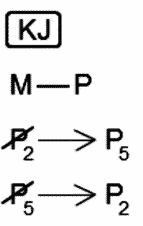
I drew the last rule before the third rule because we can combine them. If L is in 3 and N is in 5 then P is not in 5. So P must be in 2. M goes before P so M is in 1.


L is in 3, N is in 5, P is in 2 and M is in 1.
We can add in the other rules. We have to put KJ on the end because that’s the only place we can put them together. And O, which is our random variable, goes in 4.

If P is in five, then L must not be in 3 (otherwise N would go in 5.) That’s about all we can say. 
Game 2 Main Diagram
Main Diagram
The setup section explains how to build this diagram.
This is a linear game. Each of seven singers (Jamie, Ken, Lalitha, Maya, Norton, Olive, and Patrick) will give a solo performance in order.




Question 6
A is CORRECT.
B is wrong because M comes after P.
C is wrong because P isn’t in 5 or 2.
D is wrong because K and J aren’t together.
E is wrong because L is in 3 but Norton isn’t in 5.
Question 7
If L is third, we know everything that happens. N goes in 5. That forces P into 2. That forces M into 1. There is only space for KJ in 6 and 7. O goes in 4. (all the rules are combined)

Just look at who is 6. Ken. B is CORRECT.
Question 8
If N is fifth we know that P will have to be second. (P is either second or fifth.) M is first, because M goes before P.

Some people get tricked here. They think that L has to be in 3. But they’re getting it backwards.
If L goes in 3, N is in 5. But it doesn’t work in reverse. When N is in 5, L could be in 3 but doesn’t have to be.
So we have space to put Ken and Jamie in either 3 and 4 or 6 and 7.
A is wrong because Jamie can’t go in sixth. There’s no space to put Ken before Jamie.
B is wrong because P is in second. Ken can’t go there.
C is CORRECT. L could be fourth if we put O in third and K and J in 6 and 7.
D is wrong because M has to go before P. (P is in 2)
E is wrong. M has to go before P. So M has to go in 1, not O.
Question 9
If M is second we know that P has to be fifth. (P only goes in 2 or 5). L cannot be third, because that would put N in fifth instead of P.

A is wrong. We can’t put Jamie sixth because we need to put Ken before Jamie.
B is wrong. We can’t put Ken fourth because we have to put Jamie after Ken. P is in fifth; it wouldn’t fit.
C is wrong. We can’t put L third because that would put Norton in fifth.
D is wrong. We can’t put Norton in fifth. P has to go there.
E is CORRECT as Olive could be fourth. It’s shown by this diagram:

Question 10
Question 10 gives us a new rule. Now we have K, J, and L all together.

There’s one place we can’t put this. If L goes third, none of this works. Why? If L goes third, N goes fifth. That means P goes second… but we need to put J second if L is third.

A is CORRECT. J can’t go second.
Game 3: Introductory and Advanced Textbooks
Game 3 Setup
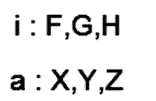
This game is an interesting mix of linear and grouping. There are six textbooks. F, G and H are introductory and X, Y, Z are advanced.
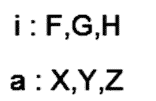
Commit these to memory. Just remember that the later letters are advanced (XYZ), and the earlier letters are introductory (FGH).
R has to be the first one to evaluate any advanced textbook and J has to be the first one to evaluate any introductory textbook. So, R’s first textbook is advanced and J’s first textbook is introductory.
R must finish the advanced books before the sixth week so that J can do the last advanced book. And vice versa. So R’s last book is introductory, and J’s last book is advanced.
R can’t do two introductory books in a row. This lets us figure out a lot. We already know that R’s first book is advanced and his last book is introductory. “a, __ __ __ __ i”
If we can’t put two i’s together, then 5 must be advanced: ““a, __ __ __ a, i”
There are two i’s and one a left. We have to put the a in the middle, to keep apart the i’s. R must do the books in this order: a, i, a, i, a, i.
It’s the only way for R to finish all the advanced books before week 6 and to split apart the introductories.
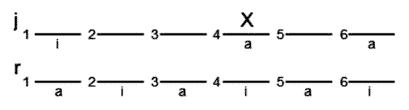
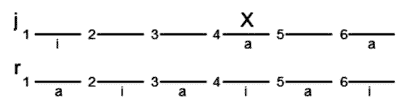
J has to do X in week 4. Other than that, J is a bit more open ended. We deduced above that J has to do an “i” first, and an “a” last.
That’s all we know. Just remember that J can’t do an advanced book unless R does it first, and R can’t do an introductory book unless J does it first.
Game 3 Main Diagram
Main Diagram
The setup section explains how to build this diagram.
This is a mix of linear and grouping games. Three introductory (i) textbooks (F, G, and H) and three advanced (a) textbooks (X, Y and Z) will be evaluated by both Juarez (j) and Rosenberg (r). Juarez and Rosenberg each evaluate one different textbook per week.
Question 11
A is wrong because J has to do X in 4.
B is CORRECT.
C is wrong because R can’t do two introductory books together. They’ve done G and H in 2 and 3.
D is wrong because R does F (an intro book) before J does F.
E is wrong because J does Y (an advanced book) before R does Y.
Question 12
J does H in 3 and R does G in 6. This tells us where F has to go: 2.
Why? Well, R can only do F, G and H after J does them.
R isn’t going to be able to do H any earlier than 4, because J only does H in 3. And R does G at the end.
R must evaluate an intro book second. F is the only intro book left.
If R does F in 2 that means J does F in 1.
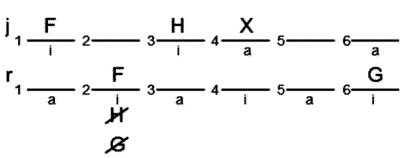
Basically, R can’t do H or G in the second spot, so R has to do F.
A is CORRECT.
B could be true but doesn’t have to be. J could also do G in 5.
C could be true but doesn’t have to be. Z could come earlier: in 1 for R and 2 for J.
D could be true but R could also do X in week 3.
E could be true but it doesn’t have to be true. R could do Y in week 1.
Question 13
If J does Z in week 2 then we know R must do Z beforehand, in week 1.
We also know that R must do X before week 4, so that J can do X then. So X goes in week 3 for R.
5 is always an advanced textbook for R. R must do his last advanced textbook in 5. That’s Y.
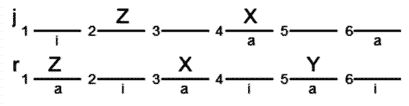
D is CORRECT.
Question 14
A is wrong because there is no difference between F, G and H. They’re interchangeable. R has to do an introductory textbook in week 6, but it doesn’t matter which one.
B has to be true. If R didn’t do an advanced textbook in week 3 then R would have two introductory textbooks in a row. B is CORRECT.
C could be true but it doesn’t have to be. J could evaluate all three introductory textbooks in the first 3 weeks.
D could be true but it doesn’t have to be. J could easily evaluate G before Y. All the variables are interchangeable except X.
E doesn’t have to be true. J could even evaluate all three introductory textbooks together.
Question 15
This is another local rule. You should always draw these.
If R does F in week 2 then J has to do F earlier, in week 1. We’re also told that R did X in week 1.
Since R does X first, that means J can’t do any other advanced textbooks before 4. R only does his second advanced book in 3. That’s too late for J to use (they could do that book in 5, at the earliest).
So J does three intro books then three advanced books.
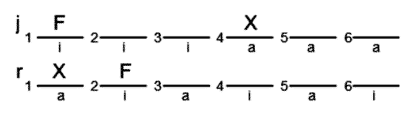
We’re looking for something that could be true.
A is wrong because J always does X fourth, not third.
B is wrong because R can do Y third at the earliest. There’s no space for J to evaluate Y before X.
C can’t be true because there is no advanced textbook that J can do before X. R does X in 1. By the time R does another advanced book in 3, it’s too late for J to do it.
D can’t be true. J can’t do G in week 5. J has to do all three of the introductory books in weeks 1-3.
E could be true, and is CORRECT. It doesn’t matter which order J does the advanced books in. They just have to do them after R does them.
Question 16
We don’t know that much about J. We know:
- They do an advanced textbook in week 4 (X)
- The last week is advanced, because J has to finish all the advanced early enough for R to do them.
- The first week is introductory, so that R can do an introductory book in the second week.
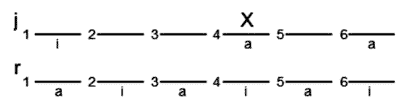
A is CORRECT. Week 1 is introductory.
Question 17
A is wrong. J can’t do F in the last week. Then R wouldn’t be able to do F.
B is wrong. J can’t do Z in week 1. R hasn’t had time to evaluate Z.
C is wrong. R has to do an advanced book in week 3. F is introductory.
D is CORRECT. If J did H in week 1, R could do H in week 2.
E is wrong. R can’t do X in week 5. R has to do X sometime before week 4. That’s when J does X.
Game 4: Antibiotics Diets and Physical Therapies
Game 4 Setup
This is a grouping game. It looks open ended, but it’s quite restricted. It shows the importance of trying to combine rules before starting the questions.
We have three variables of each type and it’s very important to draw those so you can refer to them quickly, or to memorize them.

Notice that earlier letters in the alphabet go together. E.g. A is with the earliest letters, P is with the latest.
We need exactly five. The first rule says we can’t have all three antibiotics. We can either have one or two. We have exactly one dietary regimen. So we could have three P and one A.

Or we can have one dietary regimen, two physical therapies and two antibiotics.

We’ll come back to these.
Next, you can combine the next two ordering rules and say that if F is in then O is in and W is out. And if W is in, then O is out and F is out.

The are two more rules. If you have N and U then G is out. Don’t read that backwards as saying G needs N and U. It’s a very easy mistake to make.
Lastly, if you have V then you need H and M.

(The contrapositives)

Let’s look at our two scenarios. If we put all three physical therapies in then we can apply the last rule. If V is in, H and M are in. H is an antibiotic and M is a dietary regimen. So there is only one way to set things up if all three Ps are in.

Things are more open ended when we have two physical therapies.
It’s worth trying out all the scenarios to see what happens. We could put in any of these three combinations: UV, UW, WV
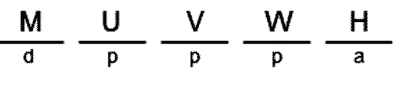
Here’s U and V in. V needs H and M. U, V, H and M fill four spots.
The only remaining spot is a single antibiotic. It might look like we could put either F or G there. But F requires O, which is a dietary regimen. That spot is already filled by M. So we can’t put F in, we have to put G. Here’s what it looks like:

Next, U and W in. If we have W then we can’t have F. That means our two antibiotics must be G and H.
N can’t be the dietary regimen. If we have G, we need either U or N to be out. Here, U is already in, so N is out.

Instead we have to have either M or O. Here’s what that looks like:

Lastly, let’s try V and W in. If we have W then we don’t have F. We must instead have H and G.
If we have V we need H and M. So our dietary regimen is M. It looks like this:

These are the only four possible scenarios. You’ll notice something interesting: we never have N and we never have F.
This is always true. You can’t make a workable scenario where F or N are in. So we can add these two deductions.

Game 4 Main Diagram
Main Diagram
The setup section explains how to build this diagram.
This is a grouping game. Nine treatments are available: F, G and H are antibiotics (a); M, N and O are dietary regimens (d); and U, V and W are physical therapies (p). A total of five treatments will be prescribed.
Scenario 1
Scenario 2

Scenario 3
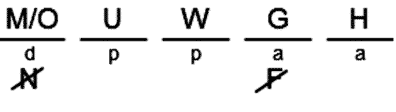
Scenario 4
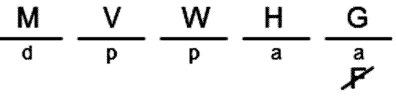

Question 18
A is wrong because we have F without O.
B is wrong because we have two dietary regimens: M and O.
C is wrong because we have two dietary regimens: M and O.
D is wrong because we have N, U and G in.
E is CORRECT.
Question 19
This is another list question. We can just apply our rules.
A is wrong because F and W are together.
B is wrong because we have F without O.
C and D are wrong because if we have V then we need H.
E is CORRECT.
Question 20
For this question we can look at our scenarios. Only the one with U and W works.
The reason is: if we had V then the dietary regimen would be M, not O.
So we need the scenario with O, U, W, G and H.
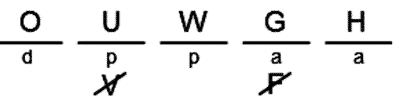
A is wrong because we can never have F, ever. In this case, W means no F.
B is wrong because if we had V we would need M, not O.
C is wrong because if we had N then we couldn’t have O.
D is wrong because if we had V we would need M instead of O.
E is CORRECT.
Question 21
If we have G we know that we can’t have one of either N or U. But that doesn’t eliminate anything.
However, we know from our setup that we can never have F and N. That eliminates A, B and C.
If you want other reasons for why these are out:
A is wrong because if you have F you need O, not M, for the dietary regimen.
B is wrong for the same reason. If you have F then you need O, not N.
C is wrong because if you have V then you have M, not N.
D is wrong because if you have V then you have M, not O.
E is CORRECT and is proven by this scenario.

Question 22
A is wrong. If you have F, M, U then you need to choose a second physical therapy. You need V, not W: W would kick out F. But, V requires H. That leaves no room for O, and F needs O.
B is wrong because it has F and W together.
C is wrong because if you have V then you need M, not N.
D is CORRECT and is proven by this scenario.

E is wrong because if you have V then you need M, not N.
Question 23
This is testing the deduction we made in the setup. We can never have N.
Why? If you have V in, then you need M, not N. And if you don’t have V in, then you need W and U. That makes the antibiotics G and H, because W doesn’t go with F.
If we have G, we need one of N or U to be out. We already have U, so N has to be out.
C is CORRECT.