
LSAT Preptest 27 LG Explanations
Full explanations for every question from the logic games section of LSAT Preptest 27.
Archived Logic Games explanations
Logic Games are no longer part of the LSAT. LSAC removed the Logic Games section beginning with the August 2024 LSAT. If you are studying for the current LSAT, you can skip this section.
These explanations remain available for students, tutors, and readers using old-format PrepTests. For current guidance, see Logic Games and the current LSAT.
Table of contents
Game 1: Investors and Building Sites
Game 1 Setup
This is a linear game. The standard diagram of seven spaces looks like this:

This game has one of my favorite types of rules: those which tell us that something can only be one of two ways.
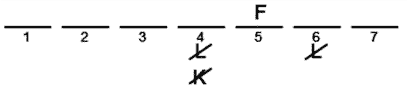
The first rule is that F is either on day 3 or day 5. Whenever you see this, make two separate scenarios. It usually pays off, as it does in this game:


I’ve also added the second rule onto these diagrams( L doesn’t go in 4 or 6). I’m going to draw the last rule next. H comes before G:

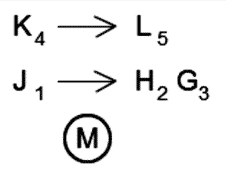
Next rules: If K is in 4 then L is in 5.
If J is in 1 then H is in 2. That means G is in 3. M is the variable with no rules.

It’s very important to combine your rules to make deductions. For example: if K is in 4 then L goes in 5. That means F has to go in 3, not 5.
So on our diagram where F is in 5, we can write that K is not in 4. If K were in 4, F would not be in 5.

Likewise, if J is in 1 then H is in 2 and G is 3. So F can’t be in 3. In our diagram where F is in 3 we can write that J is not in 1.

These will come in handy on future questions. They remind us of our deductions, and prevent us from making mistakes. I can’t count how many times I’ve seen people make a deduction, not write it down, then forget it.
You could also draw the diagrams for the rules for what happens if K is in 4. I didn’t find it very useful here so I didn’t draw it, but it’s not harmful either. So feel free to do so if it helps you understand the rule.
Game 1 Main Diagram
Main Diagram
The setup section explains how to build this diagram.
This is a linear game. Seven investors (Fennelly, Gupta, Hall, Jones, Knight, Lopez, and Moss) are seeing the building in an order.


Question 1
A is wrong because Joan and Gwen, two majors, can’t go together
B is wrong because Frank has to go with Victor, not Xavier.
C is CORRECT.
D is wrong because Joan has to go after Frank, not before.
E is wrong because Gwen and Wanda can’t go together.
Question 2
If J is on day 1, we know H is on day 2. That means G is there in day 3 (G always comes directly after H).
F can only go on day 3 or 5, so we must put F on day 5.
We know that L is not in 4 or 6. The only place L can go is day 7.
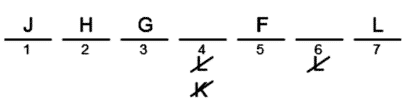
We have K and M left to place. If we put K in 4 then L would be in 5. But F is in 5. So therefore K goes in 6 and M goes in 4.

E is CORRECT.
Question 3
If K is on day 4 then we know that L is on day 5.
F can only go on 3 or 5. So, F is on day 3.
That means J can’t visit on day 1. Otherwise H would go on 2, and G would end up in day 3.

We have to put H and G together. And we’ve got an additional rule for this question: M comes after J. So we have to put H and G in 1 and 2 then J and M in 6 and 7.
If we put HG in 6 and 7, then J, M would be in 1 and 2. But we can’t put J in 1 (that would force G into 3).

C is CORRECT. J has to be on day 6.
Question 4
If Hall is on day 2 then G must be on day 3. Therefore F has to be on day 5. (F can only be on 3 or 5).
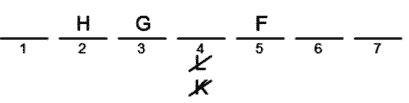
If F is there in day 5 we know that K can’t go in 4. Otherwise L would go on 5.
Answers A, D and E are wrong for that reason.
Moss is in both B and C. So we only have to figure out whether J can also go on day 4. This diagram proves that it is possible. C is CORRECT.

Question 5
This question gives us two new rules. K comes right before H and L is right before F.
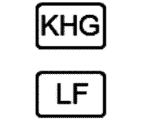
This tells us that F has to go on day 3. If F was on 5 then the new rule would force L to go on 4. But L can’t go on 4.
Therefore J can’t be on day 1. If J were there, then the second rule says H would go on day 2, where L has to be.

Next, where we can put the K, H and G bloc?
We can’t put them on 4, 5 and 6. If K goes on 4 then L goes on 5.
We have to put them in 5, 6 and 7. That leaves only day 4 for J.

D is CORRECT. J goes in 4.
Question 6
We have another new rule. L and G are before F. It looks like this:
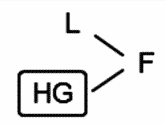
There are three people before F. So there is no space to put F in spot 3: F goes in 5.
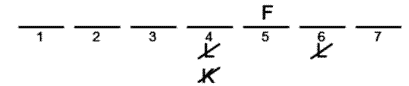
A is wrong because F has to go in spot 5, not 3.
B is correct as this diagram shows.

C can’t be true. If J went on day 3, then H and G would have to go in 1 and 2 (they need two spaces). L could only go in 4, but that’s not allowed.
D is wrong for the same reason as C.
E is also wrong for the same reason as C. Only G, H or L can go in 3. Anything else forces H and G in 1. That leaves only spot 4 for L, which violates the second rule.
Game 2: Snakes and Lizards
Game 2 Setup
This is a strange game. I haven’t seen many like it.
There are five habitats for seven reptiles. Since no habitat has more than two, that means we’re going to have at least two habitats with two reptiles. The other habitats will have one reptile.
We can also have empty habitats: the rules don’t say that that we can’t. So we could have three habitats with two, one habitat with one reptile, and one empty habitat (for example).
Four of the reptiles are snakes and three are lizards. Five are female and two are male. It’s worth writing this down, like this:
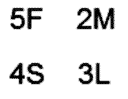
You can draw this game vertically or horizontally. I chose vertically, but it doesn’t really matter. This is a non-standard game.
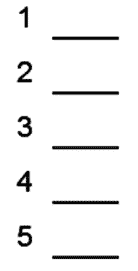
There are only two rules that don’t depend on numbers. You can’t put a snake and a lizard together and you can’t put a female snake by a male lizard.

This lets us make some deductions about numbers. We have three lizards, an odd number. You can’t combine lizards with snakes. So you either have three lizards alone, or two lizards together and the last lizard alone. There will always be at least one lizard alone. This lets us answer Question 9.
Game 2 Main Diagram
Main Diagram
The setup section explains how to build this diagram.
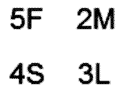
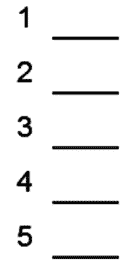
This is an unusual sort-of grouping game. Five habitats (1-5) contain a total of four snakes (S) and three lizards (L). There are five females and two males.

Question 7
A is wrong. It puts a male snake in 2 and a female lizard in 4.
B is CORRECT.
C is wrong. It has female snakes in 2 beside a male lizard in 3.
D is wrong. There are three reptiles in 5. That’s too many. We can only have two lizards in any habitat.
E is wrong. There is a female snake in 2 and a male lizard in 3. That violates the third rule.
Question 8
Habitat 2 has a female snake and habitat 4 has male lizards. We can’t put female snakes in 3 or 5, because female snakes can’t go beside male lizards. It looks like this:
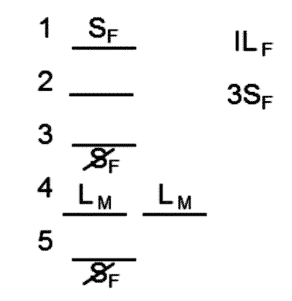
We have one female lizard and three female snakes left to place. We already used all of our males.
We know we can’t put any female snakes in 3 or 5 so we have to put them in 1 and 2.
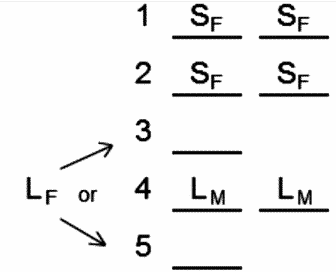
That leaves one female lizard left to place either in 3 or 5.
A is wrong. 3 can only have one female lizard, at most.
B is wrong. 5 can only have one female lizard, at most.
C is wrong. We need two female snakes in 1.
D is wrong. We need two female snakes in 2.
E is CORRECT. We could put the female lizard in 5.
Question 9
A is tempting but it doesn’t have to be true. You can put a female snake with a male snake.
So we can have two females together, two females together and then a male and female together. There would be no females alone.
B is wrong. Question 8 shows us that we can have both the males together. None are alone.
C is CORRECT. We have three lizards. We can’t put lizards with snakes. So even if we put two lizards together we’re still stuck with one.
D is wrong. In Question 7 the correct answer (B) has two male snakes and no male lizards.
E is wrong. In Question 8 there are two male lizards and no male snakes.
On “must be true” questions, it’s very useful to look back at previous questions to eliminate answers.
Question 10
This question can take awhile. It goes faster if you write down who is left next to each answer choice.
A We’ve used all our males and three of our snakes. We’ve got three female lizards and one female snake left to place. We have no restrictions on putting those anywhere. So we can just spread them across the last three spaces. For example: 3. two female lizards 4. one female snake 5. one female lizard.
B We have used all the males. We have three female snakes and two female lizards left. As long as you don’t put female snakes bedie the male lizard then we’re fine. We can spread five reptiles across three spots. For example: 3. 2 female snakes. 4. one female snake. 5. two female lizards.
C We have one lizard left and three snakes. Two males are left. As long as we keep the male lizards away from the female snakes we can easily split the four remaining reptiles across the last three spaces. For example: 3. One female lizard 4. One female snake 5. Two male snakes
D is CORRECT. It leaves us with three lizards and three snakes. There is no way to put these in the last three spots: we can’t put lizards with snakes. Even if we put two lizards somewhere and two snakes somewhere, we’re still left with a lizard and a snake. It just won’t fit.
E We have two lizards and four snakes. Both are males. This may look tricky but we can put things this way: 3. two female lizards 4. two male snakes 5. two female snakes. Everything fits.
Question 11
Habitat 3 is empty. We don’t have snakes beside snakes.
We must put two snakes in 1 or 2 and two of them in 4 or 5, together. It looks like this:

The arrows show what is reversible. On one side of 3, we’ll have two snakes and a female lizard. On the other side, we’ll have two snakes and two female lizards.
The sides could be reversed, it makes no difference. Two of the snakes are male, and two are female. That also doesn’t matter.
The only thing we can’t do is have a male lizard because it would be beside female snakes.
A is CORRECT. There are no rules about even numbered habitats. We can switch our reptiles around and we can put snakes in even or odd numbered places, it doesn’t matter.
B is wrong. We can’t make any lizards male. They would be beside female snakes.
C is wrong. We can’t have snakes alone; we have to fit all four snakes in just two places. Otherwise we would have snakes beside habitats with other snakes.
D is wrong. Since snakes are apart, this also forces the lizards apart.
E has to be true and is therefore wrong. Because we have an odd number of lizards, there is always one that’s alone.
Question 12
This is pretty restrictive. Every snake is female and the lizards are alone.
If the snakes are female then two lizards are male and one is female. You can’t put male lizards by female snakes.
The first thing to try is putting female snakes in the middle. That would make it hard to keep the lizards away from them.
If you put snakes in habitat 3 there is no way to keep them away from male lizards. I’ve drawn a diagram that shows me trying to keep them away. It still doesn’t work.
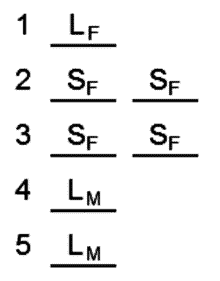
You can see I put two snakes in the middle, two snakes in 2 and one female lizard in 1.
I still can’t keep the male lizards away from the female snakes. All the lizards have to be in separate places. C is CORRECT. We can’t put snakes in 3.
Game 3: Films and Film Buffs
Game 3 Setup
This is a grouping game. There are three films and seven film buffs. We have to see which film buffs go to see the films.
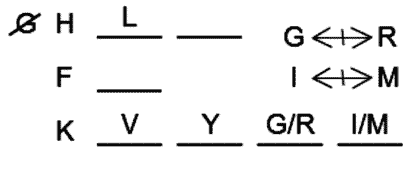
The game involves numbers. The first rule splits the game into two scenarios. Twice as many people see the Hitchcock film as the Fellini film.
We could put four with Hitchcock and with two Fellini. One will see Kurosawa:
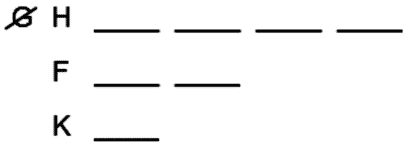
Or we could put two with Hitchcock and one with Fellini. Four will see Kurosawa:
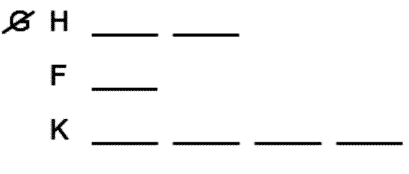
G can never see Hitchcock. I drew that directly on the diagram.
Different things are going to be true in each scenario. From our rules, we can’t put G with R, we can’t put I with M and we have to put V with Y. L goes in the Hitchcock film.
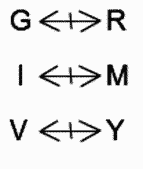
This is unusual. There’s no random variable: every variable has a rule. Our main restriction will be keeping G, R, I and M apart. We should see how this works in each scenario.
We’ll start with the scenario where two see Hitchcock.
We should see where we can put V and Y. Only Kurosawa has space.
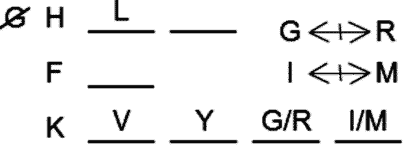
There are four variables left. G and R, and I and M. We have to keep those pairs apart.
We will have to put one from each pair in Kurosawa. One from each pair will fill the two empty spots left: one in Fellini, and one in Hitchcock.
The other scenario is where there are four at Hitchcock. We must put V and Y in Hitchcock along with L.

We’re left with the two pairs that must be kept apart. One from each pair goes to see Fellini.
The other person from each pair goes into the empty spots in Hitchcock and Kurosawa.
It looks like there is a third scenario. Couldn’t we put V and Y in Fellini? There are two spaces there. But it doesn’t work. Here’s why:
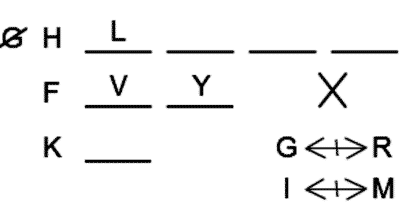
We need to put G, R, I and M in separate groups. We’ve got three spaces in Hitchcock and one in Kurosawa. There is no way we can keep them all apart.
We’re going to have to put at least one pair of them together in Hitchcock. So V and Y can’t go see Fellini.
Game 3 Main Diagram
Main Diagram
The setup section explains how to build this diagram.
This is a grouping game. Ginnie, Ian, Lianna, Marcos, Revoke, Viktor, and Yow are attending films by Fellini (F), Hitchcock (H), or Kurosawa (K). Each viewer sees one film.

Question 13
A is wrong. We can’t have both G and M in Hitchcock. From our setup, we either have L and one other person, or L, V, Y and one other person. We only have space for one of G and M.
B is wrong. We can have two people see Fellini, at most. Here we have I and V. We would also need Y, because Y always goes with V. That makes three seeing Fellini.
C is wrong for the same reason as B. We have V see a Fellini film.
D is CORRECT.
E is wrong. It puts three people at Hitchcock. V would also have to be there, because Y is included. And L always goes in Hitchcock. That makes five people, which is too many.
Question 14
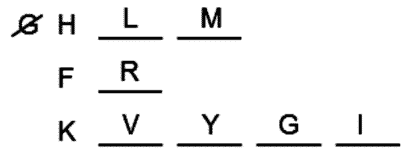
A is CORRECT. We could have R as the only buff at the Fellini film.
B is wrong. L always has to see Hitchcock.
C is wrong. Y always goes with V.
D is wrong because there are either one or four buffs seeing Kurowawa. There’s no other way to put obey the first rule.
E is wrong. We need to have two or four people seeing Hitchcock.
Question 15
We either have four or two people seeing Hitchcock. If there are four people seeing Hitchcock, that means three people see other films.
If there are two people seeing Hitchcock, that means five people see other films.
So the only possible right answers are the ones with three. A and B are wrong.
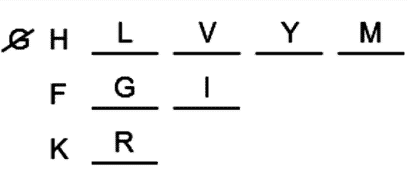
C is correct, as this diagram shows:
D is wrong because we need V with Y.
E is wrong. Everybody not on the list is in Hitchcock. That means I and M are together.
Question 16
If just one buff sees the Kurosawa film, then there are four people at Hitchcock and two at Fellini. That’s our second scenario and it looks like this:
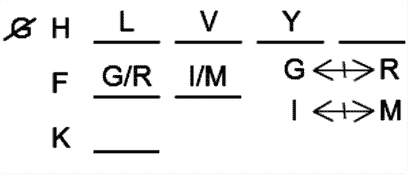
A is correct; it has to be true that V sees Hitchcock in this scenario.
B – E are wrong because G, M, I, and R can all be in different places, as long as they aren’t together. We can put them with any film.
Question 17
This is a “must be true” question.
A is wrong. G can see the same film as Ian: Kurosawa. Just put R and M elsewhere.
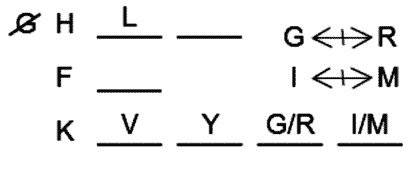
B is wrong. Ian can go in Hitchcock with L. Using the scenario below, just put Ian in Hitchcock and M in Fellini.
C is wrong. Ian can go with V in Hitchcock. Using the scenario below, just put Ian in Hitchcock and M in Fellini.
D is wrong. I, L and V can go together in Hitchcock. Using the scenario below, just put Ian in Hitchcock and M in Fellini.
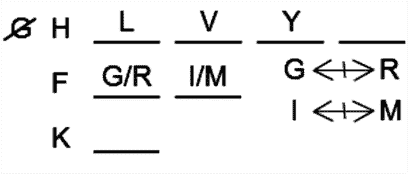
E is CORRECT. If we had L, M and G together then there is no place to put V and Y. L, M and G would be in Hitchcock. We saw in the setup that V and Y can’t go together in Fellini. Then there would be no way to keep GR and IM apart.
Question 18
If V sees the same film as G then they must go together in Kurosawa. G can’t see Hitchcock. Here’s one way it could go.
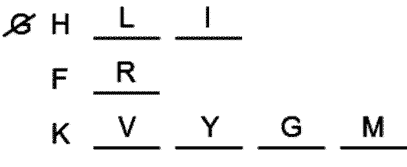
A can’t be true, they all can’t see Fellini. Fellini has two people, max.
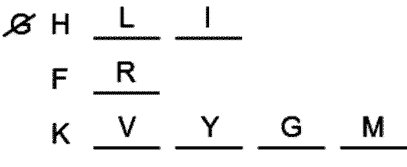
B could be true. B is CORRECT. Here is how it could look:
C is wrong. R can’t see Kurosawa. G and R can’t go together, and G is in Kurosawa.
D is wrong. The last rule says that G sees either Fellini or Kurosawa.
E can’t be true. If Y sees Fellini then V and G would both have to see Fellini too. We can only have two people in Fellini.
Question 19
We already saw from our setups that V and Y can’t be the only ones in Fellini. E is CORRECT. All the other answer choices are two groups of variables that can go together. G and Ian, G and M, Ian and R, M and R. In all of our scenarios it’s pretty easy to stick those people together in Fellini. See below:
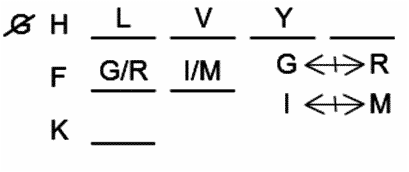
It’s really easy to mix and match any of these four and put the two appropriate people in Fellini. A-D are all wrong: they could be true.
Game 4: Multi-Coloured Cars
Game 4 Setup
This is a linear pattern game. We have six cars of three colors: green, orange and purple. The main restriction is that you can’t put two cars of the same color beside each other. We can set up our main diagram like this:

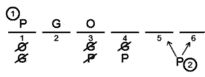
The second rule says that car 5 or 6 has to be purple. We should draw separate scenarios. Here is what happens when P is in 5:
(You can see I’ve also added the rules that 1 cannot be orange and 4 cannot be green.)
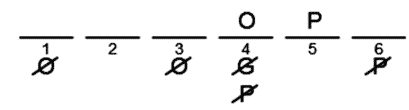
Green doesn’t go in 4. Purple can’t go in 4 either, because the same color can’t go beside itself. 4 has to be orange.
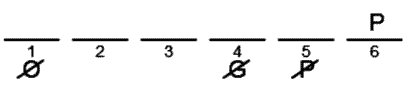
When P is in 6 here is what it looks like:
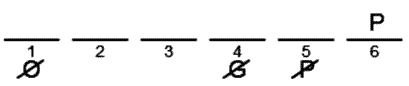
That’s pretty much it. The game is very open ended. Remember your rules and don’t put any color beside itself. Then everything will go fairly simply.
Game 4 Main Diagram
Main Diagram
The setup section explains how to build this diagram.
This is a linear pattern game. Six cars are parked in order from 1-6. Two are green (G), two are orange (O), and two are purple (P).
Scenario 1
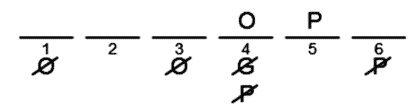
Scenario 2
Question 20
A is CORRECT. 1 and 4 can’t both be green, because 4 can’t be green. 1 and 4 can’t both be orange, because 1 can’t be orange.
They can’t both be purple, because one purple has to go in 5 or 6. All the other two spots could be the same color.
Question 21
We’re told that 2 is the same color as 4. We can’t make them both green because 4 is never green. We can’t make them both purple because one purple is always 5 or 6.
Therefore, they both have to be orange. That’s true no matter where you put purple. B is CORRECT.
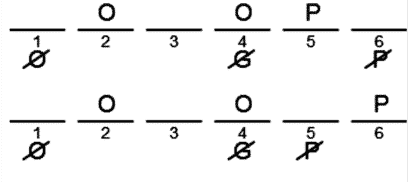
This diagram proves the wrong answer choices don’t have to be true:
Question 22
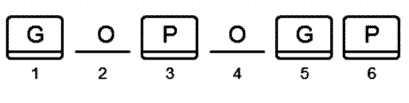
If Car 4 is purple, car 5 can’t be purple. The same color can’t go beside itself.
So that means car 6 is purple. (One of either car 5 or 6 has to be purple.)
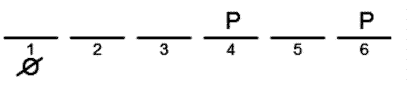
E is CORRECT.
This diagram proves the wrong answer choices don’t have to be true:

Question 23
A is CORRECT. If car 2 is green then car 1 can’t be orange or green. It has to be purple. The other purple will have to go in 5 or 6.
So far, so good. But we couldn’t make 3 or 4 green or purple. We’d have to make them both orange. That doesn’t work.
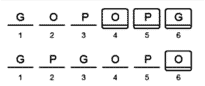
I’ve also drawn some diagrams that show how all the other answers are possible.
Question 24
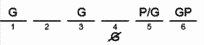
Now we have three green cars. We know that car 4 can still never be green. At most, one of car 5 or 6 can be green because greens can’t be together.
That means there will be two greens in front of car 4. We must put them in cars 1 and 3, so they won’t be together. Then green can be either 5 or 6. D is CORRECT. 1 and 3 are the only places that absolutely have to be green.

Leave a Reply