
LSAT Preptest 28 LG Explanations
Full explanations for every question from the logic games section of LSAT Preptest 28.
Archived Logic Games explanations
Logic Games are no longer part of the LSAT. LSAC removed the Logic Games section beginning with the August 2024 LSAT. If you are studying for the current LSAT, you can skip this section.
These explanations remain available for students, tutors, and readers using old-format PrepTests. For current guidance, see Logic Games and the current LSAT.
Table of contents
Game 1: Racehorses
Game 1 Setup
This is a linear game. We have to place six racehorses. The main diagram looks like this:

I put the last rule directly on the diagram: P has to be in spot 3.
The other rules are: K and L are exactly one away from each other, K is not beside N, and M goes before N. O is a random variable. It’s always important to note that.

At this point many people would just go on and try the questions. That’s a mistake. You should always see if you can combine rules in order to make new deductions. If you’re stuck on how to do this, start with the most restricted variables.
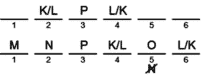
In this case, ask yourself where K and L can be placed. You can’t put them in 1 and 3 because P is already in 3. You can’t put them in 3 and 5 for the same reason. You can only put them in 2 and 4 or 4 and 6. It looks like this:

Not much happens when you put them in 2 and 4. We can still put M, N and O pretty much anywhere as long as M goes before N and don’t put K beside N.
But when we put K and L in 4 and 6, we can’t put N in 5 (N can’t go beside K).
Since N has to go after M that means we have to put M and N in 1 and 2. O is left to go in 5.
This is a very restricted game. There is only two ways L and K can go. In the second scenario there is only one way to place everything else.
Game 1 Main Diagram
Main Diagram
The setup section explains how to build this diagram.
This is a linear game. Horses K, L, M, N, O, and P are arranged in order from 1-6.

Question 1
A is wrong because K and L aren’t one space apart.
B is CORRECT.
C is wrong because P is not in 3.
D is wrong because N has to come after M.
E is wrong because N and K can’t be beside each other.
Question 2
This question is testing whether or not we made a correct deduction about where K can go. We know that any answer with 1, 3 or 5 is wrong: K can’t go there. If K is on 1 or 5 then L must be in 3: that doesn’t work because P is in 3. So A, B and D are wrong.
Now we have to choose between C and E. They both have 2 and 4. Can we put K in 6?
There is no reason we can’t put K in 6, O in 5, L in 4 and M, N, P in 1, 2, and 3. In fact, it’s scenario 2. E is CORRECT.
Question 3
The slow way to answer this sort of question is to go through each answer choice in order. The fast way is to look over all the answer choices and compare them to the scenarios done earlier and see if they work.
In our first scenario K and L can both be in 2. So A and B could be true.
In our second scenario M is in 1. In the first scenario, M could be in 5 if N goes in 6. So C and D are wrong. These two diagrams prove this:
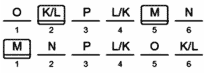
E can’t be true. E is CORRECT. We see in our first diagram that K or L are in 2, so O can’t go there.
If K and L are in 4 and 6 instead, then M and N have to be in 1 and 2. Here’s what would happen if we tried to put O in 2:
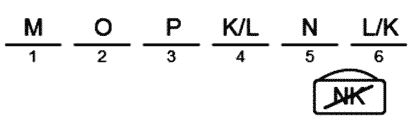
We have to put M before N, so we can’t put M in 5. K and L are in 4 and 6. We have to put N between them. That doesn’t work because N can’t go with K.
E is CORRECT.
Question 4
A doesn’t have to be true, as the second scenario shows.
B is CORRECT. K and L are either in 2 and 4 or 4 and 6. One of them is always in 4.
C could be true but doesn’t have to be. We could also put L or K in 2 and M and N in 5 and 6.
D could be true but doesn’t have to be. We could put M and N in 1 and 2 and K and L in 4 and 6.
E could be true, but it doesn’t have to be. We can put O in 6, 5 or 1.
Question 5
A could be true. The following diagram proves it’s possible:

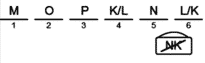
C is CORRECT. If M is beside O, N is forced between L and K. That breaks the rules:
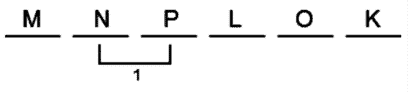
D is wrong. The following diagram proves this:
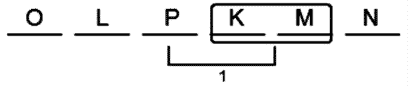
B and E are wrong. The following diagram proves they could be true:
Game 2: Researchers and Languages
Game 2 Setup
This is a grouping game. We have four researchers learning different languages. Here is how I set it up:
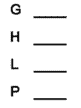
I’ve listed the researchers vertically. I’ll be listing languages along with them.
We know that if the geologist learns something then the historian also learns it. The linguist and paleontologist don’t learn that language.
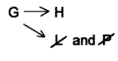
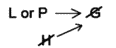
If the linguist and paleontologist learn a language then the geologist doesn’t learn it. If the historian doesn’t learn a language then the geologist also doesn’t learn it.
Numbers are important on this game. Three people learn Y, two learn S, two learn Tigrinya and one learns R.
The historian, paleontologist and linguist all have to learn Y. Why? If the geologist learns Y then the linguist and paleontologist couldn’t learn it. Then only two people could learn Y, the geographer and the historian.
We also know the geologist can’t learn R. Then the historian would have to learn it too…but only one person can learn R.
The geologist obviously has to learn some language, so they must learn either S or T. If the geologist just learns one of those languages, then the setup looks like this:
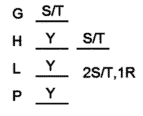
The geologist will learn S or T, the historian learns the same.
We have the two of the other S/T, plus R.
For example, one possibility would be that the geologist learns T. The historian would learn Y and T. The linguist would learn Y and so would the paleontologist.
We would have to place two Ss and one R. We can’t place them with the geologist. The historian could learn any of those. We could (for example) place one S with the historian, another with the linguist, and have the paleontologist learn R.
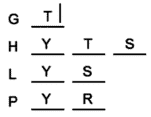
That’s just an example to make clear how things could look. There are other possibilities.
It’s also possible that the geologist learns both S and T. In that case there are fewer options. It looks like this:
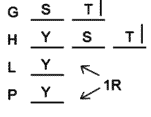
The geologist learns two languages and the historian learns three. Either the linguist or the paleontologist learns R. That’s it for that setup.
Game 2 Main Diagram
Main Diagram
The setup section explains how to build this diagram.
This is a grouping game. A geologist (G), a historian (H), a linguist (L), and a paleontologist (P) each must learn 1-3 of four languages, including Rundi (R), Swahili (S), Tigrinya (T), and Yoruba (Y).
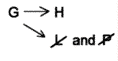
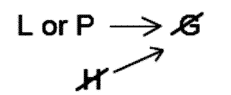
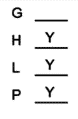
Language Totals: 3Y, 2S, 2T, 1R
Question 6
A is wrong because the linguist learns S and T. That doesn’t leave any languages for G to learn.
B is wrong because the linguist learns S and T. There is no languages for G to learn.
C is wrong because the historian always has to learn Y.
D is CORRECT. This scenario proves it could be true:
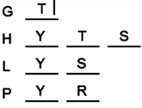
E is wrong because the paleontologist learns S and T. There are no languages for the geologist to learn.
Question 7
The only way for the linguist to learn three languages is to learn R, Y and one of S/T.
They can’t learn Y, S and T: that leaves no languages for the geologist.
So they need to learn Y, one of S or T and R. It must be true that the linguist learns R. B is CORRECT.
A, C and E could be true but don’t have to be and D can’t be true.
Question 8
The geologist can’t learn R (because then the historian would learn R too.) Anyone else can learn R.
The historian, palaeontologist and linguist all learn Y. They’re the only ones who can learn R. So whoever learns R has to learn Y. C is CORRECT.
A, B, D and E are wrong because S and T can go anywhere. The linguist and the palaeontologist can learn either one of S or T, (along with Y and R) or none of them. It’s a very open ended game.
Question 9
This tests whether you understand how S and T can be placed. They can go pretty much anywhere, as long as you don’t give one of S/T to both the geologist and either the linguist or palaeontologist.
A could be true, as our second scenario shows:
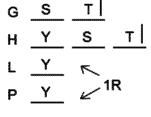
The first scenario proves that C, D and E could be true. We have two S’s to place. We could put them with the historian and linguist, or with the historian and palaeontologist, or with the linguist and palaeontologist.
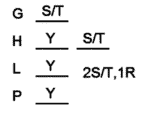
It’s only B that can’t be true. B is CORRECT. The historian, linguist and palaeontologist all learn Y. If the palaeontologist is the only one of them who learns S and Y, then where do we put the other S? The geologist is the only other researcher, but the geologist and palaeontologist can’t learn the same language.
Question 10
If the geologist learns two languages then we are in the following scenario:
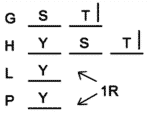
The geologist and historian are already full. The linguist and paleontologist just have Y. One of them will have R.
A is CORRECT. Either the paleontologist or the linguist could learn R.
B is wrong. The paleontologist can’t learn S, because the geologist learns it.
C is wrong. The historian already has three languages, he can’t learn anymore.
D is wrong. There is only one more language that the paleontologist can learn: R.
E is wrong. The historian must learn Y, S and T.
Question 11
For this question you should think about which rules link two people.
We know that if the geologist learns a language then the historian learns a language. So the geologist can never learn more languages than the historian.
The historian always has to have Y. So the historian will always have more languages than the geologist. If the geologist has S and T, the historian will have Y, S and T.
If the geologist has just one of S or T then the geologist will have Y and one of S or T.
B is CORRECT. The geologist learns fewer languages than the historian.
A and C are proven wrong by this scenario:
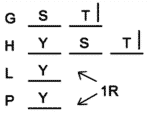
D is proven wrong by that same scenario as well. We can give R to the linguist or the paleontologist. Either one of them could have more languages than the other.
E is proven wrong by this scenario. The paleontologist has more than the historian:
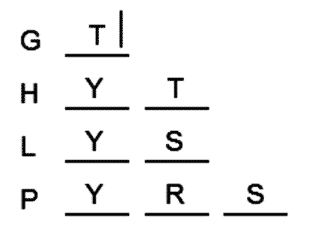
Question 12
If the historian just learns two languages then we are in this scenario:
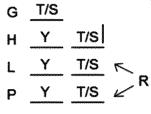
The geologist learns one language, T or S. The historian learns that same language plus Y.
The linguist and paleontologist learn the remaining language out of T or S. One of them learns R.
A could be false. R could be learned by either the linguist or the paleontologist.
B doesn’t have to be true. The geologist could learn S if the linguist and paleontologist both learn T.
C doesn’t have to be true. Either the linguist or the paleontologist could learn R.
D is CORRECT. If the historian just learns two then he always learns Y and one of T and S. That leaves no space for R.
E could be true but doesn’t have to be. The paleontologist could learn S if the geologist and historian learned T.
Game 3: Hotels Restaurants and a Health Inspector
Game 3 Setup
This game is a mix of linear and grouping. I set it up like this:

This sounds obvious, but many people forget it: morning comes before afternoon. So if G is on Tuesday morning and J is on Tuesday afternoon (for example), then G is before J. For some reason, the LSAT makes some people forget things they know in real life.
I’ve drawn the rule that hotels can’t go on day three directly on the diagram. G, J and L can’t go on Wednesday. That means that exactly three hotels and one restaurant are inspected on Monday and Tuesday.
The rest of the rules are: G is inspected before J. We can’t have G and S on the same day together. If Z is in the morning then L is in the morning too.
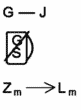
Apart from listing the rules, when a game divides things into categories you should always draw the variables.

Hotels are earlier in the alphabet, and restaurants are later in the alphabet. It’s extremely important to be able to know instantly which group the variables are in when you see them. There aren’t many deductions you can make, so learn the rules well.
Game 3 Main Diagram
Main Diagram
The setup section explains how to build this diagram.
This is a linear/grouping game. A health inspector is inspecting three hotels (h), including Grace, Jacaranda, and Lido; and three restaurants (r), including Seville, Vesuvio, and Zeno. One building is examined each morning and afternoon from Monday to Wednesday.

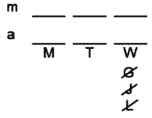
Question 13
A is wrong because G and S are on the same day.
B is wrong because L has been placed on Wednesday. Hotels can’t go there.
C is wrong because J has to come after G.
D is CORRECT.
E is wrong. Z is in the morning but L is in the afternoon.
Question 14
A is wrong. Z is in the morning but L isn’t.
B is wrong because J is on Monday morning. But J has to come after G.
C is CORRECT. The following diagram shows how this could work:
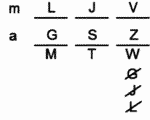
D is wrong. If J is on Tuesday morning then G has to go on Monday (G goes before J). But S is there too, and G can’t go with S.
E is wrong. G must go on the first day, to be before J. That means G is stuck with S.
Question 15
You could simply try all the answer choices here, but that would be slow. It’s worth thinking about who is restricted.
G and J can only go in a few places. G has to be before J.
We could have G on Monday morning, Monday afternoon or Tuesday morning. If G is on Tuesday morning then so is J. They’re both hotels, so they can’t go Wednesday.
So G can only go with other people (apart from J) on Monday morning or Monday afternoon. We should first try the answers with G.
A is wrong because G and J could be together on Tuesday, too.
B is CORRECT. It is the only day that G and V could be together.
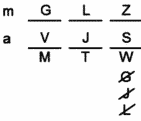
We can put them together on Monday. We can’t put them together on Tuesday. If G is on Tuesday morning, then J has to be Tuesday afternoon.
We can’t put them on G and V on Wednesday because G is a hotel and can’t go on Wednesday.
C is wrong. The same diagram shows that J and L could be together on Tuesday.
D and E are wrong. L could go with any of the hotels (S, V or Z) on Tuesday. We would just have to put G and J on Monday
Question 16
G is inspected on Tuesday. We know they must be on Tuesday morning and J must be on Tuesday afternoon. G has to go front of J.
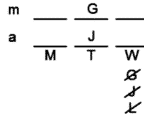
C and D are wrong because we need J on Tuesday afternoon.
E is wrong because L is a hotel. Hotels can’t go on day 3.
A is wrong because Z is in the morning. (Since it isn’t listed in the afternoon.) That means L would have to be in the morning as well.
B is CORRECT. The following diagram shows how:
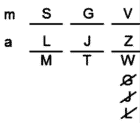
Question 17
If S is on Monday morning, then G is not on Monday.
G must therefore go on Tuesday morning. That puts J on Tuesday afternoon.
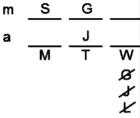
L will be on Monday afternoon, since L can’t go on Wednesday.
Since L is in the afternoon that means that Z must also be in the afternoon. That leaves V left to go on Wednesday morning.
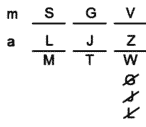
So everything is decided.
A, B, C and E all have to be false according to the diagram.
D is CORRECT.
Question 18
If Z is on Wednesday morning then we know that L also has to be inspected in the morning.
G is on Monday morning, so only Tuesday morning is left for L.
We know that S won’t be on day 1 with G and J will go in one of the afternoons. We get this diagram:
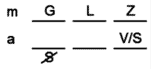
A could be true but we could also put J on Tuesday afternoon.
B could be true but we could also put J on Monday afternoon.
C doesn’t have to be true. We could put S on Wednesday afternoon.
D is CORRECT. L is on Tuesday morning and S can’t go anywhere on Monday. So S is after L.
E doesn’t have to be true. V could go on Monday afternoon.
Game 4: Town Councillors
Game 4 Setup
This is a grouping game. We have to see who votes for and against each bill. We can set up the councilors this way:
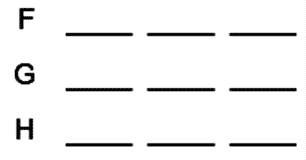
They each have three spots: one for each bill. Everybody votes for something and against something.
Two people vote for recreation. Gianola votes against recreation. That means both Fu and Herstein vote for it.
We also know that Fu is against schools and Herstein is against taxes.
That’s all we know for certain. I’ve drawn a diagram that shows this. The Rs are circled because they have to be voted for. The rest of the variables have lines though them to show they’re voted against.
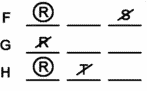
I should note that this is not the only way this can be diagrammed. There are many other ways of showing this that make sense. If you’ve drawn in a different way, that isn’t a problem. This is a fairly unique game. It doesn’t really matter how you draw unique games as long as it’s logically consistent and makes sense to you.
It’s only for the rules that repeat frequently that you want a fairly standardized method that is as clear and efficient as possible.
We know that only one person votes for the school bill and one for the tax bill, so two vote against each. We already know that F voted against the school bill and R votes against the tax bill.
So one of F or G votes for the tax bill and one against it.
One of G and H votes for the school bill and one against it.
I drew a box around those to show that one is for and one is against.
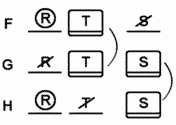
In local diagram, when we’re sure someone is voting for taxes or schools, I switch the box to a circle.
Game 4 Main Diagram
Main Diagram
The setup section explains how to build this diagram.
This is a grouping game. The council members (Fu, Granola, and Herstein) vote on three bills, including recreation (R), school (S) and tax (T). Each council member can vote for a bill (represented by a circle) or against (represented by a strikethrough).
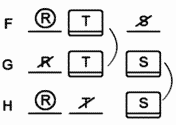
Note that in total, four bills are voted for, and five bills are voted against.
Question 19
A is wrong. One of F and G votes for the tax bill (because H is against), and one has to vote against it (because only one councillor supports the tax bill.)
B is wrong. G is against the recreation bill. Two people vote for recreation, so H has to vote for it.
C is wrong. Exactly one person votes for the school bill. F is already against it. So one of G and H votes for it and one against it.
D is CORRECT. It could be true as the following diagram shows:
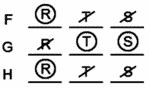
Two people are for recreation, one is for taxes and one is for schools.
E is wrong. It says F and G vote for two bills each. If we add the one bill R definitely supports, that’s five votes in favor of bills. That’s one too many.
Question 20
We know that H is voting against tax and F is voting against schools. To make the set of people voting against tax and schools the same, we have to make F vote against taxes and H vote against schools.
One person has to vote for taxes and schools, so G does. It looks like this:
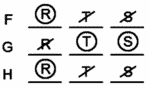
A has to be false.
B can’t be true because G always votes against recreation.
C can’t be true. Someone has to vote for the school bill.
D can’t be true. H always votes for recreation.
E has to be true. H votes against the school bill. This lets them vote the same way as F. E is CORRECT.
Note that there is no other way to set this up. If we have G vote against taxes (for example) then the people voting against tax are not the same as the people voting against schools.
Question 21
If G votes for tax then we have a diagram that looks like this:
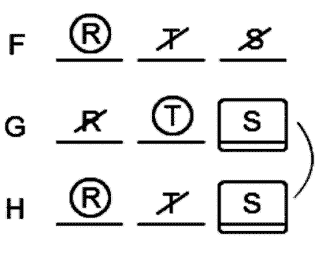
We still don’t know who votes for schools. It could be G or H.
A is CORRECT. It could be true if H votes for schools. Then Fu would be voting for recreation only and G would be voting for taxes only.
B can’t be true. One of G and H is going to have to vote for two bills, because F is only voting for one.
C can’t be true. We’re told G votes for taxes. F only votes for recreation.
D can never be true. G always votes against recreation.
E can’t be true. We always need two people voting for recreation. Since G doesn’t, F and H have to.
Question 22
If G votes for two of three bills then we have this diagram:
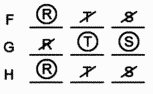
A is wrong because G, not F, votes for the tax bill.
B is wrong because G never votes for recreation; it’s the second to last rule.
C is CORRECT. G has to vote for schools and taxes.
D is wrong. If G votes for two then she has to vote for taxes and schools. She cannot ever vote for recreation. It’s the second to last rule.
E is wrong because G is voting for the school bill, not H. Only one person votes for the school bill.
Question 23
The only way to get two people voting for and against the exact same number of bills is using this scenario. F and H vote the same way on everything:
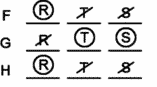
A is wrong because Fu is not voting for tax.
B is wrong because G always votes against recreation.
C is wrong because the only way to make everything the same is to have G vote for the school bill.
D is wrong because G votes for schools and taxes.
E is CORRECT.

Leave a Reply