
LSAT Preptest 31 LG Explanations
Full explanations for every question from the logic games section of LSAT Preptest 31.
Archived Logic Games explanations
Logic Games are no longer part of the LSAT. LSAC removed the Logic Games section beginning with the August 2024 LSAT. If you are studying for the current LSAT, you can skip this section.
These explanations remain available for students, tutors, and readers using old-format PrepTests. For current guidance, see Logic Games and the current LSAT.
Table of contents
Game 1: Lockers
Game 1 Setup
This is an explanation of the first logic game from Section I of LSAT Preptest 31, the June 2000 LSAT.
Five adjacent lockers (1, 2, 3, 4, 5) will be assigned to seven students. There are four boys – Fred, Juan, Marc, and Paul (F, J, M, P) – and three girls – Nita, Rachel, and Trisha (N, R, T). You must determine the assignments of the lockers based on the rules.
Game Setup
This game is a combination of grouping and linear. There are seven students, but only five lockers. So some students go together.
I’m going to combine the rules as I go through them. I’ve never found it useful to write out the rules separately without thinking about how they can be combined. Wastes time and space.
The two shared lockers have a girl and a boy (rule 2). There are only three girls: N, R and T.
R can’t share a locker (rule 3). That means that N and T must share lockers.
This is very important, so I’ll repeat it: N and T must share lockers, because R can’t.
This is especially interesting because of rule 4: Since N and T can’t be beside each other, the two shared lockers can’t be beside each other.
I left out the first half of rule 3: Juan must share a locker. Since we figured out N and T are the two girls who share lockers, J must share a locker with one of them. I drew it like this:
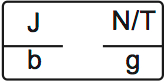
It’s also a good idea to draw symbols to remind yourself that R is alone and N and T aren’t beside each other:


The last rule tells us F has locker 3. It’s best to draw this directly on your diagram:

It can be useful to draw the list of variables. Though hopefully from their names you’ll be able to figure out who is a boy and girl without checking the list:
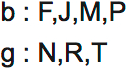
There are no rules for M and P. They could share lockers, but they don’t have to. And they can go anywhere.
This is a very open ended game. Focus on F, J, R and N and T.
Game 1 Main Diagram
These diagrams show the rules used to determine the assignment of the lockers (1, 2, 3, 4, 5) to students (F, J, M, P, N, R, T).
Refer to these diagrams when solving this game. Copy them on your own page, and on each question make a new version of them in order to follow along with my explanations. You’ll learn much more if you draw along.
The setup section explains how to build this diagram.
Rules
On some of these earlier games, I did not draw every rule. Some are important enough that they must be memorized, and I could think of no clear way to draw them. Here are the rules I didn’t draw:
1. Locker = 1 or 2 children. All children assigned.
2. Shared locker = 1 boy and one girl
3. This diagram shows rule three: Juan must share a locker, with a girl that’s not Rachel
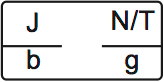
4. This shows the other half of rule 3: Rachel is alone

5. Nita can’t be beside Trisha

6. Fred is assigned to locker 3:

Question 1
The first question is not a list question. Whenever that happens, it’s a strong sign you should have made some deductions.
However, the LSAT is doing you a favor by asking you about this at the start. If you get it right, you’ll have the deduction to use for the rest of the game, even if you didn’t make the deduction in the setup.
J is assigned to a shared locker (rule 3), but that doesn’t help, since he’s in all of the answers.
N and T are the only others who must be assigned shared lockers. We need two girls to share lockers, thanks to rule 2. And R can’t share a locker, thanks to rule 3. N and T are the only girls left.
E is CORRECT. J, N and T must all share lockers.
Question 2
The shared lockers are the key to this game, and to this question.
If T is in the third locker with F, that means N can’t go in lockers 2 and 4 (rule 4).
N also can’t go in locker 1, because this question assigns M there, alone.
That means N has to go in locker 5. J goes there too, since J always has one of the two shared lockers.
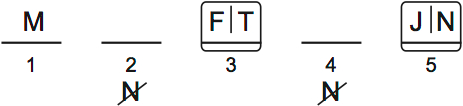
Most local rule questions can be solved by making a deduction, then checking to see if it is the right answer. That works here. B is CORRECT.
C and D could be true, but don’t have to be. A and E can’t be true.
Question 3
R has to be alone. If the four boys are assigned to lockers 2-5, then R must be assigned to locker 1.
Therefore, locker 1 can’t be shared.
The two shared lockers can’t be beside each other, because N and T are in the shared lockers. J shares locker 5 with one of N or T.
So locker 4 can’t be shared, because it is beside J and N/T.
D is CORRECT.

Question 4
It’s helpful to draw a diagram to solve this question. Let’s try assigning R to locker 1.

We can’t assign J to locker 1, because R is there and R has to be alone. We can’t assigned J to locker 3, because F is there and two boys can’t share.
But there’s no reason J can’t be assigned to lockers 2, 4 or 5. No matter where we put J, we just have to put the other shared locker somewhere else, and we obey all the rules.
So if we put R in 1, we can put J in three lockers. We can be sure that this is the maximum, because J can never go with R or F, no matter where we place R.
C is CORRECT.
Question 5
There are three girls: R, N and T. This question assigns them to the first three lockers.
N and T can’t be beside each other, so that means we have to put R in the middle of them. One of them shares a locker with F, and the other shares a locker with J in 1.
J has to be assigned to 1, because J always shares a locker with a girl.

A is CORRECT.
Question 6
We can make a few deductions thanks to the local rule.
First, M and P must be the boys assigned to lockers 1 and 2. We can’t assign J, because J always shares. And we can’t assign F, because F is already assigned to locker 3.
Second, F must share a locker, because two of the boys must always share.
Third, J must be assigned to locker 5, because the shared lockers can’t be beside each other.
Fourth, R must be assigned to locker 4, because R must always be alone.

The question asks who is assigned to locker 4. That’s R.
C is CORRECT.
Game 2: CD Sale
Game 2 Setup
This is an explanation of the second logic game from Section I of LSAT Preptest 31, the June 2000 LSAT.
A music store is having a sale on some of its CDs. The store offers jazz, opera, pop, rap, and soul CDs (J, O, P, R, S). Each genre has both new and used CDs (N, U) for a total of ten types of CDs. You must use the rules to determine the possible list of the types of CDs that are on sale.
Game Setup
This is one of the hardest games ever to appear on an LSAT. It’s an in-out grouping game, but it’s complicated by the fact that each type of CD has a new and an old version.
Sometimes, a sufficient or necessary condition needs both the new and old CD. Sometimes, only one is enough.
As with any other in-out grouping game, it’s possible to make a single diagram and its contrapositive.
These two diagrams let you solve each question somewhat easily, but the diagrams here are more difficult to set up and understand than on most games.
But without them, the game is practically impossible. So let’s see how to make the diagrams.
The first rule is simple. Used pop is always in, new opera is always out. You can draw that like this:
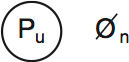
Or you can put it in a table like this:
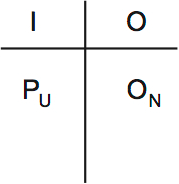
I don’t care how you draw it; different diagrams work better for different people. Just don’t forget this rule.
The second rule looks like this:

The rule mentions both types of pop, but I only drew new pop. Why? Used pop is always in. So if a local rule tells you new pop is in, you know this rule is triggered.
You can ignore the third rule for now, since it doesn’t connect with the diagram. Instead, go directly to the fourth rule. (It makes sense to approach the rules out of order in an in-out grouping game, since they can all be joined.)

If we don’t have either type of jazz, then we do have new pop. This leads to both types of soul.
The final rule looks like this:

If we take the contrapositive, we get this:

This next part gets a little tricky. Don’t hesitate to reread it and the rules if it seems strange.
We can join this to our other diagram; sort of. The other diagram ends with both types of soul being in. But either one of them is sufficient to force both types of rap out. So we can connect the two, but we’ll need to add an “or” to the arrow to remind us that only one of the two souls is needed to force rap out.

This is easy to explain in person, but harder to explain in a book. If you have Pn, you have both souls. But if you have either soul, you have neither type of rap. So Pn leads to the a sufficient condition for having no rap.
But you don’t want to think you need both souls out to have no rap. That’s why there is an “or” above the arrow. Putting all of the rules on one diagram makes things hard to forget.
Now we can add the third rule to the diagram. Both types of jazz leads to no rap:

So one type of soul being in, or both types of jazz being in forces rap out. That’s why there’s an “or” between the two arrows.
The complete diagram can be confusing; these symbols are like a new language. But trust me, it’s a powerful language. Once you learn it, even a hard game like this becomes easy.
If you’re not 100% clear on how I built the diagram and what it means, try drawing it on your own. It should start to make sense.
Taking the contrapositive of the main diagram
You can take the contrapositive of a long chain of rules by flipping everything around, negating everything, and changing “and” to “or” and vice versa.
Once you think you have the correct contrapositive diagram (try it on your own first, as an exercise), double-check it against the rules. An error here can be fatal. Here’s the original again:
Here is the contrapositive:

Notice that the order of everything is reversed, and the lines through the variables are switched. The “and’s” became “or’s”.
So if either type of rap is in, we know two things:
- All soul is out
- New pop is out
- One type of jazz is in.
- One type of jazz is out.
The main diagram (and the game) are a bit weird
There is some weirdness between S and P on the contrapositive diagram. Again, this is because we combined a rule with “and” and a rule with “or” (the two rules with soul). It’s messy, but it lets us get everything on one diagram.
I put the “or” above the arrow between the S’s and P to show that having one type of soul out is enough to force P out of the game. That’s what the contrapositive of the second rule says (used pop is always in).
Having one rap in forces both soul out. But having one soul out forces new pop out. This is good to know in case a question tells you one soul is out, but doesn’t mention rap.
Again, if you’re unclear about these diagrams, try to make them yourself before going on to the questions. Match each rule from the setup with the diagrams, and see how everything connects together.
They’re incredibly powerful, once you understand how they work.
Game 2 Main Diagram
These diagrams show the rules used to determine the possible list of the types of new and used CDs (J, O, P, R, S) that are on sale.
Refer to these diagrams when solving this game. Copy them on your own page, and on each question make a new version of them in order to follow along with my explanations. You’ll learn much more if you draw along.
The setup section explains how to build this diagram.
Main Diagram
Note: This is perhaps the hardest logic game ever, and the diagram is necessarily rather confusing. Newer games are far easier. However, it can be good training to learn how to make and interpret these diagrams.


Rules
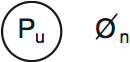
The only rules left are that used pop is always in, and new opera can’t be in:
Question 7
A is wrong because if you have both types of jazz, you can’t have any rap (rule 3).
B is wrong because if you have any type of rap you can’t have soul (rule 5).
C is wrong because if you don’t have new pop, then you must have at least one type of jazz (the contrapositive of rule 4).
D is wrong because if you have both types of pop you need both types of soul (rule 2).
E is CORRECT.
Question 8
This tests your knowledge of rule two. If we have new pop, we must have both types of soul. So if we don’t have one type of soul then we must not have new pop.
(Scroll down for diagrams + explanation)

I’ve circled what we can conclude from the diagram.
You could also have figured out this question directly from rule 2. But that’s risky to rely on. The correct answer could also have been “at least one type of jazz is on sale.”
E is CORRECT.
A and B are wrong; we know nothing about rap. We can only read our diagram left to right, and rap is to the left of soul (when soul is out).
C is wrong because there are no rules about used opera. It can be in or out.
D is wrong. We know one type of jazz is in. That doesn’t mean one type of jazz has to be out.
Question 9
This is a strange question. Only rule 3 mentions both types of jazz being on sale. That forces rap to be out.
And then…nothing else happens. No other new CD has to be in.

So if both types of jazz are on sale, then only one type of new CD has to be on sale: new jazz.
A is CORRECT.
Question 10
A-C are pretty easy to eliminate. There are no rules for used opera. Since it can be in or out, it’s easy to have neither type of opera on sale.
It’s also not hard to imagine having both types of rap, jazz, or soul not on sale (individually), because the rules mention all of those possibilities. Past questions help show that these scenarios work.
D is CORRECT.
Having no jazz means new pop is on sale (rule 4). If new pop is on sale then soul is on sale. The diagram below shows this:
E could be true, as we can see from the diagram below. If both types of jazz aren’t on sale, then both types of rap aren’t on sale either.

Question 11
This diagram shows what happens if both types of jazz aren’t on sale:
(Scroll down for diagrams + explanation)
New pop, new soul and used soul are on sale. Used rap and new jazz aren’t. This shows that B-E all have to be true.
A is CORRECT. You can figure this out by using the deductions above.
Another way of getting this answer is to notice that no rules affect used opera. So there’s no way for jazz being out to force used opera in.
(apart from a very specific scenario in question 13)
Question 12
This is a hard question. Start by listing the CDs that aren’t in:
- New jazz
- New pop
- New rap
We know new soul is in (thanks to the local rule), and we already knew that new opera is not in.
Your next question should be: do any of these variables cause anything to happen on your own?
Yes. If new pop is out, then at least one type of jazz has to be in. Since new jazz can’t be in for this question, used jazz must be in.

A is CORRECT. Note that this answer is a double negative. Used jazz “cannot not” be for sale.
B is wrong because there are no rules that affect used opera.
C is wrong because used rap not being on sale is not a sufficient condition for anything:

It comes only at the end, as a necessary condition.
D and E are wrong. If doesn’t matter whether used soul is for sale or not.
If used soul is in, both types of rap are out, as per the second diagram above. We already knew new rap was out, and it doesn’t matter if used rap is out.
If used soul is out, new pop is out, as per the first diagram above. But we already knew that happened.
Question 13
The last rule lets you answer this question. If either type of rap is on sale (including used rap), then no soul is.
The contrapositive means that if any soul is on sale (including used soul) then no rap is on sale.
Here’s the same rule in graphical form:
This is all a complicated way of saying that used rap and used soul can’t be on sale at the same time.
That’s a problem, since we need four out of five of the used CDs to be on sale.
Since one of S or R is missing, everything else has to be in. The other three all have to be on sale.
So the CDs on sale are:
- Used opera
- Used pop
- Used jazz
- One of either used soul or used rap
Answers A and D say the same thing: used jazz isn’t on sale. We can’t have that. We’d only have three CDs.
B can’t be true either. If used opera isn’t on sale, we can only have three used CDs on sale.
E can’t be true. One of used rap and used soul isn’t on sale, but if they’re both not on sale, then we’ll only have three used CDs on sale.
C is CORRECT. Either used rap or used soul isn’t on sale, so this could be true.
Game 3: Division Tours
Game 3 Setup
This is an explanation of the third logic game from Section I of LSAT preptest 31, the June 2000 LSAT.
A company’s three divisions – Operations, Productions, Sales (O, P, S) – will be toured five times during a single week. One tour will be conducted each day, from Monday through Friday (M, T, W, Th, F). You must use the rules to determine the schedule of the tours.
Game Setup
This is a linear game, and it’s a little more complicated than it looks. Though there are only five tours, there are not many rules to tell us how often each division is toured.
The first rule says each division has to be included. That’s important to remember.
You can put the second and third rules directly on the diagram:

The fourth rule is important. The two S’s are beside each other. You can draw it like this:

There are only the two S’s. We can combine this with the first rule, and realize the other variables must either be:
- Two O’s and one P
- Two P’s and one O
This rule about S also greatly restricts which division can be toured on Monday and Wednesday.
Many questions tell you when S is toured. If S isn’t toured on Wednesday, then O must be toured on Wednesday (because P can’t B).
And if you know S isn’t toured on Monday, then P has to be toured on Monday (because O can’t be). This is extremely important, as it answers questions 16, 17 and 18.
The final rule doesn’t connect with anything else. If just tells us what happens if O is inspected on Thursday.
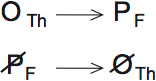
Game 3 Main Diagram
These diagrams show the rules used to determine the company divisions’ (O, P, S) schedule of the tours (M, T, W, Th, F).
Refer to these diagrams when solving this game. Copy them on your own page, and on each question make a new version of them in order to follow along with my explanations. You’ll learn much more if you draw along.
The setup section explains how to build this diagram.
Main Diagram

Rules

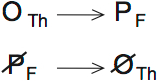
Question 14
This is an unusual first question, but this is an unusual game. Normally, if the first question isn’t a list question, then you should have made many deductions. But there aren’t many deductions for this game.
The fastest way I found was to draw quick diagrams. Often you can prove two answer choices wrong with one diagram.
For example, this diagram proves A and E could be true:
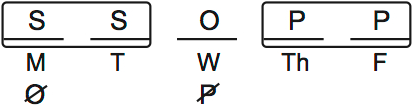
This diagram proves that B can be true:
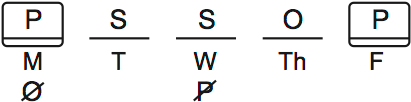
This diagram proves D can be true:
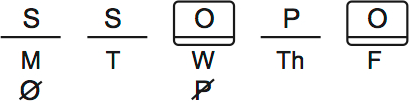
This diagram proves that C is CORRECT.
(The Xs represent the same division both days)
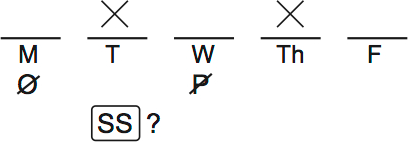
If the same division is toured on Tuesday and Thursday, then there’s no space to tour the two S’s in a row.
Question 15
As with question 14, the fastest way to answer this is to draw quick sketches. They shouldn’t take long. If you know the rules, you should be able to draw each scenario in 5-10 seconds.
If you can’t draw that fast, then practice. Your new diagrams don’t need to be fancy. Here’s how I drew A, for example:
P ___ ___ O ___
(first step, 3 seconds. I just did what the rule said)
P ___ ____ O-P
(second step, 1 second. I added in rule 5)
P-S-S-O-P
(third step, 2 seconds I added in SS)
My actual sketches are less detailed than what I draw in this book. On these diagrams I include all the details so they’re easier to follow.
On the local diagrams I’ve circled the letters mentioned in the answer choice.
A doesn’t work, because we don’t have two variables that go consecutively.
B is CORRECT.
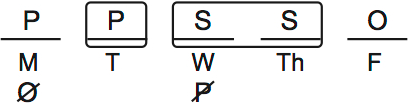
C doesn’t work. We have to put the two S’s in the middle, and only Monday is open. But O can’t go on Monday.
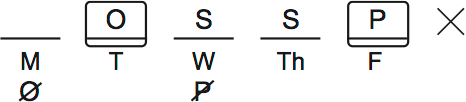
D doesn’t work. There are two spaces open in the middle. We can’t make them both P, because P can’t go on Wednesday.
We can’t make them both O, because of rule 5. If O goes on Thursday, then P has to go on Friday.
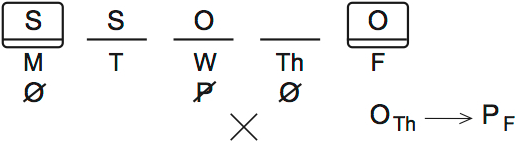
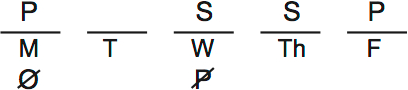
E doesn’t work. There are two possibilities. If S goes on Thursday, then there’s no space for anyone else to go twice.
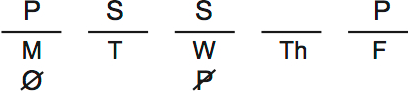
O can’t go on Monday, so P goes there. If we put P on Tuesday too, then O has nowhere to go.
If S is inspected on Tuesday and Wednesday, then we run into the same problem. If we put P on Thursday, then O has nowhere to go.
Question 16
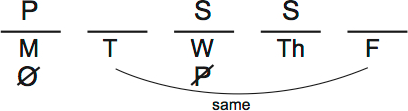
This question may seem open ended, but there’s one big deduction. The same division (either O or P) is inspected on Tuesday and Friday.
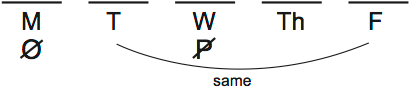
So, where can we put SS? Only Wednesday and Thursday have space.
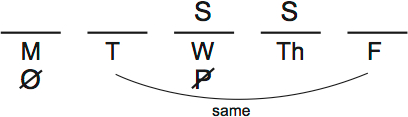
Now the question was: where does P have to go? Tuesday and Friday can be either P or O.
But: who can go on Monday?
Not O, thanks to rule 2.
Not S, because S is inspected on Wednesday and Thursday.
P has to go Monday. A is CORRECT.
Question 17
The same division can’t be toured on Monday and Tuesday, for this question.
(On my diagram, I drew an arc underneath the two days and drew a line through it to remind myself of this local rule.)
This tells us that S can’t be toured on Monday. And we already know that O can’t be toured on Monday.
So, P must be toured on Monday. This deduction eliminates answers A-D!
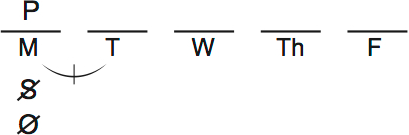
A and B are wrong because P is inspected earlier than any other division.
C is wrong. If S were on Monday, S would also be on Tuesday. But this question doesn’t allow Monday and Tuesday to be the same.
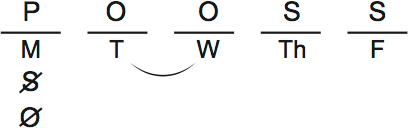
D is wrong because P has to be on Monday. If P were on Tuesday too, then the two days would be the same. But this question doesn’t allow that.
E is CORRECT. Here’s how it could look:
Question 18
P can’t go on Wednesday. So there are only two possibilities here for the divisions toured on Tuesday and Wednesday: SS or OO.
We can also figure out that P has to go on Monday.
Why? Well, O can never go on Monday.
S also can’t go on Monday, because then S would also be inspected on Tuesday. But the local rule says that whoever is inspected on Tuesday has to be inspected on Wednesday, too. S can’t be inspected on three days (rule 4).
So P has to go on Monday. This is testing the same deduction as in questions 16 and 17! If S doesn’t go on Monday, P goes there.
Here are the two possibilities. In the first diagram, Thursday-Friday could be OP or PO.
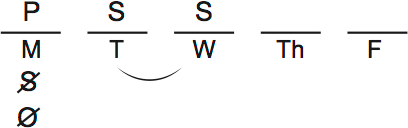
A is CORRECT.
B doesn’t have to be true in the first diagram.
C doesn’t have to be true in the second diagram.
D doesn’t have to be true in the first diagram.
E doesn’t have to be true in the second diagram.
Game 4: Work Crew
Game 4 Setup
This is an explanation of the fourth logic game from Section I of LSAT Preptest 31, the June 2000 LSAT.
A work crew of up to five workers will be chosen from a group of seven. The seven workers are: George, Helena, Inga, Kelly, Leandra, Maricita, and Olaf (G, H, I, K, L, M, O). The crew will install a partition within three days, at most. They will complete five tasks in this order: framing, wallboarding, taping, sanding, and priming (F, W, T, S, P).
Game Setup
This is an unusual game, I’ve only seen one other like it. If you don’t set it up well (as I didn’t, the first time), it’s a very, very difficult game. But with the right diagram, things become simpler.
The key is arranging the diagram by tasks. The tasks are the central point. Different people can do each task, and the tasks are done on different days.

Those are the five tasks. The next step is to write each person who can do the task underneath.
For instance, G does T, so you can write G underneath T. H can do S and P, so you write T under those letters:
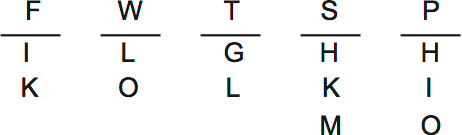
After making this kind of drawing, do yourself a favor and double check that you drew everything right. A mistake on this sort of list could be fatal.
The setup says that a crew of “up to five” workers will do the tasks. There are seven workers. So not every worker will be part of the crew.
Three sets of workers are very important
There are three pairs of important workers however:
- Only I and K can do F
- Only L and O can do W
- Only G and L can do T
So at least one person from each of those pairs must always be in the game. This knowledge answers questions 19 and 21.
Be sure to understand the effect of rules 1, 3 and 4. They make something simple seem complex. Here is what they mean:
“Tasks are done by separate workers, and finished in a day. There are no days without tasks.”
The tasks can be done in two days or three days
The number of days is important. The setup says the work takes “at most” three days.
That means the tasks could be done faster. But not too fast – rule 2 says that T and P are on different days. So two days is the minimum. I’ve drawn the days over the diagram, for a two day job:
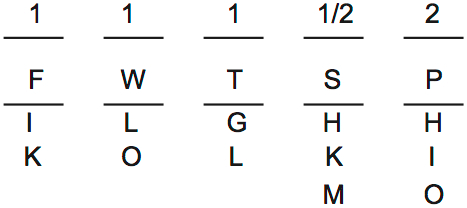
In this two day setup, T is on day one, and P is on day two. S could be done either on day one or day two.
A three day setup is also possible. There are more possibilities and it looks a bit messier, so bear with me:
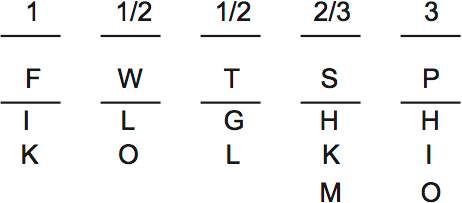
F is on the first day, and P is on the third. T can be on days one or two; it just can’t be the same day as P.
S can go on day two or three. S can’t be done on day one, because then no task would be done on day two.
(Remember, the above setup is for a three day job)
I drew the possibilities for three day and two day installations over my main diagram:
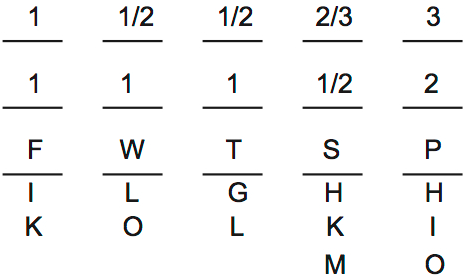
These aren’t the main part of the game though. If you only know three things about the number of days, they should be:
- T and P aren’t on the same day.
- The tasks can be done in two or three days.
- Each day has to have at least one task.
And remember, the other main point is that one person from each of these three pairs has to work:
- IK
- LO
- GL
Game 4 Main Diagram
These diagrams show the rules used to determine the designation of tasks (F, W, T, S, P) to workers (G, H, I, K, L, M, O).
Refer to these diagrams when solving this game. Copy them on your own page, and on each question make a new version of them in order to follow along with my explanations. You’ll learn much more if you draw along.
The setup section explains how to build this diagram.
Main Diagram
This diagram is potentially confusing. The letters on the bottom show who can do each task. The two rows at the top indicate the potential days the tasks are done on. The first line is for a three day distribution of the tasks. The second line is for a two day job.
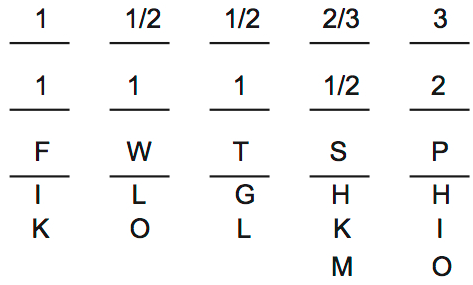
Question 19
Remember that we need at least one person from IK, LO and GL in order to go F, W and T.
A is wrong because neither L nor O is on the crew. There is no one to do W.
B is CORRECT. Here’s who could do the tasks:
F: K
W: L
T: G
S: H
P: H
S and P could be done on different days, by H.
C and D are wrong because neither G nor L works. N one can do T.
E is wrong because neither I nor K works. No one can do F.
Question 20
There are two crew members on days one and three. That means that there are two tasks done on those days.
The first two tasks are done on day one, and the last two tasks are done on day three. T is done on day two.
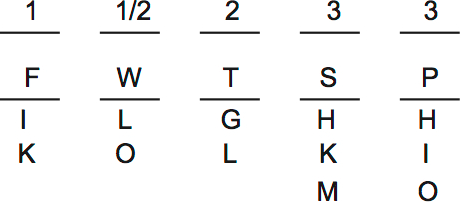
Next, you have to see which crew members could work both F and W and S and P. Find a pair that fits on both days. It’s K and O:
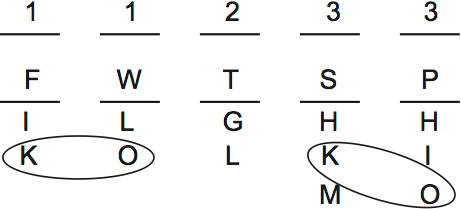
The wording of the question is confusing, but once you understand what you’re being asked, you just need to look for a pair on both sides. The same question type is repeated on question 23.
D is CORRECT.
Question 21
This question is similar to question 19, in reverse. You can use the same method to answer it. Make sure each answer choice has all three of these pairs:
- IK
- LO
- GL
They’re needed to complete F, W and T.
A is CORRECT. A doesn’t have LO, so there’s no one who can do W.
Question 22
Again, the number of days shows its importance. S and P are on day three. T has to be on a different day from P. And T can’t be done on day one, because then no task could be done on day two.
F must be done on day one. W could be done on either day one or day two:
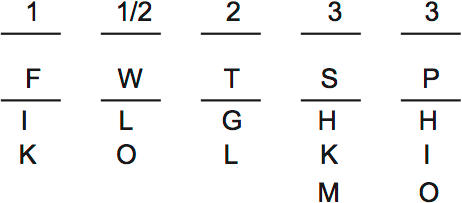
One of G and L has to be part of the answer, because someone has to do T. This eliminates A-C.
D is wrong because it includes H. H has to be on day three, since S and P are both done on day three for this question.
E is CORRECT.
Question 23
This is just like question 20. You want to look for members who can do two tasks, and who are spread out.
A is wrong, for example. M can only do S, so M can’t work on two tasks.
B is wrong because H can only do S and P. We need someone who can work on two different days with the same person. They should be spread out.
C is wrong. I and L could work together on the same day doing F and W. But they couldn’t work together to do T and P, because those have to be on different days.
D is CORRECT. K and L could do F and W on day one and T and S on day two:
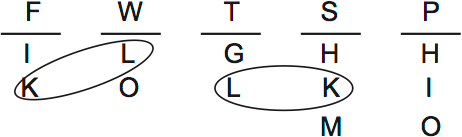
E doesn’t work. L and O are stuck together on the same task: W. Only one of them can do W, so they can’t work together on the day that task is done.

Leave a Reply