
LSAT Preptest 32 LG Explanations
Full explanations for every question from the logic games section of LSAT Preptest 32.
Archived Logic Games explanations
Logic Games are no longer part of the LSAT. LSAC removed the Logic Games section beginning with the August 2024 LSAT. If you are studying for the current LSAT, you can skip this section.
These explanations remain available for students, tutors, and readers using old-format PrepTests. For current guidance, see Logic Games and the current LSAT.
Table of contents
Game 1: Oral Reports
Game 1 Setup
This is an explanation of the first logic game from Section III of LSAT Preptest 32, the October 2000 LSAT.
A group of eight students attended a seminar. They are George, Helen, Irving, Kyle, Lenore, Nina, Olivia, and Robert (G, H, I, K, L, N, O). Six students from this group need to make individual oral reports. The reports will be given for three days, from Monday through Wednesday (M, T, W), one in the morning (M) and one in the afternoon (A). The rules allow you to make schedules for them.
Game Setup
The game is complicated by the fact that there are eight people but only six spaces. So not everyone is in at once.
It’s easiest to set the game up horizontally. Here’s what my diagram looks like:
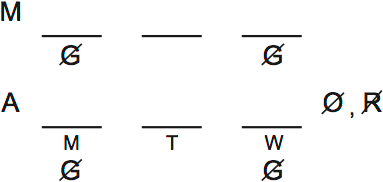
I put the first two rules directly on the diagram. G doesn’t go on Monday or Wednesday, and O and R can’t give reports in the afternoon.
The third rule is that if H gives a report on Monday or Tuesday, H and I give reports the day after.
Here’s how I drew it:
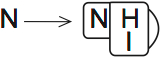
But the best thing is simply to memorize it. There are only three rules in this game. Two of them are directly on the diagram. The game will be much easier if you can memorize this final rule.
Wednesday is special. Wednesday is the only day N can go without triggering the final rule.
You should always draw the list of variables, and circle those with no rules. K and L are important, because we can put them anywhere.

Game 1 Main Diagram
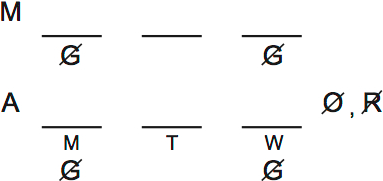
These diagrams show the rules used to determine the oral report schedule of the students (G, H, I, K, L, N, O).
Refer to these diagrams when solving this game. Copy them on your own page, and on each question make a new version of them in order to follow along with my explanations. You’ll learn much more if you draw along.
The setup section explains how to build this diagram.
Main Diagram
Rules
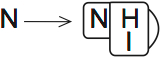

(The circles indicate that K and L are random. When there are many variables, you need to know which ones have no rules)
Question 1
It’s easiest to answer list questions by taking each rule and using it to eliminate 1-2 answer choices. Start with one that’s easy to spot, such as looking for O or R in the afternoon.
A is wrong. R can’t be in the afternoon (rule 2)
B is wrong. O can’t be in the afternoon (rule 2)
C is CORRECT.
D is wrong. When N is on Monday, H and I have to be on Tuesday (rule 3).
E is wrong. G can’t go on Wednesday (rule 1).
Question 2
K and L were the two flexible variables that had no rules. So now we can only use the six other variables. And they must obey the rules. This lets us conclude a few things:
- G must be in, on Tuesday.
- O and R must be present, in the mornings.
- Nina will have to be in, likely on Wednesday.
When you make deductions, you should go through the answer choices and try to eliminate them using the easiest deduction. It’s hard to check whether G is on Tuesday, since we can only see the mornings, for example.
But it’s easy to check whether both O and R are in the answers. They have to both be there, in the morning. Only D has both O and R, so we can eliminate the rest.
D is CORRECT.
Question 3
Many people look at this question, and don’t know where to start. Here’s a hint: check which rules mention Wednesday.
Only rule 3 does. N can’t go with H or I, unless N goes on Wednesday. If N goes on Monday or Tuesday, H and I are forced onto the next day.
So look for an answer choice with N and H or I. Wednesday is the only day N can go with H or I.
B is CORRECT. If N goes on Monday or Tuesday, H goes the following day. But on Wednesday, they could be together.
This question is as simple as that.
Question 4
G has to present on Tuesday. N can’t give a report Monday, because then H and I would go on Tuesday and crowd out G.
So N presents on Wednesday, G presents Tuesday and that leaves Monday for R. He presents in the morning (rule 2).
I’ve drawn G and N under Tuesday and Wednesday. They could present morning or afternoon.
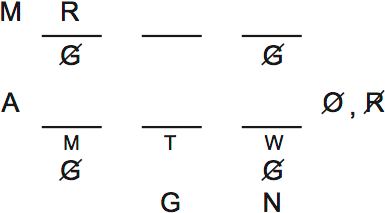
The above diagram has all of the rules, but there’s a bit too much going on.
So I thought I would show you how I would draw this local rule if I were actually doing the game:
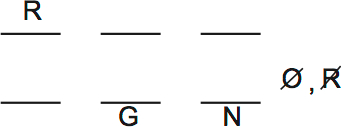
I tend to make my local diagrams very simple. You know the top and bottom row and M and A. No need to repeat it locally.
A is CORRECT.
B is wrong because if N went on Monday, G couldn’t go on Tuesday (rule 3).
C is wrong because the local rule for this question says G and N have to go on different days. G can only go on Tuesday (rule 1).
D is wrong because O can only go on mornings (rule 2) and R is already presenting Monday morning.
E is wrong. G has to go Tuesday. If R went on Wednesday, that just leaves Monday for N. But that would prevent G from going on Tuesday, since H and I have to present on the day after N.
Question 5
There’s an easy way and a hard way to solve this question. The hard way involves drawing each possibility. You can probably figure out the question on your own that way, but it takes too long.
The easy way is to focus on the most restricted point. Monday afternoon is hard to fill.
O and R can’t go there, because they can never go in the afternoon. K and H can’t go there, because the question assigned them elsewhere.
That’s four of our eight people who can’t go there.
G can’t go Monday afternoon, because G can only go on Tuesdays. And N can’t go there, because H and I have to go the day after N. In this case, H has to go Wednesday.
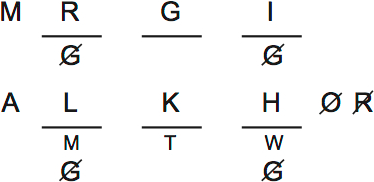
So only I and L can present on Monday afternoon. Everyone else has been eliminated. So one of I and L has to present on Monday afternoon.
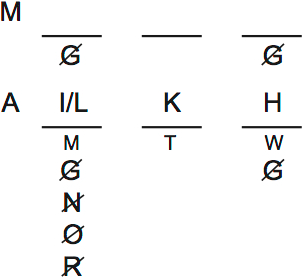
All four of the wrong answers place both I and L in the mornings. They ignore Monday afternoon.
Process of elimination proves that D is CORRECT. This diagram shows how it could work:
Question 6
There are eight people. This question tells us H, K and L give morning reports.
So five people are left for the afternoons. But rule 2 tells us that O and R can’t give afternoon reports.
So only three people are left for the three afternoon spots: I, G and N.
G has to go on Tuesday. That means N has to go on Wednesday. If N went on Monday, rule 3 would knock G out of Tuesday.
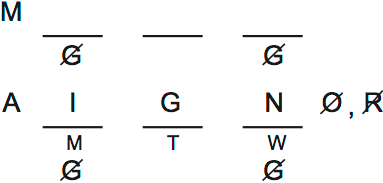
Therefore, I presents on Monday; it’s the only remaining afternoon spot. B is CORRECT.
Here’s the diagram. It doesn’t matter what order H, K and L go in, as long as they are in the mornings.
Game 2: Works
Game 2 Setup
This is an explanation of the second logic game from Section III of LSAT Preptest 32, the October 2000 LSAT.
A reading club organizer will select five or six works from a group of nine works. There are six novels (n) in total: three in French (F) and three in Russian (R). There are also two French plays (p), and one Russian play. You must decide which works will be selected depending on the rules.
Game Setup
Numbers are very important for this game. It’s also important to learn all of the rules by heart, or number them in a list.
Some games depend on mastery of the rules, and this is one of them. There are deductions to be made, but they come from thoroughly understanding the rules.
I want to draw attention to the last two rules, as they can lead to confusion. Rule three says you can’t have more Russian than French novels. Since we have either three or four novels, this means that at least two French novels must be chosen. Otherwise the Russian novels will outnumber the French.
There are only three plays: French, French and Russian. The fourth rule effectively tells us that we can never have all three plays. If we have both French plays, we lose the Russian.
So the maximum number of plays is: two.
Before starting, you should think about how everything works together. For instance, if there are six works, then we must have four novels and two plays, thanks to rule 2 and rule 4.
Its useful to start with the scenario where there are six works, because it’s more limited. Here it is:

There has to be at least one French play, because there’s only one Russian play. If you have more than one play, one of them will have to be French.
There can be at most three French novels, because there only are three French novels.
There are at least two French novels. If there were only one French novel, then Russian novels would outnumber the French novels. Rule 3 doesn’t allow that.
There are two possibilities if only five works are selected. We could have three novels and two plays:

At least two novels are French, to prevent Russian novels from outnumbering French novels (rule 3). One play is French, because there is, at most, only one Russian play to select.
Or we could select four novels and one play:

At least two novels are French, to prevent Russian novels from outnumbering French novels (rule 3).
One novel is Russian, because there are only three French novels.
The other novels and the play could be French or Russian. The only other restriction is that they can’t all be French (rule 1).
Note that in every case we need at least two French novels, and at least one play.
Rules and deductions to remember:
- No more than four French works (rule 1)
- Three or Four novels (rule 2)
- At least two French novels (rule 3)
- Max two of three plays (rule 4)
You don’t need the scenarios I drew. But thinking through them helps make this game a lot easier.
In case you wondered how I have time for that – I don’t always do all this work upfront. Sometimes I do it while doing the questions, as the game becomes clearer. But I do do the work, it makes the game clearer and I get the answers faster.
Game 2 Main Diagram
These diagrams show the rules used to determine which of the French (F) and Russian (R) works will be selected by the reading club organizer. The works are novels and plays (n, p).
Refer to these diagrams when solving this game. Copy them on your own page, and on each question make a new version of them in order to follow along with my explanations. You’ll learn much more if you draw along.
The setup section explains how to build this diagram.
Main Diagram
Six Works:

Three novels, two plays:

Four novels, one play:
The empty spaces can be filled with French or Russian works.
Question 7
As with all list questions, use each rule in turn to eliminate the wrong answers:
A is wrong because the Russian novels outnumber the French novels (rule 3).
B is wrong because all three plays are in (rule 4).
C is CORRECT.
D is wrong because five French works are selected (rule 1).
E is wrong because five novels are selected (rule 2).
Question 8
A is CORRECT. Here’s one way it could work:

B can’t work. If we only have one French novel then Russian novels will outnumber French novels.
C can’t work, because of rule 4. If you have both French plays, you lose the Russian play.
D can’t work, because the Russian novels would outnumber the French novels (rule 3). You can have four novels, at most (rule 2).
E violates the first rule.
Question 9
We have three French novels. Apart from that, we don’t know much. We could have five or six works, and three or four novels.
A is wrong, because there are only four works selected.
B is wrong, because five French works are selected. That violates rule 1.
C is CORRECT.
D is wrong, because five French works are selected. That violates rule 1.
E is wrong, because five novels are selected. That violates rule 2.
Question 10
If you followed along with the setup, you’ll know that D is CORRECT. There must be at least two French novels.
If we only had one French novel, then Russian novels would outnumber French novels (rule 3). There are always at least three novels (rule 2).
This scenario proves A, C and E wrong:

This scenario proves B wrong:

Question 11
A is CORRECT.
It’s slightly tricky. It’s easy to forget that there are only three french novels, max. So if you have three French novels, no Russian novels and one play, you only have four works.
The first sentence of the setup says we need five or six works.
If you’re unsure about the other answer choices, the easiest (and only) way to eliminate them is to try drawing them to see if they work.
B works:

C and D work:

E works:

Game 3: Compositions
Game 3 Setup
This is an explanation of the third logic game from Section III of LSAT preptest 32, the October 2010 LSAT.
Eight compositions will be performed in a concert (F, H, L, O, P, R, S, T). You must arrange the performances in sequence based on the rules.
Game Setup
This is a linear game. There are six rules, and success depends on knowing them all very well.
The easiest way to do this is to draw as many as you can directly on your diagram.
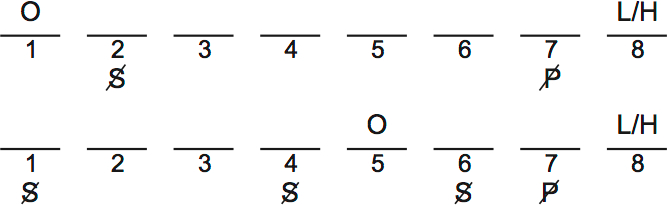
The first rule is fairly odd. I drew it like this:

T is the central point. So in each diagram, make sure T either has F after it or R before it.
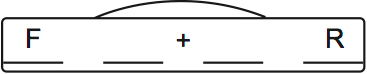
The second rule says R and F can’t be together. They are at least two spaces apart:
(the plus sign is for the “at least”)
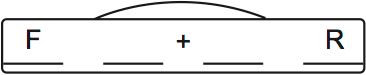
The arc above the box shows that this is reversible. R can’t be within two spaces before or after F.
The other rules can be put directly on the diagram:

People are often confused by the last rule. It’s just a complicated way of saying that O and S aren’t beside each other. So wherever you put O, draw a “not S” rule beside it.
Since P goes before S, P can’t go seventh and S can’t go first.
Here’s how to draw the fifth and sixth rules:

You should draw them separately and put them on your diagram.
There aren’t any more deductions to be made. This game depends on knowing the rules very well, and applying them. The most important rule is the third rule: a lot depends on where we place O, since that affects other rules.
L and H are the flexible variables. One goes eighth, while the other can go anywhere.
Game 3 Main Diagram
These diagrams show the rules used to determine the sequence of the compositions (F, H, L, O, P, R, S, T) to be performed in a concert.
Refer to these diagrams when solving this game. Copy them on your own page, and on each question make a new version of them in order to follow along with my explanations. You’ll learn much more if you draw along.
The setup section explains how to build this diagram.
Main Diagram

Question 12
As with all list questions, take the rules one at a time, and use them to eliminate wrong answers. Start with simple rules such as looking for L/H in eighth, or making sure that O is in first or fifth.
A is CORRECT.
B is wrong because T needs to be before F or after R.
C is wrong because O has to be in 1 or 5 (rule 3).
D is wrong because S can’t be beside O (rule 6).
E is wrong because F and R are too close (rule 2).
Question 13
Only rule 5 affects P. S has to come after P.
L/H go eighth. So if P goes seventh, there’s no space for S to come afterwards.
E is CORRECT.
Question 14
(Scroll down for diagrams + explanation)
The first step should always be to draw the diagram, as above. R can’t go fourth or seventh, because of rule 2. It would be too close to F.
That means R goes second or third.
S is who we’re interested in. The only open spots are 2, 3, 4 and 7.
S can’t go second, because it would be beside O. S also can’t go third. Why?
If S went third, P goes second. (rule 5)
The only spaces left for R would be fourth or seventh. That doesn’t work, because of rule 2.
Here’s my inelegant drawing of this (non)possibility:

So S can’t go second or third, and A is CORRECT. S goes fourth or seventh.
Question 15
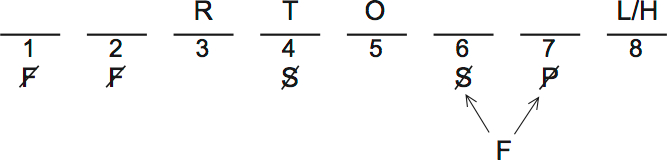
O has to go first or fifth. So if O goes after T, O must go fifth.
T needs F afterwards or R beforehand (rule 1). O is directly after T, so F can’t go there.
R has to go before T, instead.
F can’t be performed within two spaces of R (rule 2). So F can only be performed sixth or seventh.
E is CORRECT.
Question 16
O and S can’t go beside each other. And O can only go fifth or first.
So if S is fourth, O has to go first.

This leaves only C and D as possibilities. It’s a hard choice, but it’s easier if you draw both:
 (S is fourth for this question)
We can’t have OPTS, because it violates the first rule. We need one of TF or RT, but T is stuck in the middle of P and S.
C is CORRECT.
Question 17
If S is sixth, then O can’t be fifth. They can’t be beside each other (rule 6). So O must be first instead, because O can only be first or fifth (rule 3).

I’ve drawn TF and RT under the diagram. Do they look familiar? The first rule says we need either TF or RT. And spaces 4 and 5 are the only place they’ll fit.
C is CORRECT. Either F or T has to go fifth.
Question 18
O can only go first or fifth. So if F is two spaces before O, then O must be fifth.
(Scroll down for diagrams + explanation)

R can’t be within two spaces of F (rule 2).
This shows that R can’t go anywhere except sixth or seventh. But those are both possible answer choices.
So there must be a further restriction on R. I found it easiest to discover the restriction by trying both possibilities allowed by the first rule: TF and RT.
First, let’s see what happens if we put T before F.
Where can we place S? S can’t go fourth or sixth, because then S would be beside O.
And S can’t go third, because then S would be before P. So S goes seventh, and R goes sixth.
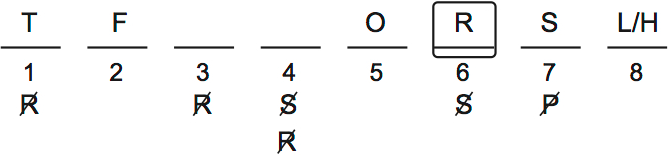
What about if we put T after R, instead?

Then R is still sixth, because 6 and 7 is the only place we can fit TR.
D is CORRECT.
Game 4: Pets
Game 4 Setup
This is an explanation of the fourth logic game from Section III of LSAT preptest 32, the October 2000 LSAT.
A pet shop will feature kittens and puppies for seven consecutive days (1, 2, 3, 4, 5, 6, 7). One breed will be featured each day. There are three breeds of kitten – Himalayan, Manx, and Siamese (H, M, S) – and three breeds of puppy – Greyhound, Newfoundland, and Rottweiler (G, N, R).
Game Setup
I haven’t seen another game quite like this. I suppose it’s a linear game, but I don’t feel that classification helps here.
This game requires you to know the rules. Know them cold. If you can learn to keep 3-4 facts in your head for eight minutes, forty-five seconds, you’ll do much better on logic games.
The most useful thing here is to draw rules underneath your diagram that show which variables
can’t go in certain spots.
It’s easiest to draw everything horizontally. If you look at the first question, you’ll see that the LSAT has represented the kittens horizontally.
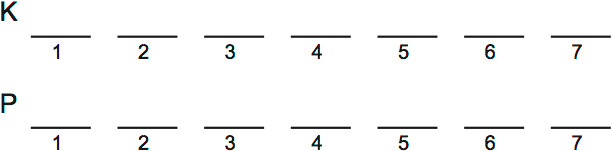
G goes on day 1. Rule 2 says no breed can go beside itself, so G can’t go on day 2. And we know from rule 3 that G can’t go on day 7. (The same variable can’t go on days 1-7)
Rule 5 tells us that R also can’t go on day 7. So since both G and R can’t go on day 7, N must go there.
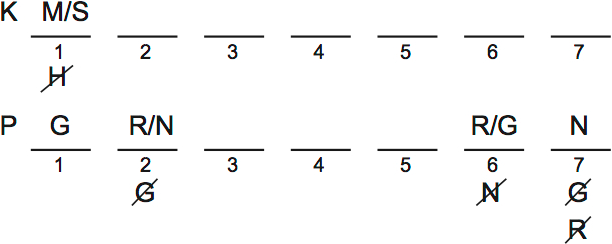
N can’t go on day six, since no breed can go twice in a row.
I also added rule four: H can’t be featured on day 1.
The one rule you absolutely must remember without putting it on your diagram is that H and R can’t go together. You could draw it like this:

But it’s most effective simply to memorize this rule.
There are several possibilities for how to place the three H’s, so it’s not worth your while to draw scenarios. Local rules for individual questions will limit where H can go, and you can draw H on your diagram then.
The rules are mostly for puppies. H is the only type of kitten mentioned in the rules.
Here’s a list of rules to remember:
- The first and last breeds are different
- A breed can’t go twice in a row
- H can’t go with R
Game 4 Main Diagram
These diagrams show the rules used to determine which breeds of the kittens (H, M, S) and puppies (G, N, R) will be featured in a pet shop.
Refer to these diagrams when solving this game. Copy them on your own page, and on each question make a new version of them in order to follow along with my explanations. You’ll learn much more if you draw along.
The setup section explains how to build this diagram.
Main Diagram

Rules
On this game, several rules can’t really be drawn in a standard way. You can make a list and draw them in whatever way is both clear and short:
- The first and last breeds are different (I’ve already shown this for puppies)
- A breed can’t go twice in a row (You could draw this
GG,RR, etc.) - H can’t go with R
Here’s how I drew the third one:

Question 19
A is wrong because H can’t go on day 1 (rule 4).
B is wrong because the same breed (Manx) can’t be featured on both day 1 and day 7 (rule 3).
C is wrong because we need three H’s (rule 4). There are only two here.
D is wrong because the same breed (Siamese) can’t go twice in a row (rule 2).
E is CORRECT.
Question 20
We need three H’s. They can’t ever go on day 1, and for this question they can’t go on day 2. So they must go on days 3, 5 and 7.
There’s no other way to fit them in and keep them apart.
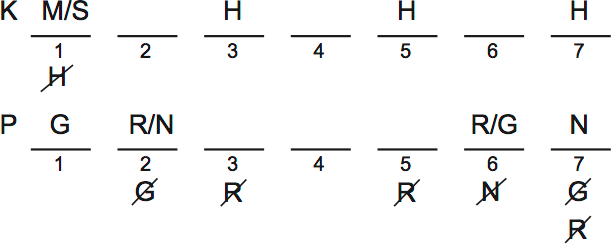
That means R can’t go on days 3, 5 and 7 (rule 5).
A is wrong because H has to be on day 3. M can’t go there.
B is CORRECT. There are no rules about S, so they could go on day 4.
C is wrong because H has to be on day 5. H and R can’t go together (rule 5).
D is wrong. We can’t fit three H’s if we put H on day 6. (no breed can go beside itself).
E is wrong. G can never go on day seven, because G goes on day 1 (rules 1 and 3).
Question 21
This question can be answered quickly if you know the rules well and made a few deductions in the setup. Y0u can use these deductions to quickly eliminate wrong answers.
Otherwise, the question is difficult.
Nothing pays off better than learning and remembering a game’s rules. It takes a bit more time, but you’ll go through the questions much faster.
A is wrong. G can’t go on day 2, because G is on day 1 (rule 1). A breed can’t be featured twice in a row (rule 2).
B is wrong because the same breed can’t be featured on both day 1 and day 7 (rule 3). G is already featured on day 1.
C is wrong. R and H can’t go together (rule 5).
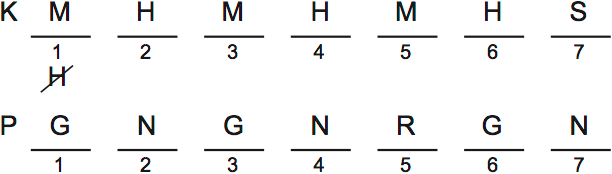
D is CORRECT. There are no rules about M. This diagram shows one way things could look:
E is wrong. N has to be featured on day 7, so N can’t also be featured on day 6 (rule 2).
The reason N has to be featured on day 7 is because no one else can go there.
G is on day 1, and therefore can’t go on day 7 (rule 3). And rule 5 says R can’t be featured on day 7.
Question 22
We already know H can’t be featured on day 1, and this question tells us they can’t go on day 7 either.
We still need to put in 3 H’s. The only way to keep them apart within those limits is to put them on days 2, 4 and 6.
When I was doing the game, I figured this out by making a quick sketch of seven lines and seeing how I could fit three H’s in spaces 2-6. Try it. It should only take 5-10 seconds.
Here’s what it looks like, with full details:
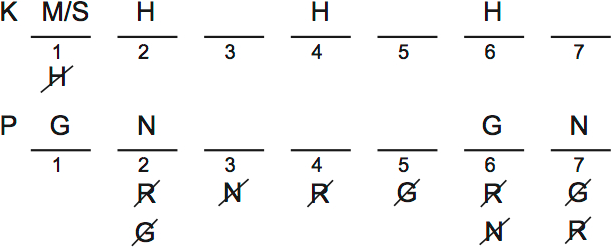
We know R can’t go opposite H. So I’ve drawn “not R” in those spaces.
In 2 and 6, we also know that G and N respectively can’t go in those spots, because breeds can’t go twice in a row.
So N is featured on day 2, and G is featured on day 6.
Whenever you make a deduction, you should check if it is the right answer. Here, it is.
B is CORRECT. Days 2 and 6 have different breeds of puppy.
Question 23
This question is great. It shows that eliminating wrong answers is often the easiest way to find the right answer.
I did this game many times with students, and I never bothered to think about what A meant. I didn’t have to. The other answers were much easier to eliminate.
B is wrong. Here is my attempt at putting G every place that H goes. H can’t go in 1 (first rule). I’ve avoided 2, because G can’t go there.
I put H in 3 and 5, along with G. But you can only manage 2 out of 3. H can’t go in 6, because it is already in five (rule 2).
You could put H in 7, but G can’t go there. (3rd rule)

C doesn’t work. G is featured on day 1, and H can’t go on day 1 (rule 4).
D doesn’t work. R isn’t featured on day 1, but H can’t go there (rule 4).
E doesn’t work. H isn’t featured on day 1 (rule 4), but R can’t go there, because G is featured on day 1.
A is CORRECT. Here’s how it could work:

M, H, N and G are featured on three days. But there’s no need to figure this out. It’s far easier to eliminate the other answer choices.
Question 24
If H isn’t featured on day 7, then it must be featured on days 2-6 (H can’t be featured on day 1).
This is the same scenario as in question 22:
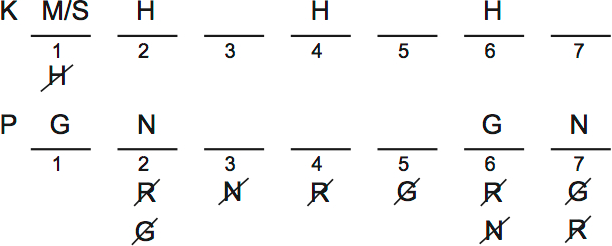
A is wrong. G can’t be featured on day 5, because they are featured on day 6.
B is wrong. N can’t be featured on day 3 because they’re featured on day 2.
C is wrong. H is featured on day 6, so R can’t be featured there (rule 5).
D is CORRECT. No rule says we have to feature R on several days. We can fill in the other puppy spots with G and N.
E is wrong. R can only be featured on days 3 and 5. On days 2, 4 and 6 they’re blocked by H. Rule 5 says they can’t go in 7, and rule 1 says they can’t be featured on day 1.

On Law Hub PT these all do not correlate. Your S3 Logic Games is S1 for the Law Hub PT32. Not sure why they are mixed up. This is not the first “seek and find” of explanations I’ve had. Just FYI.
Lsac unfortunately has inconsistent ordering between the print and Lawhub versions of the LSAT. Neither form is dominant yet.
You can however choose “lawhub order” in the quickjump tool to use that. And Lr is market Lr1 and LR2, this will be consistent in both versions.
No clean solution to this issue unfortunately unless lsac makes their own systems consistent.