
LSAT Preptest 36 LG Explanations
Full explanations for every question from the logic games section of LSAT Preptest 36.
Archived Logic Games explanations
Logic Games are no longer part of the LSAT. LSAC removed the Logic Games section beginning with the August 2024 LSAT. If you are studying for the current LSAT, you can skip this section.
These explanations remain available for students, tutors, and readers using old-format PrepTests. For current guidance, see Logic Games and the current LSAT.
Table of contents
Game 1: Fruit Stand
Game 1 Setup
This is an explanation of the first logic game from Section IV of LSAT Preptest 36, the December 2001 LSAT.
A fruit stand sells at least one of these fruits: figs, kiwis, oranges, pears, tangerines, and watermelons (F, K, O, P, T, W). You need to determine what fruit or fruits it sells based on the rules.
Game Setup
Update: The “note to advanced students” below is now how I recommend all students approach games like this. I no longer draw the rules individually, I just add them one by one to a larger diagram.
——
This is a grouping game. There are only two options for the fruit. They can be in the cart, or not in the cart.
As with many in/out grouping games, you can combine all of the rules into two diagrams that cover every variable. This can seem difficult, but it isn’t so hard if you take it step by step. Just keep adding little pieces until you’ve built a big diagram.
It’s important to be able to take the contrapositives. Sometimes we can’t add a rule onto a diagram the way it’s given, but we can add the contrapositive. Taking the contrapositive is easy:
- Reverse the terms.
- Put a line through them, or remove the line if they already had one.
- Change any “and” to “or”, and vice versa.
So: A ➞ B becomes “not B” ➞ “not A”.
Or, a plain English example: If you have a pet, then you have a cat or a dog (pretend it’s true)
P ➞ C or D
Not C and not D ➞ no pet
The first step for most people on an in-out game should be to diagram all of their rules and contrapositives.
Note For Advanced Students: I personally just add each rule to a single large diagram, but that’s an advanced tactic. If you want to try that yourself, just skip the step where I draw each of the rules individually. Instead, attach each new rule on to your existing diagram.
The advanced method is a lot faster and more efficient, but it can lead to error if you’re not 100% confident with sufficient-necessary statements.
The Four Rules + Their Contrapositives
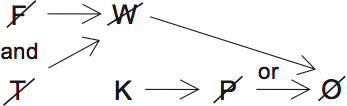
Here are the four rules drawn with their contrapositives:
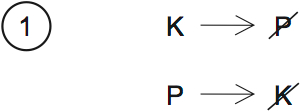
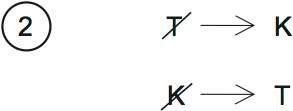
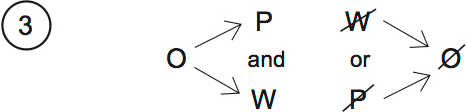
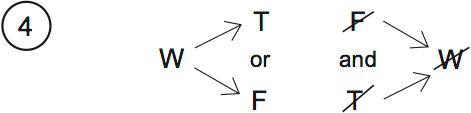
Combining the Rules Into a Larger Diagram
Now I’ll show you how to combine these into a single large diagram. Start with one rule and draw it in the middle of your page. The first rule is as good as any.

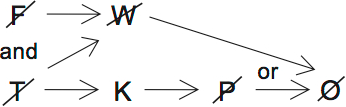
Now look for another rule that you can match up to it. You need a rule that has “K” as the necessary condition, or that has “not P” as the sufficient condition. If that sounds complicated, think of it like playing dominoes: you need to make both sides match to join something together.
We can add in the second rule: “Not T leads to K”

The next rule tells us that oranges have two necessary conditions. Pears are one. So without pears, we can’t have oranges.
Therefore, not P leads to not O.

The next rule mentions W. W requires figs or tangerines. The contrapositive is “no F” and “no T” ➞ no W.
(the “not both” in the rule is useless. “Or” already implies that we could have both.”)
We already have no T on this diagram. We can add no F in above.
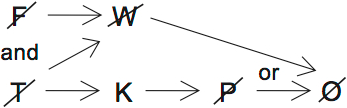
I’ve also connected no W to no O. It may seem superfluous, since no T also leads to no O.
But, it’s possible to have T but still not have W. In that case, it’s important to know that O is still out.
Drawing A Contrapositive Of The Main Diagram
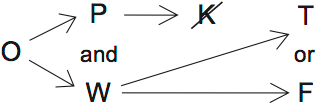
This diagram is done, so now you can flip it around and do the contrapositive. Remember to cross out (or remove the line from) everything you flip. Lastly, change “and” to “or” and “or” to “and.”
It’s also a very good idea to be looking over the rules again when you’re drawing the contrapositive. It’s easy to make a mistake, and a mistake is often disastrous.
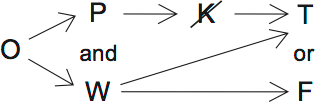
The new diagram starts from O. O leads to P and W (rule 3).
P leads to not K (contrapositive of rule 1). Not K leads to T (contrapositive of rule 2). And we can simply draw in rule 4 to show that W leads to T or F.
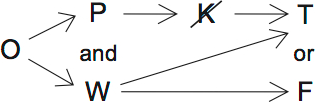
(It may seem superfluous to draw W’s rule. If O is in, then we already have T, which satisfies the rule. But…O doesn’t have to be in. Neither does P. So we should know what happens if W is in but not O or P. )
Two Important Rule Types On In/Out Games
A quick note about these two rules:
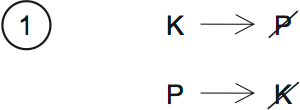
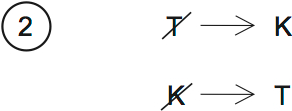
They look very similar, but they mean different things.
If K is in, P is out. And vice versa. So one of K and P is always out. And they could also both be out. This type of rule means we can’t have both of the variables in together.
The next rule says that if T is out, K is in, and vice versa. One of T and K is always in. And they could both be in.
The reason both T and K could be in (and P and K could both be out) is that you can only follow the arrows left to right. So K being in doesn’t tell us anything about T.
To sum up: an important deduction here is that one of K and T is always in, and one of P and K is always out. We have at least 1 fruit always in and at most 5 in.
Game 1 Main Diagram
These diagrams show the rules used to determine the possible kinds of fruit the fruit stand sells (F, K, O, P, T, W).
Refer to these diagrams when solving this game. Copy them on your own page, and on each question make a new version of them in order to follow along with my explanations. You’ll learn much more if you draw along.
The setup section explains how to build this diagram.
Main Diagram
Deductions
- One of either T or K is always in.
- One of either P or K is always out.
Question 1
A is wrong because O leads to P and also W and also T or F.
B is CORRECT. O, W and F could all be out. Their being out isn’t a sufficient condition for anything else being in.
C is wrong because O also leads to T or F, through W.
D is wrong because we can’t have O without P.
E is wrong because we K leads to no O.
Question 2
On this question, you should look for a type of rule where one variable being out causes another to be in.
For example, T being out causes K to be in. So any answer without T and also without K is wrong. We always need one of K or T to be in.
There are no other rules of that type.
One of T or K always has to be in – you can’t make a scenario without them. So they’re the only possible right answers. D is CORRECT. It says T could be the only fruit for sale.
Question 3
(I’m reproducing the diagrams from the setup)
We’re told that four of the scenarios work, and only 1 doesn’t work. We should start with the longest string of variables: it’s the one most likely to violate a rule. E is CORRECT. If P is in, you can’t have K.
Many people think A can’t be true. But there’s no reason we can’t have T and K together. K being out means that T is in. So they can’t both be out. But they can both be in. K being in is not a sufficient condition for T being out.
None of the other answer choices have any rule violations. It’s also important to see if some variables being out cause other variables to be in. There’s only one pair of variables like that in this game: T and K. We always need one of them in. But B, C and D all do have either K or T.
So since those answer choices don’t violate any rules, and they all have T or K, they all work.
Question 4
W being out tells us that O is also out (rule 3).
Answers D and E are tempting because they include O, but they also include other variables that could be in, so they don’t work. The answer choices say that both variables must be missing.
A is wrong. We don’t need kiwis, ever. We only need kiwis or tangerines.
B is wrong because we could have just one kind of fruit: T or K. Question 2 disproves this answer choice.
C is CORRECT. We’re always missing one of either K or P. Since O and W are also out, that means we have three variables out of six automatically missing. So we can’t have more than 3 variables.
D is wrong because while we don’t have oranges, we could have pears as long as we don’t have K.
E is wrong because it’s possible to carry Kiwis.
Setup Diagrams
Question 5
This is a very funny question. I’ve never seen another like it…the local rule has nothing to do with the right answer.
If the stand has watermelons, then it must have T or F. But it turns out that doesn’t tell us much.
Instead, we have to consider the answer choices in light of the general rules.
A could be true. The stand doesn’t have to carry figs as long as it has tangerines.
B could be true. The stand doesn’t need T as long as it has F.
C could be true. There’s no reason the stand has to carry pears. No rule says pears must be in, ever. And there’s no relation between pears and watermelons.
D could be true. Oranges require pears, but pears don’t require oranges.
E cannot be true, so it is CORRECT. If the stand has P, then it doesn’t have K. And without K, the stand needs T. So if the stand has P it must have T as well.
The funny thing is, E is always true, whether or not W is in. I’ve never seen a local rule question where the local rule is irrelevant.
Question 6
People seem to find it really hard when the LSAT asks us to change a rule. I’m not sure why. It’s easy!
Get ready for this mind-blowing technique I’m about to show you.
We normally have an arrow connecting “not T” to K. Now this question is telling us to get rid of that rule.
So, just erase the arrow…
All you need is an eraser, and you’re set. All the other rules apply, I just removed the connection between K and T in both diagrams.
Previously, one of K or T always had to be in. Now we’ve removed that rule. So nothing has to be in.
Pears could be the only fruit, since they no longer force T to be in. So A is wrong.
B is wrong because neither F nor P are sufficient conditions for any other fruit to be in.
C is CORRECT. If W is in, then either T or F have to be in. But they aren’t, so this answer choice is wrong.
D is wrong because P and F don’t force any other fruit to be in the stand. W needs F or T, but we have F in this answer choice.
E is wrong for the same reasons as D. E also includes O, but O just needs P and W, and they’re already in.
Game 2: Talk Show
Game 2 Setup
This is an explanation of the second logic game from Section IV of LSAT Preptest 36, the December 2001 LSAT.
Five phone calls are aired sequentially on a talk show. The five calls are from Felicia, Gwen, Henry, Isaac, and Mel (F, G, H, I, M). The calls are either live or taped (L, T). The calls are from Vancouver, Seattle, and Kelowna (V, S, K).
Game Setup
This is a linear/grouping game. We need to figure out which order the telephone calls go in, where they’re from, and whether they are live or taped.
Yikes. Fortunately, the rules let us tie down most of these variables.
First off, notice that the setup tells us how many calls come from each city. Two are from Vancouver, two from Seattle and 1 from Kelowna.
Now for the rules. I’m going to draw the first two rules together. We know that M and Isaac come before everything else. The third call is from Kelowna, and it is taped.
So M and Isaac’s calls must be before the call from Kelowna.
(I’m referring to “I” as “Isaac”, because “I” is confusing, sounds like I’m referring to myself)
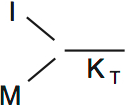
The third call is the only call from Kelowna
The two Seattle calls are live. It doesn’t matter how you draw that, as long as you remember it. Here’s how I drew it:

If G and F are after H, then we know exactly where H goes: third. It can’t be any other way.
There are only five spots. Isaac and M are before H; they fill the first two spots. Since G and F come after H, H must be in the middle.

We know that H calls from Kelowna. Two of the remaining calls are from Vancouver, and two are from Seattle.
The last rule says that M and F are not from Seattle. They must be from Vancouver.
That means that Isaac and G must be from Seattle. I’ve shown this in the main diagram section.
Game 2 Main Diagram
These diagrams show the rules used to determine which order the telephone calls go in (F, G, H, I, M), where they’re from (V, S, K), and whether they are live or taped (L, T).
Refer to these diagrams when solving this game. Copy them on your own page, and on each question make a new version of them in order to follow along with my explanations. You’ll learn much more if you draw along. The setup section explains how to build this diagram.
Main Diagram
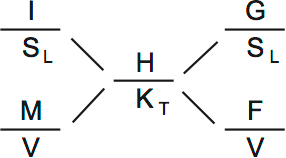
Remember that the Seattle calls are live.
Question 7
Another list question. Eliminate the answers by choosing a single rule and seeing which answer choices violate it. Then repeat for the next rule.
A is wrong because Isaac and M have to be the first two calls.
B is wrong because F and G must come after H.
C is wrong because Isaac and M have to be the first two calls.
D is wrong because H has to come before F and G.
E is CORRECT.
Question 8
A is CORRECT. All we know about F is that she calls from Vancouver and she is after H. There’s no reason she couldn’t go in 5.
B is wrong because Isaac or M have to be first.
C is wrong because Isaac or M have to be first.
D is wrong because Isaac has to be first or second.
E is wrong because M has to be first or second.
Question 9
If the first call is from Seattle, then Isaac must go first, because M calls from Vancouver. M comes second and H comes third (as always).

A can’t be true, because M comes after Isaac.
B can’t be true, because rule 4 says F comes after H.
C must be true, and is CORRECT. Isaac goes first, M goes after and Henry goes third.
D can’t be true. Isaac goes first, since the first call is from Seattle.
E can’t be true, because Isaac has to go before M in this scenario.
Question 10
If a taped call airs first then M must go first. Isaac calls from Seattle, and Seattle is always live.
So the first call is a Vancouver call, from M, and is taped. The second call is from Seattle and is live.

A could be true. We have no rules for which order F and G have to appear in.
B could be true, for the same reason as A.
C can’t be true. Isaac has to go second. Isaac calls from Seattle, and Seattle is a live call. C is CORRECT.
D has to be true. Henry always makes a taped call from Kelowna, third.
E could be true. We have no rules for what order F and G appear in.
Question 11
A is CORRECT. We know that Gwen is in Seattle, because F and M can’t be in Seattle. And all Seattle calls are live.
Henry’s call has to be taped, because H is third and the third call is taped. B is wrong.
Mel is from Vancouver, so we don’t know if Mel’s call if live or taped. C is wrong.
D doesn’t have to be true, because F is from Vancouver. We don’t know whether Vancouver calls are live or taped.
Isaac can’t be taped. Isaac is from Seattle, which means Isaac makes a live call. E is wrong.
Question 12
Henry makes a taped call from Kelowna in spot 3. If no taped calls are consecutive that means that calls 2 and 4 must be live. And that means that calls 1 and 3 must be taped.
T-L-T-L-T. The Seattle calls can only be live, so they must go in 2 and 4. The Vancouver calls go in 1 and five.
There’s only one order possible. Remember that M and F call from Vancouver, and Isaac and G call from Seattle.
A is CORRECT.

Question 13
If a taped call airs second, then that means M from Vancouver called second. Isaac from Seattle (who is always live) called first.

A must be true. So A is wrong.
B is CORRECT. The Vancouver call must air second.
C, D and E are all possible. We have no idea whether F or G comes first. We only have rules for what happens before H.
Game 3: Bus Ride
Game 3 Setup
This is an explanation of the third logic game from Section IV of LSAT Preptest 36, the December 2001 LSAT.
A group of six people ride a bus together. They are Gutierrez, Hoffman, Imamura, Kelly, Lapas, and Moore (G, H, I, K, L, M). The bus seats are numbered 1 through 3, from front to back. There are two rows and each row has two seats each (W, A).
Game Setup
This is a grouping game. We have three rows of two bus seats, and have to figure out where everybody sits.
This game is quite hard. You have to know all of the rules. Really, you have to know them: memorize them. Don’t try to understand this game if you don’t know the rules.
I’ve made a list of them below. There are only 5, so commit them to memory or write out the list yourself while trying this game. If one of my explanations says something must be true and you’re not sure why, it’s almost certainly because of one of the rules.
I find it easiest to draw this vertically. But if you drew a horizontal diagram, that can work too.
Here’s how I drew it:
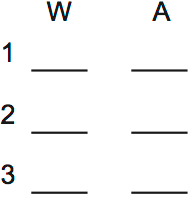
The first rule is the most restrictive rule. G and H both sit in the aisles. G comes right before H.
There are only three aisle seats. So G and H can either go in 1 and 2, or 2 and 3.
Whenever a restrictive situation can only be drawn two ways, I always draw those two scenarios. I find it is very useful to help me think through the diagram.
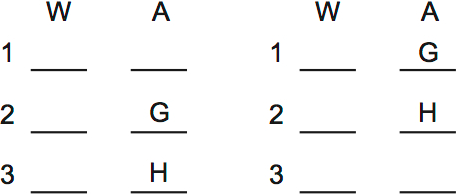
These will also serve as guides when we have to make sketches for later questions.
We could make exhaustive scenarios for the next four rules, but there are too many to be useful.
Instead, I recommend making a numbered list of the last four rules, memorizing them, and/or referring back to the list quickly as needed. This game centers on the rules.
The next rule is that if M is in an aisle seat then L is in the same row as H.
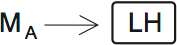
We know that G is always above H. So we can expand on this rule by including that.
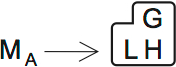
The third rule is that if G and K are in the same row then M is behind I.
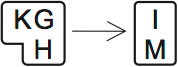
I placed H under G, because G is always over H. This rule actually lets us figure out quite a lot, but I’ve put that in a separate section later.
The fourth rule is that if K is in a window then M is in row 3.

If M is in the aisles, then K must be in a window seat (because only three variables can fit in the aisles.)
So if M is in an aisle seat then K will force M to be in seat 3.
The final rule tells us that if K is in 3 then Imamura is in 1.
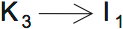
Scenarios
This isn’t essential. I’m adding this section to show you how you could build scenarios to help you on this game.
I didn’t use these on the questions, but drawing them helped me get a better intuition for the game.
When you have a conditional rule, it’s good to think through all of its implications. Consider the third rule. If G and K are in the same row, M, is behind I:
That’s pretty restrictive. It covers five variables. We can only fit three variables in the window or aisle columns.
There’s no room for I to be over M in the aisle seats, because G and H are already there. There are four variables but only three spots.
So they have to go in the window seats. K has to go above them. It’s the only way to fit all three and still have space for H.
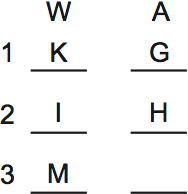
The only other way to place K and IM would be to put K in 3 and IM in 1-2. But then G would be in 3 and there would be no space to put H below.
By default, L will go in the bottom of the aisle seats:
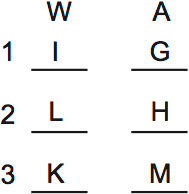
So if K and G are in the same row, there’s only one way to place the variables.
Therefore we can make a further deduction is that K and G can’t go together unless they are in the first row. We can add this to the main diagram:
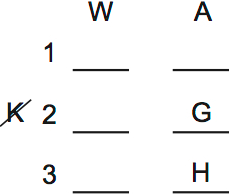
There is one more scenario worth drawing. We should figure out what happens if M is in an aisle seat, since there are many restrictions when that happens.
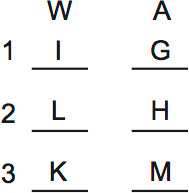
If M is in an aisle seat, then K, L and I are in window seats. If K is in a window seat, M goes in seat 3:
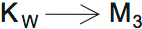
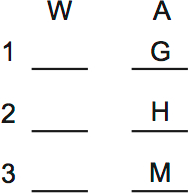
If M is in the aisles, H and L are on the same row. This fills row 2:
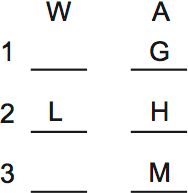
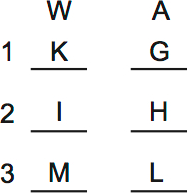
That leaves K and Imamura to be placed in rows 1 and 3. It turns out we can’t place K in row 1. Why? Then K would be beside G. We saw that scenario earlier: if K is beside G, M has to be directly below Imamura.
So K must go in 3 and Imamura in 1:
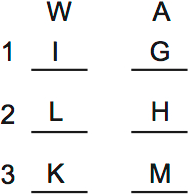
This scenario involved almost every rule. So if you weren’t sure how to do it, go back and review the rules, or try drawing it yourself. It’s a useful exercise to be sure you’re applying the rules correctly.
As I said, you don’t need these scenarios to get this game correct. But drawing them correctly will help your diagramming skills.
Solving A Rules Based Game
Some of my diagrams for the individual questions may seem mysterious, so I want to explain what I’m doing.
Questions 15-18 are all “local rule” questions. The game gives you a new rule, and you can combine this rule with the existing rules to make new deductions.
Take question 15 for example. The question says that L and K are in window seats.
If you properly memorized the rules, you’ll notice a rule is triggered by this new condition. If you didn’t memorize the rules, look at the list to the right.
If K is in a window seat, M is in row 3.
This simple deduction lets us solve everything. There are only two places to put M in row 3: window or aisle.
From there, you can continue to make deductions until everything is solved. See question 15 for the full walkthrough.
In general, the process should be:
- Identify local rule
- See which regular rules it affects.
- Make a deduction
- Continue combining those deductions with the regular rules, until you’re done.
- Check if you found the answer.
I encourage you to try this process for each question before looking at my explanations.
Game 3 Main Diagram
These diagrams show the rules used to determine the seating arrangement (W, A, 1, 2, 3) of the bus passengers (G, H, I, K, L, M).
Refer to these diagrams when solving this game. Copy them on your own page, and on each question make a new version of them in order to follow along with my explanations. You’ll learn much more if you draw along.
The setup section explains how to build this diagram.
Main Diagram
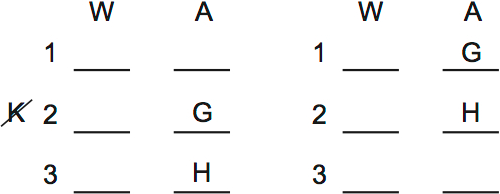
(The “not K” rule is from one of the optional scenarios)
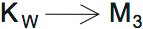
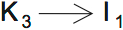
Scenario when K is beside G:
Scenario when M is in an aisle seat
Question 14
The fact that this is not a list question should set off alarm bells. The game’s author expected you to make deductions, and they think you should be very comfortable with the rules and how they interact.
If you’re still unfamiliar with them, reread the rules and look over the list in the main diagram section. Otherwise this game won’t make sense.
A is wrong because if K is in 3 then Imamura must always be in 1. It’s the fourth rule from our list.
B is wrong because if G is in the same row as K then M has to be behind Imamura. This question says we have to put M in the aisle seats. G, H, M and Imamura would make four variables in the aisles seats.
C is wrong because G can never be in a window seat. It’s the first rule.
D can’t be true. If M is in an aisle seat, then L is in the same row as H, not M.
E can be true. If K is in 3 then Imamura is in 1. There’s nothing wrong with that. L would be in 2, beside H, so it doesn’t matter whether K or M is in the aisle.
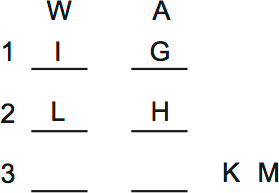
E is CORRECT.
Question 15
If L and K are in window seats, then M must be in seat 3 (K window ➞ M seat 3.)
There are two possibilities. M could be in row 3 in the window, or M could be in the aisle.
If M is in the aisle then L must be in the same row as H. I covered this scenario in the setup.
K can’t be in the same row as G, because then M would have to be directly beneath Imamura. So K goes in 3 and Imamura goes in 1.
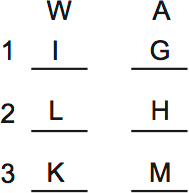
If M is in the window, then we still have to place K and L in their window seats. We can’t place K with G, because then M would have to go underneath Imamura. So K goes in row 2, and L goes in row 1.
Imamura will go in the third aisle seat.
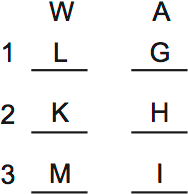
A is CORRECT. Moore is in the aisle in the first scenario I drew for this question.
B is wrong. If Imamura is in the third window seat, then L, K and Imamura fill the window column. M would have to sit in the aisle.
But if M is in the aisle, K is in the third window seat. It’s covered in the first scenario above. Otherwise, K would be with G.
C is wrong. If G and K are in the same row then Imamura is above M. But they can’t fit in the aisles or the windows. In the aisles, G and H are there and only one space is free. In the windows, K and L already take up two spaces.
D is wrong. M is in row 3 because K is in a window seat. G is always in row 1 or 2 because G is above H.
E is wrong. This question places L in a window seat. To go beside L, M would have to go in the aisles.
But the second rule says that if M is in the aisle, L to go beside H, not M.
Question 16
If M is in row 1, then M must be in a window seat. If M were in an aisle seat, then K would be in a window seat, and that would force M go to in row 3.
In fact, K must be in an aisle seat, so that M doesn’t go in row 3.
Finally, K must be in row 1. Why? The only spare aisle spaces are 1 or 3. If K were in 3, then Imamura would be in 1. But that wouldn’t work, because M must go in 1.
We can therefore also deduce that G and H must be in 2 and 3.
This was a complicated sequence of rules. Work through it on your own if you’re not clear how it works.
So the drawing looks like this:
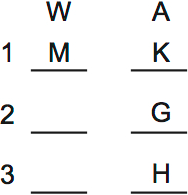
It doesn’t matter whether Imamura or L are in rows 2 or 3. Those aren’t sufficient conditions for anything.
A is wrong because H must sit in row 3.
B could be true, but it doesn’t have to be. There are no rules for L and Imamura.
C could be true, but it doesn’t have to be. There are no rules for putting L and Imamura in spots 2 and 3.
D is CORRECT. If K were in a window seat, that would force M to be in 1, not 3.
So K sits in the aisles. If she sat in row 3, then Imamura would be in row 1 of the windows, and there would be no space for M to go there.
E could be true, but doesn’t have to be. There are no rules to tell us where to put L and Imamura.
Question 17
If K is in the aisle seat of row 3, then Imamura is in row 1. (fourth rule):
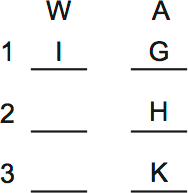
A has to be true. Both G and Imamura are in row 1.
B could be true, but it doesn’t have to be. We have no rules telling us where to put L and M if K is in the aisle. B is CORRECT.
C has to be true. G, H and K are all in the aisle in this question, leaving no room for L.
D has to be true. There’s only space left in the window seats. G, H and K fill up the aisle seats on this question.
E has to be true. If K is in the third aisle seat then G and H will have to be in 1 and 2.
Question 18
If Imamura isn’t in row 1 then K must not be in row 3 (contrapositive of the final rule.)
And if G isn’t in 1 then G must be in 2 and H is in 3.
K also can’t go in row 2, beside G. Why?
That would force Imamura to be above M…but there’s no space for the two of them in either the window or the aisle. K would be in row 2 in the window seats, and G is in 2 in the aisle seats.
So K is in row 1, in either the window or the aisle.
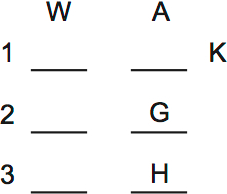
A is wrong because if G is in row 2 then H must be in row 3.
B is wrong because if K were in row 2 then Imamura would have to be right above M. But there’s no room for that if K and G fill row 2.
C is CORRECT. Moore could be in 2 in a window seat and Imamura could be in row 3 on a window seat. K would go in row 1 of the aisle, and L would be in row 1 of the window. It looks like this:
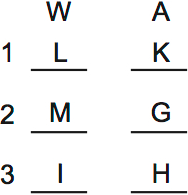
D is wrong because that would force K into a window seat. And if K is in a window seat then M also has to go in an aisle seat. Imamura, M, G and H can’t all fit in aisle seats.
E is wrong because the only free aisle seat is in row 1. But if M were in an aisle then K would be in the window. And when K is in the window, M goes in row 3, not row 1.
Game 4: Pilots
Game 4 Setup
This is an explanation of the fourth logic game from Section IV of LSAT Preptest 36, the December 2001 LSAT.
Four pilots and four co-pilots are assigned to four flights (1, 2, 3, 4) that fly from New York to Saratoga. The four pilots are Fazio, Germond, Kyle, and Lopez (F, G, K, L). The co-pilots are Reich, Simon, Taylor, and Umlas (R, S, T, U). Exactly one pilot and one co-pilot are assigned to each flight.
Game Setup
This game isn’t so bad, compared to most games. It combines linear and grouping, but everything can be grouped into two simple scenarios. It’s good practice for the harder games that also require scenario creation.
The first task of any game (and often the hardest) is figuring out your layout. I prefer a vertical layout for this game. You can draw a column for pilots and copilots, and four rows.
I’ve drawn it below, and added in the rule that K goes second. It’s a good idea to read over all the rules first and draw the simple ones directly on the diagram.
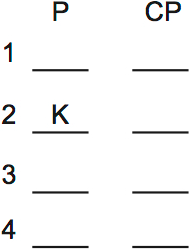
Next, F takes off before G, and someone comes in between them.
F and G are both pilots. We can’t put F-G in 3-4 because no one would come between them. So F must go in 1, and G can go in either 3 or 4.
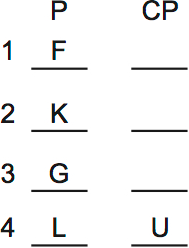
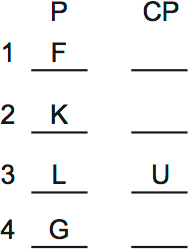
We also know that L (a pilot) has U as his copilot. We can combine all of these rules into two scenarios: one with G is in 3 and one with G is in 4.
Scenario with G in 3:
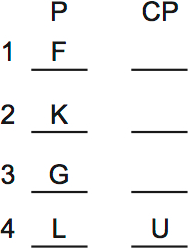
If G is in 3, then L must go in 4. It’s the only space left for a pilot.
If G is in 4 then L must be in 3:
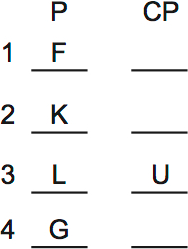
To recap:
- K is in 2 because a rule places him there.
- F is in 1, because F has to be kept separate from G.
- G can go in 3 or 4.
- L goes in the place G doesn’t go.
- U goes with L.
- There are no rules for R, S and T, the remaining copilots. They are random variables.
Game 4 Main Diagram
These diagrams show the rules used to determine the assignments of the pilots (F, G, K, L) and co-pilots (R, S, T, U) to flights (1, 2, 3, 4).
Refer to these diagrams when solving this game. Copy them on your own page, and on each question make a new version of them in order to follow along with my explanations. You’ll learn much more if you draw along.
The setup section explains how to build this diagram.
Main Diagram
Scenario 1
Scenario 2
Question 19
Clearly, the first question expects us to have made a few deductions: it isn’t a list question.
We know that F is always in spot 1. That’s the only way to keep F at least one space apart from G.
Only answers A and B have F. B is wrong because it includes Umlas: U has to go with L.
A is CORRECT. There are no rules telling us where to put R, so R can go in 1.
Question 20
We’ve got a local rule on this question: R comes after U. So we have to ask which scenario we’re in.
U can only be in 3 or 4. U must be in 3 for this question, so that R can go after.
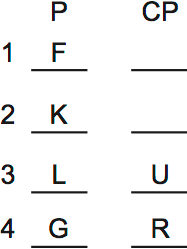
A could be true. F could come before S if S went in spot 2.
B has to be true. K comes in 2 and R comes in 4.
C can’t be true, because T can go in spot 2 at the latest. U and R fill up 3 and 4. C is CORRECT.
D has to be true. S can only go in 1 or 2. Meanwhile, R must go in 4. So R is always after S.
E could be true if T went in 1. Then T would be earlier than K.
Question 21
If L is earlier than G then we must be in scenario 2:
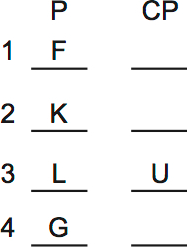
We’re looking for something that could be false. All the wrong answers have to be true.
A has to be true. F is always in 1 and U is in 3 in this scenario. (of course, U can never be earlier than 3 in any scenario.)
B must be true. It’s the only way to put L ahead of G.
C also must be true. One of Reich or Taylor can go in slot 4, after Umlas’s flight. But they can’t both go there at the same time, so one will always be before U.
D doesn’t have to be true. We have no rules telling us where to put S. So while Simon could fly earlier than Umlas, he doesn’t have to. D is CORRECT.
E has to be true. L has to go in 3 in order to fly before G. And since U always flies with L, U has to be in G too.
Question 22
We have to figure out how many different teams could go fourth. First, L and U could be assigned to slot four:
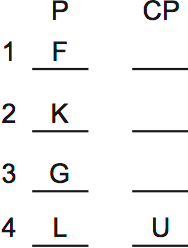
That’s one possibility.
Second, G could go in slot 4 with R, with S, or with T. There’s no rule preventing any of those copilots from going with G.
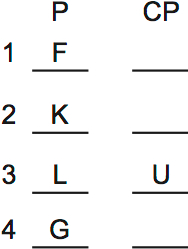
LU, GS, GR, GT. Four possibilities means that answer C is CORRECT.
Question 23
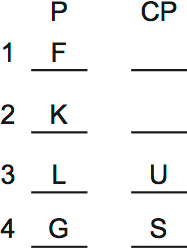
If S comes after L, then LU must be in 3 and S must go in 4 with G.
R and T will fill in 1 and 2, in either order.
G therefore must come after R. So A is wrong.
B is just like A. G must come after both R and T.
C is wrong too. L comes after R and T, just like G.
D is CORRECT. We have no rules to tell us whether to put R in 1 or T in 1.
E can’t be false. U is always in 3 with L, and R has to go in either 1 or 2.

Leave a Reply