
LSAT Preptest 62 LG Explanations
Full explanations for every question from the logic games section of LSAT Preptest 62.
Archived Logic Games explanations
Logic Games are no longer part of the LSAT. LSAC removed the Logic Games section beginning with the August 2024 LSAT. If you are studying for the current LSAT, you can skip this section.
These explanations remain available for students, tutors, and readers using old-format PrepTests. For current guidance, see Logic Games and the current LSAT.
Table of contents
Game 1: Appointments
Game 1 Setup
This is an explanation of the first logic game from Section III of LSAT Preptest 62, the December 2010 LSAT.
A motel operator is starting up services at a new motel. The operator is setting appointments for six services: gas, landscaping, power, satellite, telephone, and water (G, L, P, S, T, W). The rules determine the possible schedules of the service appointments.
Game Setup
This is, at first glance, a linear game where you just list the rules and apply them. But by drawing the rules on the diagram and making a couple of deductions, you can figure many things out up front.
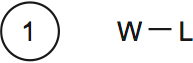
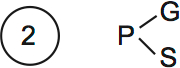
First, let’s draw rules one and two. Water is before landscaping, and power is before gas and satellite:


Next, draw rules three and four directly on the diagram. Gas, satellite and telephone can’t go second or third, and telephone can’t go sixth:
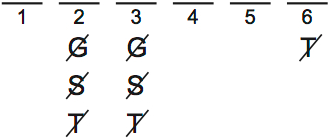
Many people stop here. But with so many restrictions, we should see if there are other restrictions we can add to the diagram.
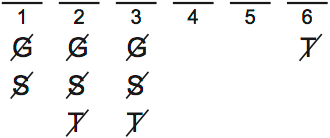
For instance, gas and satellite can’t go first (rule 2). Since there are so many gas/satellite restrictions, you should draw that on the diagram:
Next, let’s see who can’t go last, since it also has a restriction. Power can’t, because power is before gas/satellite. And water can’t, because water is before landscaping:
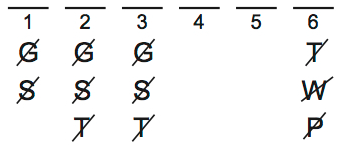
TWP can’t go last….so only gas, satellite and landscaping can go last. This is an important deduction! And gas/satellite must take up two of the last three spaces.
I’d like to have a better sense of who can go where. If you just think about a deduction but don’t write it down, it’s easy to forget.
I divided the diagram into two. Gas and satellite are always 4-6. Water is always 1-3, because it’s before landscaping. G/S already take up two of the three final spaces, so there’s no room for G, S and W – L:
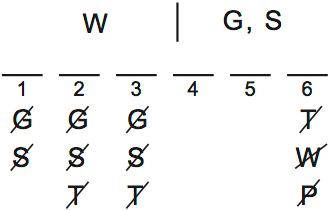
This way, it’s easy to see who must go 1-3 and who must go 4-6.
(Note: Landscaping doesn’t have to go 4-6. You just can’t put water 4-6, because landscaping is after water.)
Now we’re set. You do need to remember the first two rules to use this diagram properly, of course.
Note that I only drew the final diagram as my main diagram. For individual questions, I drew this diagram:

It has no detail. I look down to the main diagram to see detail and fill in the local diagrams. I keep my main diagram near the questions so I can easily look down at it.
In these explanations, I include details on all the local diagrams, for clarity. But my local diagrams are rather more minimal.
Game 1 Main Diagram
These diagrams show the rules used to determine the possible orders of the appointments (G, L, P, S, T, W) at the motel.
Refer to these diagrams when solving this game. Copy them on your own page, and on each question make a new version of them in order to follow along with my explanations. You’ll learn much more if you draw along.
The setup section explains how to build this diagram.
Main Diagram

Rules
Question 1
For acceptable order questions, go through the rules and use them to eliminate answers one by one.
Rule 1 eliminates C. Water needs to be before landscaping.
Rule 2 eliminates A. Power has to be before gas.
Rule 3 eliminates E. Telephone can’t be second.
Rule 4 eliminates B. Telephone can’t be last.
D is CORRECT. It violates no rules.
Question 2
This question adds a new rule: gas, satellite and telephone can’t be fourth. This really restricts the game. Here’s the new diagram:

Now gas and satellite can only go fifth and sixth!

That also leaves only space one for telephone:
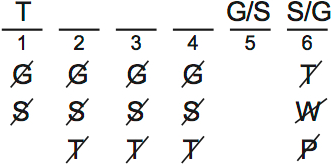
This leaves water, landscaping and power to go in 2-4:
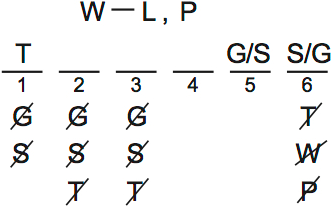
D is CORRECT. The other answers could be true but don’t have to be.
Question 3
The diagram from question 2 disproves A and B:
C and D both said the telephone must go early. So I made a scenario putting telephone as far back as I could. This scenario disproves both C and D:
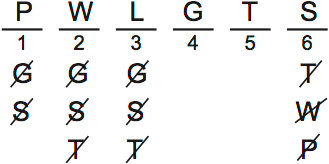
E is CORRECT. We saw this in the setup. Water has to be earlier than gas and satellite.
The reason is that gas and satellite already take up 2/3 spaces in the back half. That means there’s only one space open after gas, at most.
Since landscaping goes after water (rule 1) that means we would need two open spaces to place water after gas.
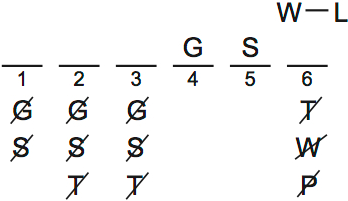
This diagram shows water won’t fit.
Question 4
In the setup, we saw that gas and landscaping must take up two of the three spaces in 4-6. That’s because gas and satellite can’t go first, second or third (rules 2 and 3).
Since these answers show the last three spaces, at least two of the variables must be gas and satellite.
E is CORRECT. It’s missing satellite.
Question 5
Gas and satellite are already restricted to days 4-6. This question further restricts them to only spaces 4 and 5:
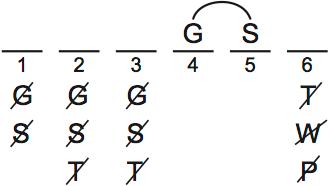
I prefer to draw them with a loop to show they are reversible. This is the fastest way I know of doing this.
Now, in the setup we saw that only gas, satellite and landscaping can go last. This question further restricts gas and satellite from going last, so only landscaping is left:
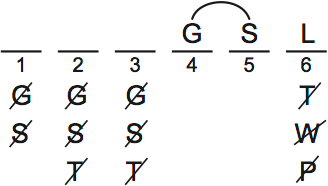
You can fill in the rest of the diagram for fun, should only take you three seconds if you know the game. Telephone must go first, and power and water are in the two remaining spaces:
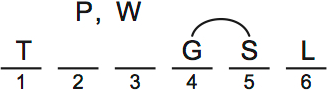
However, landscaping = last was the first major deduction, and the first major deduction is usually the answer. So whenever you find a major deduction, you should check the answers to see if it is there.
It is. B is CORRECT. The diagram shows that the other answers don’t have to be true. They all deal with reversible variables. (P, W is another way of drawing reversible variables, once there are already some restrictions on the board).
Question 6
Everyone hates rule substitution questions. But I actually don’t think they’re that hard. You have to ask the right questions:
- Does this new rule add the same restrictions?
- Does it allow everything that used to be allowed?
Most of the wrong answers add weird new restrictions. You can use your past scenarios to eliminate answers. If an answer contradicts a past, working scenario, then that answer is WRONG!
LSAT answers are worthless. Don’t give them the time of day. They’re 80% likely to be wrong. Approach them looking for reasons to disprove them.
Now, we’re looking for something that makes telephone “not last”.
A seems to add the correct restriction. If telephone is before gas or satellite, it’s not last. Let’s come back to this.
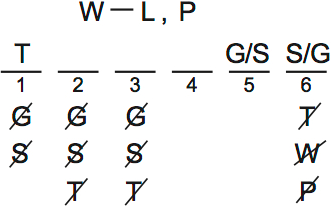
B and D add weird new restrictions that weren’t in the original setup. Telephone doesn’t need to be directly in front of gas or satellite. This scenario from question two disproves both answers:
This diagram from question three disproves C. The telephone doesn’t have to go before landscaping:

This diagram from question five disproves E. Gas or satellite don’t have to go last:
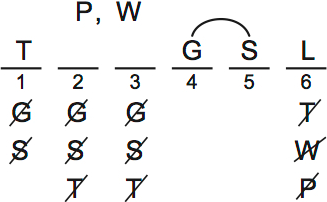
That leaves A. It’s CORRECT. Since we thought A was right, and we eliminated the other answers, we can be very sure it’s right.
Just for fun, I’ll prove conclusively that A is true. We saw in the setup that Gas and Satellite had to be in spaces 4-6. So if something goes after gas and satellite, it must go last.
Therefore, saying that “T can’t go last” is the same as saying that “T must go before gas and satellite”.
Game 2: Stained Glass
Game 2 Setup
This is an explanation of the second logic game from Section III of LSAT Preptest 62, the December 2010 LSAT.
An artisan is creating three stained glass windows (1, 2, 3). Five colors will be used: green, orange, purple, rose, and yellow (G, O, P, R, Y). The artisan must use each color at least once, and she must use at least two colors of glass in each window.
Game Setup
This game is rather unique, I can’t think of any others like it. You have to choose colors for stained glass windows, in three groups.
One very important point: the order of the windows doesn’t matter. There is no difference between window 1 and window 3. This lets you be flexible in your diagrams.
For instance, I drew the first rule directly on the diagram:
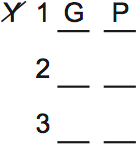
Rule one says there’s exactly one GP. You can draw them in any group, because group order doesn’t matter. I chose group one.
Note that I’ve also drawn “not Y” beside this group. That comes from rule three, we’ll get to that soon.
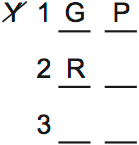
Next, there are exactly two roses. I recommend just memorizing this rule. There’s no good way to draw it, and you’ll go faster if you know it cold.
I did draw one rose by itself as a reminder. Since there are two roses, at least one of the non-GP groups has a rose. This is an optional addition:
You should combined rules three and four. Both rules mention orange. You can almost always combine rules that mention the same variable. They say:
- If you have yellow, you don’t have green or orange.
- If you’re missing orange, you have purple.

You should always draw the contrapositive of any conditional diagrams, especially if they combine multiple statements:
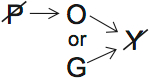
Note that yellow always leads to purple. So there’s always at least one YP in the game. It’s also important to note that yellow can’t go with green or orange. That’s why I drew “not Y” beside GP on the main diagram.
The relationship between orange and purple (rule 4) is a bit special. Most students find this type of rule confusing, so the LSAT tests it mercilessly. If you can wrap your head around this kind of rule, you’ll do much better on in-out games.
So, the fourth rule says that if we don’t have purple, we do have orange. The contrapositive is that if we don’t have orange, we do have purple.
This means we always have at least one of purple or orange. In every window. This is crucial: remember this as a separate deduction.
Now, the part that people find confusing: orange and purple can both be in the same group. There’s no rule that says if you have orange, then you don’t have purple.
So if you’re missing one of O and P, you need the other. But you can have both O and P. Another way to think about it is that you need “purple or orange” and “or” is inclusive on the LSAT. “Inclusive” means that “or” includes the possibility of both.
Technically this is already covered in the conditional diagrams I drew earlier, but it’s something that most people miss if they just look at the diagram. The games test kind of rule so much that you need to be aware of it as a separate deduction. Think of it as “at least one and maybe both”.
Another way to think about this game is that there’s a minimum number of variables that you must place:
- GP
- Two R’s (in separate groups)
- At least one O (every variable need to be used)
- YP
You’ve got to fit those into the three groups. And YP can’t go with GP, or with O. This is hard to do. Whenever a question has you place some of these variables, you should ask yourself what’s left and where they can’t go.
It’s worth thinking about numbers. For instance, green, orange and yellow cannot be in all three groups. That’s because yellow can’t go with green and orange. Two questions test this deduction (11 and 12).
Note: There are a couple other rules. Every window needs at least two colors, and every color needs to be used at least once. You should just memorize these. I drew two spaces for every window, which helps me remember that. If those spaces were “only two”, I would have drawn a vertical line indicating those spaces were closed off.
Game 2 Main Diagram
These diagrams show the rules used to determine the possible colors (G, O, P, R, Y) used in the three stained glass windows (1, 2, 3).
Refer to these diagrams when solving this game. Copy them on your own page, and on each question make a new version of them in order to follow along with my explanations. You’ll learn much more if you draw along.
The setup section explains how to build this diagram.
Main Diagram
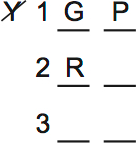
Rules
Note: The first rule has GP crossed out because there can only be one window where GP are together, and we already drew that on the main diagram so this reminds us not to do it a second time.


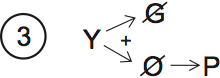
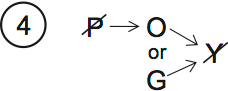
I said in the setup that every window needs either orange or purple. If you ever find yourself forgetting this deduction, then you should draw a note, like this. Remember that “or” includes the possibility of “and”:

It may also be useful to list the elements that need to be used at least once:
- GP
- Two R’s (in separate groups)
- At least one O (every variable need to be used)
- YP
Note: There are a couple other rules. Every window needs at least two colors, and every color needs to be used at least once. You should just memorize these. I drew two spaces for every window, which helps me remember that. If those spaces were “only two”, I would have drawn a vertical line indicating those spaces were closed off.
Question 7
For acceptable order questions, go through the rules and use them to eliminate answers one by one.
Rule 1 eliminates C. There can only be one window with green and purple.
Rule 2 eliminates E. There must be two windows with rose glass.
Rule 3 eliminates D. Yellow and orange can’t go together.
Rule 4 eliminates A. Every window needs at least one of orange or purple. Window 2 has neither.
B is CORRECT. It violates no rules.
Question 8
This question is asking what cannot be the complete combination of colors.
The only way to solve this question is by finding a rule violation. The rule violation has to be within a single window, because that’s all the answers show.
Only rules three and four can lead to rule violations within a single window. Here are the two possible violations:
- Yellow with either orange or green (rule 3).
- A window without orange or purple (rule 4).
None of the answers violate rule 3. C violates rule 4. C is CORRECT.
Many people choose D. If you did this, you need to review the rule about purple and orange. Here was the form:
A ➞ B
B ➞ A
This form means that you need at least one of A or B. But you could have both! You can only read diagrams left to right. The diagrams don’t say that if you have A you can’t have B.
I’ll give an example with parents. Suppose I say “if you’re a parent, you have a boy or a girl”. Here’s that rule in the same format:
boy ➞ girl
girl ➞ boy
If you have no boy, you have a girl. But everyone know parents can have both boys and girls.
So remember: if the sufficient condition is negated and the necessary is normal, it means “you need at least one and could have both”.
Question 9
This question says that two windows have exactly two colors of glass. It seems like a hard question, so I skipped it at first. I eliminated two answers, then left it and came back after the final question.
I do this sometimes on “brute force” questions. I can disprove answers faster once I’ve finished other questions and developed a better sense of the game.
A and D were the two answers I eliminated. Both violate rule 4: every window needs at least one of purple or orange.
The only way I know how to choose between the remaining answers is to make scenarios to disprove or prove those answers.
Note: The vertical lines in these scenarios indicate the group is full. Remember, the question says that two of the groups only have two. And the letters mentioned in the answer are a complete list of what’s in that window.
This scenario proves that B is CORRECT.
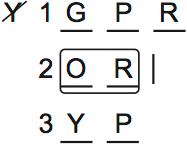
This is what I drew to eliminate C:
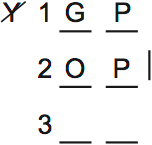
I’ve placed GP (which is always in one group) and OP (which is in the answer) fills window two. Now we have two groups left to place:
YP
Two R’s
YP can’t go with either green or orange, so they must go in group three. That leaves us no space to put both R’s, since this question says two windows must have only two colors.
I drew the incomplete diagram above to show you what I actually drew to eliminate this question.
E has the exact same problem. Here’s green and orange in the second group:
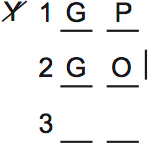
Once again, there’s no space to put YP and both R’s without having more than two colors in two groups.
If you have trouble following either of those eliminations, draw the diagrams yourself, and try to place YP and both R’s while keeping in mind the new rule for this question.
Question 10
This question says that the complete combination in one window is purple, rose and orange. I drew this, with a vertical line indicating the group is closed:
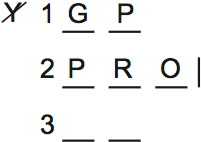
I added the rule to the main diagram. The main diagram includes GP, because of rule 1. It’s in window one because the order of windows doesn’t matter. Reread the setup if you don’t remember why I’ve drawn things this way.
Now, who do we still have to place? YP and one R. YP can’t go with green or orange, so they must go in window three:
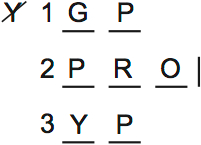
So now there’s one more rose to place. It could go with GP or YP.
Also, you can put an orange in the first window, though you don’t have to. This proves B CORRECT. One window could be green, purple and orange. Here’s the full scenario:
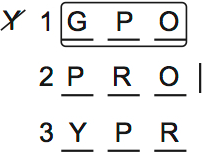
Remember, this is a could be true question. B is right because it’s possible.
None of the other answers work. They don’t fit in any of the three windows.
Question 11
The question says orange glass is used more than green glass. We know two things:
- Green glass is used once already.
- Orange glass can’t be in every window, because orange and yellow can’t go together.
This means that orange is used twice, and green is used once. We can also say that yellow is used separately from orange. Here’s what we get when we draw that:
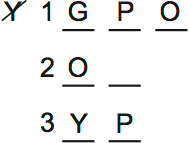
(remember, window order does not matter. This diagram would be the same with YP in 2 and O in 3.)
We still have to place the two roses. But let’s use this diagram to eliminate answers. Remember that these answers are talking about the complete combination.
A seems possible. We’ll leave it for now.
None of B-E work. Window one has the only green. And that window has GPO. None of the answers list GPO, so they’re all wrong.
A is CORRECT. This diagram proves it works:
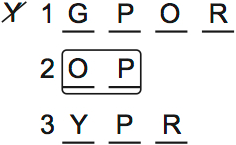
There’s no reason you can’t put purple with orange.
Question 12
Almost all of the colors have restrictions. This prevents them from going in all three windows, since every color must be used once.
- Green and orange block yellow. They’re out.
- Likewise, yellow is out. It blocks green and orange.
- Rose can’t go in three windows because rule 2 says it can’t.
That leaves purple. C is CORRECT.
Question 13
Note: I’m leaving this explanation as I wrote it, but commentor Adam Pan has a simpler explanation in a comment below.
———
This question is a bit hard. You need to do some up front thinking. But then the most important thing is drawing. There’s actually very little room for thought on logic games, apart from deciding what to start drawing.
The question says no windows have both rose and orange. And there are two rose windows. So that fills all three groups.
That’s interesting. Let’s look at the base diagram again. GP is there because of rule 1:
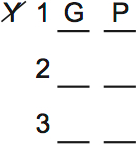
We have to place two Rs and an O, across all three groups. This means there are only two scenarios: GP is either with one of the Rs, or with an O.
Let’s try putting one of the Rs with GP. We’ll place O in two (remember, window order doesn’t matter – O could equally go in 3).
Why start with GP and R? It doesn’t really matter. The main thing is to make a working scenario. If you make a working scenario, you can do two things:
- You can eliminate answers that don’t have to be true in the scenario.
- You can see if there’s another scenario. Then look for what must be true in both scenarios.
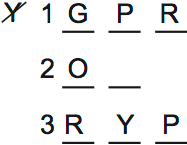
Now, if orange is in 2, rose is in windows 1 and 3.
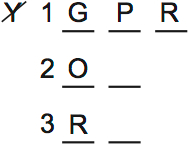
Next, we need to place YP. YP can’t go with green or orange, so it must go with R in group 3:
Finally, every window needs two colors, so one of P/G needs to go with O in group 2:
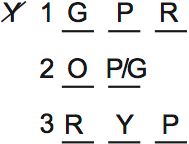
This scenario eliminates answers A-D. None of those answers need to be true, because they’re not true or not necessarily true in this scenario. And E does have to be true in this scenario. So E is CORRECT.
Technically, we’ve just proven that A-D don’t have to be true. We can’t be 100% certain that E has to be true. Maybe there’s another possible scenario where it isn’t true. Maybe we’ve made a mistake.
This is unlikely, but if you want to be extra sure, you can draw a second scenario to check whether yellow, purple and rose must go together in that scenario. The other scenario will place O with GP, and R in the other two groups. Here’s the other one I drew:
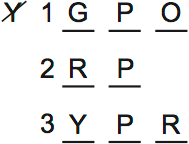
This scenario still has YPR, so E is definitely true.
I recommend practicing making scenarios constantly. The more you do it, the faster you’ll get, and the better you’ll become at seeing how variables interact.
For instance, the reason YPR must go together is that O and the two R’s must go in different groups.
YP must go in one group. Since they can’t go with O, then they must go with R. No one else can go with YPR, since G can’t go with Y.
If that didn’t make sense, I recommend trying to draw it, and make a scenario that obeys the rules and doesn’t use YPR (it won’t work). That’s really the only way to understand these restrictions.
Game 3: Conference
Game 3 Setup
This is an explanation of the third logic game from Section III of LSAT Preptest 62, the December 2010 LSAT.
Four Softcorp employees (Q, R, S, T) attend a management skills conference. Five talks are held in the following order: Feedback, Goal Sharing, Handling People, Information Overload and Leadership (F, G, H, I, L). Each of the employees attends exactly two talks and no talk has more than two employees in attendance.
Game Setup
This is a hard game. There are lots of elements to keep track of. It’s easy to get paralyzed.
On logic games, you have to trust that the game is easier than it looks. There’s always an easy way. On this game, if you just draw new diagrams for each question and go one step at a time, the game will lead you to the right answer.
The key to logic games is trying things, rather than thinking. But trying things in a methodical way, where you look for deductions and what must be true. Don’t just draw things that could be true.
On to the setup. I looked at the first question and drew this. The first question often shows you the best way to diagram a game, though I don’t always follow it:
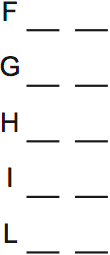
Each talk has up to two people. But there are only eight people to place in this game, so two spaces will be empty.
I drew the first two rules directly on the diagram. Quigley doesn’t attend Feedback or Handling People. And Rivera doesn’t attend Goal Sharing or Handling People:
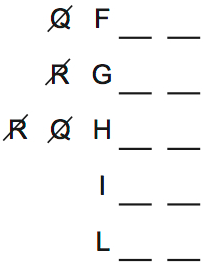
The last three rules can’t be put on the diagram, and they can’t be combined. So I numbered them 1, 2, 3 and made a list. A numbered list makes it easy to see all the rules at a glance:



The final two rules are most important. There is always a TQ to place, and always an RS to place. And they have to be the first T, and the first R. And there are many places where Q and R can’t go. So TQ and RS are restricted. You should always look for the most restricted elements.
Oddly, the rule that S and T can’t go together never came up when I solved this game. That happens sometimes.
There’s one small deduction you can add to the main diagram. The first T can’t go in F. This is because Q goes with the first T and Q can’t go in F.
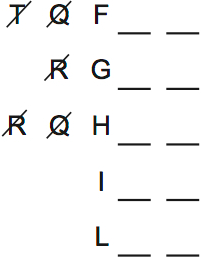
Note: I thought it might be the case that RS has to go in F. But I tried this, and it’s not true. That’s because there are ten spaces but only eight variables. So it’s pretty easy to avoid the restrictions. Most of the questions add artificial restrictions which tie things down.
Game 3 Main Diagram
These diagrams show the rules used to determine which conference talks (F, G, H, I, L) the employees (Q, R, S, T) can attend.
Refer to these diagrams when solving this game. Copy them on your own page, and on each question make a new version of them in order to follow along with my explanations. You’ll learn much more if you draw along.
The setup section explains how to build this diagram.
Main Diagram

Rules



Question 14
For acceptable order questions, go through the rules and use them to eliminate answers one by one.
Rule 1 eliminates nothing.
Rule 2 eliminates B. Riviera can’t attend Handling People.
Rule 3 eliminates A. Spivey and Tran can’t go together.
Rule 4 eliminates D. Quigley has to attend Tran’s first talk.
Rule 5 eliminates E. Spivey has to attend Riviera’s first talk.
C is CORRECT. It violates no rules.
Question 15
This questions says that no Softcorp employees attend Handling People. That’s interesting, because normally there are two extra spaces in this game. But for this question, every remaining space has to be filled.
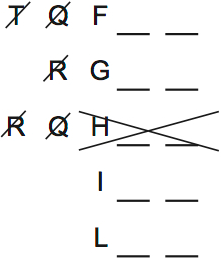
You should think about how to place TQ and RS. They’re the most restricted elements. And TQ is the hardest to place, because neither T nor Q can go in Feedback.
Now, think about the two things I’ve said so far:
- RS and TQ are the most restricted
- Every space has to be filled.
- TQ can’t go in F.
- There are only four variables: TQRS
If TQ can’t go in F, and every space has to be filled, then RS must go in F:
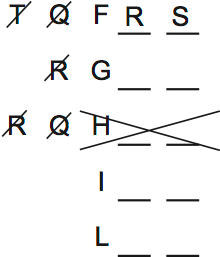
This may seem like a hard deduction. On logic games, you must always think through consequences. If TQ can’t go in a place, then who can go there? In this case, since only RS are left, we know exactly who must go in F.
This means that A is CORRECT.
Many people choose D. But Tran doesn’t have to attend goal sharing. This diagram proves it:

B is another popular choice. This diagram proves that R doesn’t have to attend leadership.
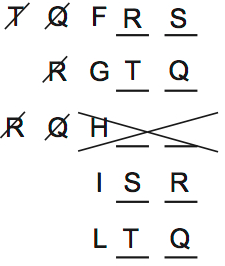
This diagram also eliminates E. Note that the fact that RS go in Feedback is enough to prove A correct. But on review or in case of doubt it’s worth making diagrams to disprove the other answers. The more diagrams you make, the faster you will get at making them.
With one more diagram, we can disprove the final answer, C. Note that on paper I would have just seen you could switch SR and TQ, I wouldn’t have drawn a whole new diagram:

Question 16
I used elimination for this question.
B is wrong because rule two says that R can’t attend Goal Sharing.
C is wrong because it’s missing Feedback. The diagram from question 15 shows that R can attend F.
D is wrong because it’s missing information overload. The correct answer from the first question shows that R can attend information overload.
Only A and E are left. Can R attend leadership?
I looked at the correct answer to the first question, and I saw that no rule prevents you from switching S and R between Information Overload and Leadership.
So R can attend Leadership and A is CORRECT. Remember, if something isn’t explicitly forbidden by the rules, then it’s allowed.
Question 17
First you should draw the new rule. Q is the only person attending leadership:
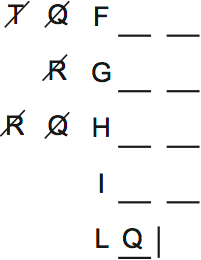
Next, ask yourself what rules affect Q. Rule 4 does:
- We need to place TQ somewhere.
- It must be the first T.
Q can only attend Goal Sharing and Information Overload. But information overload won’t work, because there’s nowhere for the second T to go. So TQ must go in Goal Sharing:
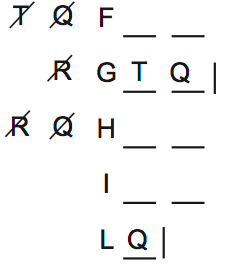
Next, think about the other restricted variable: RS. This must be the first R. Information overload doesn’t work for the first R, because there’s no place to put the second R. And since Goal Sharing is full, the first R must go in Feedback:
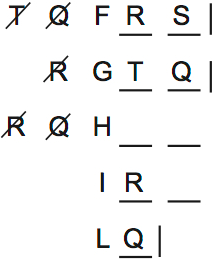
The second R goes in information overload. I drew that too. Now, who’s left? We need to place one T, and one S. They can go in either Handling People or Information Overload:
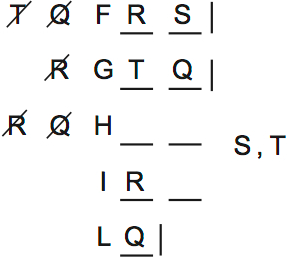
This diagram proves that S could attend Information Overload and not Handling People, so D is CORRECT. All the other answers contradict the diagram.
Question 18
Your first step should be to draw the new rule. R is the only one attending Information Overload:
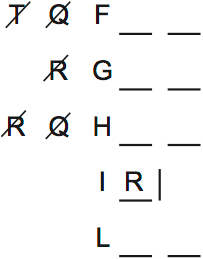
This must be the second R, because the first R is RS. So the next step is to think about where to place RS. It can’t go in Leadership; RS is the first R. And we know R can’t go in Goal Sharing or Handling people. So RS must go in Feedback:
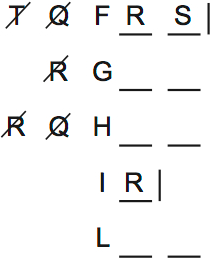
Next, think about where to place TQ, the other restricted element. This is the first T, so TQ can’t go in leadership. And Q can’t go in handling people. So TQ must go in Goal Sharing:
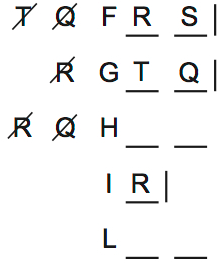
Finally, the second Q must go in Leadership. There’s one S and one T left to place. They can go in Handling People or Leadership. Note that they can’t both go in handling people, due to rule 3.
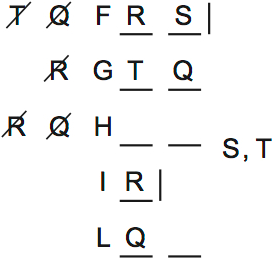
E is CORRECT. Tran doesn’t have to attend handling people.
Game 4: Six Witnesses
Game 4 Setup
This is an explanation of the fourth logic game from Section III of LSAT Preptest 62, the December 2010 LSAT.
Six witnesses will testify at a trial. The witnesses are Mangione, Ramirez, Sanderson, Tannenbaum, Ujemori, and Wong (M, R, S, T, U, W). Each of them will testify only once, and one at a time.
Game Setup
I found the first three questions easy, and the last two questions hard. I drew a lot of diagrams to eliminate answers on the final two questions.
The key to drawing diagrams quickly is to have a ready list of the rules you can refer to. Any diagram that doesn’t violate a rule is legal. I find most students are way too hesitant when drawing “could be true” diagrams. Usually the problem is that they don’t know the rules and they don’t have a clear list.
I couldn’t make any upfront deductions on this game. Instead I just drew the rules. I did draw the third rule second. This makes for easier scanning, because the first and third rules are similar:


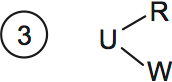
Note that the or’s are exclusive. I just committed this to memory.
Game 4 Main Diagram
These diagrams show the rules used to determine the possible orders of the six witnesses (M, R, S, T, U, W) who will testify at a trial.
Refer to these diagrams when solving this game. Copy them on your own page, and on each question make a new version of them in order to follow along with my explanations. You’ll learn much more if you draw along.
The setup section explains how to build this diagram.
Main Diagram
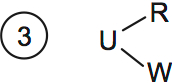
Note: The or’s are exclusive. I just committed this to memory.
Question 19
For acceptable order questions, go through the rules and use them to eliminate answers one by one.
Rule 1 eliminates D. Sanderson needs to be before Tannenbaum or Ujemori.
Rule 2 eliminates A and E. Ujemori needs to be before Ramirez and Wong.
Rule 3 eliminates C. Tannenbaum or Wong must be before Mangione.
B is CORRECT. It violates no rules.
Question 20
When a question gives you a new rule, the first thing you should do is draw it:

Don’t skip this step. It seems trivial, but it’s far easier to make the next deduction if you have something on paper.
Once you draw the new rule, see what rules it affects. T is mentioned in the first rule: we need ST or SU. We can’t have ST on this question, so we need SU.
This in turn connects with the third rule: SU is before R and W:
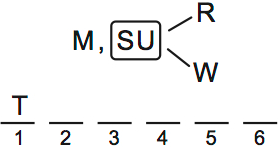
I drew them floating above the diagram. I also drew the one remaining variable, M. The comma indicates that M could go before or after SU and the rest.
Now, we can use this diagram to eliminate wrong answers.
Ramirez has so be after T, S and U, so A is wrong.
Wong has to be after T, S and U, so B is wrong.
Sanderson has to be before U, R and W. S can go third at latest. So C is wrong.
Ujemori has to be before R and W, so they can’t go fifth. So D is wrong.
This diagram proves that E is CORRECT:

Question 21
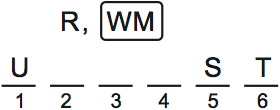
This question gives us a new rule. First, draw that: Sanderson is fifth.

Next, see which rules are affected. The first rule says we need ST or SU. When I was doing this game, I drew both possibilities. When I did that, I realized the SU is impossible here, because R and W must be after U.
So T is sixth:

Next, we need TM or WM. We can’t have TM on this question, since T is last. We need WM. This modifies our remaining rule:
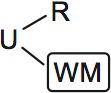
Every variable is after U. So U has to be first. A is CORRECT.
Question 22
There’s no easy way through this question. You just have to brute force it.
That’s what I thought at first, anyway. But I realized there was a better way. Remember, on this game there are four special configurations:
- ST
- SU
- TM
- WM
Reversing one of those is difficult. And we’re looking for an answer that can’t be true. So why not look for an answer that reverses one of them?
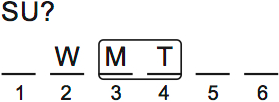
That’s A, which is CORRECT. It reverses TM to MT. If you don’t have TM, you need WM. And you need SU since you can’t have ST.
So we would have WMT. And SU would have to go before them, because U is before W. There’s no space:
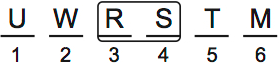
These diagrams prove that B–E are possible:
B
C
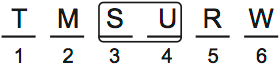
D
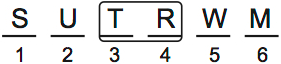
E
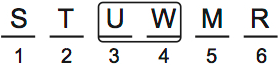
Remember, if a scenario doesn’t violate any rules, it’s correct. If you’re slow at drawing scenarios like these, practice! If you know the rules like the back of your hand you can draw a scenario to disprove an answer in about 5-10 seconds.
Question 23
This is very similar to question 22. I thought I had to brute force it. But then I remembered the four special configurations:
- ST
- SU
- TM
- WM
Answers C and D reverse one of these configurations. Reversing a special configuration makes it harder to obey the rules.
I drew C first, but it was possible:
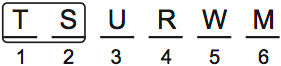
D doesn’t work, so it’s CORRECT. If you draw UT first, then there’s no way to do ST or SU:
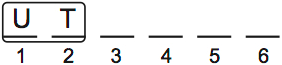
I’ll repeat the rationale for trying C and D first. We need ST or SU. So taking two of those letters and putting them out of order (UT) greatly restricts our options for placing ST or SU.
These diagrams prove that A, B and E are possible:
A
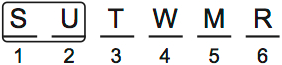
B
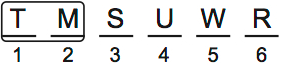
E
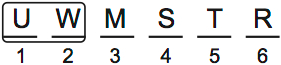
Note that A and B use SU and TM. Those are two of the four special configurations. So these answers make it easier to satisfy the rules. They were poor candidates.

Leave a Reply