
LSAT Preptest 63 LG Explanations
Full explanations for every question from the logic games section of LSAT Preptest 63.
Archived Logic Games explanations
Logic Games are no longer part of the LSAT. LSAC removed the Logic Games section beginning with the August 2024 LSAT. If you are studying for the current LSAT, you can skip this section.
These explanations remain available for students, tutors, and readers using old-format PrepTests. For current guidance, see Logic Games and the current LSAT.
Table of contents
Game 1: Courts
Game 1 Setup
This is an explanation of the first logic game from Section II of LSAT Preptest 63, the June 2011 LSAT.
There are seven candidates to be judges. They will each be appointed to one of two courts. The judges are Hamadi, Jefferson, Kurtz, Li, McDonnell, Ortiz, and Perkins (H, J, K, L, M, O, P). Each of them will be be appointed either to the appellate court (A) or to the trial court (T). There are nine open positions but not all of them will be filled – there are not enough candidates.
Game Setup
This is one of the easiest logic games I’ve ever seen. If you redo this, you should aim not just to get everything right, but to be able to solve it in four minutes or less.
Here’s how I drew the trial and appellate courts:

The first and second rules are easy. You just place Li on the appellate court, and place Kurtz on the trial court:
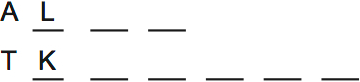
The third rule says that Hamidi and Perkins can’t go on the same court. You might be tempted to draw that rule separately. That would be a mistake. You should always draw rules directly on the diagram, if possible. Watch what happens when you draw the third rule directly on the diagram:

Now it’s obvious that the appellate court only has one space open. This is the key to solving the game very quickly. This deduction can save you 2-3 minutes on this game, which will leave you extra time for the hard games.
Finally, you should think about who’s left to place. J, M and O have no rules. I drew these at the upper right of the diagram. This way, they were always in my mind.

Game 1 Main Diagram
These diagrams show the rules used to determine the courts (A, T) to which the seven candidates (H, J, K, L, M, O, P) will be assigned. The scenario is quite restricted: only J, M and O can be placed freely between the two courts, and there is only one space on the appellate court.
Refer to these diagrams when solving this game. Copy them on your own page, and on each question make a new version of them in order to follow along with my explanations. You’ll learn much more if you draw along.
The setup section explains how to build this diagram.
Main Diagram
Question 1
For list questions, go through the rules and use them to eliminate answers one by one.
Rule 1 eliminates A. Li must be on the appellate court.
Rule 2 eliminates C. Kurtz must be on the trial court.
Rule 3 eliminates B and D. Hamidi and Perkins can’t be on the same court.
E is CORRECT. It violates no rules.
Question 2
Questions 2, 3 and 4 deal with the fact that there’s only one space open on the appellate court. I looked for this rule violation first.
B is CORRECT. If McDonnell and Ortiz are both on the trial court, then there are four people on the trial court: L, one of H/P, M and O.
If you think any of the other answers also can’t work, you’ve likely got one of the rules wrong. Go back over the setup to see what you’re missing.
Question 3
There’s only one space open on the appellate court. So Jefferson and McDonnell can’t both go there.
A is CORRECT.
Question 4
If Ortiz is placed on the appellate court, the appellate court is full. Thus, Jefferson and McDonnell must go on the trial court.

C is CORRECT.
Question 5
The only hard question on this game. Remember, four answers are wrong. You shouldn’t treat them as if they’re good answers! They’re almost certainly wrong. The answers have to prove themselves to you before you take them seriously.
You’re looking for a rule which will have:
- The same restrictions as the original rule.
- No additional restrictions.
The original rule was simply: Hamidi and Perkins can’t be together, on either court. Let’s evaluate the answers from this perspective.
A: What about the trial court? This answer lets H and P be together on the trial court.
B: This answer lets H and P be together on the trial court.
C: Jefferson can go on either court. So using this answer, Jefferson could go on the appellate court, and Hamidi and Perkins could be together on the trial court.
D: What happens if Hamidi is not appointed to the same court as Li? In that case, this rule allows Hamidi and Perkins to be together.
Those answers are useless. They were put there to distract you and prevent you from looking at answer E.
Let’s talk about how you can replace a rule. You can’t just reword a rule. That would be the same rule. Instead, you have to use some other factors already present in the game to achieve the same effect.
The game places Li in the appellate court, and Kurtz in the trial court. So, we can say that Li is the appellate court and Kurtz is the trial court. By which I mean: anyone placed with Li is on the appellate court. Anyone placed with Kurtz is on the trial court.
E talks about “three of Hamadi, Kurtz, Li and Perkins”. Li and Kurtz are already separate. So three of those four must either be:
Hamadi, Perkins and Li, or
Hamadi, Perkins and Kurtz
Those are the two possibilities rule three originally prevented. So answer E is CORRECT, it achieves the same effect as the original rule.
Game 2: Skydiving
Game 2 Setup
This is an explanation of the second logic game from Section II of LSAT Preptest 63, the June 2011 LSAT.
Six skydivers – Larue, Ohba, Pei, Treviño, Weiss, and Zacny (L, O, P, T, W, Z) will dive from a plane one at a time. The entire skydiving team will dive. You must use the rules to determine the possible orders they can dive in.
Game Setup
This is an interesting game. You could solve it effectively by making a list of rules and applying them to every question. But you can solve it even faster by making two main scenarios.
Let’s look at the fourth rule first. It’s the most complicated. Pei is after one of Obha or Larue, but not after both.
The LSAC has been including this type of rule more and more on modern sequencing games. It’s confusing the first time you read it. What this rule is really saying is that Pei is in the middle of Obha and Larua, in either order. Like this:

Now, Larue was mentioned in the second rule as well. Anytime a game mentions a variable in two rules, there’s usually a way to combine those rules.
Use the second rule to make two scenarios
First, let’s draw the second rule. There are two possibilities: Larue goes first or last. Whenever there are only two possibilities, you should split the diagram:
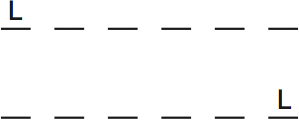
How do we combine the rules? Look at both diagrams. The placement of Larue determines the order for Pei and Ohba in each scenario. If Larue is first, then we get P – O. If Larue is last, then we get O – P.
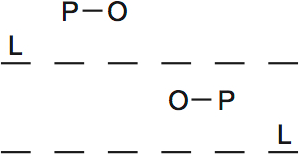
I’ve drawn P – O and O – P floating above the diagram. This is a reminder of what order the members must be in, in each diagram. There’s no sense making a deduction then not drawing it. This way you can never forget the order of L, P and O in each scenario.
We can get separate deductions in each scenario
Next, let’s add the third rule. Weiss and Zacny can’t be last. This only affects the first scenario, since L is last in the second scenario:

Finally, Treviño is before Weiss. That’s just a simple ordering rule, drawn like this:

However, I prefer to place that rule directly on the diagram, along with the remaining variables. When you see everything together, you can make deductions and form scenarios:
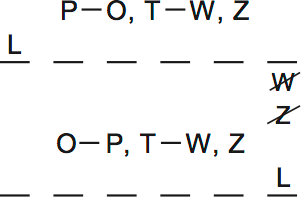
Now we can see everything at once. The commas indicate there’s no ordering rule. So in the second diagram, Zacny could go first, second, third…. anywhere but last.
These two scenarios let you visualize all the possibilities without getting sucked into drawing endless “could be true” scenarios.
But we’re not done. Notice that the first scenario is more restricted than the second scenario. Weiss and Zacny can’t go last. Whenever a space has restrictions, you should see who can go there.
- Not Weiss and Zacny, due to the third rule.
- Not Treviño, because Weiss is after Treviño.
- Not Pei, because Obha is after Pei.
- Not Larue, because Larue is first in scenario one.
The final scenarios are very restricted
Only Obha can go last in scenario 1!

This is the final diagram I used to solve this game. I had never seen this game before, and I did it in five and a half minutes. Such a diagram is far faster than the normal approach of making a list of rules and applying them.
(On some games I do make a list of rules and apply them, because it’s not possible to make a diagram like this.)
I recommend you print a fresh copy of this game, and draw this diagram on the page. Then solve the questions. Do this before you look at the explanations. I want you to practice visualizing scenarios using this kind of diagram.
Game 2 Main Diagram
These diagrams show the rules used to determine the possible dive sequences of the six members (L, O, P, T, W, Z) of the skydiving team.
Refer to these diagrams when solving this game. Copy them on your own page, and on each question make a new version of them in order to follow along with my explanations. You’ll learn much more if you draw along.
The setup section explains how to build this diagram.
Main Diagram
Question 6
For list questions, go through the rules and use them to eliminate answers one by one.
Rule 1 eliminates C. Treviño must be before Weiss.
Rule 2 eliminates E. Larue has to be first or last.
Rule 3 eliminates A. Weiss can’t be last.
Rule 4 eliminates D. Pei has to be between Ohba and Larue.
B is CORRECT. It violates no rules.
Question 7
Here are the two scenarios again:
I looked at these diagrams to eliminate answers. Remember, if an answer doesn’t have to be true, then it’s not right.
A doesn’t have to be true in the second scenario. Larue is last.
B doesn’t have to be true in the first scenario. Obha is last.
C doesn’t have to be true in either scenario. We can place Pei fifth. The commas indicate that Pei can go anywhere in the open spaces, as long Pei is in between Obha and Larue.
E doesn’t have to be true. We can place Weiss fifth in either scenario. Though I’ve drawn Zacny after Weiss, the commas indicate that they’re interchangeable.
D is CORRECT. Weiss is always after Treviño. And in both scenarios there’s someone after Weiss: Ohba or Larue. That makes at least two people after Treviño.
Question 8
Larue is last in the second scenario. Here’s that scenario again:
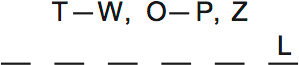
Remember, you’re looking for something that can’t be true.
I disproved the wrong answers by rearranging the variables in my mind. For instance, in A, I saw that nothing stopped my from placing Treviño and Weiss fourth and fifth, like this:
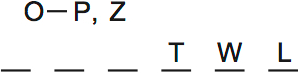
I recommend you practice shuffling variables around like that, mentally. It’s a very fast method. I only drew this diagram so I could have something to show you. I wouldn’t draw it under timed conditions. I’d do everything mentally.
Here’s the diagram again for the remaining answers. That most recent diagram was just to prove A:
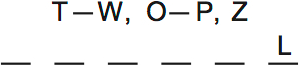
B is possible. T – W can be placed third and fourth.
C is not possible. Obha goes before Pei, so Obha is fourth at latest in this scenario. C is CORRECT.
D and E are possible. There’s nothing stopping Pei or Zacny from going fifth.
Question 9
When a question gives you a new rule, you should draw the new rule. Here are both scenarios, with Zacny immediately after Weiss:
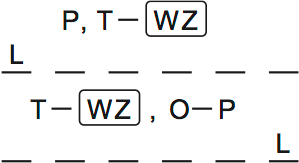
Now you can use the same approach of visualizing the scenarios using these two diagrams. If an answer is possible, it’s wrong.
A is possible in the first scenario. Larue is first in that scenario.
B is possible in the first scenario. Just put Pei second and Treviño third.
C is possible in the second scenario. Just put T – WZ in the first three spaces.
E is possible in the first scenario. Put Zacny fourth and Pei fifth.
(Note that most of these are possible in either scenario. I’m not trying to prove all the possibilities. I’m just trying to prove the answers are possible somewhere, and therefore wrong.)
D is CORRECT. In this scenario, Pei can only go second, third or fifth. I recommend trying a couple of sketches using the diagram above if you have any doubts on this point.
Question 10
This question places Treviño after Larue. That means we’re in the first scenario, since Larue is last in the second scenario.
Here’s the first scenario, with Treviño directly after Larue:
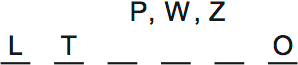
You’re looking for an answer that can’t be true.
A is CORRECT. In the first scenario, Obha is last.
All of the other answers are possible. There are now no restrictions on where Pei, Weiss and Zacny can go. Any of them can go third, fourth or fifth.
Game 3: Servicing
Game 3 Setup
This is an explanation of the third logic game from Section II of LSAT preptest 63, the June 2011 LSAT.
Six company vehicles – a hatchback, a limousine, a pickup, a roadster, a sedan, and a van (H, L, P, R, S, V) – will be serviced during a week. One vehicle will be serviced each day, from Monday to Saturday (M, Tu, W, Th, F, S). You must use the rules to determine the possible orders of the vehicles.
Game Setup
I made almost no deductions on the setup when I first did this. But as I was going through the questions, I saw I had missed a major deduction. I’ll first show you the standard setup, then I’ll show you how to make the deduction.
(I still did fine on this game. I figured out the deduction on the first question where it was useful, and so I was able to use the deduction on all the questions where it mattered. )
Here’s the standard setup. I combined rules one and two:

We don’t know who is after H, but someone is, so you should draw that.
The third rule, I drew as an “Or” statement. This is an exclusive or, unlike most “Or’s” on the LSAT. Since both “Or’s” in this game are exclusive, I just memorized that detail.

Most people draw the fourth rule wrong
The fourth rule is very common on modern linear games. Most students just draw this:

This is incomplete. The rule says “but not both”. If the sedan is before the pickup, then it can’t be before the limousine. That means the sedan is after the limousine. Likewise, if the sedan is before the limousine, then it can’t be before the pickup, so the sedan is after the pickup. Here’s the full rule:

Always draw the full rule.
Deduction: Only L or P can go last
Now, the three diagrams I’ve drawn above are enough to solve the game. It’s what I drew when I first did this game – but I made a big deduction on question 14: only the pickup or the limousine can go last.
I’ll explain how I figured that out. It’s possible to make this deduction upfront. You can do this by looking at the most restricted space. In this case, the last space is very restricted.
- The van and the roadster can’t go last, because they’re before the hatchback.
- The first rule says the hatchback can’t go last.
- The sedan can’t go last, because it’s in between the pickup and the limousine.
You can draw these restrictions as “not” rules under the final space:
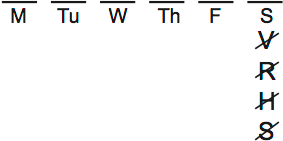
That’s four variables that can’t go last. So only the limousine and the pickup can go last. You can turn this into two diagrams:

Remember, the order has to be P – S – L or L – S – P. Having P or L last determines the order of this group in both diagrams. I’ve drawn this.
We know that the pickup needs to be beside either the sedan or the van. In the second scenario, only the sedan can go fifth. That’s because the van is before the roadster and the hatchback. (You can’t deduce anything new in the first scenario):
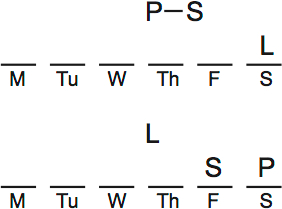
Next, you should draw the remaining variables on each diagram. This helps to visualize possibilities:
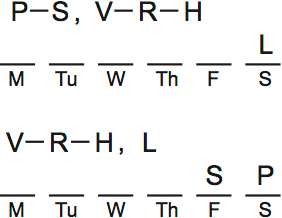
The commas indicate that variables are interchangeable. For instance, P – S could go before V – R – H in the first scenario, or after, or in between.
In the initial setup, I drew V – R – H – __ . I haven’t drawn a space after H here because the rule just says H can’t go last, and both diagrams now have someone last. So the first rule is automatically fulfilled in both diagrams.
There are only two main scenarios
Only the third rule isn’t on the diagram now. That still applies to the first scenario. I drew it up and right as a reminder:
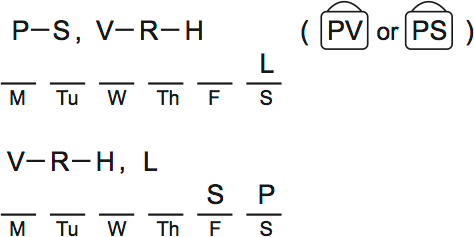
This is exactly what my diagram looked like the second time I did the game. It was much faster. I recommend you try this game with both the rules based approach and the scenario based approach. Personally, I find the scenarios much faster, but I don’t always see them up front.
Game 3 Main Diagram
These diagrams show the rules used to determine the possible orders that the vehicles (H, L, P, R, S, V) will be serviced in during the week (M, Tu, W, Th, F, S).
Refer to these diagrams when solving this game. Copy them on your own page, and on each question make a new version of them in order to follow along with my explanations. You’ll learn much more if you draw along.
The setup section explains how to build this diagram.
Main Diagram
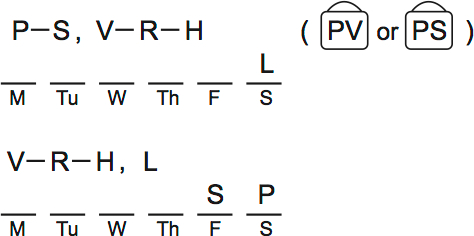
In the setup, I showed two ways to do this diagram. The first way is the rules based setup. The second splits the game into two scenarios, because only L and P can go last.
See the setup section for a walkthrough of how to get the two scenarios.



OR
Question 11
For list questions, go through the rules and use them to eliminate answers one by one.
Rule 1 eliminates C. The hatchback can’t be last.
Rule 2 eliminates A. The van has to be before the hatchback.
Rule 3 eliminates D. The pickup needs to be beside the sedan or the van.
Rule 4 eliminates E. The sedan needs to be between the limousine and the pickup.
B is CORRECT. It violates no rules.
Question 12
This question asks who can’t go Thursday. Thursday is closer to the end. We should look for people who are hard to place near the end. Check the rules and see who has to be placed earlier.

The van needs three people after it. It can go Wednesday at the latest. E is CORRECT.
Question 13
This question says that the pickup and the limousine can’t be placed Monday. Whenever a question placed restrictions on a spot, you should check what other restrictions exist.
Who else can’t go Monday? Not the sedan, the sedan must go between the pickup and the limousine.
Not the roadster and the hatchback, they must go after the van (rule 1). So none of the pickup, the limousine, the sedan the roadster or the hatchback can go first in this question:
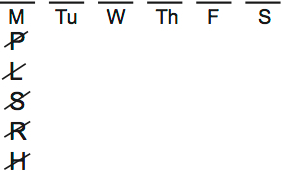
Only the van can go Monday! C is CORRECT.
Question 14
Remember the deduction from the setup: only the pickup and the limousine can go last. This question says the limousine can’t go Saturday, so that means the pickup goes saturday:

The third rule says that either the sedan or the van is beside the pickup. In this scenario is has to be the sedan, since the van must go before the roadster and the hatchback (rule 2):

Once you make a deduction like this, check to see if it answers the question. E is CORRECT. The sedan can’t go Wednesday, because the sedan must go Friday.
Now, for the other answers. Here’s a diagram showing all the possibilities when SP and 5 and 6:
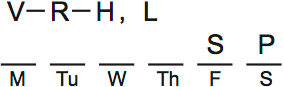
The order as I’ve drawn it disproves B and C. Just lower the variables into the spaces they’re hovering above.
The comma indicates L could go before V – R – H. If you put LVRH in 1-4, then this disproves A and D.
Question 15
Remember the deduction from the setup: only the pickup and the limousine can go last. This question places the sedan before the pickup. Therefore the order is L – S – P (rule 4) and the pickup must be last:

The sedan goes friday because the pickup needs the sedan or the van beside it. And the van can’t go Friday, because it’s before the roadster and the hatchback.
(So far, this is exactly the same as question 14)
Now that you have this diagram, you should use it to eliminate answers. I’m going to eliminate the easy ones first.
B is wrong because the sedan is Friday, not Wednesday.
D is wrong. The hatchback can’t go Friday because the sedan is already there.
E is wrong. The limousine can’t go Saturday because the pickup is already there.
That leaves A and C. You should always try and eliminate the answer with the most restrictions.
The van has more restrictions than the limousine, so let’s try C. But, this doesn’t work; it turns out the van can’t go Wednesday. Only Thursday is left open after the van, but both the roadster and the hatchback must come after the van.
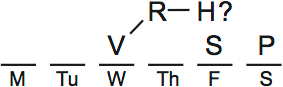
A is CORRECT. The limousine can go Wednesday. This diagram proves it:

Question 16
The limousine is mentioned in rule four: the order of the three variables is either L – S – P or P – S – L
This question places the limousine last, so the order must be P – S – L.

Once you make a deduction, check the answers to see if it’s there. It is: B is CORRECT.
If you make a prephrase and you find it in the answers, you can be very sure it’s right. Especially if it’s based on a deduction linked to the local rule.
Whereas if you approach the answers not knowing the answer, you have to be skeptical of every answer, because they may be traps.
Question 17
I used the deduction from the setup for this one: either the pickup or the limousine has to be last.
I’ll repeat that, it’s extremely important. Either the pickup or the limousine must be last. See the setup section for how to reach that deduction.
Also, the sedan has to be in between the pickup and the limousine. These two facts eliminated three answers.
Remember, the answers are telling us who’s in Tuesday, Wednesday and Friday. Thursday is skipped:
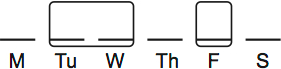
A is wrong because either the pickup or the limousine needs to be last.
C is wrong because the sedan has to be in between the limo and the pickup. But since one of P or L must go last, the pickup. That means the sedan is not in the middle:
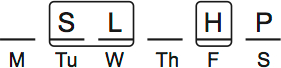
E is wrong because the limousine and the pickup would be beside each other. Either the limousine or the pickup must go last. Since this question place the limousine Friday, then the pickup would go saturday. There’s no space for the sedan to go between them:

Note that I eliminated those answers without drawing diagrams. I’m including them only so this explanation is easier to follow.
Now only B and D are left. I did draw diagrams to test these.
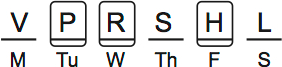
This diagram shows that B is CORRECT. It violates no rules:
This diagram shows that D doesn’t work. there’s no space for R to go after V:
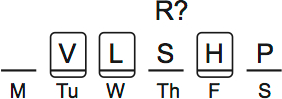
The sedan has to go Thursday because the sedan must go between the limousine and the pickup.
Game 4: Colored Balls
Game 4 Setup
This is an explanation of the fourth logic game from Section II of LSAT Preptest 63, the June 2011 LSAT.
A street entertainer has six boxes, stacked on top of each other. They are numbered 1 through 6, from the bottom to the top. Each box has a single colored ball. There are three possible colors – green, red and white (G, R, W).
Game Setup
This is a linear game, but it says the balls are above/below each other. So here’s how most people draw this game:
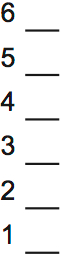
But here’s how you’ve drawn dozens of games that are very much like this one:

Why would you totally switch the way you make a diagram, just because the setup says above/below? None of the questions use “above/below”. They just use the normal numbers you’ve seen on dozens of other linear games.
Draw this one left-to-right, like the rest.
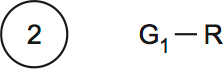
The rules themselves are nothing special. I couldn’t combine them. Here’s how I drew the three rules:

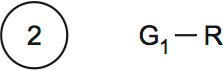
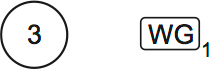
Rules two and three are both “at least one”, so the ‘1’ in both rules is a reminder. I just memorized the fact that it was “at least one” and not “only one”.
(The “at least one” is implied by “there is a”. Unless a rule specifies “only one”, the rule means “at least one”.)
The first rule is the one worth thinking about. There are more red balls than white balls. The possibilities are rather limited. If there are two white balls, there are three red balls, and one green ball.
If there is one white ball, then things are more flexible. There could be as many as four red balls, and at least one green ball. Or there could also be as many as three green balls, and only two red balls.
The other two rules you simply have to memorize. This game is a lot faster if you always remember that there’s a green ball before any red balls, and that there’s at least one white directly before a green.
Game 4 Main Diagram
These diagrams show the rules used to determine the colors (G, R, W) of the balls inside the boxes (1, 2, 3, 4, 5, 6).
Refer to these diagrams when solving this game. Copy them on your own page, and on each question make a new version of them in order to follow along with my explanations. You’ll learn much more if you draw along.
The setup section explains how to build this diagram.
Main Diagram

Rules
Question 18
If there are two white balls, then there must be three red balls (rule 1) and one green ball – you always need a green ball.
Since there’s only one green ball, there must be a white ball directly in front of it (rule 2). And this WG pair must be in front of all red balls (rule 3):
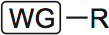
There is a second white ball. This is the only ball that can go in front of the WG pair. So green can go second or third:


B is CORRECT.
Question 19
Whenever a question gives you a new rule, you should draw it. There are green balls in boxes five and six:

Now, let’s think about the other elements we need:
- A green before the reds (rule 3)
- A white directly before one of the greens (rule 2)
That’s four letters. There are two left. Rule one says we need more reds than white, so the other two balls must be red. So here’s what’s left to place: W, G, R, R
Let’s see what happens if we put white in four:

We have a green and two reds left. They must go like this:

There’s a second scenario, where the WG block is first:

Next, look through the answers to see which one of them is possible in one of the two scenarios.
C is CORRECT. It’s possible in the second scenario.
Question 20
This is a tricky question. I skipped it the first time I did it. I was then able to use scenarios from later questions to eliminate some answers.
Note: This question is asking if a ball cannot be the only one of its kind, and in the listed space. So if a ball can be the only one of its kind, in the listed space, that answer is wrong. For example: if there is a scenario with only one white ball, and that white ball is in spot 3, that scenario eliminates B.
This scenario from question 19 eliminates C:

This scenario from question 23 eliminates D:

In question 18, we saw a scenario with two white balls, three red balls and one green ball. We were able to place Green 2nd or 3rd, and it was the only green. This eliminates A and B:

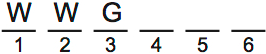
(There are no other greens. That’s why I haven’t bothered to fill out the rest of the scenarios. In a timed situation, I just looked back at the diagram I drew for question 18 and said “ok, this eliminates A, there is only one green, etc.”)
Sometimes it makes sense to do questions out of order. Thanks to elimination from other questions, we disproved all the wrong answers.
E is CORRECT. Process of elimination is enough, but I’ll explain why it’s right using logic. If the sixth spot is red, it isn’t unique. There are always multiple reds.
If the sixth spot is white, it isn’t unique. There must be another white before a green, somewhere (rule 3). If the sixth spot it green, it isn’t unique. There must be a green before the reds too (rule 2).
Question 21
A is CORRECT. I’ll prove it must be true. Green must be before red. And there are always at least two reds. If there are three or more reds, we can’t put green fourth. Green would go third at earliest.
So let’s try with just two reds. We could put them in five and six, and put a green in four:

So far so good – but what color are the other balls? We can only have one white ball, because we need more red balls than white balls. So the other balls must be green. Here’s one example:
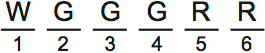
With so many greens, there’s no way to avoid putting them earlier than four!
My scenario above disproves B and C.
This scenario disproves D and E.
Remember, you can do anything as long as the rules don’t specifically ban it.
Question 22
This question says red balls are in boxes two and three. You should draw that, then apply the rules. Green has to come before red (rule 2), so green goes first:

Next, think about who’s left to place. We need a WG block. The third variable will be red or green. It can’t be white, because we need more reds than white:
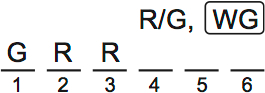
This diagram disproves A and B.
D and E don’t fit. C is CORRECT. The fourth ball can definitely be green.
Question 23
This question says that balls 2, 3 and 4 are the same color as each other.
That can only be green or red. We can’t have three whites, because there must be more red than white (rule 1).
I made both diagrams (red and green):
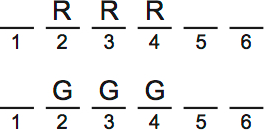
Let’s apply the rules. There must be a green before the reds. And there are at least two reds. In the first diagram, that means we need to put green first. In the second diagram, that means we need to put two reds in 5-6.
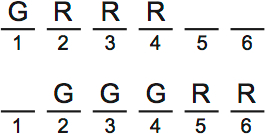
Next, we to place a WG block (rule 3). In the first diagram, only 5-6 has space. In the second diagram, we can put a white in spot 1:
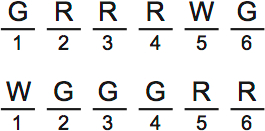
D is CORRECT. In both diagrams it must be true that there’s only one white.

Leave a Reply