
LSAT Preptest 64 LG Explanations
Full explanations for every question from the logic games section of LSAT Preptest 64.
Archived Logic Games explanations
Logic Games are no longer part of the LSAT. LSAC removed the Logic Games section beginning with the August 2024 LSAT. If you are studying for the current LSAT, you can skip this section.
These explanations remain available for students, tutors, and readers using old-format PrepTests. For current guidance, see Logic Games and the current LSAT.
Table of contents
Game 1: Parking
Game 1 Setup
This is an explanation of the first logic game from Section II of LSAT Preptest 64, the October 2011 LSAT.
Six new employees must be assigned parking spaces. An administrator will assign the spaces to Robertson, Souza, Togowa, Vaughn, Xu, and Young (R, S, T, V, X, Y). The rules determine which employee can get which space.
Game Setup
This is a linear/sequencing game. You have to figure out how to order the six employees. The last rule is the most restrictive and it makes sense to start there (I always read all the rules before drawing).
The last rule says that R can’t go in 5 or 6:

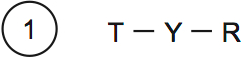
Now you can look at the sequencing rules. Start with one rule, and see what you can add on to it. You can usually combine some or all of them.

Above, I’ve combined the first and third rules. It’s a good idea to focus first on rules that can be combined. No one said you have to do them in order.
Note that “higher numbered” is to the right in this game. Often “higher” is to the left on sequencing games, so it’s easy to get confused. If you’re ever uncertain, look to the first question. You’ll see they’ve set it up with the higher numbers to the right.
Here’s the second rule. S comes before X. This can’t be combined with anything

The final thing to notice is that V has no rules. You should always check for random variables that have no rules. I draw circles around them.

Before moving on, think about how everything fits together. R has two people in front of it, so it can only go in 3 or 4. Here’s what things look like if R is in 3:

Since T and Y come before R, they have to go in 1 and 2.
I’ve drawn “S – X, V” above the diagram. That shows those three variables come after R. S is before X, and the comma before V shows V is also there, in any order.
There are other ways to draw this, but you should always try to fit rules and variables directly onto the diagram. Otherwise it’s easy to forget them. I find placing variables above the lines is a very useful way to remind myself of what the other variables are and where they go.
So in my diagrams, if you see things above the diagram, separated by a comma, it means they go in that area, in any order.
Here’s R in four. This diagram is a bit more flexible:

Either S or V could go before R, and S/V could go before, after or between T – Y. You should be aware of these possibilities, but don’t try to draw all of them.
I like having this template to help me visualize the possibilities when a question calls for it. Note that the template is a bit unclear. I’ve drawn S and V after R, but one of them will go before R.
Game 1 Main Diagram
These diagrams show the rules used to determine the possible placements of the new employees’ (R, S, T, V, X, Y) parking spaces.
Refer to these diagrams when solving this game. Copy them on your own page, and on each question make a new version of them in order to follow along with my explanations. You’ll learn much more if you draw along. The setup section explains how to build this diagram.
Main Diagram
Rules


Question 1
The first question is usually easiest to answer by taking the rules one at a time and applying them to the answer choices.
Rule 1 eliminates A. Young should be after Togawa.
Rule 2 eliminates C. S should be before X.
Rule 3 eliminates D. R should be after Y.
Rule 4 eliminates B. R cannot be in 5 or 6.
E is CORRECT.
Question 2
This question gives us a new rule; these are called local rules because they’re specific to the question. They only apply “locally”.
You should always draw local rules.
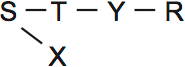
Now S is in front of T, Y and R. Since R can’t go in 5 or 6, this means R must go in 4.
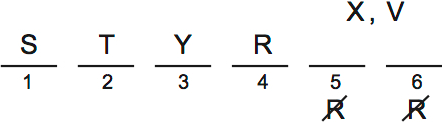
I’ve drawn X and V above to show that they come afterwards, in either order. There are no rules about where to put X and V, as long as X is after S.
We can see from the diagram that none of the answer choices can be true except B, which is the CORRECT answer.
There’s only one way to draw STYR with the new rule. Everything becomes clear once you draw the new rule.
Question 3
LSAT games have a lot of moving parts. These questions ask you to pin everything down. That can seem hard, so here’s a tip: start with the answer that mentions a random variable. Random variables have no rules, so they’re the hardest to force into one place. Watch what happens if we put V in 3:



I’ve drawn the ordering rules above. R has to come after T – Y, and R can only go in 3 or 4, so we have to put R in 4, and TY in 1 and 2.
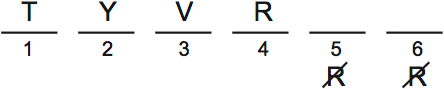
Only S and X are left, and we know S comes before X.

C is CORRECT. Often, it’s best to pick the most likely answer and start drawing. It’s hard to see how things fit together unless you try.
We saw A and B and D in question 2. S was in 1, Y was in 2 and R was in 4, but we still could choose where to put V and X.
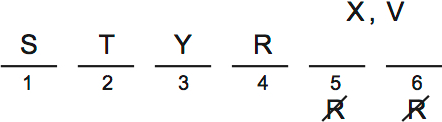
E is wrong because if you put X in 5 you can still choose to put S before or after T – Y.
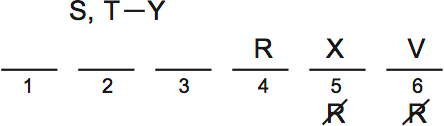
Question 4
Past diagrams can be useful on this type of question. It also helps to think about variables in groups. Start with the most restricted group: T – Y – R.
R, T and Y can only go in two spots each. R goes in 3 or 4, and that leaves T and Y only two spaces to move in too.
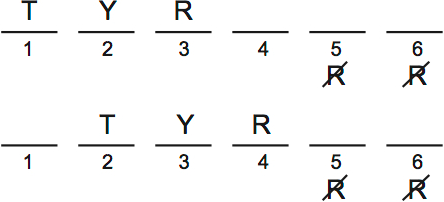
Most people choose C. But X is also restricted to two places. That’s because X has to go after S. That leaves only slots 5 or 6 open for X. There’s no space for both S and X to go before R.
Here are three different diagrams with X in five or six. I’m also using these diagrams to prove that V and S can go in more than two places:

So T, Y, R and X can only go in two places.
D is CORRECT.
Question 5
This question gives us another local rule to draw. If you’re not comfortable changing your diagram, or you’re not fast at it, then practice. It’s a supremely important skill for logic games, and you can get better at it.
This should only take about 5–10 seconds to draw. You draw T – Y – R, then draw the new rule showing S in front of Y, then add in your old rule that puts X afterwards:
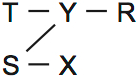
R has to go in 4 because three variables come earlier. Y is in 3 because S and T come earlier. X and V are left to go after R.
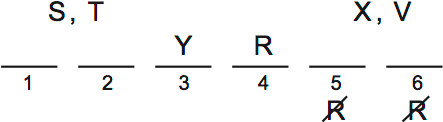
A is CORRECT. T can go in 1 or 2.
You can see from the diagram that B–E are wrong. Y and R have to be in 3 and 4, and S and V can’t be in 3 and 4.
Question 6
Another new rule. R is in 3. We saw this at the start. If R is in 3 then T and Y are forced into 1 and 2.
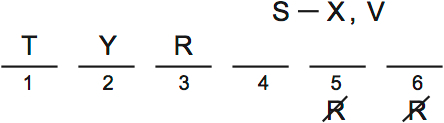
S and X come afterwards, in that order, and V can go anywhere.
A is wrong because S could also go in 5.
B is wrong because T has to be in space 1, not 2.
C is wrong because V could also go in 4 or 6.
D is wrong because X could also go in 5.
E is CORRECT. Y is always between T and R. So if R is in 3, Y goes in 2.
Game 2: Ambassadors
Game 2 Setup
This is an explanation of the second logic game from Section II of LSAT Preptest 64, the October 2011 LSAT.
A government needs to assign new ambassadors to Venezuela, Yemen, and Zambia (V, Y, Z). There are five candidates to fill the positions: Jaramillo, Kayne, Landon, Novetzke, and Ong (J, K, L, N, O). You need to use the rules to determine who can be assigned to each country.
Game Setup
This is an in-out grouping game, with three groups. There are five ambassadors, and only three will be chosen.
The first thing you should always do is read through the rules and think about how to setup the game. Some people start drawing right away, but you should think about the best way to set up the game before you draw anything. Taking the time to do things right usually helps you go faster.
If you’re stuck, the first question often shows the best way to do it. On this game, the countries are the groups, and it’s easiest to arrange them vertically.

I’ve drawn the final rule on the left of the diagram. L can only go to Zambia. Another way of saying that is: L can’t go to Venezuela or Yemen.
There are a couple of ways to draw the first rule. This diagram shows that K and N are never together.

But this is incomplete. It doesn’t show that one of K and N has to be in. Also, you can’t connect this type of diagram to other rules.
I’ve come to prefer drawing this type of rule a different way, on games where you can join several rules together (like this one. We’ll get to that soon).

This is confusing at first, but it’s very effective. If you have K, you don’t have N. And if you don’t have N, you do have K.
If you draw the two halves of the rule separately, it’s very easy to forget half of the rule. I get to watch a lot of students do logic games, and forgetting easy rules is one of the most common problems.
So I’ve drawn the two halves together as a reminder. You don’t want to forget that the relationship goes both ways. There’s no logical problem with having the same variable twice on the same diagram. If you are told N if out, you must remember that K is in, and this diagram helps you do that.
Once you split these diagrams into two and write down the full rule, there’s quite a bit you can do. Look at the second rule. We can add it to the first diagram, to get this.


If J is in, you know almost everything. You have J and K, and you’re missing N. You need one of O and L too, to get three ambassadors.
N ➞ K ➞ N was the other diagram. Here’s the second rule combined with the other diagram:

If you have N, you don’t have K and you don’t have J. And if you don’t have K, you do have N.
You may still be wondering why it’s important to write N twice. Well, some questions may start by saying “K is not assigned to an ambassadorship”. If you don’t write the second N, you might forget about that rule, and only focus on the rule that says J isn’t in.
I can’t count how many times I see students forget rules; the games are designed to make you forget.
When you write both rules on the diagram this way, you literally cannot forget. It’s right there, staring you in the face. You no longer have to think about it, you can simply apply the rules. Most students’ mistakes come from forgetting rules they drew correctly.
Drawing both rules also lets you make a further deduction from this diagram. You need three out of five candidates. If N is in, you lose K and J. So you need O and L to make three.

If N is in, we know almost everything that happens. L is assigned to Z, and N and O go with V or Y.
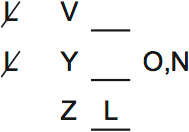
The last rule is simple. If you see O with V, then K is not with Y.

As it turns out, these diagrams aren’t much use on the questions for this game. But I wanted to show you how to make them, for two reasons:
They usually are very useful.
If you know how to make this sort of diagram, then you truly understand the game. You’ll do well on the questions, whether or not you actually need the diagrams.
You should get in the habit of making deductions and making complete diagrams whenever you can.
There’s one other thing you should know for each game. You should know all of the rules, by heart if possible. If you can’t remember them, then have them all in a list. On this game, you can solve most questions by mechanically applying the rules to eliminate answer choice. The rules are:
1. Exactly one of K or N is in.
2. If J is in, K is in. If K is out, J is out.
3. If O is in assigned to V, K is not assigned to Y.
4. L can only be assigned to Z.
Know these four rules, and the game is simple. A good setup for this game would be the two diagrams I drew below, and the list of rules.
Game 2 Main Diagram
These diagrams show the rules used to determine which of the five ambassadors (J, K, L, N, O) will be chosen to fill the positions (V, Y, Z).
Refer to these diagrams when solving this game. Copy them on your own page, and on each question make a new version of them in order to follow along with my explanations. You’ll learn much more if you draw along. The setup section explains how to build this diagram.
Main Diagram
Scenario 1


Scenario 2 (Contrapositive)
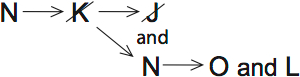

This game can be reduced to three simple diagrams that let you solve everything easily. If you’re unsure about them, then go back to the rules and try to set them up yourself. Learning to make this sort of diagram makes many games incredibly easy.
Rules
1. Exactly one of K or N is in.
2. If J is in, K is in. If K is out, J is out.
3. If O is in assigned to V, K is not assigned to Y.
4. L can only be assigned to Z.
Question 7
As with almost all first questions, you should use the rules to eliminate each answer choice, one by one. Each rule generally eliminates one answer.
A is wrong because J needs K (second rule).
B is CORRECT.
C is wrong because L can’t be assigned to any country except Z (last rule).
D is wrong because N and K can’t go together (first rule).
E is wrong because if O is assigned to V then K can’t be assigned to Y (third rule).
Question 8
These questions are hard, because you also have to think about the candidates who are assigned to ambassadorships. The easiest way is to write down the three ambassadors beside each answer choice.
A is CORRECT.
B assigns K, N and L to ambassadorships. K and N can’t go together (first rule).
C is wrong because J is in. If J is in then K has to be in too, not out (second rule).
D is wrong because one of K or N always has to be in (first rule).
E is wrong because it puts J, K and N in ambassadorships. K and N can’t both be assigned (first rule).
Question 9
Your first step on local rule questions should always be to draw the new rule, and make deductions. If O is in V, then K can’t be assigned to Y (the third rule).
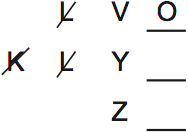
A is wrong because one of K or N needs to be in (first rule).
B is wrong because if J is in, K needs to be in too (second rule).
C is wrong because K can’t be assigned to Y in this case (third rule) and L can never be assigned to Y (fourth rule). Y needs someone to be assigned to it.
D is wrong because K and N can’t go together (first rule).
E is CORRECT. L can be assigned to Z and N can be assigned to Y.
Question 10
You should also draw this local rule question. Since K is in Yemen, O can’t be assigned to Venezuela (third rule). We know N can’t be in, because K is in (first rule). L can never be assigned to Venezuela either.
So the only person left who can be assigned to Venezuela is J. One of L or O will be assigned to Z.
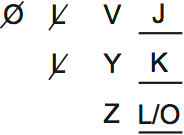
A is CORRECT. J must be ambassador to Venezuela.
B could be true, but O could be assigned to Z instead.
C could be true, but L could be assigned to Z instead.
D cannot be true. J has to be assigned to V, because no one else can go there.
E could be true, but it’s possible for O to be assigned to Z.
Question 11
This diagram proves A could be true:
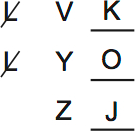
This diagram proves B could be true:
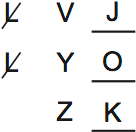
C is CORRECT. We saw in the setup that if N is in, K and J are out, and O and L are in. If L is in, L must be assigned to Zambia, so N cannot go there.
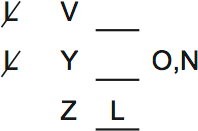
This diagram from question ten proves that D and E could both be true. Either L or O can sit out:
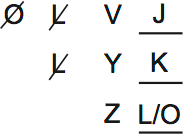
Question 12
The final question of a game sometimes asks you to substitute a rule. Many people find these questions very difficult, but they don’t have to be. You should ask yourself what the main effect of the rule is.
If J is in, K is in. That forces N out.
If N is in, K is out. That forces J out.
So J and N can never go together, because of the combination of the first and second rules. And if J is in, and N is out, then K must be in, because we always need one of either N or K (the first rule).
So the right answer has to force N out if J is in, and force J out if N is in. Any secondary effect of a rule is almost the only way the LSAT can make a rule substitution answer work.
Answer choice D is CORRECT. It captures all of this information. If J being in causes N to be out, then K to has to be in, thanks to the first rule. Everyone works out the same.
A gets the second rule backwards, and so it has a different effect.
B has a different effect as well. Previously, it was possible to have K, O and L all in together. Now this can’t happen. And this answer also ignores the main effect of the second rule: now J no longer forces K in.
C is way off base. There was no such relation between O and K in the original setup, and this new rule leave J with no effect on K.
E contradicts the old setup. The original rules combine to the effect that if N is in, O and L are in. See the setup for more detail on this point.
Game 3: Cycling Study
Game 3 Setup
This is an explanation of the third logic game from Section II of LSAT Preptest 64, the October 2011 LSAT.
Four bicycle riders – Reynaldo, Seamus, Theresa, and Yuki (R, S, T, Y) will do a two-day study for a cycling magazine. Each of them will test one of four bicycles – F, G, H, and J. The riders will test one bicycle each day, and they will test different bicycles on both days. Every bicycle is tested each day.
Game Setup
This is a grouping game. There are four bicycles, and four riders. The riders test one bicycle per day, for two days. They don’t test the same bicycle both days.
The first thing you should always do is read through the rules and think about how to setup the game. If you’re stuck, the first question usually shows the best way to do it. Here, it’s best to arrange the bicycles vertically.
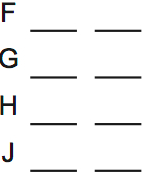
The first three rules are simple to add. R doesn’t test F, and Y doesn’t test J. You can draw those variables to the left of each bike, with lines through them. That reminds you not to put that rider with that bicycle.
T has to test H, once. You can draw T to the right of H, to remind yourself. Don’t think you won’t forget. You might get lucky, but in general, people who don’t write down rules forget them at some point. At best, you’ll go slower because you’ll have to look away from your diagram to remember the rules.
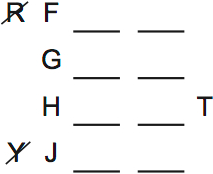
The last rule is the key to the game. YS go together on one of the bicycles. Y tests it first, then S.
Where can they go? Not J, because Y can never test J. They also can’t test H.
Why? Because if YS go in H, then there’s no room for T to go in H. So YS go in either F or G.
Note that it’s only on the first day that Y can’t test H. Y could test H on the second day; the rule with S only applies to Y’s first day.

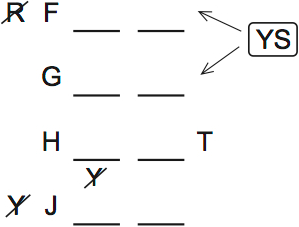
That diagram above tells us every rule. If you’re not sure how it works, then reread the rules to see how it’s built. If you know this diagram well, the game is easy.
Keep one main diagram that looks like this, then draw a simpler diagram when you have to make one for an individual question. You can usually leave off details like the T, since you’ll be often be putting T in H based on information the question gives you.
Game 3 Main Diagram
These diagrams show the rules used to determine the possible assignments of riders (R, S, T, Y) to bicycles (F, G, H, J).
Refer to these diagrams when solving this game. Copy them on your own page, and on each question make a new version of them in order to follow along with my explanations. You’ll learn much more if you draw along.
The setup section explains how to build this diagram.
Main Diagram
Question 13
It’s almost always easiest to solve the first question of each game one rule at a time. Forget your diagram, for this question only.
A is wrong because R can’t test F. (rule 1)
B is wrong because T has to test H once. (rule 3)
C is CORRECT.
D is wrong because Y can’t test J. (rule 2)
E is wrong because S has to test the bicycle Y tests on the first day. (rule 4)
Question 14
As with all local rule questions, you should draw the new rule on a diagram and see what it lets you figure out.
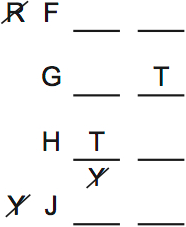
If T tests G on the second day then T must test H on the first day. The third rule says T has to test H at some point.
Next, we see where we can place YS. Y can’t test J, so YS must test F.
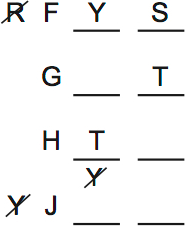
This also lets you know which bicycle Y tests on the second day. Only H and J are left. Y can’t test J, so Y must test H on the second day.
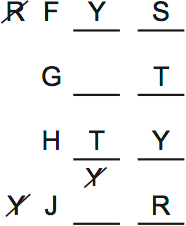
R and S both have to test a bike on day 1, so we have to place them in the only two days that are left. R tests G (because R tests J on day 2) and S tests J on day 1.

This lets us see that E is CORRECT. A–D not only don’t have to be true, they can’t be true.
Question 15
If you followed along in the setup, it’s easy to see that D is CORRECT. If Y tests H on the first day, then S has to test H on the second day. That leaves no room for T to test H.
So Y can’t test H on the first day.
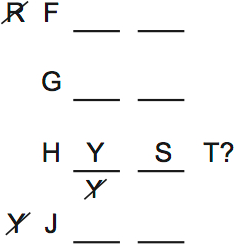
This diagram proves A and C could be true.
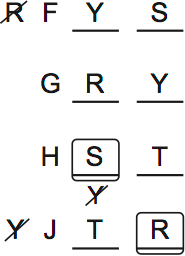
The diagram from question 14 proves that B and E could be true. R tests J on the second day and Y tests H on the second day.
Question 16
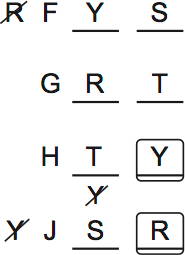
The correct answer from question 13 proves A can be true. R tests G on the second day.
The following diagram proves B, D and E could be true:
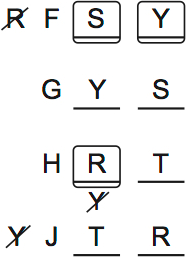
C is CORRECT. If T tests F on the second day, then T must test H on the first day. YS have to test G, there’s no space anywhere else.
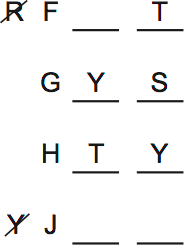
This doesn’t work: there’s no place to put R for the first day of testing. R can’t test F, so R would have to test J on both the first and second days. That doesn’t work.
Question 17
By adding the new rule, we get this diagram.
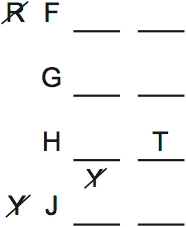
This doesn’t seem like much of a deduction. But it eliminates answers C, D and E!
C: H on the second day is now full
D: S’s second day has to come after Y, not T. So S can’t test J on the second day.
E: T can’t test G, because both Ts have been placed.
The following diagram proves B is CORRECT.
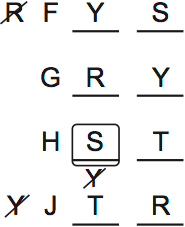
And this diagram shows why A can’t be true. There’s no place to put Y on the second day. Y can’t test J.

The trick to solving these questions is to eliminate answers. Once you realize the local rule eliminates C, D and E, you can take a bit of time to draw diagrams and decide between A and B. There’s no other shortcut. Diagrams let you understand how everything fits together.
For example, the diagram that proves R can’t test H on the first day should draw itself, once you try putting R there and see what other rules are affected. If you’re not sure how I got that diagram, recreate it yourself. It’s the best way to learn.
Question 18
Past questions can be useful on cannot be true questions. Any past diagram that works can prove an answer could be true. Could be true answers are wrong.
The diagram from question 14 proves that R and S can both test J. A is wrong.

The diagram from question 17 shows that R and T can both test J. It also shows that R and Y can test G. So B and C are wrong.
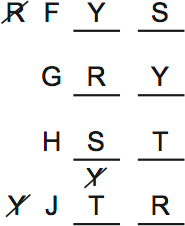
D is CORRECT. Seamus’ second day always has to come after Y’s first day. So Seamus could only test G with T on his first day.
That means T goes in the first day of H. Y and S have to test F, since Y can’t test J.
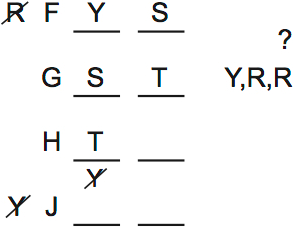
There’s no way to fit Y’s other test and both of R’s tests in the remaining spots, since Y can’t test J. If you have Y test H on the second day, R is forced to test J both days, which isn’t allowed.
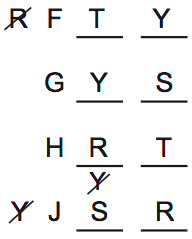
This diagram shows that T and Y could both test F, so E is wrong.
Game 4: Bookshelves
Game 4 Setup
This is an explanation of the fourth logic game from Section II of LSAT Preptest 64, the October 2011 LSAT.
Eight books (F, G, H, I, K, L, M, O) are placed on a three-shelf bookcase. On each of the three shelves – the top shelf (1), the middle shelf (2), and the bottom shelf (3) – there are at least two books. You must determine the placement of the books based on the rules.
Game Setup
This is a grouping game, with a bit of numerical uncertainty. There are at least two books on each shelf, but there are two different possibilities for the number of books on shelves 1 and 2.
That comes from the first rule. The third shelf (bottom) has more books than the first shelf (top). There are eight books in total. Each shelf has to have at least two books. The only way we can put more on the bottom is to put at least three books there and put only two books on the top shelf. These are the two orders, from top to bottom:
2 – 3 – 3
2 – 2 – 4
Both total to 8. If we put three books on the top shelf and four books on the bottom, we’d only have one book left for the middle shelf.
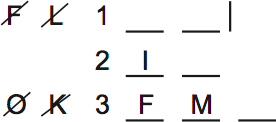
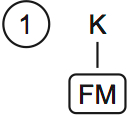
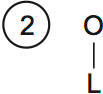
You can draw the last three rules together. K is higher than F and M (which are on the same shelf). O is higher than L. The vertical lines indicate that one variable comes higher than the other.
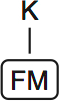

It’s best to draw rules 3 and 5 rules together: K is higher than both F and M. I often see students draw rules separately, then get lost on their own page. Drawing a smaller number of rules, together, helps you go faster and avoid mistakes.
We can add those rules to a main diagram. I’ve drawn three horizontal rows to show books on the three bookshelves.
O and K can’t go on the bottom shelf (labelled shelf 3) and L, F and M can’t go on the top shelf. If K were on the bottom, for example, there’d be no way for FM to be below K.
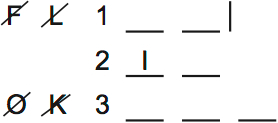
I is on the middle shelf. It’s best to draw that directly on the diagram. Order doesn’t matter, so I just put I on the left.
The vertical line by shelf 1 means that there can only be two books on that shelf.
The lack of a vertical line by the other two shelves means an extra book can be added to one of them. Shelf three has at least three books, because the bottom shelf needs more books than the top shelf.
G and H are random variables, with no rules attached to them (I draw circles around random variables).

If it helps you visualize things, you could draw two separate shelf setups to show the different numbers of books that could go on the bottom two shelves. One diagram would have four books on the bottom, and one would have three books on the bottom and three on the middle.
I didn’t find that useful. Instead, I thought it was helpful to visualize what happens when F and M go on the second shelf.
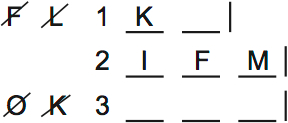
K has to go on the top shelf, because K must go above F.
O has to go on the top shelf too, because O has to go above L.
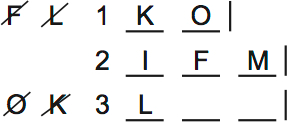
In this case, the random variables G and H are forced to go on the bottom shelf. There’s no space elsewhere.
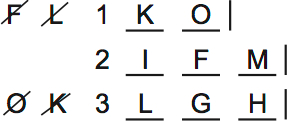
So if F and M are on shelf 2, everything falls into place.
The other scenario (F and M are on the bottom) is less interesting, but it’s still worth drawing. Drawing it will remind you that FM are on the bottom shelf in all scenarios that don’t look like the one I drew above.
Game 4 Main Diagram
These diagrams show the rules used to determine the possible arrangements of the books (F, G, H, I, K, L, M, O) on the bookshelves (1, 2, 3).
Refer to these diagrams when solving this game. Copy them on your own page, and on each question make a new version of them in order to follow along with my explanations. You’ll learn much more if you draw along.
The setup section explains how to build this diagram.
Main Diagram
First scenario – FM are on bottom:
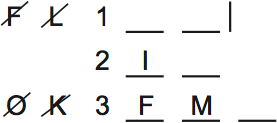
In the first scenario, there are either two books in the middle and four books on the bottom, or three books on each shelf.
Second scenario – FM are on middle shelf. See setup for how to build this:

Rules

Question 19
Usually, the first question on a game is a list question. When there’s no list question, it’s a strong sign that you were expected to make many deductions.
A is wrong because there must be at least three books on the bottom shelf. The bottom shelf must have more books than the top shelf.
B is CORRECT, as shown by this diagram which obeys all of the rules.
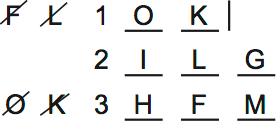
C and D are wrong because K and O can’t be on the bottom shelf. K has to be above FM, and O has to be above L.
E is wrong because M needs to go with F.
Question 20
A is CORRECT. M always goes with F. If M is with I, that means FM goes on the middle shelf.
In the setup, we saw that placing FM on the middle shelf determined everything:
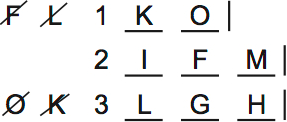
This is what the diagram looks like if FM are on the bottom shelf instead:
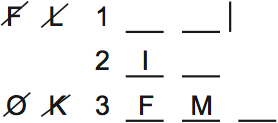
If FM are on the bottom shelf, this game is almost impossible to lock down. There’s one more book to place: the 8th book can go on shelf three or four.
None of the remaining answers deal with this. Answers B, C and E place one of the random variables, G and H. That really doesn’t do much in this game.
K and G (answer B) and H and O (answer E) could both go together on either the top or the middle shelf. They’re very easy to move around, if F and M are on the bottom shelf.
If F, H and M are all on the bottom (D), we still get to decide whether we want to put a fourth book on the bottom, or put a third book on the middle shelf.
The same is true of C. If you put L and F together, they go on the bottom. M goes there too, with F. You still get to decide whether to put a fourth book with them, or a third book on the middle shelf instead.
Question 21
Let’s start with A. It says O must always be higher than M. This is true. O can never go on the bottom shelf: it has to go higher than L. So if FM are on the bottom shelf, O is higher.
When FM are on the middle shelf, O goes on the top shelf. It’s the only way to put O above L.
This is the scenario from the setup: placing FM on the middle shelf determines everything. It’s the only way to put O higher than L.
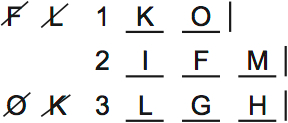
So, A is CORRECT. No matter where you place FM, O is always higher.
The diagram above also proves C wrong. I and F can be placed on the same shelf. The diagram likewise proves D wrong: G is lower than O.
E is wrong. We’ve seen plenty of diagrams where FM are on the bottom shelf, lower than L. The diagram below proves it.
Finally, B is wrong because G is a random variable. It’s really easy to put G above K. Here’s one example.
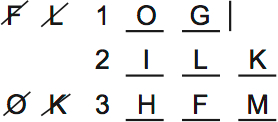
Question 22
The first step with any local rule question is to draw the new rule onto a diagram.
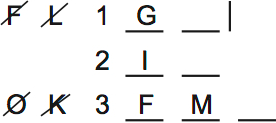
In the setup, we saw that placing FM on the middle determines everything. When FM are on the middle shelf, G can’t go on the top shelf. So FM must go on the bottom shelf for this question.
Both K and O have to be on either the middle or the top shelf. We saw this in the setup. K is above F and O is above L. That leaves at least one of L and H to fill the third space on the bottom shelf.
(The other L/H could go on another shelf.)
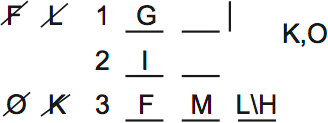
There are, at most, three spaces left for K and O: one or two on the middle shelf, and one on the top shelf. I’ve drawn them up and to the right as a reminder that they must be placed somewhere above the bottom shelf.
The wrong answers fail because of this. They put too many variables on the middle shelf, and thus there’s no room for K and O to go above F and L.
A is tricky if you forget that the answer choices show us a complete list. H and I could go on the middle shelf if one of K and O went there too, but H and I can’t go there alone.
B has the same problem as A. We’d need L, I and one of K and O for it to work.
C is even worse. There’s only one spot on the top shelf left for K and O, and no spots left on the middle.
D is CORRECT. This diagram shows how it could work.
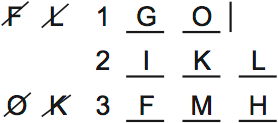
E is wrong because if FM are on the middle shelf then both K and O must go on the top shelf, forcing G onto the bottom. It’s the scenario from the setup and question 20, where everything falls into place.
It’s a major part of the game. If you’re not sure how it works, reread the setup and try to create the scenario yourself. Start by placing FM on the middle shelf, and apply each rule in turn. It’s a necessary skill to learn.
Question 23
Another local rule, another local diagram. We now know that O is above L and L is above H.

You can draw that rule. Or you can just insert each letter on the diagram; there’s only one way to put them in that order.
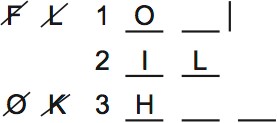
You’re not done yet. When building local diagrams, focus on the most restricted variable. In this game, it’s F, which has two rules.
F has to go with M, and the only place you can fit them is on the bottom shelf.
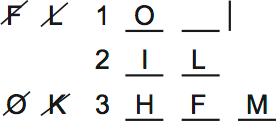
Now we only have G and K left to place. K could go either on the top or middle shelf, and G could go anywhere. Just remember the extra shelf goes either in the middle or on the bottom.
A, B and D are wrong because G can still go anywhere. It could go on the top if K went on the middle, or on the middle or bottom if K went on the top.
E is wrong for the same reason. G could go on the top, and K would go on the middle shelf.
C is CORRECT. H and M are always on the bottom.

Leave a Reply