

LSAT Preptest 66 LG Explanations
Full explanations for every question from the logic games section of LSAT Preptest 66.
Archived Logic Games explanations
Logic Games are no longer part of the LSAT. LSAC removed the Logic Games section beginning with the August 2024 LSAT. If you are studying for the current LSAT, you can skip this section.
These explanations remain available for students, tutors, and readers using old-format PrepTests. For current guidance, see Logic Games and the current LSAT.
Table of contents
Game 1: Lab Sessions
Game 1 Setup
This is an explanation of the first logic game from Section III of LSAT Preptest 66, the June 2012 LSAT.
Six lab sessions for a chemistry class will be held over a span of three days: Wednesday, Thursday and Friday (W, T, F). One session will be in the morning and one in the afternoon. There will be six lab assistants, one for each session. They are Julio, Kevin, Lan, Nessa, Olivia and Rebecca (J, K, L, N, O, R). You must assign the lab assistants to labs based on the rules.
Game Setup
This game is a mix of linear and grouping. It tests your ability to remember the rules. If you have them in your head and can combine them, then this game is easy. If you have to constantly check the rules, then this game is hard.
I set up the game horizontally. If you set it up vertically, that’s fine too. It’s a matter of preference.
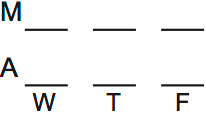
Next, KR have to be on the same day, in either order:

The line indicates that K and R can be reversed. Think of it like a suitcase handle.
L and O can’t be on the same day:

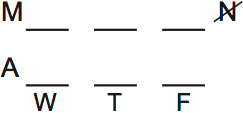
N can only go in the afternoon. I drew this on the diagram itself. I used a ‘not’ rule to show that it can’t be in morning.
That’s what we know for certain, it’s best to stick to what is definite.
Finally, J comes on an earlier day than O.

This diagram is slightly ambiguous. It just shows that J comes earlier. Morning is earlier than afternoon, so you have to remember that it means J comes on a day earlier than O does.
There aren’t any obvious deductions, but you can make some by thinking about how the rules fit together. If you suspect a game is restricted, it helps to make a sample scenario to see how things fit together.
KR take up an entire day. This is very restrictive. L/O are split between the other two days, and J-O are also split between the other two days.
In fact, JL always have to go together, and ON always go together. I’ll show this with an example.
By the way, I didn’t figure this out explicitly the first time I did the game, though I knew it intuitively well enough and could draw fast diagrams. You don’t need to make a perfect diagram to do well on a game.
Ok, time to prove the deduction. Let’s see what happens if you put KR on Wednesday. Remember that they’re reversible:
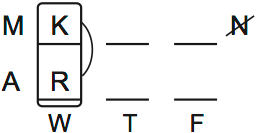
J goes before O (rule 4), so J is on Thursday and O is on Friday. Since L and O can’t go together, then L must also go on Thursday with J.
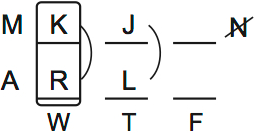
I haven’t placed O yet. I’ll get to that. First, I’ll explain what I’ve drawn.
KR have a box around them as a reminder that this is based on a rule.
JL have a line between them to indicate that they’re reversible, but there’s no box because no rule says they must be together. It just so happens that the other rules force them together.
This is an arbitrary style I made up for this game, because it’s unique. You could easily draw a box around J/L and do fine.
Ok, now let’s place O. We only have O and N left to place. And N can’t go in the morning. So this is the only possible diagram when KR go Wednesday:
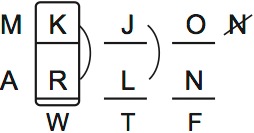
If KR go Thursday or Friday then we get slightly different diagrams, but the principle is the same:
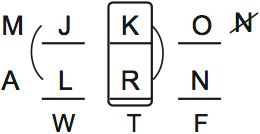
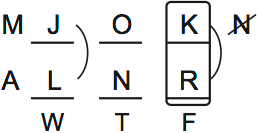
So there are only three possibilities for this game, and they’re based on the same idea. JL (in either order) are before ON (in that order). KR (in either order) fill one of three days.
Important. For the rest of the game, I’m going to say things like JL must come before ON. You must reread the above explanations if you don’t see why JL comes before ON. Otherwise this game won’t make sense.
The deduction is based on a combination of rules, which force JL to always go together. J goes before O, and L can’t go with O. KR splits JL and ON into two groups.
Game 1 Main Diagram
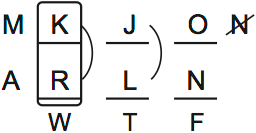
These diagrams show the rules used to determine the proper assignments of lab assistants (J, K, L, N, O, R) to sessions (W, T, F).
Refer to these diagrams when solving this game. Copy them on your own page, and on each question make a new version of them in order to follow along with my explanations. You’ll learn much more if you draw along.
The setup section explains how to build this diagram.
Main Diagram
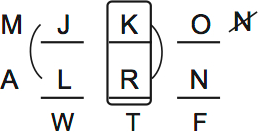
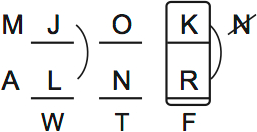
Rules
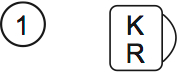
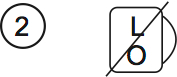

Note that we’ve already placed all the rules on the diagram in the three scenarios. It’s still a good idea to make a list of the rules, and try to commit them to memory.
The questions are easier if you remember why the scenarios must be as they are.
Question 1
As with all the list questions, you should go through the rules to eliminate answers one-by-one.
Rule 1 eliminates C. KR must be together.
Rule 2 eliminates D. O and L can’t go together.
Rule 3 eliminates A. N must go in the afternoon.
Rule 4 eliminates B. J must come before O.
E is CORRECT. It violates no rules.
Question 2
Remember from the setup that J and L must go together. L can only go Wednesday or Thursday. So if L is not Wednesday, they must go Thursday and we get this diagram:
If you’re unsure why this diagram must be true, review the rules and the setup. The idea that JL are before ON is the key to the entire game.
E is CORRECT.
Question 3
KR can only go directly before ON only if the two groups go on Thursday and Friday:
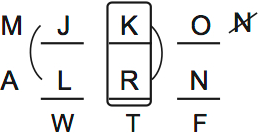
B is CORRECT.
If we tried to put KR on Wednesday, then ON would have to go Friday so that JL could go before them.
Question 4
In the setup, I made three diagrams. Review the setup and draw them yourself if you’re unsure why they have to be true.
In all three scenarios from the setup, J and K could be morning or afternoon. That’s why they had reversible lines.
Have a look at the diagram in question 3 as a reminder of what the setup diagrams look like. JL and KR are reversible.
If J and K must be in the morning, then JL and KR are no longer reversible. L and R must be in the afternoon.
And that’s all we can say.
A is CORRECT. If J is in the morning, then L must be in the afternoon, not the morning.
Question 5
On this question it makes sense to depart from the setup scenarios and build a new diagram based on the rules.
If J is on Thursday afternoon, then we know O is on Friday. J comes before O (rule 3).
In fact, ON are on Friday, because KR go together (rule 1) and only Wednesday has space to take both of them:
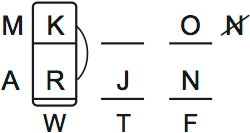
O is in the morning, because N can only go in the afternoon.
Finally, L must fill Thursday morning.
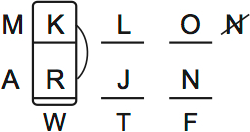
We can tell where L, O and N are placed, in addition to J. So C is CORRECT.
KR can go in either order.
Game 2: Seven Shops
Game 2 Setup
This is an explanation of the second logic game from Section III of LSAT Preptest 66, the June 2012 LSAT.
A shopping center has a row of seven extra spaces (1, 2, 3, 4, 5, 6, 7). Seven businesses will be located in these extra spaces. The seven businesses are: an optometrist, a pharmacy, two restaurants, a shoe store, a toy store and a veterinarian (O, P, R, R, S, T, V). You will decide which business will be assigned to each space.
Game Setup
This is a linear game, but it’s complicated by the first rule. P and one of the R’s must be on either end of the diagram.
When a rule lets you draw something only two ways, it’s a very good idea to make two separate scenarios for your main diagram. This helps you visualize the game, and lets you draw separate deductions for each diagram.
Here are the first three rules. Draw it yourself while referencing the rules, then I’ll walk you through this diagram:


Here are the first three rules:
- P/R are at either end of the diagram.
- O/V must be beside P.
- And R can’t go in the two spots beside the first R.
Makes a simple diagram, right?
The final rule is that T/V can’t be together. Remember this rule well, it’s the only rule that can’t be shown on the diagram.

There are no rules for S, so S can go anywhere. I represent random variables with a circle:

Game 2 Main Diagram
These diagrams show the rules used to determine which spaces (1, 2, 3, 4, 5, 6, 7) the businesses (O, P, R, S, T, V) go in.
Refer to these diagrams when solving this game. Copy them on your own page, and on each question make a new version of them in order to follow along with my explanations. You’ll learn much more if you draw along.
The setup section explains how to build this diagram.
Main Diagram



Question 6
As with all list questions, you should go through the rules and use them to eliminate answers 1-by-1.
Rule 1 eliminates C. P must be on one end of the diagram.
Rule 2 eliminates B. The two R’s can’t be beside each other.
Rules 3 eliminates D. P must be beside O or V, not S.
Rule 4 eliminates A. V can’t be beside T.
E is CORRECT. It violates no rules.
Question 7
If S is 2nd, then we must place R first and P seventh. This is because P must be beside O or V.

This eliminates B, C, and D.
What about E? T and V can’t go beside each other (rule 4). If V is in space 4, then only spaces 3 and 5 are left for T.
A is CORRECT. There’s only one way it would work, but it does:

Question 8
For this question, V is in the 5th space. You should make both scenarios, to see what happens in both of them.
One of O/V must be beside P. Since V is in spot 5, that means O must be beside P.

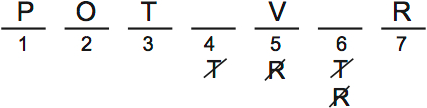
In both diagrams I’ve drawn the rule that T can’t go beside V. In the second diagram that means T must go third.
Next, you can place the second R, since R must be more than two spaces away from the first R.


Finally, in the first diagram T/S go in either order in spots 2 and 3. In the second diagram, S must go sixth.


The only point both diagrams have in common is that R must go fourth. C is CORRECT.
Question 9
The question tells you to put OS together. It also tells you that whoever is beside OS are the stores that always must be beside OS.
So to find the right answer, you just have to make a single correct diagram. You don’t have to make every possible diagram.
The question has told you that if you put OS together, then whoever is beside OS must always be beside OS. They told you it’s something that must be true.
O or V has to be beside P. I first tried making a diagram with O beside P, because it seemed simpler to place S. But this didn’t work. T and V end up beside each other. That violates the fourth rule:
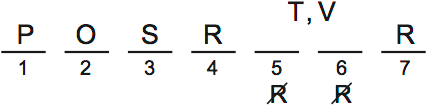
(R is fourth because of rule 2, it can’t be fewer than two spaces away from the other restaurant.)
So let’s try again, with V beside P. Remember, we just need to find one diagram that works:

Let’s think about R. R can’t go fifth or sixth.
Turns out R also can’t be fourth. If you try to place R fourth, then OS will be fifth and sixth. T would have to go third, beside V.
Draw this and you’ll see. You should be drawing these diagrams yourself as you follow along, they’ll make more sense.
So R is third:

Since OS must be a block, then they either go fourth and fifth or fifth and sixth:


They are in a block with a line across to show that their order is reversible.
Either way, they are surrounded by T and R.
D is CORRECT.
Question 10
For this question, the shoe store is in fourth.
To figure out what must be true, you’ll need to make each scenario and check what has to be true in both.
Here’s S fourth. I’ve added a deduction about R which I’ll explain below.


R has to go between P and S in both cases. Remember, it has to go at least two spaces away from the other R.
Only T and V/O are left to fill the spaces between R and S.
Since T and V can’t go beside each other, it must be T and O. So V will be beside P.
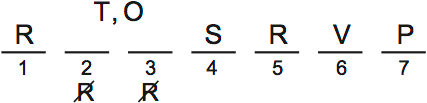

B is CORRECT. P is beside V in both cases.
Question 11
The rule says that R must be a placed away from the first R. That’s another way of saying that it has to be placed close to P.
If you count, you’ll see that in any diagram the second R must always be within two businesses of P.
D is CORRECT.
Rule substitution questions are tough. You should always think about the full effect of a rule and see if there’s another way of describing it.
The other answers are unlikely, because they are complicated. Usually a substituted rule will be simple, and merely describe the effect another way.
This diagram proves that A, B and C are wrong. It meets the conditions listed in those answers, but violates the rule we’re trying to replace. The two R’s are too close together.

E is strange. It doesn’t even mention restaurants. We’ve seen many past diagrams that obeyed all the rules and put O and S together, such as the diagrams from question 9.
Game 3: Sales Reps
Game 3 Setup
This is an explanation of the third logic game from Section III of LSAT Preptest 66, the June 2012 LSAT.
A software company employs seven sales representatives: Kim, Mahr, Parra, Quinn, Stuckey, Tiao, and Udall (K, M, P, Q, S, T, U). Each of them will be assigned in exactly one of the three sales zones: Zone 1, Zone 2 and Zone 3 (1, 2, 3).
Setup
This is a grouping game. There are no ordering elements.
The game has five rules, which is more than most games. It will be important to simplify these and keep a clear list of rules.
I’ve drawn the three groups vertical, as the game itself did in question 12. You can also draw this game horizontally. These differences are just a matter of personal preference.
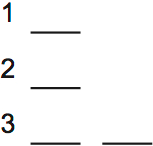
I’ve drawn two spots in group 3, as a reminder of the final rule. You should always read all the rules before drawing, it lets you take shortcuts like this.
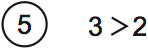
The final rule says Group 3 always has more representatives than group 2 does. You can draw something like this as a further reminder on your list of rules:

But this diagram isn’t that helpful. 3 > 2 is sort of ambiguous. It looks like a mathematical equation, referring to the numbers 3 and 2.
In the heat of the moment, it’s easy to forget that this actually refers to the numbers of reps in groups 3 and 2.
It’s far better just to memorize rules that have no clear diagram. When a game gives you a unique situation, make up a plausible diagram and try to memorize it.
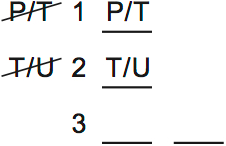
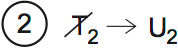
The first and second rules I also prefer to memorize, or partially memorize. They say we need one of two variables in a group, but not both.
This means that, for example, exactly one of P or T will be in group 1. But both of them can’t be there.
I like drawing this directly on the main diagram:

There’s no great way to draw a ‘either-or but not both’ rule. I usually draw them like this:
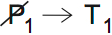

These are actually ‘at least one’ diagrams. I memorize the added context that you can’t have both at once.
It’s true that the diagram leaves out some information, but you can still solve a game very effectively with an imperfect diagram. Memorizing the missing elements is easier than it sounds, and a very powerful tool.
If you want to capture the full effect of the rules, you can draw these diagrams. These are just for the first rule:
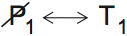

This means that T1 is always NOT with P1, and the reverse. If T is not in 1, P is there.
That diagram is accurate, and if you memorize what it means, it works. But it’s big and clunky. For rare situations, I prefer a smaller diagram, and keeping part of the rule in my head.
Ok, the last two rules are simple. PQ and SU go together.


You should also note the random variables. There are two, M and K:

That’s all the rules. There aren’t any deductions, but you can turn the rules into scenarios.
Scenarios are not essential to solve this game, but the though process involved in making scenarios is very useful.
I didn’t make scenarios when I first did this game, but I could construct them on the fly when doing questions because I’m used to doing it. I’ve built scenarios a bit further on as an example. You should follow along and draw them yourself if you’re not clear how to do it on your own.
Before you try this game, make sure you’ve memorized the full impact of rules 1 and 2. There’s no diagram that will be as effective as having them in your head.
There are no shortcuts on logic games. This section tests your working memory. To get better, you have to be comfortable with memorizing at least a couple of the rules.
Game 3 Main Diagram
These diagrams show the rules used to determine which of the sales representatives (K, M, P, Q, S, T, U) will be assigned to each sales zone (1, 2, 3).
Refer to these diagrams when solving this game. Copy them on your own page, and on each question make a new version of them in order to follow along with my explanations. You’ll learn much more if you draw along.
The setup section explains how to build this diagram.
Main Diagram
Rules




Scenarios
T is involved in both of the first two rules. Wherever you place T, it has an effect. Always look for variable mentioned in more than one rule.
It makes sense to construct scenarios using T. Just place T in a group, and apply the rules to see what you can deduce. Then do the same for the other two groups.
You need to be familiar with the rules to build scenarios. I’m going to say things like ‘U has to go with S’. I’ll expect you to know that I’m referring to rule 4. Review the rules if you’re unsure why I say something has to happen.
Here’s T in group 1. That forces U to go in group 2:
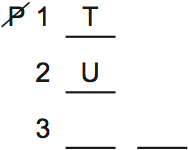
U has to go with S. This means we need at least 3 in group 3, so that it has more than group 2:
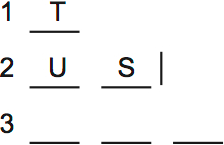
Group 2 can’t take any more people. I drew the vertical to show that it’s closed.
PQ, M and K are the only variables left to place.
PQ and one of M/K must go in group 3:
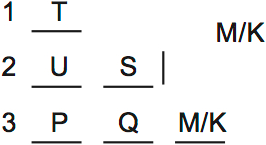
The other M/K can go in either group 1 or 3.
That scenario is complete. Let’s try T in group 2. This forces P to go in group 1, and U can’t go in group 2:
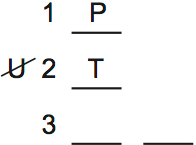
We can’t deduce much in this scenario. PQ go together, so Q is in group 1.
SU, M and K are left to place. They can go anywhere as long as you keep more variables in group 3 than group 2:
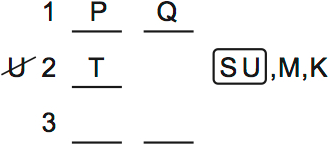
Lastly, try T in group 3. This forces P in group 1 and U in group 2.
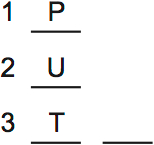
You know Q goes with P and S goes with U:
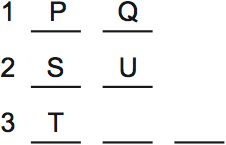
Since there are two variables in group 2, you need to place three variables in group 3. Only M and K are left.
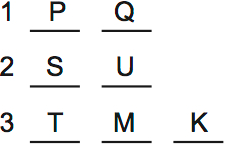
So if T goes in group 3, then everything is determined.
Here are the three scenarios I built above. They’re T in group 1, 2 and 3 respectively.
Scenario 1
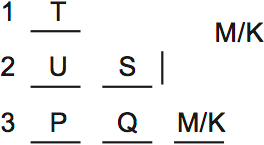
———————————————
Scenario 2
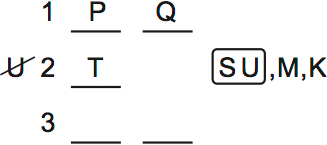
———————————————
Scenario 3
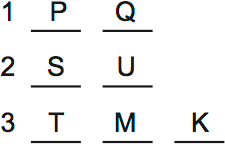
Question 12
For list questions, go through the rules and use them to eliminate answers one by one.
Rule 1 eliminates D. P or T must go in group 1.
Rule 2 eliminates E. T or U must go in group 2.
Rule 3 eliminates A. P must go with Q.
Rule 4 eliminates C. S must go with U.
B is CORRECT. It violates no rules.
Question 13
Look to the three scenarios and you’ll see that only scenario two allows the possibility that group 1 has more variables than group 3.
Here’s scenario two with two extra slots added to group 1.
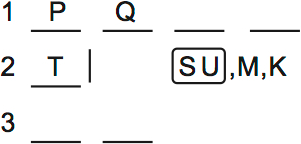
It’s the only way to have more people in group 1 without violating the rule that group 3 has more than group 2.
The line beside T in group 2 is a reminder that the group is full. It’s the only way to have more people in group 3 than group 2.
The diagram directly disproves C and D.
Group 2 is full, so K and M can’t go there. A and B are wrong.
E is CORRECT. M and K would go in group 1, while SU would go in group 3:
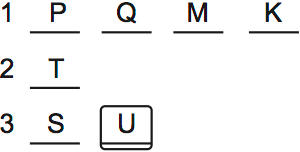
I boxed U because that’s what the answer says.
Question 14
To answer this kind of question, you have to become fast at drawing scenarios to disprove wrong answers.
There’s no secret to doing this. You need to know the rules, and you need to practice making scenarios. The more you practice drawing correct scenarios, the faster you’ll get.
A is CORRECT. Let’s try it and see what happens.
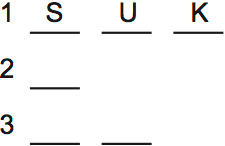
SU go together. Now, the second rule says one of T or U goes in group 2. So T must go in group 2. Likewise, the first rule says one of P or T must go in group 1. So P goes in group 1.
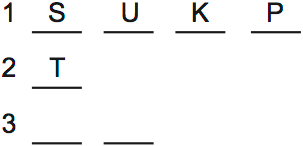
Q has to go with P (rule 3), so M is the only one left to go in group 3. This doesn’t work, since group 3 needs more sales representatives than group 2.

B-D are unlikely candidates to be correct. They all involve random variables, and they place variables in group 3. It’s easy to place people in group 3, as you need more people in group 3 than group 2.
They’re also all the same answer. SU are interchangeable, since they’re always together. Likewise, M and K are interchangeable, since they have no rules.
This scenario disproves B, C and D:
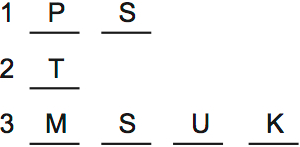
This diagram disproves E.
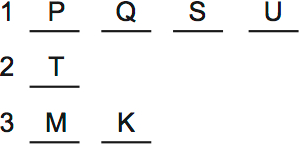
This answer is similar to A, but it only forces four people to go in group 1, whereas A forced five people to go there.
Question 15
A is CORRECT. We saw this scenario in answer E of question 14:

It’s an easy diagram to make because M and K are both random.
B and C don’t work because they don’t have more people in group 3 than in group 2.
For B, if T is in group 3, then SU must be in group 2. So each group has two.
For C, if P is in group 3 then T must be in group 1 and SU are automatically in group 2. So groups 2 and 3 each have two people.
(These deductions are based on rules 1 and 2)
D and E violate either the first or second rule. Two our of three of P, T and U must be in groups 1 and 2. Both of these answers place too many of those variables in group 3.
Question 16
Q is always with P (rule 3). P can’t be with T (rule 1). That means Q can’t be with T.
D is CORRECT.
Question 17
This question was removed from scoring. That means it had a flaw.
It’s very rare that LSAC does remove a question, but it happens.
Question 18
To answer this question, it’s best to create a working diagram, then see what you can change. It turns out you can only place M and S in group 3.
M and S can’t go together in group 1, for the same reason that K and S can’t go in group 1 (the correct answer to question 14). There’s not enough people to go in group 3:
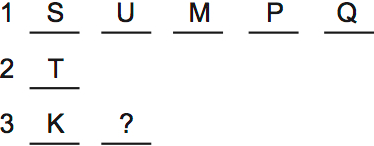
Briefly, U has to go with S. Since U is in group 1, T must go in group 2.
Since T is in group 2, P goes in group 1. That means Q also goes in group 1.
So only K is left to go in group 3.
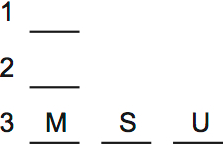
Likewise, M and SU can’t go in group 2. Then you would have to place four people in group 3, and there would be no one to go in group 1.
So M and SU must go in group 3:
Apply rules 1 and 2, and you can place T and PQ:
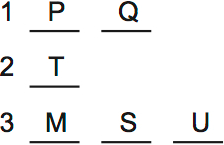
T has to go in group 2, because U is not there. That means P has to go in group 1, and Q always goes with P.
Only K is left to place. they can go in any group.
A is CORRECT.
Game 4: Piano Solos
Game 4 Setup
This is an explanation of the fourth logic game from Section III of LSAT Preptest 66, the June 2012 LSAT.
Two pianists, Wayne and Zara (W, Z) will perform five solos in a recital. Each piece will either be modern or traditional (M, T).
Game Setup
This is a game where you can solve almost everything before starting. That’s rare on the modern LSAT.
To do this, you must split the game into two scenarios. The third rule nearly forces you to make such a split.
Whenever a rule gives you two options, draw both of them. It lets you make extra deductions, and visualize the game more easily. This is a hidden feature of LSAT logic games.
But I’m getting ahead of myself. Let’s start with the first rule. The third solo is traditional:

You could make two rows to put both the performer and the type of music they play. I prefer to just put the type below the slots. It makes a smaller, simpler diagram which is easier to recopy.
Let’s come back to the second rule in a minute. All we can do with it at the moment is try to draw it, which isn’t very useful, since it’s a non-standard rule.
It’s perfectly ok to skip rules and come back later. I read everything before drawing precisely so that I can see which rules are simplest to draw first.
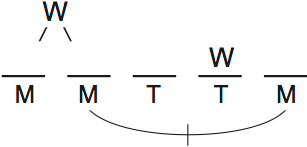
Rule 3 lets us make two scenarios.One where W performs a traditional piece, and one where Z performs a modern piece:


Now we can add the second rule. It says there is one and only one group of two consecutive T’s. You can’t put more than two T’s together, and it can only happen once.
In the first scenario, that has already happened. That means 2 and 5 must both be M:

In the second scenario, 2 must be T, and 1 must be M. It’s the only way to put two T’s together, but no more than two T’s:

Here’s how I drew the fourth rule, that 2 and 5 must have different soloists:
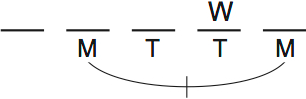
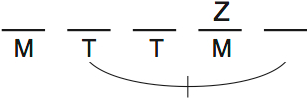
Lastly, W must perform a modern piece before the first traditional piece. In the first diagram, that means that the first piece is modern, and W goes first or second:
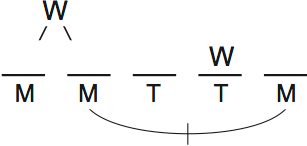
I made up this way of showing W can be 1 or 2. It’s not a common rule. If you come across an uncommon rule, feel free to improvise.
In the second diagram, W must go first:
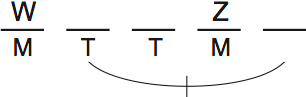
There is very little uncertainty in this game. All the rules are drawn directly on the diagram.
Game 4 Main Diagram
These diagrams show the rules used to determine the proper sequence of modern and traditional pieces (M, T) performed by Wayne and Zara (W, Z) during the piano recital.
Refer to these diagrams when solving this game. Copy them on your own page, and on each question make a new version of them in order to follow along with my explanations. You’ll learn much more if you draw along.
The setup section explains how to build this diagram.
Main Diagram
Question 19
You can use both diagrams from the setup to eliminate answers. Here they are again:
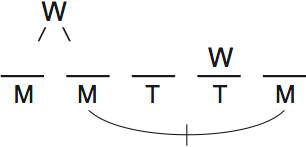

T can never be first, so A is wrong.
B has three T’s in a row, which violates rule 2.
C is CORRECT. You can see it in the second diagram. Just make the final piece M.
D is wrong because it doesn’t have two T’s in a row. This violates rule 2.
E doesn’t work on either diagram. In the first, T is fourth but not fifth. In the second, the fourth piece is M, not T.
Question 20
W doesn’t have to perform any traditional pieces. A is CORRECT.
You can prove this by making a diagram that doesn’t have W performing any traditional pieces.
It’s best to start at the low end, anyway. There’s no obvious reason why W has to perform traditional pieces, so you might as well see if you can hit zero.

This diagram obeys all the rules. I used the second scenario, because the first scenario has W performing a traditional piece.
Question 21
In both scenarios, W performs at least first, or second. So if the same pianist performs first and second, it must be W.
The fourth rule says that the player who performs second can’t be the player who performs fifth.
So if W performs 2nd, then Z must perform 5th.
C is CORRECT.
Question 22
This is the second scenario. In the first scenario, the fifth piece was modern. Here’s scenario two:
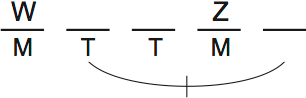
Two players are placed. B is CORRECT.
Question 23
As with question 22, this has to be the second scenario. In the first scenario, the fifth piece was modern, not traditional.
Here’s the second scenario, with W performing a traditional piece:
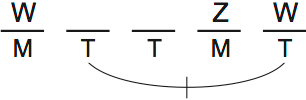
As the line under the diagram reminds us, the second and fifth soloists must be different. So the second soloist is Z:
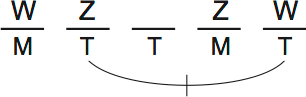
That’s all we know. Everything is set except for the third soloist, which can be Z or W.
C is CORRECT.

Leave a Reply