
LSAT Preptest 70 LG Explanations
Full explanations for every question from the logic games section of LSAT Preptest 70.
Archived Logic Games explanations
Logic Games are no longer part of the LSAT. LSAC removed the Logic Games section beginning with the August 2024 LSAT. If you are studying for the current LSAT, you can skip this section.
These explanations remain available for students, tutors, and readers using old-format PrepTests. For current guidance, see Logic Games and the current LSAT.
Table of contents
Game 1: Concerts
Game 1 Setup
This is an explanation of the first logic game from Section III of LSAT 70, the October 2013 LSAT.
A concert promoter is arranging six bands to play in a benefit concert: Uneasy, Vegemite, Wellspring, Xpert, Yardsign, Zircon (U, V, W, X, Y, Z). You must place them in order.
This is a linear game, with a few twists. It’s not a particularly difficult game. Nonetheless, it’s worth noting that all of the game types are becoming less standard.
The LSAC is aware that people are prepping more intensely, so they’re reducing the number of games that can be learned from a strategy guide.
To get better at non-standard games, you should repeat them. This way you’ll develop an intuition for the underlying patterns on logic games, and you’ll be able to handle new, non-standard rules. It’s a good idea to repeat the game on your own before reading these explanations.
Now, for the setup. First, you hopefully know that linear diagrams should have a series of horizontal slots:

Next, this game has some pure sequencing rules. These often appear in linear games. Here’s the first rule:

Here’s the second rule:

The first two rules can and should be combined. Notice that Z is in both rules. You can join both diagrams together using Z:
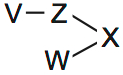
Always watch for multiple rules that mention the same variable.
The third and fourth rules are fairly rare. They say that U must be in the final three spots, and Y must be in the first three.
You could just write these in your list of rules, marking something like “U = last 3”. Or you could draw a “Not U” symbol under slots 1-3.
I think both of those methods add visual clutter without clarity. I do use “not” rules, but not when six of them are required to represent two rules. Instead, here’s how I drew these rules:
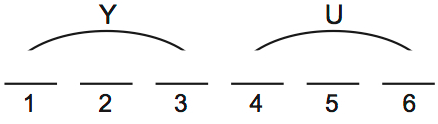
Notice that this diagram is both clear and minimal. Y goes somewhere in the first three and U goes somewhere in the final three.
One glance at the main diagram is enough to remind you of exactly what the rules say. I also find this helps me visualize where Y and U can go.
You should always check for deductions before starting. Look for restricted points. The main deduction is that only U or X can go last.
Y must go in the first three spaces, and V, Z and W must go before X. So only U or X are left to go sixth. You could draw this on the diagram:
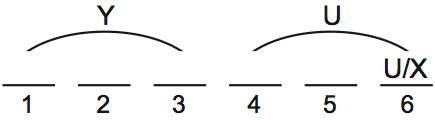
However, I would only do this if you’re prone to forgetting this type of deduction. If you’re an advanced student of logic games, this type of deduction is likely second nature to you.
It might be worth adding Y – X on your ordering diagram. X has three variables before it, so X can’t go in the first three spaces. However, I haven’t drawn this on mine, as it’s easy for me to see this.
Game 1 Main Diagram
These diagrams show the rules used to decide when the concert promoter will schedule bands (U, V, W, X, Y, Z).
Refer to these diagrams when solving this game. Copy them on your own page, and on each question make a new version of them in order to follow along with my explanations. You’ll learn much more if you draw along.
The setup section explains how to build this diagram.
Main Diagram
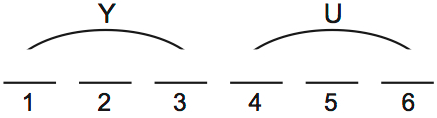
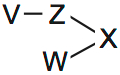
Notice that all six variables are represented, along with their rules. This setup makes it pointless to draw a separate list of the variables (UVWXYZ). Such a list adds no value, and wastes space and time.
This setup also makes it easy to visualize possibilities. You don’t have to hold any rules in your head.
It’s difficult to explain what you see inside your own head. But when I look at these, I can see V – Z – X floating over the diagram and interacting with Y and U.
Obviously, whether or not you can do this depends on your visualization skills. But I expect it’s a learnable skill to some extent. Practice seeing the variables move around over the diagram: it really comes in handy for sequencing games.
Question 1
Unusually, this question is not an ‘acceptable order’ question. Usually first questions are. If the first question is not an acceptable order question, it’s a sure sign that you were expected to make a deduction in the setup.
Here, the only deduction is that you can combine rules 1 and 2 to get this diagram:
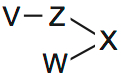
Since it’s the only deduction, this diagram is almost certainly what will let us get the right answer. We’re looking for something that can’t go fifth. That means something that has more than two other variables after it.
That’s V. Both Z and X have to go after V, so V can go fourth at latest.
B is CORRECT.
Question 2
When a question gives you a new rule, you can combine it with the existing rules to make a deduction.
We know Z is after V and before X:
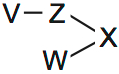
This question also places Z before Y. And we know Y can go third at latest.
So Z is after V, and before Y. That’s three variables. Since Y can’t go later than third, we must place these three variables in slots 1-3:
The question asks about the earliest we can place W. Let’s first look at the remaining variables. W comes before X. U is the only variable left, and the only rule for U is that it goes somewhere 4-6. Here’s how I draw this:
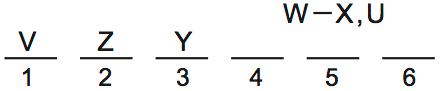
The line between W – X shows that W comes somewhere before X. The comma between W – X and U means that there are no rules governing where you can place U. It could go before W – X, in between them, or after them.
This way of drawing “W – X, U” is a flexible method of visualizing everything that can be true, without clutter.
There is no reason we can’t place W fourth, so C is CORRECT.
Question 3
This question tests your ability to apply the ordering rules. Let’s look at them again:
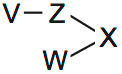
The question places V third:
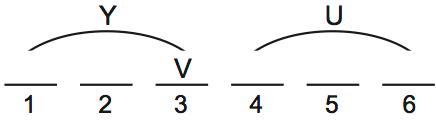
We know that Y has to go in slots 1-2. Who else can go there?
Not U. They must go 4-6.
Not Z. They must go after V
Not X. They must go after Z.
So only W can also go in slots 1-2. We get this diagram:
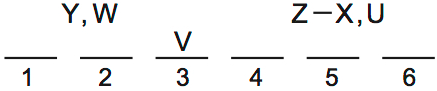
The commas indicate that variables are interchangeable, while the line between Z – X indicates that there’s an ordering rule for them to obey.
You might have seen Powerscore draw Y and W like this: Y/W W/Y
That works too. However, that method doesn’t work well for slots 4-6, which is why I prefer my more flexible method. You get a very clear view of where every variable can go.
B is CORRECT. W has to be 1st or 2nd, so they are always before Z in this scenario.
A, C and E are wrong because U could be before Z – X, in between them, or after them.
D is wrong because Y and W are interchangeable in this scenario.
Question 4
For this question, ZW are a block. Let’s look at what other rules apply. We know that X is after ZW, and V is before ZW:
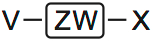
This is not an easy group of variables to place. In fact, ZW can only go third and fourth.
You may be thinking “how can you know that”? If so, I encourage you not to think. Instead, draw.
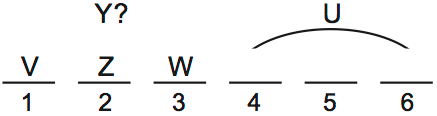
Make a diagram with ZW second and third. Doesn’t work: V has to go first, and there’s no space to put Y in 1-3.
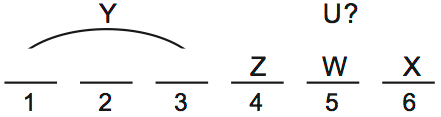
Make a diagram with ZW fourth and fifth. Doesn’t work, X has to go last, and there’s no space to put U in 4-6.
I’m sure you can see why we can’t put ZQ in 1-2 or 5-6. It’s because V has to go before them, and X has to go after.
So with two diagrams, you can prove that this is the only possible setup:
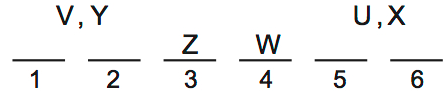
With practice, you can draw 2-3 test diagrams in about 15 seconds. If you find it slow going, it’s because you haven’t practiced, and because you don’t have the rules memorized. But you can learn to be faster.
I don’t “think” about most logic games. I just try stuff, and then I “see” what works and what doesn’t. Logic games are a very mechanical process. Usually the new rules for individual questions are quite restrictive.
Anyway, E is CORRECT. Z has to go in slot 3.
A and C are wrong because U and X are interchangeable in this scenario.
B and D are wrong because V and Y are interchangeable in this scenario. Either one could be first or second.
Question 5
It can be helpful to identify the groups that can’t perform first.
U can’t perform first, because they must go 4-6.
Z can’t perform first, because they come after V.
X can’t perform first, because Z, V and W come before X.
That leaves V, Y and W. They have no variables in front of them, so they all could go first.
D is CORRECT.
Question 6
This question places W immediately before X. That rearranges the ordering rules:

Nobody but U can go after X. So in this question, WX and U fill the final three spots:
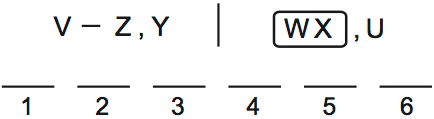
I put a dividing line in the middle to make clear which side the floating variables go on. Though on my own sheet I just drew the blocks a bit further apart. I find these floating variables the easiest way to visualize who can go where. No need to draw five separate scenarios – this one diagrams lets you see them all in your head.
A doesn’t work because U can only go before WX or after, so U can only be fourth or sixth.
B doesn’t work because V is before Z. Since Z is third at the latest in this scenario, V can only go first or second.
C doesn’t work because W has to go in the final three slots in this scenario.
D is CORRECT. This diagram proves it:
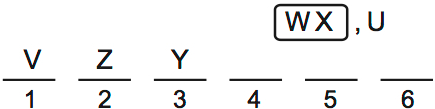
I filled in only the first half in order to emphasize how you should view these diagrams. This is a “could be true” question, so you just have to show that an ordering is possible.
You don’t have to prove everything, or even finish the scenario, since you know that any order for 4-6 is legal as long as it fits the constraints we set up for this question. WXU or UWX are both fine.
E is wrong because Z has to go in slots 1-3 for this question.
Question 7
If you’re like most LSAT students, I’ll bet you hate rule substitution questions. If I told you they don’t have to be hard, would you believe me?
The trick is to look at the full effect of a rule, and describe it another way. Let’s look at what we know about X:
X comes after Z, V and W. X also comes after Y, because Y has to be in one of the first three places, and X already has three people in front.
So Z, V, W and Y comes before X. Only U could come after X. That’s the full extent of the rule.
And now that’s we’ve looked at the full extent of the rule, it’s obvious that A is CORRECT.
You can also answer these questions by elimination. An answer is wrong if it allows something that shouldn’t be allowed, or if it prevents something that normally would be allowed.
B is wrong because it puts V before W. Normally, it’s possible for W to go before V.
C is wrong because it leaves out Z. With the rule in this answer, it would be possible for Z to go after X.
D is wrong because it allows Z to go after X. For example, this order is normally illegal, but it would be allowed with this rule:

That diagram also proves that E wrong. E allows Z to be after X as long as X is in five. That is different from the normal rules.
Game 2: Research Team
Game 2 Setup
This is an explanation of the second logic game from Section III of LSAT 70, the October 2013 LSAT.
A corporate manager is choosing at least four employees to place on a research team. The manager can choose from the following employees: Myers, Ortega, Paine, Schmidt, Thomson, Wong, Yoder, Zayre (M, O, P, S, T, W, Y, Z). You must decide which employees can go on the research team.
Game Setup
This is an in-out grouping game. If you found this game hard, you’re not alone. Most students find that in-out grouping games are one of the hardest game types on the LSAT.
But I’ve got good news for you: this is also one of the most common and standard types of games on the LSAT. That might not seem like good news, but it means you can practice many games of this type.
You’ll find that once they practice this type of game, it becomes one of the easiest game types. So if you work at it, you can turn in-out games from a disadvantage to an advantage.
I’ll note that if you look at games classifications online, they lump a bunch of different games together as “in-out grouping games”. The type I’m referring to here has the following characteristics:
- All of the rules are conditional statements.
- All of the rules can be connected together to form one big diagram and its contrapositive.
Now, since all the rules can be combined, it is not sensible to draw them separately. It’s better to just start combining them right off the bat.
Some students don’t agree, at first. They worry and fret and feel they can’t do it. Instead, they draw all the rules separately, and the contrapositives, and end up with a jumble of rules. They then spend 3-4 minutes looking for deductions, but their drawing is so confusing that they never make a single one. I’ve never seen a student make proper deductions when they start by drawing the rules separately.
Don’t be like that. You can do this. Just follow along, and draw the diagram for yourself on paper. Do it a few times and it will feel like second nature.
The key to combining rules is to look for multiple rules that mention the same variable. You can always connect two rules if they have a variable in common. You might have to take the contrapositive of one of them, if the common variable is in the form “M” and “Not M” (i.e. negated) form.
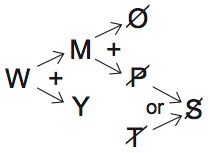
Enough preamble, let’s look at the first rule:

This means that if M is in, both O and P are out. Don’t ever forget the + and ‘or’ signs in between arrows. They’re very important.
The next rule looks like this:

It may not be obvious how this connects, but both rules mention P. So let’s take the contrapositive of rule 2:

To take the contrapositive, you reverse the terms, and negate them. You also change “and” to “or” and vice-versa.
Now both the first and second rule have a “not P”. We can connect the two rules like this:

It’s a mistake to move on to the third rule if you don’t first combine the first rules like we just did.
The third rule mentions M, and M is already on the diagram, so you can connect the third rule like this:

That’s it! That one big diagram covers all the rules.
Learning how to draw it is one thing. You also need to know how to read it. You must read these diagrams left to right.
As an example: if W is in, then both Y and M must be in as well. Since M is in, O and P and S are out. We don’t know anything about T, it could be in or out. I’ve circled what we know, if W is in:

Let’s look at another example. What happens if P is out? We only know one thing: S is also out:

We don’t know anything about the other variables. Maybe M is in, or maybe it is out. P being out is just a necessary condition for M being out, so it doesn’t tell us anything about M.
The more you do these games, the more this type of diagram will make sense. It’s like learning a language, you can’t read them fluently at first. But once you can read this diagram, it’s by far the most powerful way to solve these games.
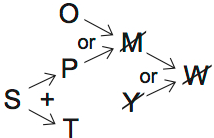
Now, we also need to take the contrapositive of the main diagram. You do this just like you’d take any other contrapositive:
- Reverse the order
- Negate everything
- Change ‘and’ to ‘or’, and vice versa.
Here it is:

I highly recommend you draw this yourself on paper and practice the three steps. Taking contrapositives is a very mechanical process, which means it gets easy with practice.
There is one other rule that doesn’t fit on this diagram. At least four variables are selected. There could be more than four selected as well of course – four is just the minimum.
This rule was in the opening paragraph – you should always scan the opening paragraph to see if there’s any rules hidden in there.
Lastly, there are no rules for Z. A good way to represent this is to draw Z with a circle around it. I drew this near my other two diagrams.

Game 2 Main Diagram
These diagrams show the rules used to decide how the corporate manager will select employees (M, O, P, S, T, W, Y, Z) for the research team.
Refer to these diagrams when solving this game. Copy them on your own page, and on each question make a new version of them in order to follow along with my explanations. You’ll learn much more if you draw along.
The setup section explains how to build this diagram.
Main Diagram

At least four employees are selected.
Question 8
For acceptable order questions, go through the rules and use them to eliminate answers one by one.
I do not recommend using your diagram to solve acceptable order questions, even on in-out grouping games. It’s faster to use the rules, and reading them again helps you to memorize them.
Rule 1 eliminates A. M and P can’t go together.
Rule 2 eliminates C and D. If S is on a team, then both T and P must be there.
Rule 3 eliminates E. If W is on a team, then M must also be on that team.
B is CORRECT. It violates no rules.
Question 9
This is a common question type on in-out games. It asks which two people can’t go together.
You’re looking for the following relationship:
- The variable on the left is in positive form. i.e. “S”
- The variable on the right is in negative form i.e. “M”
- Example: S ➞ M, M ➞ S
In other words, one variable being in forces the second variable out. This method works whether you look at the main diagram or the contrapositive. Pick a pair of variables from an answer and look for the left most variable on either of the diagrams. Then see if it matches the form I described above.
A is wrong. There are no arrows connecting M and T.
B is wrong. There are no arrows connecting O and Y.
C is wrong. Z has no rules, it can never force another variable out.
D is CORRECT. If S is in, W is out:
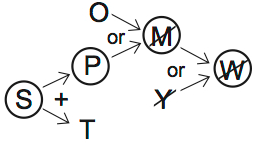
(T is in too of course. I’ve only circled the variables leading from S to W in order to clarify the relationship you’re looking for on this question.)
E is wrong. If W is in, Y is in. Clearly, those two can be together.
Question 10
I found this question hard. I eventually figured out what I was missing: I had forgotten that at least four employees must be selected.
This question places Y out. That also forces W out. You can draw this as an in-out diagram, it may help you to keep track:
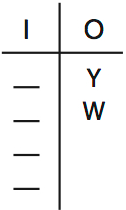
We need at least four variables in. I’ve drawn that as a reminder in this diagram, but I won’t always repeat it.
So, Y and W are out. Since we need at least four employees in, we can have, at most, two more employees in the out group.
The answers ask who can’t be placed in. The right answer will be an employee that forces more than two other employees out if they are in.
That’s M. Refer to the diagram, look at “M in”, and you’ll see that O, P and S must be out. That’s five people out total, which is too many:
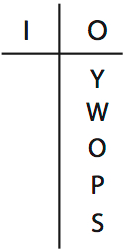
E is CORRECT.
Question 11
Another tricky question. I found trial and error to be the most effective method. If P is out, then S is out.
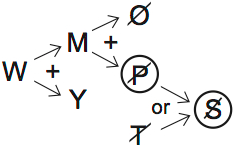
Only a max of four employees can be out. So we’ve only got two employees left to place out, at most.
All of the wrong answers force three people out, which makes a total of five out. That’s one too many.
A places M and O out. M out means W is out, for a total of five out: P, S, M, O, W
B places M and T out. M out means W is out, for a total of five out: P, S, M, T, W
C places M and Z out. If M is out, then W is also out. That makes a total of five out: P, S, M, Z, W
D is CORRECT. This answer places O and T out. O being out doesn’t force anyone out.
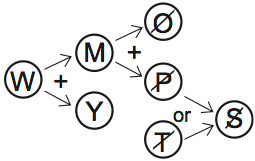
T being out only forces S out, and S was already out on this question. Here’s the in-out diagram for this that shows this answer works:
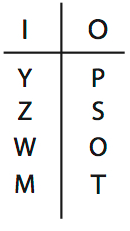
In fact, this answer is just the main diagram, plus Z. So it obeys all the rules:
E places O and Y out. If Y is out, then W also has to go out. That makes a total of five out: P, S, O, Y, W
Question 12
oLG Game 2 Question 12 Explanation, by LSATHacksThis is a slightly unusual question. Normally, when looking for a pair where at least one has to be in, yu would look for a pair with the sufficient negated, and the necessary in. E.g. Q ➞ M
But there are no pairs like that in this game. So we’ll have to use a different method to find out what variables must be in.
The fast way to solve this question is to find a couple of working orders. If you find an order that works, you can use it to eliminate wrong answers. Any variables not included in your working order obviously don’t have to be in.
To quickly make two working scenarios, I used the main diagrams. I just started from the left and fulfilled all the sufficient conditions. Like this:
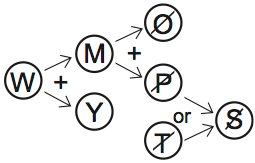
For the first diagram, that gives us WYM in, and OPST out. Add Z in to make four variables in.
Let’s make another working scenario, using the second diagram. If you activate all the sufficient conditions, SPTO are in, and MYW are out.
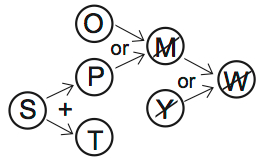
I also left Z out, because this question is asking who has to be in. Z doesn’t have to be in if we already have four variables in.
So now we have two groups of employees that fulfill all the rules:
WYMZ and SPTO
You can use these groups to eliminate answers.
A is wrong. The first group doesn’t include O or S.
C is wrong. The first group doesn’t include P and S.
E is wrong. The second group doesn’t include Y or Z.
Hopefully this method makes sense. I’m attempting to describe the kind of short cut that high scorers use routinely.
Under timed conditions, it took me all of 10 seconds to create those two groups. It takes longer to explain it, because I’m walking you through the steps I went through instantaneously in my head. I recommend practicing this question a few times to get better at quickly creating scenarios to disprove answers.
So now we’ve narrowed things down to B and D. If you use a quick method to eliminate three answers, you can afford to spend more time testing the remaining two. Let’s see if we can create a scenario without OW or without TY.
This scenario eliminates B. MYZT. It obeys all the rules, and doesn’t include O or W. For purposes of illustration, I’ll highlight all the variables I selected across both diagrams. MYTZ are in, POSW are out.
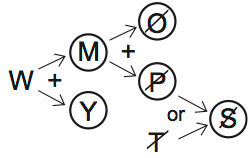
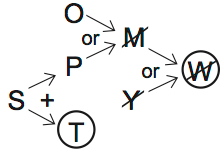
You must read the diagrams left to right. We’ve covered all seven variables across both diagrams, and none of the rules conflict.
D is CORRECT. It’s impossible to construct a correct scenario without either T or Y.
Game 3: Theatre
Game 3 Setup
This is an explanation of the third logic game from Section III of LSAT 70, the October 2013 LSAT.
A repertory theatre is showing fives movies on three screens. There will be a horror film, a mystery, a romance, a sci-fi film, and a western (H, M, R, S, W). The films can be shown at 7 o’clock, 8 o’clock or 9 o’clock. You must decide which films go on which screen at what time.
This game is a mixture of linear and grouping. I don’t classify games beyond that. Few people who score well on logic games really care about games classifications. That’s just something prep companies invent to sell books and courses, and also because they enjoy classifying things.
It’s more important to repeat games and develop an intuitive sense of how to draw the rules.
Ok, let’s look at the setup of this game. First, you need to think about how to draw this game. There are three groups, and three time slots. The first question is a good guide to how to represent this. They’ve arranged the groups vertically, and the times left to right. I’ve added a slight modification to make clear that 8 o’clock is after 7 o’clock.

I’m just going to draw the diagram like this once, so that it’s perfectly clear to you where 123 and 789 are. But for future diagrams, I’m going to leave off the 789, like this:
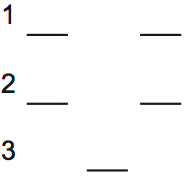
The 789 diagram is very cluttered. If you put too much stuff on your diagrams, your brain won’t be able to make sense of them.
And actually, my own diagrams are even more minimal. My main diagram has the 123, but my diagrams for individual questions generally don’t have numbers. Here’s a scenario from question 17, drawn the same way I’d draw it on my page:
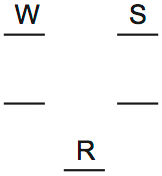
It’s lightning fast to draw a diagram like that, and by glancing at the main diagram I can orient myself easily. My main diagram is on the second page, beside the questions.
Even looking at this, without checking my main diagram, I find it obvious to see which groups are 123 and 789.
However, I’ll be including the 123 for the rest of the explanations, for clarity. However, I encourage you to experiment with the most minimal diagrams that make sense to you.
I’ve just given you a little peek behind the curtain. The explanations in all of my books are very similar to what I would draw on test day, but they’re not identical.
This is true of every set of logic games diagrams you might find online. LSAT instructors need to add some complexity in order to make diagrams clear for explanatory purposes. But you should leave off any details you don’t find essential. Your diagrams only have to make sense to you.
Ok, now, for the rules. I’ll start with rules 1 and 4, as they can’t be drawn on the diagram. Rule 1 says that W is before H:

You could also add this rule to the diagram as “not” rules, where you draw “not H” under slot 7, and “not W” under slot 9. I’m avoiding this, because that’s a tactic for beginning students. Advanced students can tell just by looking at W – H that H can’t go at 7 o’clock and W can’t go at 9 o’clock.
Rule 4 says that H and M don’t go in the same group:

You may recognize this as a diagram that’s also used in linear games. I’ve never run into a problem using it for both linear and grouping games.
If this were a linear rule, it would mean that HM can’t go beside each other, in either order. As a grouping rule, it means that H and M can’t be in the same group.
Rules 2 and 3 can be drawn directly on the diagram. I put them as ‘not’ rules to the right of each group. R can’t go in group 2 and S can’t go in group 3:
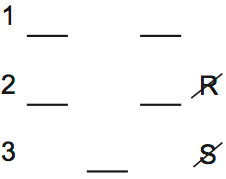
Game 3 Main Diagram
These diagrams show the rules used to decide how the theatre will schedule films (H, M, R, S, W).
Refer to these diagrams when solving this game. Copy them on your own page, and on each question make a new version of them in order to follow along with my explanations. You’ll learn much more if you draw along.
The setup section explains how to build this diagram.
Main Diagram
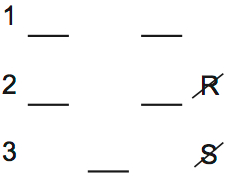
Rules


Question 13
For acceptable order questions, go through the rules and use them to eliminate answers one by one.
Rule 1 eliminates B. The western is supposed to begin earlier than the horror film.
Rule 2 eliminates D. The sci-fi film can’t be shown on screen three.
Rule 3 eliminates E. The romance can’t be shown on screen two.
Rule 4 eliminates C. The horror and mystery films must be shown on different screens.
A is CORRECT. It violates no rules.
Question 14
This is another type of acceptable order question. Remember that the two movies in the answers are on screen two. They are shown at 7 and 9.
It’s best to go through the rules one at a time to see if a rule proves an answer correct.
The first rule proves that C is CORRECT. The western must go before the horror film. That means that W can’t go at 9.
You should, of course, check that none of the answers violate rules 2-4. And all the other answers are fine.
I’m not going to bother proving that the other answers work. It’s not something you’d ever want to do under timed conditions.
If you think that one of the other answers also doesn’t work, then you’re misreading the rules. I don’t know which rule you’re misreading, so I can’t solve the problem except by telling you to read the rules again and find your mistake.
Question 15
I actually got this question wrong when I took the test under timed conditions. (Yes, I make mistakes)
I chose A, because I forgot that the romance film can’t go in group 2.
But I’m getting ahead of myself, I’ll show you the diagram we can draw based on the new rule this question gives us.
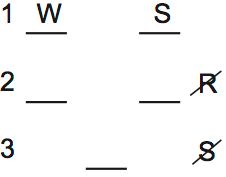
This question says that W and S are in the same group. That means they’re in group 1 or 2, because only those groups have two spaces.
We can also figure out the order of W and S. The western has to go before the horror film, so the western can’t go in group 3. Therefore the western goes at 7, and the sci-fi goes at 9.
So we get these two diagrams:
——————————————–
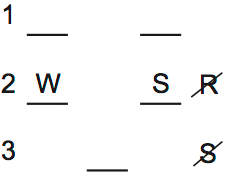
But actually, the first diagram won’t work. The romance film can’t go in group two, so it would have to fill group three.
That would leave the mystery and horror films to go in group 2. And that violates rule 4.
So we’re working from the second diagram. One of M/H goes in group 3, because they can’t go together:
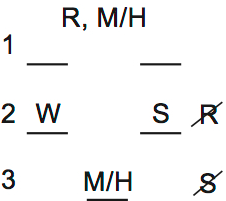
The romance film and the other one of M/H fill group 1. Just remember that the horror film can’t go at 7 o’clock, because it comes after the western.
This is a could be true question.
A can’t be true. The second screen is filled by the western and the sci-fi film.
B is CORRECT. This diagram shows that it works:
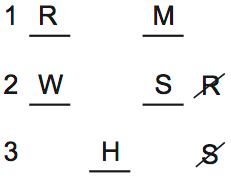
C doesn’t work. If the romance film is on screen three, then the mystery film and the horror film would have to go together, which violates rule 4.
D can’t be true. If the sci-fi film starts at 7, then the western would start at 9, since they’re in the same group. But the western can’t start at 9 – it has to go before the horror film (rule 1).
E doesn’t work. This question says that the western is on the same screen as the sci-fi film. Only screens 1 and 2 have two spaces, and neither of them have a show starting at 8 o’clock.
Question 16
This question places the romance before the western. We also know that the western is before the horror film. So we get this order:
R – W – H
That means the romance is at 7 o’clock, the western is at 8 o’clock, and the horror film is at 9 o’clock.
The romance film can’t go in group 2, so it must be in group 1. The western is in group 3, as that’s the only screen with an 8 o’clock showing:
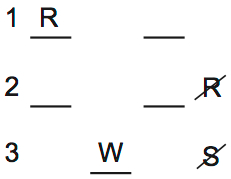
Next, the mystery and horror films must be in different groups (rule 4). That means one of them is in group 1, and the other in group 2:
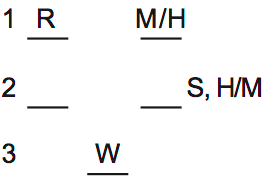
The sci-fi film also has to go in group 2, as it’s the only group left open. E is CORRECT.
In case you were wondering, I drew S and M/H to the right of group two, with a comma, to indicate that they both go in that group, in either order.
Question 17
This question appears similar to question 14. It looks like a rule based “acceptable order” question.
Unfortunately, I went through every rule and none of them seemed to directly eliminate any answers.
When you’re stuck, you should consider the most restricted variables. In this game, the horror film and the mystery film are quite restricted, as rule 4 says they can’t go together.
Notice that answers A-D all include one of the horror and mystery films. So they automatically fulfill our toughest rule.
E does not have either the horror or the mystery film, so let’s start there.
The western and the sci-fi film fill group one, and one of H/M fill group 3:
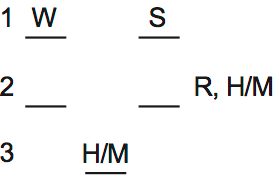
So the romance film and the other H/M go in group 2. But this doesn’t work: rule 3 says that the romance film can’t go in group 2.
E is CORRECT.
This is a hard question, but it fits a pattern. If a question seems impossible, look for what’s not included in the answer choices. The LSAC knows that people aren’t very good at imagining things that aren’t listed, so they’re pretty predictable at using this trick to make hard questions.
Question 18
This question places sci-fi and romance on the same screen. Rule two says that the sci-fi film can’t go on screen 3. Rule three says that the romance film can’t go on screen 2.
So if the sci-fi and romance film are together, they have to be shown on screen 1, in either order:
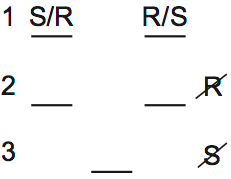
We have the western, the horror film, and the mystery left to place. We know the horror and the mystery have to fill two groups, so one of H/M fills group 3:
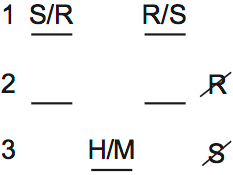
The western and the other H/M goes in group 2. The western has to go in 7 o’clock, because rule 1 says the western is before the horror film:
A is CORRECT. The western must start at 7 o’clock.
B-E all could be true, but don’t have to be. R/S and H/M are interchangeable for this question.
Game 4: Birds
Game 4 Setup
This is an explanation of the fourth logic game from Section III of LSAT 70, the October 2013 LSAT.
A naturalist is giving five lectures on different types of birds: osytercatchers, petrels, rails, sandpipers and tern (O, P, R, S, T). The lectures are either in Gladwyn Hall or Howard Auditorium (G, H). You must decide the order of the lectures and which auditorium they take place in.
This is a linear game, with each lecture assigned to one hall.
It’s best to keep your diagrams as simple as possible, so I draw the lectures above the slots, and the halls underneath the slots. I’ll demonstrate by drawing the main diagram with the first and second rules:

Notice that I haven’t included numbers. If you make diagrams without numbers, you’ll very quickly learn to see which slot is which. You’ll also be able to draw diagrams much faster, with less space.
I usually include numbers in my diagrams for explanatory purposes, but with only five slots it’s better to show you how I would actually draw this.
There’s not much we can do with the third rule. It says that three of the lectures are in Gladwyn hall. It’s best just to memorize rules like this, though it’s not a bad idea to include a note in your list of rules, like so:

The most important thing you must realize about the first rule is that if there are three Gs, then there are only two Hs.
This comes up over and over, so I’ll repeat it: there are only two Hs.
The next two rules also can’t be drawn on the diagram. The fourth rule says that S is in Howard Auditorium, and that S is before O:

Once again, this diagram includes as much detail as necessary, but no more.
The fifth rule is similar. T is before P, and P takes place in Gladwyn Hall:

That’s it. As with most modern logic games, there’s no way to combine these rules to draw deductions. The most important things on modern logic games are making a clear representation of the rules, and memorizing the rules.
Is it possible to make a couple of scenarios. We know that there are only two Hs, and S has to take place in H.
S is also in front of O. So either S can go fourth, or S can go in one of 2/3.
If S is fourth, we know that O is last:

If S is 2/3, then the placement of G and H is completely determined, because we’ve placed both Hs:
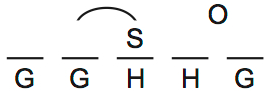
O is floating to the right of S in the second diagram. This is a way of placing the fourth rule directly on the diagram: O is after S. That way it’s harder to forget the rule.
The line above the second and third slots indicates that S could go second or third (you have to move H too).
There are no added deductions you can make by placing S 2nd or 3rd, so I represented both possibilities as one scenario. The two positions are interchangeable.
The scenarios on the previous page are very rough diagrams. They are useful because they let you see how limited the game is. S can only go second, third or fourth.
I find that when I make these diagrams in advance, I see things that I wouldn’t have noticed otherwise. Many questions become very obvious, as I’ve realized the possibilities are quite limited.
I encourage you to sketch out a couple of scenarios before you start games. You may be surprised at the insights you gather. Try to split the scenarios based on an objective factor, such as “S is fourth, or S is 2/3”. Don’t just draw randomly.
I normally only draw scenarios when I can make a clear division between two exclusive possibilities. i.e. Things can only go one way, or another way.
Game 4 Main Diagram
These diagrams show the rules used to decide when and where (G, H) the naturalist will give his lectures (O, P, R, S, T).
Refer to these diagrams when solving this game. Copy them on your own page, and on each question make a new version of them in order to follow along with my explanations. You’ll learn much more if you draw along.
The setup section explains how to build this diagram.


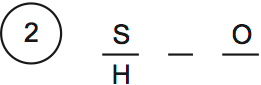
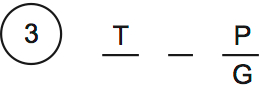
Two scenarios
S fourth
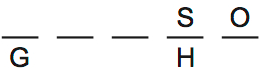
S second or third
Question 19
For acceptable order questions, go through the rules and use them to eliminate answers one by one.
On this question, you must combine two rules to eliminate D and C. That’s unusual, but the process is the same.
When I solved this, I eliminated all the answers I could get rid of with a single rule, then I examined the remaining answers in more detail to see if they violated a combination of rules.
Rule 5 eliminates A and B. Petrels must be lectured on earlier than Terns.
None of the other rules eliminate any answers on their own.
Rules 1 and 4 eliminate D. The first lecture is in Gladwyn Hall, and the Sandpipers lecture is in Howard Auditorium. So Sandpipers can’t go first.
Rules 2 and 5 eliminates C. Petrels must go in Gladwyn Hall, and the fourth lecture must be in Howard Auditorium. This answer places P fourth.
E is CORRECT. It violates no rules.
Question 20
Open-ended “must be false” and “must be true” questions can be among the hardest logic games questions.
Sometimes you have a flash of insight and you can get the answer right away. Other times you have no choice but to try every answer, using trial and error.
I’m going to try to help you get that flash of insight. The key is to look at the answers and see what rules they relate to. Here the answers place G and H. Let’s see what rules relate to G and H:
- There are three Gs. Therefore there are two Hs.
- A G is first
- An H is fourth.
The right answer will violate one of these rules. None of the answers violate the rules about putting G first or H fourth. So the right answer almost certainly violates the first rule: there are three Gs and two Hs.
Let’s look at the answers that mention H, because H is the more restricted variable. One of the two Hs is already fourth, thanks to rule two. So only one of the other lectures can take place in H.
B puts H in second and third. We also know H is fourth. That’s three Hs, which is too many, so B is CORRECT.
D places two Hs, but one of them is fourth. Since there was already an H fourth, this answer only requires two Hs total. So D is possible.
There’s basically no way for A, C or E to violate a rule. Three lectures take place at G, so there’s no way for an answer to place too many Gs.
I hope this helps you see that there’s usually a method that you can apply to quickly solve “must be false” questions. The right answer was simply based on combining two rules: rule 2 and rule 3.
Question 21
When a question gives you a new rule, there is always a way to combine that rule with one of the existing rules. To do this effectively, you should have the regular rules memorized.
When you have all the rules in your head, it’s much easier to combine them.
This question says that terns are lectured on in H. Here are the existing rules that relate to that:
- Sandpipers are lectured on in H (rule 4).
- Only two lectures are H (rule 3).
- One of the H lectures is fourth (rule 2).
Whew, there are quite a few involved in this question. Let’s go through step by step.
There are two Hs. For this question, S and T are the lectures that take place in H.
Since one of the Hs is fourth, that means that one of S and T will be fourth. Whenever there are only two possibilities, you can split things up into two scenarios. Separate scenarios will let you get more deductions:
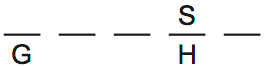
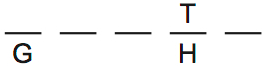
This may seem a lengthy process when I explain it. But it actually takes longer to explain than to draw. Success at logic games comes from experience.
A skilled student of logic games can get the two scenarios above with 5-10 seconds of drawing and deductions.
Likewise, a skilled student will make all the deductions I’m about to walk you through, and they’ll make them very quickly. If you move on without understanding this question intuitively, then you won’t learn that skill. Keep practicing questions like this until they’re second nature. Draw the diagrams on your own, too.
Ok, so we made two scenarios, with T and S fourth. Other rules mention those birds. T is before P, and S is before O. (rules 4 and 5)
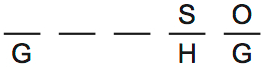
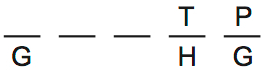
In both cases, the fifth lecture takes place in Gladwyn Hall. This is because on this question, S and T are the lectures that take place in Howard Auditorium. (Also, rule 5 says that P takes place in Gladwyn Hall)
Ok, so now we have to place T in the first diagram, and S in the second. S and T both take place in H, so they can’t go first. And they both have something after them, so they can’t go third. Therefore they each go second:
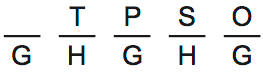
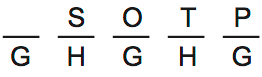
The next step would be placing R first in both diagrams. I left that off to make the previous step easier to follow.
A is CORRECT. In the second diagram, O is third and is in Gladwyn Hall.
These dual scenario deductions are a very common pattern for some “could be true” and “must be true” questions. The question can be split into two scenarios. When you fill them both out, you’ll then see what can be true in both diagrams, and what must be true in both.
As I said, you can get quite fast at this with practice. The alternative is trial and error. That can be a perfectly acceptable method. You can get lucky, try A, and see that it’s the right answer. But the problem with trial and error is that you don’t usually know where to start, and you may have to try every answer.
Question 22
The diagrams from question 21 let us solve this question. A is CORRECT. O can be fifth, and in Gladwyn Hall.
Here’s the diagram that proves it:
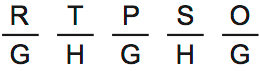
You can also eliminate some answers using the rules.
B is wrong because rule four says that petrels are lectured on in Gladwyn Hall.
D is wrong because rule four says that sandpipers go before oystercatchers. So sandpipers can’t go fifth.
E is wrong because rule five says that terns are before petrels. So terns can’t go fifth.
C is slightly trickier to eliminate. If rails are fifth and in Howard Auditorium, then we know the placement of both Hs:
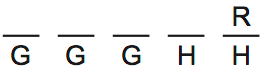
Rule four says that sandpipers have to be in Howard Auditorium. But rule four also says that sandpipers must be before oystercatchers.
That’s not possible on this diagram. The only H where we can put sandpipers is in slot 4, and that leave no room to place sandpipers ahead of oystercatchers.
Question 23
This question places sandpipers third. Let’s do that and see what happens. Remember, rule 4 says that sandpipers are in Howard Auditorium:
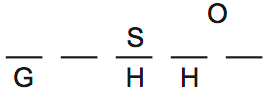
I also placed O to the right of S, as a reminder that rule 4 says that O comes after S.
So far, there are two Hs and one G on the diagram. Rule 3 says that there are three Gs, so we have to make the other two slots G:
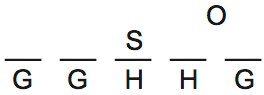
This diagram easily eliminates A-C.
A is wrong because O has to be after S. So O can’t go second.
B and C are wrong because in this diagram the Hs are third and fourth, not second or fifth.
This diagram proves that D is possible:
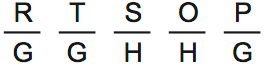
D is CORRECT.
That diagram should also make clear why E is wrong. Rule five says that P is after T. So if T is fourth, then P has to go fifth.
But we also know that O has to go fourth or fifth, because rule four says that O is after S. So If we placed T fourth, then T, P and O would have to go in fourth and fifth. There’s no space for that.

Leave a Reply