
LSAT Preptest 71 LG Explanations
Full explanations for every question from the logic games section of LSAT Preptest 71.
Archived Logic Games explanations
Logic Games are no longer part of the LSAT. LSAC removed the Logic Games section beginning with the August 2024 LSAT. If you are studying for the current LSAT, you can skip this section.
These explanations remain available for students, tutors, and readers using old-format PrepTests. For current guidance, see Logic Games and the current LSAT.
Table of contents
Game 1: Film Schedule
Game 1 Setup
This is an explanation of the first logic game from Section II of LSAT Preptest 71, the December 2013 LSAT.
Six films will be released by a movie studio. The six movies are Fiesta, Glaciers, Hurricanes, Jets, Kangaroos, and Lovebird (F, G, H, J, K, L). You need to make a schedule for the film releases.
Game Setup
This is a straightforward pure sequencing game. Except for the final question, there’s absolutely nothing tricky here.
If you found this difficult, I have good news for you. This type of game is very learnable. Just redo it until it makes sense, and you’ll be able to do every sequencing game with ease. Set high standards for yourself. A skilled LSAT student should be able to solve this in 4-5 minutes.
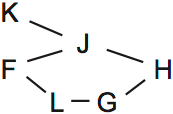
It’s best to combine all the rules into one big diagram. I don’t draw them separately. It is a waste of time, and in my experience it tends to confuse students. Better just to connect everything rule by rule. Here’s the first rule:

The second rule connects on J:

The third rule attaches on to L:
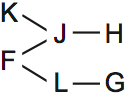
That’s the entire setup. No need to make things more complicated than they are. The diagram reads left to right. Kangaroos or Fiesta could be first, as they have nothing before them. Hurricanes or Glaciers could be last, as they have nothing after them.
It’s important to note that, for example, Jets could be before or after Glaciers. They’re not directly connected, so there’s no reason we can’t put Glaciers before Jets, even though Glaciers is further right on the diagram.
Game 1 Main Diagram
These diagrams show the rules used to determine the proper sequence of the film releases (F, G, H, J, K, L).
Refer to these diagrams when solving this game. Copy them on your own page, and on each question make a new version of them in order to follow along with my explanations. You’ll learn much more if you draw along.
The setup section explains how to build this diagram.
Main Diagram
Question 1
Unusually for a first question, this is not an “acceptable order” question. That means the LSAT was expecting you to make deductions in your setup, such as the main diagram we created.
We’re looking for what must be false. The slow way to do this question would be to test each answer choice and prove that it could work (thus eliminating it).
The fast way is to look through the answers to find the ones that seem more difficult. For instance, A is a poor candidate, because it places Fiesta early on. On our diagram, Fiesta is early: the only restrictions on Fiesta are that it goes before other variables. So it’s easy to place Fiesta early, and A is unlikely to be correct.
It should be clear that E is CORRECT, once you have practice reading this type of diagram. Kangaroos comes before Jets and Hurricanes. That means that Kangaroos can go fourth at latest.
I’m going to show the other answers are all possible, but this isn’t something you should do under timed conditions.
This diagram proves that A and C are wrong:
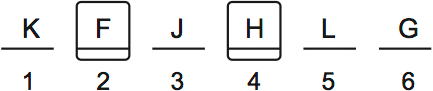
This diagram proves that B and D are wrong.

But I’ll emphasize that this is not how you should solve this type of question. Rule violations on sequencing questions tend to be obvious.
Rule violations tend to happen when something is placed too near the edge. e.g. 5th is one space away from last, but Kangaroos always has to be at least two spaces away from last.
Question 2
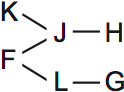
I’ve repeated the main diagram. To solve “must be true” questions like this one, you should just look at the diagram to see what has to be true.
Fiesta is always before Hurricanes, so A is CORRECT.
None of the other answers have to be true. There are no left-to-right connections between the variables mentioned in those answers. A left-to-right connection is the only way you can prove one variable comes before another.
Question 3
The new rule on this question doesn’t change much. If you find yourself hesitating, then it is best to redraw the diagram to add the new rule. This should only take 10 seconds or so. If it takes you longer, practice. Here’s the diagram, with Glaciers before Hurricanes:
The only real change is that Hurricanes now has to be last. Kangaroos and Jets could still go before Glaciers. So A is wrong. Glaciers could go as late as fifth.
E is CORRECT. Lovebird now has to have Glaciers and Hurricanes after it, so Lovebird can be fourth at latest.
Question 4
This question places Lovebird earlier than Kangaroos. I drew a new diagram showing this. I recommend trying this modification yourself. It’s very quick to draw a new rule. Most students vastly overestimate how long it takes to make drawings.

From this diagram, it’s obvious that A, B and C are wrong. Lovebird has to go second, since Kangaroos, Jets, Hurricanes and Glaciers come after Lovebird.
D is CORRECT. Glaciers can go anywhere, as long as it’s after Lovebird.
E is obviously wrong, as the diagram shows that Jets has to come after L.
Drawing the new diagram adds ten seconds, but likely saves you thirty seconds on the answer choices.
Question 5
This is the only question that most students find truly difficult on this game. Fewer than half got it right. Everyone hates rule substitution questions.
There is a way to do rule substitution questions quickly however. It’s very difficult for the test makers come up with a new rule that has the same effect. Usually their only option is to describe the effects of the rule in another way. Let’s see how to do that. Here’s the main diagram again:

Now, let’s look at the full effects of placing Fiesta before Jets and Lovebird.
- Fiesta is before J – H and L – G.
- Kangaroos is the only variable that can come before Fiesta.
I can think of two ways of phrasing this:
- Every variable except Kangaroos has to come after F.
- Only Kangaroos can come before F.
Answer A uses my second variation. A is CORRECT.
I think B and D are fairly obviously wrong. They both force something to happen that normally doesn’t have to happen. Ordinarily, Kangaroos can come after Lovebird, so B is wrong. And normally, Kangaroos can come before Fiesta, so D is wrong.
C and E are trickier to eliminate. C is the most popular wrong answer. It places Fiesta first or second. It’s true that Fiesta normally has to go in one of those positions. But that’s not all that’s true about Fiesta.
We also need the rule to force Fiesta to be before Lovebird, and answer C doesn’t do that. The rule in answer C allows this scenario:

Fiesta is second, but Lovebird is before F!
E is the second most popular answer. It says that Fiesta or Kangaroos must be first.
E is also something that has to be true normally, but we’re not looking for something that must be true. We’re looking for something that replaces the rule. This scenario is possible if we replace the rule in question with answer E:

Kangaroos is first, but Fiesta is last! That violates the normal rules.
Game 2: HR
Game 2 Setup
This is an explanation of the second logic game from Section II of LSAT Preptest 71, the December 2013 LSAT.
Four human resource officers (Rao, Smith, Tipton and Ullman: R, S, T, U) will evaluate the applications of seven job candidates: Farrell, Grant, Hong, Inman, Kent, Lopez and Madsen (F, G, H, I, K, L, M). At least one application will be evaluated by each officer and each application will be evaluated by exactly one officer.
Game Setup
This is a grouping game. I’ve set it up vertically. You can set this type of game up horizontally too. Either way is fine, depends how your brain works.
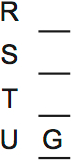
I’ve added G to group U. You should always read all the rules before drawing. Often one rule is very easy to draw and you should start there.
I next placed the final rule on the diagram:
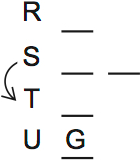
The final rule says that S has more candidates than T, so S always has at least two candidates. The arrow reminds me that S has more than T. It’s important to note that Tipton could evaluate at most two candidates. If Tipton evaluated three candidates, then Smith would have to evaluate four, and there would be no candidates left for the other two officers.
This is a non-standard rule, so you’re welcome to use another symbol to remind yourself that S has more than T. But it’s best if you can find a way to draw the rule directly on the diagram. The fewer rules in your list of rules, the better.
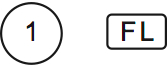
Next, is my list of rules. Here are rules 2, 3, and 4:


I’ve drawn rules 2 and 3 slightly differently. I normally prefer a box to show that variables must be or can’t be in the same group. But that doesn’t work for rule 3, so I used the dual arrow to show that Inman can’t go with M or H.
The final rule has a vertical line to the right of K. That symbol means that the group K is in is closed: there can be no more candidates there. This type of rule occurs frequently enough that you should adopt this symbol.
Game 2 Main Diagram
These diagrams show the rules used to determine which officers (R, S, T, U) will evaluate which job candidates (F, G, H, I, K, L, M).
Refer to these diagrams when solving this game. Copy them on your own page, and on each question make a new version of them in order to follow along with my explanations. You’ll learn much more if you draw along.
The setup section explains how to build this diagram.
Main Diagram
Rules

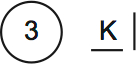
Question 6
For acceptable order questions, go through the rules and use them to eliminate answers one by one.
Rule 1 eliminates E. Grant must be evaluated by Ullman.
Rule 2 eliminates B. Farrell and Lopez must be evaluated by the same officer.
Rule 3 eliminates C. Hong and Inman can’t be evaluated by the same officer.
Rule 4 eliminates D. Kent must be evaluated alone.
A is CORRECT. It violates no rules.
Question 7
You should start local rule questions by drawing the new rule, then making a deduction. If Hong is evaluated by Rao, then Inman can’t be evaluated by Rao:
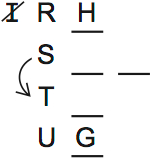
Then you must ask yourself which of the remaining rules are affected by this new situation. Kent’s rule is very important. Kent must always be alone, and now there is only one group where Kent can be alone. Kent must be evaluated by Tipton:
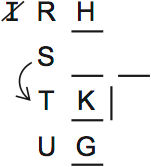
Once a diagram gets filled up, you should ask yourself who you can still place. Only FL and I,M are left, and IM can’t go together.
We need two people to be evaluated by Smith, so FL must go there:

Only Inman and Madsen are left. They must go in different groups. They can go anywhere, except Inman can’t go with Rao.
From this diagram, B is CORRECT. B could be true, and the diagram contradicts all the other answers.
Question 8
This question says that Tipton evaluates two candidates. And Rule five says that Smith must evaluate more candidates than Tipton does. So if Tipton evaluates two candidates, Smith must evaluate three candidates. That leaves one candidate for R and U:
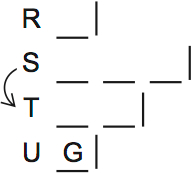
Next, look to the rules and see what applies. Kent must be alone in a group. That means Kent must be evaluated by Rao:

Just like on question 7, you must now see who’s left to place. There’s FL, and I, H and M. I, H and M can’t go together. That means FL must be evaluated by Smith. This lets us separate I and HM.
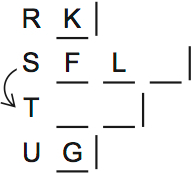
I, H and M are left. Inman has to go with FL, because if Inman were evaluated by Tipton then either H or M would also be there. Next, since only Tipton has space left, both Hong and Madsen must go there:
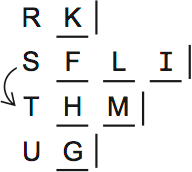
C is CORRECT. Farrell can’t be evaluated by Tipton. All of the other answers have to be true.
This may seem like a lengthy process, but on the page it should take about 15 seconds. It takes a long time for me to write and for you to read because I’m going one step at a time, and I have to make sure what I’m doing is clear. But with practice, you can learn to see these steps intuitively in your head and do them quickly.
Question 9
This question says Madsen is evaluated alone. That means that there are two candidates who must be evaluated alone: Madsen and Kent.
Smith always evaluates at least two candidates, and Ullman always evaluates Grant. So that means that Rao and Tipton must evaluate Madsen and Kent.
Madsen and Kent are interchangeable on this question, I’ve drawn a line to show this. I use this type of line whenever an entire group is interchangeable:

The next step is logically difficult. There are four people left to place: FL, H and Inman. H and Inman can’t go together.
That means that one of H/I will go with FL. So these four variables will be distributed in a group of three and a group of one.
We need at least two people to go with Smith. So the group of three, the group with FL, must be evaluated by Smith:

Hong and Inman are interchangeable between Smith and Ullman.
B is CORRECT. Lopez must be evaluated by Smith.
Notice that all the other answers mention Madsen, Kent, Inman and Hong. These four variables are all interchangeable with another variable on this question, so they could never be the right answer.
Question 10
Farrell is always evaluated alongside Lopez (rule 2). This question adds Inman to the group, for a total of three candidates.
There are only two officers that can evaluate these three candidates: Rao and Smith. Tipton can’t evaluate three candidates, because then Smith would have to evaluate four candidates.
And Ullman can’t evaluate three additional candidates. Then Ullman would have four candidates, and there wouldn’t be enough candidates left for Rao, Smith and Tipton. You need at least four candidates for those officers, since Smith always evaluates at least two.
So only Smith and Rao can handle FL and Inman. I drew a separate scenario for each possibility. If you practice making local scenarios, you should be able to do this in 15-20 seconds and then quickly solve the question.
First let’s place FLI with Rao. Kent has to go with Tipton, because Kent has to be alone:
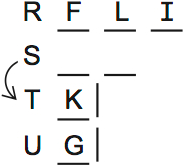
Only Hong and Madsen are left to place. They must be evaluated by Smith, since Smith must evaluate more candidates than Tipton does:
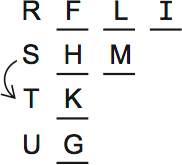
Now let’s place FLI with Smith:

Rao and Tipton are the open groups, and they are interchangeable. Kent fills one of the groups. Now only Hong and Madsen are left to place. One of H/M goes with Rao or Tipton. The other H/M is flexible: they can go in the same group, or with Ullman:

The line between Rao and Tipton is a reminder than H/M and Kent are interchangeable in this scenario.
In both diagrams it is impossible for Lopez to be evaluated by Ullman. C is CORRECT.
We have done more work than we had to. But if you practice, it shouldn’t take you too long to make these scenarios, so the wasted effort doesn’t matter. The scenarios will also help you prove definitively that the other answers could be true.
Question 11
As with all local rule questions, you should start by drawing the new rule. FL go with Rao:

I’ve placed Kent with Tipton. Kent must always be alone, and Tipton is the only officer left who can evaluate a single candidate.
Now we only have Madsen, Hong and Inman left to place. These three can’t go together (rule 3). We also need to place at least two people with Smith (rule five).
Therefore, Madsen and Hong must go with Smith. Inman can go either with Rao or Ullman. Inman can’t go with smith because of rule 3:

E is CORRECT. We know where to place L, H, M, K, and G, for a total of five. (the question asks about other applicants).
Game 3: Literature
Game 3 Setup
This is an explanation of the third logic game from Section II of LSAT preptest 71, the December 2013 LSAT.
Six books will be discussed in a six-week literature course (F, K, N, O, R, T). You must arrange the books in sequence and determine whether they will be summarized.
Game Setup
This is a linear/sequencing game, with a second element: the courses are either summarized or not summarized.
I don’t have any special approach for this type of game. I just mark summarized or not summarized under the diagram. Keep it simple.
(There will be examples summarized/not summarized diagram on the questions)
At first I thought this was just a sequencing game. I drew rules 3 and 4. Here’s rule 4:

I then added rule 3:

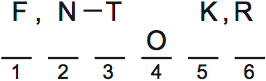
Most people would stop there. In fact, I did stop there on my own setup. But when I got to question 14, I noticed that this game is very restricted. Look at O. O is stuck in the middle. FTN are always before O, and KR are always after O.
So O is always fourth! This deduction makes the game much simpler. I redrew the sequencing rules as this diagram:

When I want to show semi-certain placement in a linear diagram, I draw some variables floating above the diagram. For instance, KR are always to the right of O. So I drew them in that position. The comma indicates that they are reversible.
I’ve done the same thing with “ F, N – T ”. N is always before T, but the comma indicates that F could be before them, after them or in the middle.
Drawing the diagram this way may seem like a small change. You might think “I could have figured all that out without the diagram!”. But did you?
In any case, all logic games diagrams are just a tool to do things faster. This particular diagram let me fly through this game in six minutes. As much as possible, you should take knowledge out of your head, and put it on the page in the clearest possible form. You want to always know that O is fourth, without thinking about it.
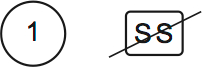
There are two more rules. Courses can’t go together if they’re summarized. I drew it like this:

That’s more of a reminder than anything else. I kept that rule in my head. Remembering it will help you go fast. You should always take 10-20 seconds at the start of a game to make sure you’ve memorized the rules.
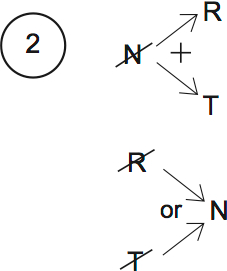
The second rule says that if N is not summarized, then T and R are both summarized:
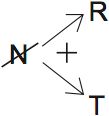
I only drew that. I’ve done enough logic games that the contrapositive is obvious to me. However, if it takes you time to see the contrapositive, then you should draw the contrapositive as well:

Game 3 Main Diagram
These diagrams show the rules used to determine the sequence of the books (F, K, N, O, R, T) to be discussed and summarized.
Refer to these diagrams when solving this game. Copy them on your own page, and on each question make a new version of them in order to follow along with my explanations. You’ll learn much more if you draw along.
The setup section explains how to build this diagram.
Main Diagram
Rules
I don’t draw the sequencing diagram I used in the setup. All that information is better captured in the first diagram I drew above.
Question 12
For acceptable order questions, go through the rules and use them to eliminate answers one by one.
Rule 1 eliminates C. T and R are summarized, so they can’t go together.
Rule 2 eliminates D. N is not summarized, so R should have been summarized.
Rule 3 eliminates B. N has to be earlier than T.
Rule 4 eliminates E. F has to be earlier than O.
A is CORRECT. It violates no rules.
Question 13
If N is second, then T must go third, since N is always before T (rule 3).
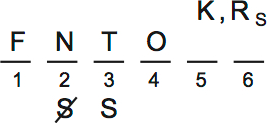
The question also says that N is not summarized. This means that both T and R are summarized (rule 2).
A is CORRECT. Since N is not summarized, there’s no reason we can’t summarize F.
B is wrong because K is beside R, and R is summarized.
C is wrong because O is beside T, and T is summarized.
D doesn’t work on this question since N is second, and T must go after N.
E doesn’t work because T is third, after N. And since N is not summarized, T must be summarized (rule 2).
Question 14
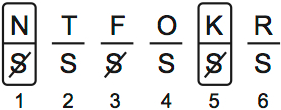
Not much changes on this question. O is summarized, so whoever goes 3rd and 5th can’t be summarized. That’s all we know:
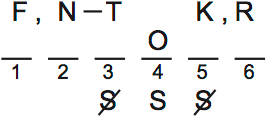
A and B are easy to eliminate. The diagram above shows that F can be first, and K can be sixth.
There are no summarization restrictions for these variables. A key to this game is that, except for N, you can always make a course not summarized.
C is CORRECT. It’s a little tricky to explain. Try drawing this yourself.
If F is summarized, it can only go first or second, since no summarized course can go beside O on this question. Let’s try placing F first. F is summarized, so the second course can’t be summarized:
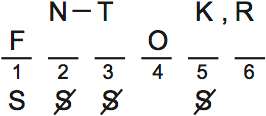
You may see the problem. We must place N and T second and third. Neither position can be summarized here. But if N isn’t summarized, then T has to be summarized (rule 2). So this can’t work.
The same problem happens if you place F second. N is first and T is third. Both positions can’t be summarized, because they are beside F. But if N isn’t summarized, then T must be summarized. We are breaking a rule:
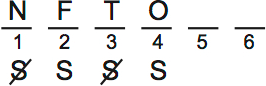
This next diagram proves that D and E are both possible, and therefore wrong:
Question 15
If the final two courses are not summarized, then that means that R is not summarized, because R is one of the final two courses. We know this from our setup diagram: R is always fifth or sixth.
The contrapositive of rule 2 says that if R is not summarized, then N is summarized.
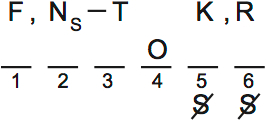
There are a few ways we could place F, N and T. The most important thing is not to make two of them summarized and beside each other. Note that T could be summarized, if you place N first.
A is wrong. K is always fifth or sixth, so on this question it can’t be summarized. C is wrong for the same reason.
B is CORRECT. This diagram shows that it’s possible for O to be summarized:
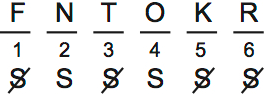
D is wrong because if F and T are summarized, then the first three courses would all be summarized. This violates the first rule.
E is wrong because if R is not summarized, then N must be summarized.
Question 16
Everyone hates rule substitution questions, and this is the second on this section. Ouch.
I actually find rule substitution questions very easy. I’ll try to convince you this is possible. There are two things a substituted rule must do:
- Allow everything allowed by the old rule.
- Ban everything not allowed by the old rule.
This gives you an easy way to eliminate answers. A, B and E add extra restrictions.
- A: This says T is discussed third. That doesn’t normally have to be true. Wrong answer!
- B: This says T is discussed earlier than F. Not a normal restriction. Eliminate!
- E: This says F is discussed third. Normally, F can also go 1st or 2nd. Bad answer!
Have the courage of your convictions. Rule substitution answers are full of silly restrictions. If a restriction contradicts the normal rules, eliminate that answer.
Now we are left with C and D. The second part of my guidelines says that rules have to ban everything that’s normally not allowed.
C doesn’t do this. C says that K and R have to be among the last three. I’m sorry, but K and R have to among the last two. This answer seems too broad. Let’s look at D.
When I did this question, I went right to D because it said O has to be fourth. That’s the most important deduction in the game, and it’s also a consequence of the rule we’re replacing.
Rule substitution answers usually work by describing a consequence of the rule we’re replacing. D does describe a consequence of the rule (O is fourth), so this is very promising. Now let’s see where this leaves us. O is fourth, and we know from rule 3 that N and T have to be before O.
This diagram shows what we’ve deduced so far.
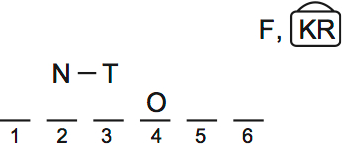
We still have to place F and KR. This answer says that KR are beside each other and reversible. So they need two spaces.
The only two spaces open are 5 and 6. That means KR goes there, and F has to go before O. So this exactly matches our original setup. D is CORRECT.
I didn’t prove this answer with this degree of certainty on the test. I just eliminated A, B and E like I showed you.
Then I discarded C because it said “last three”, and I picked D because it placed O fourth. I did do a quick mental check that the rest of the rule worked, but those were the main elements I used to quickly arrive at the answer.
Game 4: Paintings
Game 4 Setup
This is an explanation of the fourth logic game from Section II of LSAT preptest 71, the December 2013 LSAT.
A museum curator will arrange seven paintings. The paintings are a Morisot, a Pissarro, a Renoir, a Sisley, a Turner, a Vuillard, and a Whistler (M, P, R, S, T, V, W). The paintings will be arranged in a horizontal row, starting from the museum entrance.
Game Setup
This is a linear game. I normally find linear games very easy, but this one was difficult. I even made a mistake on question 21, because I read the local rule wrong.
The setup diagram is pretty standard however. There are seven spaces, which we can draw horizontally. Since the Vuillard can only be third or fourth, I draw two diagrams. This only takes a few extra seconds, and it helps with visualization.


This dual setup isn’t especially useful on this game, but on about 50% of games, dual diagrams produce incredible deductions. So I draw them out of habit, in case they produce something. Even if they don’t, it only takes a moment, and I can visualize better by looking at them.
Next I drew rules 1-3, which are pretty standard.
Rule 1 says that the Turner is before the Whistler:

Rule 2 says that the Renoir is before the Morisot, with one painting in between:

Rule 3 says that the Pissarro and the Sisley are beside each other:

There are no major additional deductions from the setup. However, you should take some time to think about how the rules work together.
There are seven variables. The most restricted set of variables is R_M. Exactly one painting is in between them. Who can it be?
Not Pissarro or Sisley, because they are a block of two paintings. So only the Turner, the Whistler and the Vuillard can go in between the Renoir and the Morisot.
Games often present limited options, and it’s important for you to think about the most restricted points in advance. The fact that only Turner, the Whistler and the Vuillard can go between R_M is very important.
Game 4 Main Diagram
These diagrams show the rules used to determine the order of the paintings (M, P, R, S, T, V, W).
Refer to these diagrams when solving this game. Copy them on your own page, and on each question make a new version of them in order to follow along with my explanations. You’ll learn much more if you draw along.
The setup section explains how to build this diagram.
Main Diagram


Rules
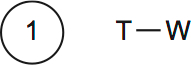
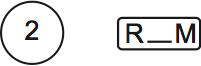

You could equally draw one diagram, and add a fourth rule that says V = 3 or 4. Whether or not you do this is personal preference. I do like having one fewer rule in my rule list.
Question 17
For acceptable order questions, go through the rules and use them to eliminate answers one by one.
Rule 1 eliminates B. The Turner must be closer to the entrance than the Whistler.
Rule 2 eliminates A. The Renoir must be closer to the entrance than the Morisot.
Rule 3 eliminates D. The Pissarro and the Sisley must be next to each other.
Rule 4 eliminates E. The Vuillard must be third or fourth, not second.
C is CORRECT. It violates no rules.
Question 18
This question places the Sisley in the seventh position. Whenever a question gives you a new rule, you can make an additional deduction.
Ask yourself which rules affect the Sisley. Rule 3 does: the Pissarro must be beside the Sisley. So the Pissarro must be in sixth on this question.
The Vuillard is the next variable I placed, since it can go third or fourth. I first tried putting the Vuillard third:

We needs three spaces for the Renoir and the Morisot, so they can only fit around the Vuillard:

In this diagram, the Turner could only go first, since the Turner has to go before the Whistler (rule 1). This doesn’t help us, since “first” is not one of the answers.
So instead we can try putting Vuillard fourth:

R_M are the next hardest to place. They can only go first and third, or third and fifth (around the Vuillard).
It doesn’t make sense to put them around the Vuillard, because then only spaces 1 and 2 would be open for the Turner and the Whistler. We already know the Turner can be in first place, and that’s not the answer.
So let’s place R_M first and third:

Here we can see that the Turner and the Whistler can go second and fifth:

So A is CORRECT. The Turner can go second.
Question 19
This is the last of the “easy” questions on this game. After this, people start making lots of mistakes.
If you got this wrong, it’s worth sketching some diagrams on your own page to see how the rules work together. This question is testing whether you can visualize restrictions and interactions between rules. I’ll walk you through how I did it. Bear in mind that this takes a lot of text to explain, but the process of drawing it on your page should only take 10-30 seconds.
If the Pissarro is fifth, then the Sisley can be fourth or sixth. I first tried fourth:

Since the Vuillard can only be third or fourth, this means the Vuillard must go third:

This diagram doesn’t work. We need three spaces for R_M, but in the diagram above there are only two consecutive spaces open.
So since the Sisley can’t go fourth, it must go sixth. And that’s the answer: C is CORRECT.
Whenever you’re working on a question like this, you should always glance over the answers whenever you make a deduction. Often the first deduction you make will be the right answer.
Question 20
This is where the questions start to get hard. I think question 20, in particular, has the potential to slow you down, unnecessarily.
I have a secret. I skip questions like this. Then I keep them in the back of my mind. As I draw scenarios for other questions, I eliminate answers. By doing this you can often eliminate all but two answers, and you only have to draw a couple of diagrams to prove which answer is right.
The correct answer to question 17 proves that Morisot can go third, so A is wrong. Unfortunately, none of the other questions produced scenarios that disproved answers here. Still, eliminating one answer is a good way to start.
I recommend making very rapid sketches to disprove the other answers. Do this before reading the rest of my explanation – this is a good review exercise. It shouldn’t take long, and you often don’t need to complete a sketch on the page to see that a scenario would work.
For instance, here’s B, in two steps:
Step 1:

Step 2:

Remember, these diagrams only have to prove that something could be true. In the diagram above, PS could be reversed, but who cares? Either way, the diagram proves the Renoir can be third.
Here’s C, in two steps:
Step 1:

Step 2:

Here’s D, in three steps.
Step 1:

Step 2:

Step 3:

Note that these don’t take long at all. I just try putting T third, then see what else has to be true, and then finally what can be true. Here are the steps to prove that T can be third:
- T third
- V must be fourth
- R_M must be 5 and 7
- PS must be 1 and 2 (or vice-versa)
- W must be 6
Since the diagram works, you can eliminate that answer. I’ll emphasize that if you practice doing this, and you know the rules, it should take 5-10 seconds to go through the steps above.
By process of elimination, E is CORRECT. Here’s why, there’s no space for PS:
Step 1:

Step 2:
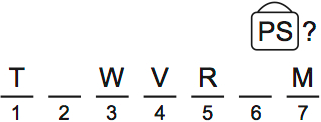
Now, you’re probably saying to yourself “I don’t have time to make all those drawings!”. Actually, you do. There are three problems:
- You overestimate how long it actually takes you to draw.
- You haven’t practiced drawing quickly.
- You don’t know the rules well enough.
I did those sequences of drawings on paper first. Each one took me about five seconds. Here’s the steps:
- Place the variable in the answer choice third.
- Place Vuillard fourth.
- Place R_M, the next most restricted element.
- Place PS.
- Place W after T.
None of that should take long. It should be automatic. Step 1, step 2, step 3, step 4, step 5, bam!
Improving is simple. On review, practice making these drawings until you are blazing fast at it. This skill will transfer over to new games.
Question 21
In the setup I said that only the Turner, the Whistler and the Vuillard can go between R_M. This question restricts R_M further. Since Turner must go before R_M and Whistler must go after, only Vuillard is left to go between.
There are two scenarios, since Vuillard can go third or fourth. Let’s build both at once. This is how I sketched it on my page:


RVM are a block. The question says that we have to place Turner and Whistler before and after this block. In the first diagram, Turner must go first, and Whistler goes after, along with PS:

The other diagram, with Vuillard fourth, doesn’t work. Once we place Turner and Whistler, there is no place to put the PS block:

(Turner doesn’t have to go second, I just placed it there to illustrate that this doesn’t work)
So only the other scenario works. We can use this to eliminate answers.
The diagram contradicts B through E. E is wrong because if Whistler were sixth then there’d be no way for PS to be beside each other.
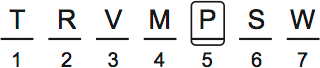
A is CORRECT. Pissarro could go fifth. This scenario proves it:
Question 22
Less than half of students get this question right. To do this question well, you have to be comfortable with making quick drawings to see what’s possible.
Let’s look at who we have to place for this question:
- V, which goes third or fourth
- PS, which go together
- R_M, which form a block of three
- T_W, which form a block of three
Apart from V, there is no variable that just takes up one space! That’s very restrictive.
Once you see these are the restrictions, you must draw it. This is not the time for hesitation. I’ve seen students waste 40-60 seconds trying to work things out in their heads. This does not work! You will learn more in five seconds of drawing than ninety seconds of thinking. Watch this progression of drawings where I try to make a correct scenario with Vuillard fourth:



I put Vuillard fourth, and I placed the three remaining blocks. You can switch the order of R_M and T_W, but the result is the same: we’re missing the two open spaces required for PS.
So let’s try putting Vuillard third. Again, I’ll show the progression of my sketch:


I made this to prove that Vuillard can go third: it’s a way of confirming that we were right to think that Vuillard can’t go fourth.
This is just a could be true scenario. I know that PS can reverse positions, and R_M and T_W can also reverse positions. You don’t need to draw every possible scenario for a diagram to be useful.
Since PS, R_W and T_W can all switch positions, none of those letters are possible candidates for something that must be true. That leaves Vuillard. We saw that Vuillard can’t go fourth, so Vuillard must go third. E is CORRECT.
Question 23
Remember in the setup I said that only the Turner, the Vuillard, and the Whistler can go between the Renoir and the Morisot?
This restriction is rather central. In this question, the Turner is beside the Vuillard. That means that neither the Turner nor the Vuillard can go in between R_M. So only Whistler can.
Once you make a deduction like that, it usually answers the question. B is CORRECT. The Renoir must always come before the Whistler, because they go in this order: RWM
This may not be a satisfactory explanation for this question. That’s the trouble with questions like this. Either they take forever, and you solve them with brute force, or you solve them quickly.
I personally didn’t figure out the solution in advance. I make one scenario with the Turner next to the Vuillard. In the process of drawing, I noticed that the Renoir had to be before the Whistler, and at that point I realized there was no other way.
Making drawings is a revelation. You see things you could never possibly realize if you just try to think a question through. If I can teach you one thing, it’s this: practice drawing, rather than thinking.
I’ll repeat that, because it’s important. Instead of thinking: draw, and draw quickly. In the process of drawing, you will figure things out.
To draw well, and fast, you need to know the rules. There’s no substitute for this.

Leave a Reply