
LSAT Preptest 75 LG Explanations
Full explanations for every question from the logic games section of LSAT Preptest 75.
Archived Logic Games explanations
Logic Games are no longer part of the LSAT. LSAC removed the Logic Games section beginning with the August 2024 LSAT. If you are studying for the current LSAT, you can skip this section.
These explanations remain available for students, tutors, and readers using old-format PrepTests. For current guidance, see Logic Games and the current LSAT.
Table of contents
Game 1: Bonuses
Game 1 Setup
This is an explanation of the first logic game from Section IV of LSAT Preptest 75, the June 2015 LSAT.
A company’s HR department must determine the bonuses of 7 employees from two different departments. Kimura, Lopez, Meng, and Peterson (K, L, M, P) work in the Finance department while Vaughan, Xavier, and Zane (V, X, Z) work in the Graphics department. Each employee can get a $1,000, $3,000 or $5,000 bonus. You must determine the possible distribution of the bonuses according to the rules.
Game Setup
This game combines linear and grouping elements. On recent LSATs the LSAC has been making more unique, unusual games. I do not believe these games are harder than past games. I merely think they are different.
For new LSATs, you should not focus on memorizing game “types”. The people who are the very best at logic games do not decide how to approach a game based on type. They just focus on what the rules say.
Your best approach is to work through past games to mastery, so that you know how different rules work and what constraints within games will have large effects. This will let you quickly and correctly solve unusual games, like this one.
Also, don’t use explanations too much, including mine. To beat these unusual games you need to practice figuring out games on your own, before checking outside resources. You can learn a lot by repeating games before checking explanations.
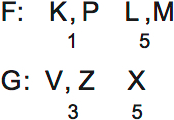
This game splits seven employees across two groups: Finance and Graphics. It’s best to represent the two groups like this:

One key to games is having all of the elements present so you can use them. It’s important that elements be close to each other. If you have to search to find things, you are taking away short-term working memory that could be spent on solving the question.
In this case, I initially made my list of variables directly above each diagram:

I’ve also underlined L, M and X to cover the final two rules:
- Lopez, Meng and Xavier are highly effective.
- The highly effective people have a higher bonus than the others.
That covers rules two and three. Note that I don’t always draw the rules in order. I want a clear, logical diagram. I don’t know how best to draw things until I’ve read all the rules. I draw them in the order that makes the most sense, once I’ve read them all.
Ok, so now only the first rule is left: no one in Graphics gets a $1,000 bonus. That means graphics employees can only get $3,000 or $5,000 bonuses.
We know that Xavier has a higher bonus than Vaughan and Zane, thanks to rules two and three combined. So that means Xavier has a $5,000 bonus, while the other two only earn $3,000:
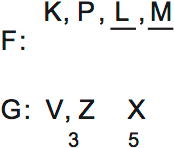
So everything is determined for the graphics department.
The finance department, on the other hand, is more flexible. We know that L and M are higher than K and P. But that’s all we know.
If I’ve counted correctly, there are twenty ways we could arrange the bonuses in the finance department. It’s inefficient to draw them all.
So the graphics department is fully determined, and already on the diagram. You only need to remember two things:
- The bonuses are $1,000, $3,000 and $5,000
- L and M have higher bonuses than K and P
The questions will do the rest. A question will give you something like “Lopez and Meng get different bonuses”. That immediately cuts the possibilities down to one diagram: K and P have $1000, and one of L/M gets $3000 and the other gets $5000. It’s much simpler to wait for the questions to narrow things down before you spend brainpower figuring out possibilities.
On the setup, stick to what must be true.
Game 1 Main Diagram
These diagrams show the rules used to determine the possible distribution of the bonuses to the employees in the Finance (K, L, M, P) and Graphics (V, X, Z) departments.
Refer to these diagrams when solving this game. Copy them on your own page, and on each question make a new version of them in order to follow along with my explanations. You’ll learn much more if you draw along.
The setup section explains how to build this diagram.
Main Diagram
The graphics department is fully determined. The lines under L and M indicate that they have higher bonuses than K and P.
The possibilities for the finance department are $1000, $3000 or $5000.
Question 1
For acceptable order questions, go through the rules and use them to eliminate answers one by one.
Note that I use the rules themselves. I don’t use my diagrams for these questions. Reading the rules again for this question will help you memorize them, and it’s also more efficient. Note that this game is a minor exception: rules 2 and 3 only have an effect when you consider them together.
Rule 1 eliminates B and E. No one in the graphics department is allowed to have a $1,000 bonus. But in B, Zane has a $1,000 bonus. In E, Vaughan has a $1,000 bonus.
Rules 2 + 3 eliminate A and D. It’s impossible to consider rules 2 + 3 separately, as they only have an effect jointly.
In A, Xavier should have a higher bonus than the other two. In D, Meng should have a higher bonus than Kimura.
C is CORRECT. It violates no rules.
Question 2
Question two gives us a new rule: Lopez and Meng get different bonuses.
We already knew from the setup that Lopez and Meng have higher bonuses than Kimura and Peterson (rules 2 + 3). That’s because L and M are highly effective, and highly effective people get higher bonuses.
So to give L and M higher bonuses and also different bonuses, we need to give P and K $1,000. Then one of L/M will get $3,000 and the other will get $5,000.
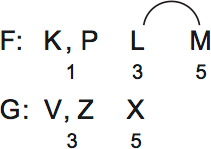
The line above L and M shows that they are interchangeable.
This is a “could be true” question.
The above diagram shows that B is CORRECT: Lopez could receive a $3,000 bonus (or a $5,000 bonus).
All of the other answers are impossible.
Question 3
This question says only one employee gets a $1,000 bonus. Here’s what we can conclude about the $1,000 bonus:
- Rule 1 says that none of the graphic employees can receive a $1,000 bonus.
- So a finance employee receives the bonus. It won’t be Lopez or Meng, because they are rated Highly Effective.
Therefore we can conclude that one of Kimura and Peterson has $1,000 and the other has $3,000 (because the question says only one person has $1,000):

Both Lopez and Meng receive $5,000 because they are rated Highly Effective and so they need higher bonuses than the others (rules 2 and 3).
Therefore, A is CORRECT. Meng must receive $5,000.
In the diagram, the line above K and P shows that they are interchangeable. That’s why B-D are wrong. One of them gets $1,000, the other $3,000, but it doesn’t matter which one of them gets $1,000 or $3,000.
If any of that description is confusing, read over the steps one by one and draw them. There’s no simpler way to approach this question. Logic games depend on taking each deduction and combining it with the rules to form a new deduction. Step by step.
Question 4
I solved this question by looking at the main diagram, and trying to prove answers false. Since this is a “must be true” question, any answer that could be false isn’t the right answer. Here’s the main diagram:

Since this is an explanation, I’m going to draw diagrams disproving A-D. But you should know that on my own test I did not make drawings for this question. I found it easiest to visualize possibilities in my head using the diagram. For example, I can look at that diagram and imagine K and P having $1000 and L/M having some combination of $3000/$5000. Or K and P having $1000/$3000 and L/M having $5000, etc.
However, if you make mistakes visualizing, then you should definitely draw diagrams.
This diagram proves that A and C could be false:

No employees have a $1000 bonus, and four employees have a $3000 bonus.
This diagram proves that B could be false:

Only two employees have a $3000 bonus.
This diagram proves that D could be false:

Only Xavier has a $5,000 bonus.
E is CORRECT. Highly effective employees must have the highest bonuses, so they’re the only ones who can have $5,000. And there are only three highly effective employees: Xavier, Lopez and Meng.
Note that while you can prove E right by logic, I didn’t find it easy to predict in advance that it would be right. So I disproved the other answers by quickly visualizing that they could be false.
However, if visualization is slow, it may be optimal for you to focus on answers that seem to have the most restrictions. For instance, you might notice that $5000 is restricted because only highly effective people can have $5000.
Question 5
This question asks what happens if precisely two employees receive $5,000 bonuses.
We already know that in the graphics department, only Xavier receives a $5,000 bonus.
That means that exactly one Finance employee will get the second $5,000 bonus. And it will have to be a highly rated employee, since they receive the highest bonuses.
So one of Lopez and Meng will get $5,000. The other will get $3,000, because highly effective employees need higher bonuses. The non-highly rated employees will both get $1000:

The arc above L and M shows that they are interchangeable. This interchangeability disproves A, B and C, since interchangeable variables can’t be right for “must be true” questions.
D is CORRECT. Peterson must receive a $1000 bonus.
E must be false and is therefore wrong. Peterson receives $1,000, not $3,000.
Question 6
This is a must be false question. Just like question 4, I used my main diagram to visualize scenarios. If a scenario is possible, then the answer is wrong:
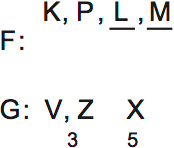
If you have trouble with visualization, it’s better to draw diagrams. I’m going to draw some here for the purposes of clarity in this explanation. But note that I did this in my head in timed conditions, because I was sure I could do it faster yet correctly that way:
This diagram shows that A is possible:
There are two $1,000 bonuses and two $3,000 bonuses.
This diagram shows that C is possible:
There are two $1,000 bonuses and two $5,000 bonuses.
This diagram shows that D and E are possible:
There are two $1,000 bonuses and only one $5,000 bonus.
There are also two $3,000 bonuses and only one $5,000 bonus.
B is CORRECT. Only K and P can have $1,000 bonuses, because they are lower rated than L and M. And rule 1 bans anyone in the graphics department from having a $1,000 bonus.
We saw in the setup that V and Z have $3,000. That’s because they must have less than X, since X is highly rated. So there are at least two $3,000 bonuses, and at most two $1,000 bonuses.
Main diagram:
K and P are the only ones that can have $1,000. (The lines under L and M indicate that L and M are highly rated and therefore have higher bonuses).
Game 2: Trees in Lots
Game 2 Setup
This is an explanation of the second logic game from Section IV of LSAT Preptest 75, the June 2015 LSAT.
Seven trees will be planted on three lots (1, 2, 3). The trees are: a hickory, a larch, a maple, an oak, a plum, a sycamore, and a walnut (H, L, M, O, P, S, W). You must determine which trees can be planted on which lot according to the rules.
Game Setup
This is a grouping game. We have to place seven trees in three lots.
From experience with similar games, it’s best to set this game up vertically:

Next, read over all the rules. You shouldn’t just blindly draw the rules in order. Some rules are easier to draw than others, because they can go directly on the diagram. Draw these first.
Rules 3, 4 and 5 can go directly on the diagram:

A couple notes on the symbols:
Technically, L/W and M/O are exclusive. You can’t have both. I know I’ll remember that because I’ve seen similar rules. If you aren’t certain you’ll remember, it’s best to make a separate note. Maybe “L/W” to the left of lot one, for example.
Lot three has at least two trees, because it has more than lot 1. The arrow + greater than sign is a second reminder of this rule.
This final rule is incredibly important. In every scenario you make you must check if lot three has more than lot one. And in some cases, the final rule determines the distribution.
For example, some questions place exactly three trees in lot two. This means that lot 1 has one tree and lot 3 has three trees – that’s the only way to divide the trees between those two lots and still obey the final rule.
The other two rules can’t be drawn directly, so you should put them in a numbered list:

The circled P and S means that those two variables have no rules. The “H O __” means that the hickory and the oak are in a lot together with one other tree.
I couldn’t make any deductions that I could draw. However, it’s important to consider numerical distributions.
We have seven trees. At least one is in lot 2. That leaves six trees to divide between lot 1 and 3. And lot 3 needs more than lot 1.
That means we can’t put three trees in lot 1, because then there would only be three trees to put in lot 3.
So lot one has, at most, two trees. I didn’t write this down because it’s fairly straightforward if you remember the final rule. But it you sometimes make mistakes with numerical distributions, you should write this deduction down.
Likewise, it’s important to consider where you could place the hickory, oak and 3rd tree (rule one). They could only go in lots 2 or 3, because lot 1 can’t have three trees.
Game 2 Main Diagram
These diagrams show the possible lot assignments (1, 2, 3) of the seven trees (H, L, M, O, P, S, W).
Refer to these diagrams when solving this game. Copy them on your own page, and on each question make a new version of them in order to follow along with my explanations. You’ll learn much more if you draw along.
The setup section explains how to build this diagram.
Main Diagram
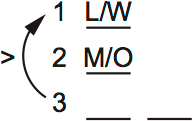
It’s important to consider numerical distributions. To obey the final rule, lot three needs at least two trees. Lot one can have at most two trees.
Rules
Question 7
For acceptable order questions, go through the rules and use them to eliminate answers one by one.
Note that I use the rules themselves. I don’t use my diagrams for these questions. Reading the rules again for this question will help you memorize them, and it’s also more efficient.
Rule 1 eliminates A. The hickory and the oak must go together with one other tree. In A they are alone.
Rule 2 eliminates no answers.
Rule 3 eliminates C. Lot one needs the larch or the walnut. Instead it has only the maple.
Rule 4 eliminates E. Lot two needs either the walnut or the larch. In E it has only the plum and the sycamore.
Rule 5 eliminates B. Lot three is supposed to have more trees than lot one.
D is CORRECT. It violates no rules.
Question 8
This question says that the hickory is planted on lot 2. Whenever a question gives you a new rule, you should draw it and then combine the new rule with the existing rules.
Rule 1 mentions the hickory. The hickory must go with the oak and exactly one other tree:

The vertical line by lot 2 shows that it’s full.
Next, consider the other rules. We know that lot three needs more trees than lot one. There are only four trees left. So we need to place three trees in lot three and one tree in lot one:
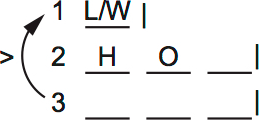
Next consider the other rules. They are:
- Maple and Walnut aren’t together.
- One of L/W goes in lot one.
- One of M/O goes in lot two.
The third one is affected by our setup. The oak is already in lot two, so the maple can’t go there. And the maple can’t go in lot one, because one of L/W must go there.
So the maple must go in lot three:

Whenever you make an extended deduction like this, you should check the answers, because this type of deduction usually solves the question instantly.
B is CORRECT. The maple must go in lot three. A, C and D could be true but don’t have to be. E must be false.
Question 9
This question asks for all the trees that could go in lot one. You should first eliminate answers. There are two good ways to eliminate:
- Up front logic
- The correct answer to the first question
Logic: in the setup, I described how lot one can only have two trees at most, thanks to rule 5. Lot three needs to have more trees than lot one.
So the hickory and the oak can’t go in lot one, since rule 1 says that the hickory, the oak and one other tree go together. That’s three trees.
So any answer with H or O is wrong. A and B are wrong since they contain the hickory.
First question: On almost all logic games the first question is easy to get right with certainty. So you can use this as a correct hypothetical.
The right answer to question seven places the sycamore and the walnut in lot one. Therefore, D is wrong because it doesn’t include the sycamore.
Now we are left to choose between C and E. The two answers are the same, except that C contains the larch and E doesn’t.
You might be tempted to just choose C, since rule 3 says that the larch or the walnut goes in lot one (but not both).
That’s a bad habit. On past games it’s been the case that a variable mentioned as a possibility for a lot actually can’t go in the lot. So before choosing C it’s best to make a quick hypothetical proving that the larch can indeed go in lot one. Like this:
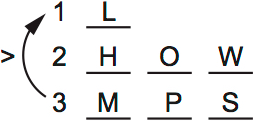
So C is CORRECT. Making a diagram like that should only take ~7 seconds. If it takes longer, practice! It’s a learnable skill.
Question 10
This question places the walnut on lot three. When that happens, you should draw the hypothetical and combine it with the existing rules:
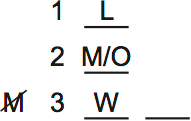
Rule two says that the maple is not with the walnut, so we can draw M beside lot three. And rule three says that the larch or the walnut is in lot 1. Since the walnut is in lot 3, we must place the larch in lot 1.
Next let’s consider the fourth rule: the maple or the oak is planted in lot 2.
If we plant the oak there, then we need to plant the hickory, the oak, and one other tree. And the other tree can’t be the maple, because the oak and the maple can’t go together in lot 2 (rule four):
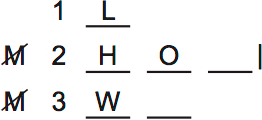
That means the maple would have to go in lot 1:
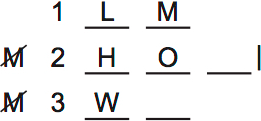
But this diagram doesn’t work. We have distributed spaces for seven trees, but lot 3 doesn’t have more than lot 1. This violates rule five.
So the hickory and the oak can’t go in lot 2. And thanks to rule five, there’s no space for them in lot 1 either. So we must place them in lot 3:
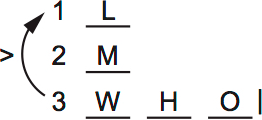
That also means we must place the maple in lot 2 in order to obey the fourth rule (maple or oak in lot 2).
Now we have the plum and the sycamore left to place. Lot 3 is full (rule 1) and so they can go in lots 1 or 2. Of course, at least one must go in lot 2, because lot one needs fewer trees than lot 3 (rule 5).
This is a could be true question, so either the plum or the sycamore in lot 1 or 2 will be the right answer.
A is CORRECT. The diagram above shows that all the other answers are impossible.
Note that these diagrams take a lot of words to explain, but they shouldn’t take that long to draw. This type of question can be solved fairly quickly, since your brain works without words. If these deductions took you a long time, then practice repeating them in order to learn to do the process faster.
Question 11
This question asks which tree will completely determine the order, if you place it in lot 2.
You should think logically about what’s restricted before looking at the answers. We know that lot 2 needs one of the maple or the oak. So placing a variable that isn’t the maple or the oak is more restrictive.
Next, we know two other things about lot 2:
- If we place the oak, then H and one other tree must also go there. (rule 1)
- If we place the maple, then the walnut can’t go there. (rule 2)
So walnut and hickory are special, because they interact with other variables. And hickory isn’t in the answers.
Let’s try the walnut. If we plant W, then we can’t plant the maple and we must plant the oak. Having the oak forces the hickory to go in lot 2 as well (rule 1):
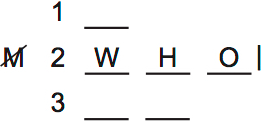
Next we must obey rule 5. Lot three needs more trees than lot one. The only way to do this is to put one tree in lot 1 and three trees in lot 3:

Next, rule three says that the larch or the walnut has to be in lot 1. Since the walnut is in lot 2, we must place the larch in lot 1:
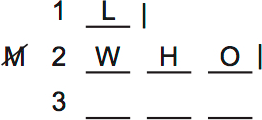
Only M, S and P are left to place. Only lot three has space, so they must go there:
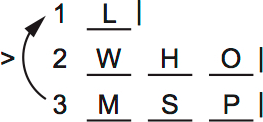
This diagram obeys all the rules, and it’s the only possible diagram if we put the walnut in lot 2.
So A is CORRECT.
On question like this, you could in theory test each of the answers to check that there are indeed multiple possibilities. But that would take a long time. If you’re sure about the rules, you can be confident about choosing A.
However, it is possible to do some elimination. B and C are wrong because the sycamore and the plum are interchangeable. Both answers can’t be right.
And the right answer to the first question eliminates D and E. That answer places both the larch and the maple in lot 2. The sycamore and the plum are in lots 1 and 3 respectively. Those two variables are interchangeable, so they could switch.
Thus even when the larch and the maple are both in lot 2 the order is not completely determined, and D and E are wrong.
It wasn’t necessary to disprove answers B-E, but it also didn’t take that long. The LSAT often has shortcuts like the ones I mentioned. If you’re not completely sure, I’d eliminate the answers.
And for most questions I do check all the answers. The only reason I advocated skipping it here is that it could potentially take a long time to conclusively disprove answers B-D. The only reason it didn’t is because the LSAC gave shortcuts.
Game 3: Librarians
Game 3 Setup
This is an explanation of the third logic game from Section IV of LSAT Preptest 75, the June 2015 LSAT.
Seven librarians, namely Flynn, Gomez, Hill, Kitson, Leung, Moore, and Zahn (F, G, H, K, L, M, Z) will be on duty from Monday through Saturday (M, T, W, Th, F, S). There will be one librarian on duty each day except on Saturday which will have two librarians. You must determined who can be on duty based on the rules.
Game Setup
This is a sequencing game. It has a slight twist in that two librarians are on Saturday. Otherwise, it’s exactly like pure sequencing games.
On these games, the optimal strategy is to combine all the rules into a large diagram. The only other difference on this game is that the final rule splits the game into two diagrams.
On this type of game the optimal strategy is to just draw the rules one by one and grow the diagram:
Rule 1:

Rule 2:
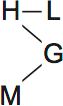
Rule 3:
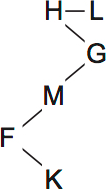
Rule 4:
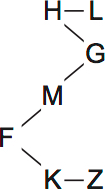
Rule 5 is the only tricky rule. It says that either L is before F, or L is on Saturday. So on the existing diagram we can just give L an “s” subscript to show it’s on Saturday if it’s after F:
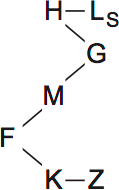
Note that, without this rule, L could have been before F. L is after H, but H isn’t connected to F. So we could have put both H and L before or after F. Even now, we can still put H before F.
So, technically we should draw a line from F to L to show that F is before L. However, for me that makes the diagram more confusing. Personally I have no trouble remembering that in this diagram, H could be before or after F (even first!) but L must be on Saturday.
For the second diagram, draw everything else in the same order but place H and L before F:
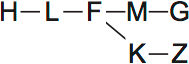
That covers all possibilities. The rest is just reading the diagrams correctly. Remember, two librarians have a relationship only if lines connect them from left to right.
For instance, in the second diagram, we know nothing about the order or Z and M. Either could go before the other. Those two variables have no lines connecting them, so we have no idea which order they go in. The fact that Z is drawn to the right of M doesn’t mean anything – it’s the lines that matter.
On individual questions, I drew a diagram like this. But there’s nothing you can put in it for now:

Note that on my own page, I left off the days of the week. For me it’s easy to see which day is which, because I’ve previously drawn many games that use the days of the week. And it’s faster and smaller to draw diagrams without the days. I recommend you try it. I only drew them here in this explanation for clarity.
Game 3 Main Diagram
These scenarios show the possible assignments of the librarians (F, G, H, K, L, M, Z) to each day (M, T, W, Th, F, S).
Refer to these diagrams when solving this game. Copy them on your own page, and on each question make a new version of them in order to follow along with my explanations. You’ll learn much more if you draw along.
The setup section explains how to build this diagram.
Main Diagram
F before L, L on Saturday:
L before F:

Main Diagram:
Note that on my own page I left off the days of the week. It’s faster and small to draw without them, and I have no problem knowing which day is which. We all use weekly calendars often enough to have an intuition for that.
Question 12
For acceptable order questions, go through the rules and use them to eliminate answers one by one.
Note that I use the rules themselves. I don’t use my diagrams for these questions. Reading the rules again for this question will help you memorize them, and it’s also more efficient.
Rule 1 eliminates E. Hill needs to be earlier than Leung.
Rule 2 eliminates no answers.
Rule 3 eliminates C. Flynn must be earlier than Kitson and Moore.
Rule 4 eliminates D. Kitson must be earlier than Zahn.
Rule 5 eliminates B. Leung has to be earlier than Flynn, unless Leung is on Saturday. Here Leung is on Thursday.
A is CORRECT. It violates no rules.
Question 13
This question asks who can’t be on Tuesday. Tuesday is the second day. To solve this type of question, just look at who needs to have two or more people in front of them.
Zahn and Gomez each have two people in front of them, so they can’t go Tuesday. Either one could be the answer.
Since only Zahn is in the answers, E is CORRECT.
Question 14
This question places Kitson in front of Moore. There are two approaches. One would be redrawing both diagrams to account for this modification. The other would be looking at the diagrams, and visualizing K in front of M.
Either approach is fine. Personally I visualize, because I am good at visualization. If you find drawings clearer, here are the two modified drawings that place Kitson in front of Moore.
The scenarios are split according to the final rule (L on Saturday or L before F):
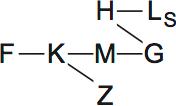

It took me about 10 seconds to draw those. It shouldn’t be an agonizing decision. Either do it or don’t. Time spent staring at the page wondering what to do is time you could have been visualizing or drawing. Logic games are about action, not thought.
From the diagrams, it’s clear that B is CORRECT. Gomez can now no longer be in front of Kitson.
All of the other answers are possible in at least one of the diagrams. Remember that if variables don’t have a line between them, we know nothing. So in the first diagram, for instance, Hill could be first.
All we know about Hill is that it’s before L and G. In the first diagram there’s a wide range of places H could go.
The same applies to Zahn. Zahn has quite a few options for placement, especially in the first diagram. All we know there is that Z is after F and K. They could be before or after anyone else.
Question 15
This question places Zahn on Thursday. You should draw that:
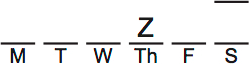
We need three variables after Zahn. This restricts our options. In the second scenario (L before F), only Moore and Gomez can go after Zahn:
So scenario 2 doesn’t work. Looks like we’re working with scenario 1:
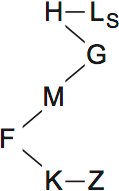
Here, H, M, L and G can go after Z. In fact, thanks to the final rule, L is on Saturday. And G has to go after H and M, so G is on Saturday too (because there’s no one else left to go after G):
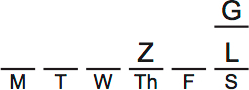
Once you make some major deductions like this, you should check the answers to see if you’ve already solved the question. It turns out I’ve actually already done more work than I needed to.
A is CORRECT. Leung is on Saturday, so Flynn is definitely before Leung.
We could have deduced this earlier merely from the fact that we knew we were working in scenario 1. However it’s not a terrible idea to make the diagram with G and L on Saturday, because the answer also could also have said something like “Moore is earlier than Gomez” and that would have been the correct answer.
Question 16
This question places Moore on Tuesday. Your first step should be to draw that and combine it with existing rules.
We know that F is earlier than M (rule 3), so we can draw that:

Rule five says that if F is earlier than L, then L is on Saturday. F is definitely earlier since F is first. So L is on Saturday:

This solves the question. C is CORRECT.
No need to consider the other answers, if you are sure your deductions are right. Also note that Hill, Kitson and Zahn all have considerable flexibility in how they are placed, making the other answers extremely unlikely to be correct.
Question 17
This question places Flynn earlier than Hill. This automatically put us in scenario 1, since scenario 2 has Hill before Flynn:
Scenario 1:
We can conclude two things:
Leung is on Saturday, due to rule 5.
Flynn is first. In scenario 1, H is the only librarian who could go before F. But this question places H after F.
Here’s a diagram of what we know:

Once you make deductions like these, you should check if they solve the question.
D is CORRECT. Moore is earlier than Gomez, and therefore not on Saturday. Therefore, Moore is also earlier than Leung. (Note: only Gomez or Zahn could have gone with Leung on Saturday).
All of the wrong answers involve H, K, M and Z. These librarians are incredibly flexible and can all go before and after one another (except K, who is before Z). So they are highly unlikely to be the basis for must be true answers when used in combination.
Question 18
This is a rule substitution question. Everyone hates them, but they’re not that hard. They’re just new, and therefore unfamiliar.
The rule in this case is: F is before K and M. You’re looking for something that replicates all of the effects of the rule. So look at what we know about F.
- It’s earlier than M, K, Z and G
- Only H and L could go before F
Just by phrasing the effects of the rule on F, we solve the question. C is CORRECT. It matches the second observation above.
If only H and L can go before F, then logically K, M, Z and G will all have to go after F. So this new rule leaves us with exactly the same possibilities for F, M and K as before.
A is just silly. It would let F be on Wednesday, but after both M and K.
B would allow F to go last if we placed H on Monday. That’s very wrong.
D and E are both similar answers. They link F with the variables after M and K (G and Z). These answers don’t work because they allow M and K to go before F, respectively.
Game 4: Newsletter
Game 4 Setup
This is an explanation of the fourth logic game from Section IV of LSAT Preptest 75, the June 2015 LSAT.
A business newsletter has five slots for each issue. Each issue should have at least three features from the following topics: finance, industry, marketing, and technology and each feature will occupy one or more of the slots. Any slot not taken by a feature should have a graphic. You must determine the possible arrangement of features and graphics based on the rules.
Game Setup
This game is fairly unique. I couldn’t say what type to call it. It’s sort of linear. Truth is, game type doesn’t matter much. The main thing on any game is understanding the effect of the rules and how they interact, and knowing a game’s “type” has nothing to do with that.
So in this game we have four features: finance, industry, marketing and technology. Features are interesting. They can span multiple slots. The game doesn’t set a max number of slots. If there were no other rules, this would be an allowable setup:
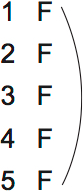
That’s a single finance feature filling all five slots. The arc to the right indicates that it’s a single large feature.
This isn’t an allowable combination because there are other rules. But I’m drawing it to show that there are no natural limits on the size of a feature.
In the setup, it says there at least three features. The setup does not say three different features. So this is actually an allowable setup:

That’s one three-slot finance feature and two single-slot finance features. This is perfectly legal and it obeys all of the rules!
A lot of people are afraid to make a diagram like the one above. “Is it allowed?” they ask. Yes! On logic games, if something isn’t explicitly forbidden, then it’s allowed.
This game is very flexible. Once you internalize that, it’s easy!
Ok, let’s look at the rules. If there’s no feature, there’s a graphic. Simple enough.
Next the listed rules:
- Multi slot features are consecutive
This just means that if a finance feature is in three slots, then it’s in 1,2,3 or 2,3,4 and not 1,3,5.
- If there’s a finance or technology feature, we need one of those in slot 1.
I believe this means that if, say, there’s a tech feature in slot 3, then slot 1 needs a tech or finance feature. I don’t think this rule means you need the same type in slot 1.
Note also that simply having a tech or finance feature in slot 1, and nowhere else, is also legal.
- Only one industry feature
Pretty straightforward. Don’t make more than one industry feature.
Marketing has no rules.
I actually drew no diagrams for the main setup on this game. What would I draw? The rules were so clear that it was easiest just to read them again if I forgot.
I think the main difficulty on this game is self-imposed. You probably want to think there must be more restrictions, because games tend to be restricted.
Nope. This game is incredibly open. Happens sometimes. The zones game is another example.
Game 4 Main Diagram
These diagrams show the rules used to determine the possible combination of features and graphics in the business newsletter.
Refer to these diagrams when solving this game. Copy them on your own page, and on each question make a new version of them in order to follow along with my explanations. You’ll learn much more if you draw along.
The setup section explains how to build this diagram.
Main Diagram
I drew no diagram. See the setup for an explanation. In timed conditions on individual questions I made diagrams that look like this:
Note that in these explanations I made no diagrams as none seemed necessary. But I encourage you to draw diagrams that match this style if needed. Drawing diagrams yourself can help clarify the game.
I didn’t make symbols for the rules because it’s very easy to remember the rules and reread the list if you forget. Plus there are no good symbols for the listed rules.
Question 19
For acceptable order questions, go through the rules and use them to eliminate answers one by one.
Rule 1 eliminates E. If a feature spans more than one slot, then those slots must be consecutive. Here marketing is in slots 2 and 4.
Rule 2 eliminates B and C. If there is a technology or finance feature, then the first slot must have a technology or finance feature. In B the first slot is a graphic, in C the first slot is an industry feature.
Rule 3 eliminates A. There can’t be more than one industry feature.
D is CORRECT. It violates no rules.
Question 20
This question says there is no tech feature, and there is a finance features in slots 4 and 5.
Rule 2 says that if there’s a finance feature, then a tech or finance feature must be in slot one.
Since there are no tech features in this question, the first slot must be a finance feature. A is CORRECT.
Question 21
As I wrote in the setup, almost everything is allowed in this game. This question is asking what can’t be true. So don’t spend too long on answers. If they don’t seem impossible or affects a rule, they’re probably possible. You should move on to answers more likely to be correct.
A complies with rule 3. That helps make it possible, not impossible.
B triggers rule 2, but that only means that a tech or finance feature must be in slot one. That’s possible.
C is possible if we place a finance feature in slot one. And we can do that.
D works if we place a tech feature in slot one.
E is CORRECT. What E tells us is that there are no finance or tech features except in slot 5. And the question says that there is a feature in slot 5, so it must be finance or tech.
So this answer violates rule 3. It places a finance or tech feature in slot 5, but it doesn’t place a finance or tech feature in slot 1.
Note: B, C and D all trigger rule two. But these answers work. We just have to put either finance or tech in slot one. Remember that rule two says we must put finance or tech. We don’t need to place the same one that appeared elsewhere. So finance in slot 1, tech in slot 3 works, for example.
Question 22
This answer places an industry feature in slot 1. We know two things that are relevant:
- There are no more industry features (rule 3)
- There are no finance or tech features (rule 2)
- We need at least three features
Since we can’t have industry or finance or tech features, the other two features must be marketing.
So at minimum those fill slots 2,3 or 3,4 or 4,5. Either way one of slots 2,3,4 has a marketing feature. So D is CORRECT.
A and B can’t be true. We can’t have more than one industry feature (rule 3).
C and E could be true, but don’t have to be. Marketing could be in 4,5 or 2,4 as well.
Question 23
As I wrote in the setup, almost everything is allowed in this game. This EXCEPT question is effectively asking us what must be false.
So don’t spend too long on answers. If the answers don’t seem obviously banned, then they’re probably allowed. You should move on to answers more likely to be correct.
Remember that except for industry, we can have an unlimited amount of other features. So to make the wrong answers work you just need to add two of the feature not mentioned.
A works if we also have two tech features.
B works if we also have two tech features.
C works if we also have two finance features.
D is CORRECT. We need at least three features. But in D, we have just one marketing feature, and no finance or tech features.
The only thing left is industry. But rule 3 says that we can only have one industry feature. So this answer allows two features max.
E works if we also have two finance features.
Note: Remember, rule two says that a finance or a tech feature fill slots one. So if, say, there’s a single finance feature in slot 3, then this works as long as we have a tech feature in slot 1.

Leave a Reply