
LSAT Preptest 76 LG Explanations
Full explanations for every question from the logic games section of LSAT Preptest 76.
Archived Logic Games explanations
Logic Games are no longer part of the LSAT. LSAC removed the Logic Games section beginning with the August 2024 LSAT. If you are studying for the current LSAT, you can skip this section.
These explanations remain available for students, tutors, and readers using old-format PrepTests. For current guidance, see Logic Games and the current LSAT.
Table of contents
Game 1: Accomplices
Game 1 Setup
This is an explanation of the first logic game from Section III of LSAT Preptest 76, the October 2015 LSAT.
A detective is trying to determine the recruitment sequence of seven criminal accomplices: Peters, Quinn, Rovero, Stanton, Tao, Villas, and White (P, Q, R, S, T, V, W). You must determine the possible orders of recruitment according to the information gathered by the detective.
Game Setup
Time on second attempt: 4:26
See “repeating games” at bottom of section
—————
This is a linear game. There aren’t really any upfront deductions, which is common for most modern logic games.
It’s best to start by drawing the easiest, most unambiguous rules. The last rule says that Peters goes fourth:

That cleanly cuts the diagram into two blocs of three spaces on either side of Peters. Drawing this kind of rule helps you visualize how the other elements can be placed.
The rest of the rules are very standard. If any of these rule types are new to you, then this is a good game to repeat as these rules come up frequently in linear games.
Here are the remaining rules

Note that the main restriction in this game is spacing. VW requires two spaces. And some questions add a new rule that makes another block of 2-3 variables.
It’s difficult to place blocks of two people. Some questions will force VW to go on one side of Peters because the question fills up the other side.
As for where to draw these diagrams, I put the main diagram on the second page, just underneath the questions. I put the numbered rules just to the right of the diagram. Then I leave everything untouched – this makes it easy to refer back to all the rules. I draw new diagrams beside the questions instead of touching the main one.
—————
Repeating Games
I’ve written elsewhere about the benefits of repeating games, to solidify your intuition for deductions. Note that the purpose of repeating games is to prove the answers right, so it doesn’t matter if you remember the right answer.
I repeated this game about three days after I first saw it, by which time I had forgotten the answers. I’ve written how long it took me on the second attempt. That time, or a couple minutes above it, is roughly the standard you should be aspiring to – a lot of people take 8-9 minutes on a repeat attempt, get everything right, and pat themselves on the back. But that’s too slow. The faster you go when repeating, the faster you’ll learn to go the first time you see a game.
(I say “a couple minutes above” my time because, after years of teaching the LSAT, I’m really, really fast. You should be almost as fast as me, but you don’t exactly need to match my pace to score -0.)
Time on second attempt: 4:26
Game 1 Main Diagram
These diagrams show the rules used to determine the possible orders of recruitment of the seven criminal accomplices (P, Q, R, S, T, V, W).
Refer to these diagrams when solving this game. Copy them on your own page, and on each question make a new version of them in order to follow along with my explanations. You’ll learn much more if you draw along.
The setup section explains how to build this diagram.
Main Diagram

Rules
Note that on my own diagram, I leave off the numbers under the seven slots. I use them in these explanations for clarity, but I recommend you practice without them. After you do a few games like that, you’ll easily know which slot is which, and your diagrams will be faster and less cluttered.
Question 1
For acceptable order questions, go through the rules and use them to eliminate answers one by one.
Note that I use the rules themselves. I don’t use my diagrams for these questions. Reading the rules again for this question will help you memorize them, and it’s also more efficient.
Rule 1 eliminates A. Tao and Stanton can’t go beside each other.
Rule 2 eliminates E. Quinn is supposed to be before Rovero.
Rule 3 eliminates B. Villas is supposed to be immediately before White.
Rule 4 eliminates C. Peters is supposed to be fourth.
D is CORRECT. It violates no rules.
Question 2
This question is almost like the first question. You should proceed in two steps:
- First, go through all the rules and use them to eliminate answers one by one. This eliminates B and E. (reasons below)
- Next, each answer is only missing two criminals. So check which two criminals need to be placed, and then try to place them. This lets you eliminate the other two wrong answers.
B is wrong because Villas is supposed to be immediately before White. (Rule 3). E is wrong because Peters is supposed to be fourth. (rule 4)
Now for A, C and D. Many logic games questions test your ability to see the unseen. The answers seem hard to eliminate until you actually consider which two criminals need to be placed in each answer. Once you actually try to place them, the rule violation becomes obvious.
In A, Rovero and White are the two criminals left to place. W should be 7th, directly after V (rule 3). But that only leaves 1st for R, which means R is before Q. That violates rule 2. So A is wrong.

In D, Tao and Quinn are left to place. We have to place Tao first so that they aren’t beside Stanton, who is sixth (rule 1). But that makes Quinn go last, which means they are after Rovero. That violates rule 3, so D is wrong.

C is CORRECT. Tao and Rovero are left to place. This order violates no rules:

Question 3
This question says that Tao is recruited second. When a question gives you a new rule, your first step should be to redraw the diagram beside the question, and add the new rule:
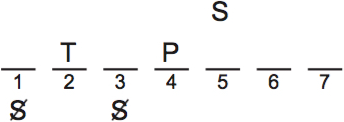
I’ve added the deduction that Stanton can’t go beside Tao (rule 1), which means that Stanton is somewhere to the right of Peters.
Next, consider the remaining rules and see which ones are affected. We have the following variables left to place:
- VW
- Q – R
VW is hard to place. They need two spaces. That space is available only to the right of P:
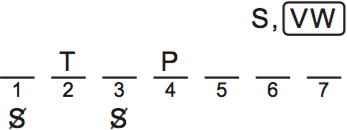
The comma between S and VW indicates that they are interchangeable: it doesn’t matter which order you place them in.
Only Q – R is left to place. Only 1st and 3rd are left open. Therefore, we must place Q in 1st and R in 3rd, to satisfy rule 2:
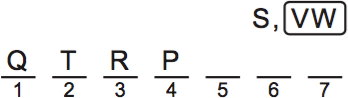
That’s all the deductions we can make. Use this diagram to go through the answers and eliminate the wrong ones.
A, B and E are clearly wrong. C is wrong because we can’t place S in 6th. Try it and see: the only possible order for 5, 6, 7 are SVW or VWS.
D is CORRECT. We can place SVW in 5, 6, 7.
Question 4
This question adds a new rule. Now Quinn is immediately before Rovero. That means we have two blocks of two variables: QR and VW.
Here’s where visualization skills come in handy. If you draw the main diagram, and stare at it, you may be able to visualize drawing VW and QR on the diagram:

What I see when I do that is that the two variable blocks always cover the middle numbers. Like this:

I’ve drawn the blocks as X’s to make it less specific. Those blocks can slide one space left or right. But they’re always covering 2 and 6.
This question asks where Stanton can’t go. Stanton isn’t part of the two blocks above. Therefore, Stanton can’t go in 2 or 6. B is CORRECT.
Question 5
This question says that White is recruited earlier than Rovero, and Rovero is before Tao. When a question gives you a new rule, you should draw it beside the question, then look for deductions.
Here’s the new rule combined with the existing rules:
Q – VW – R – T
Only S is left to place (P is already on the diagram). Here’s the diagram where we’re placing everybody:
Now it’s time for some math (Yes, logic games test math, a bit). There are three spaces on either side of P. Q and VW take three spaces, so that means that at least R – T are after P.
Could VW go after P? No, because R – T are there, and only one space is free.
So Q – VW are before P, and R – T are after P:
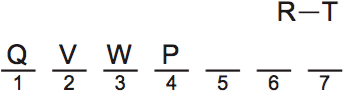
Only S is left to place. Rule 1 says that S can’t go beside T. So that means S must go before R:

Everything is solved. This question says “could be true”, but actually the right answer is also something that must be true. A is CORRECT. All the other answers contradict the diagram.
Question 6
This question says that White is immediately before Quinn. When a question gives you a new rule, you should draw it and combine it with the existing rules. Here’s what we get:
VWQ – R
We already knew VW (rule 3) and Q – R (rule 2). This question just combines the two rules.
Here’s the diagram we’re placing them on:

VWQ must go in three spaces. They’ll have to go in the three spaces before P, since R is after VWQ:

Now who is left to place? R, S and T. S and T can’t go beside each other (rule 1), so R must go in the middle:

Now we’ve deduced everything. The question asks who must go sixth. It’s Rovero. B is CORRECT.
Game 2: Newspaper
Game 2 Setup
This is an explanation of the second logic game from Section III of LSAT Preptest 76, the October 2015 LSAT.
Six photographs are going to appear in a newspaper’s Lifestyle, Metro and Sports section (L, M, S). Exactly two photographs will be put in each section. The photographs are taken by three photographers: Fuentes, Gagnon, and Hue (F, G, H). You must determine the selections of the photographs based on the rules.
Game Setup
Time on second attempt: 6:06
See “repeating games” at bottom of section
—————
This is a grouping game. As with most modern logic games, there aren’t really any upfront deductions. Instead, LSAC expects you to draw a clear diagram, know the rules that aren’t on the diagram, and not forget any rules.
That last bit is what causes 90% of logic games errors. You need to memorize the rules for new games. If you forget them, you go slowly and make mistakes.
You should generally set up the main diagram in the way that the first question sets it up. Like this:
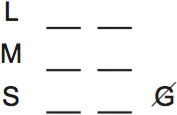
Three newspapers sections, each with two photographs. I’ve also added the fourth rule: Gagnon can’t be in the sports section.
It’s best to place as many rules as you can directly on the diagram. For instance, the second rule says there must be at least one photographer in common between the Life and Metro sections. I find a short, curved line best represents this sort of thing:

The other two rules are:
- Hue’s lifestyle photos equal Fuentes’ sports photos.
- Every photographer has between 1-3 photos.
I couldn’t easily fit either one onto the diagram, so I drew them in a numbered list beside my diagram, like this:
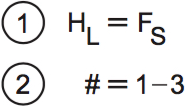
Both are rules I’ve never seen before, so I invented symbols to represent them. You’re free to use different symbols, but you must make sure they meet the same goals. My symbols i. accurately represent the rule, and ii. Are clear and fast to read.
—————
Repeating Games
I’ve written elsewhere about the benefits of repeating games, to solidify your intuition for deductions. Note that the purpose of repeating games is to prove the answers right, so it doesn’t matter if you remember the right answer.
I repeated this game about three days after I first saw it, by which time I had forgotten the answers. I’ve written how long it took me on the second attempt. That time, or a couple minutes above it, is roughly the standard you should be aspiring to – a lot of people take 8-9 minutes on a repeat attempt, get everything right, and pat themselves on the back. But that’s too slow. The faster you go when repeating, the faster you’ll learn to go the first time you see a game.
(I say “a couple minutes above” my time because, after years of teaching the LSAT, I’m really, really fast. You should be almost as fast as me, but you don’t exactly need to match my pace to score -0.)
Time on second attempt: 6:06
Game 2 Main Diagram
These diagrams show the rules governing the selection of photographs from three photographers (F, G, H) to fill the three sections of a newspaper (L, M, S).
Refer to these diagrams when solving this game. Copy them on your own page, and on each question make a new version of them in order to follow along with my explanations. You’ll learn much more if you draw along.
The setup section explains how to build this diagram.
Main Diagram
Rules
Question 7
For acceptable order questions, go through the rules and use them to eliminate answers one by one.
Note that I use the rules themselves. I don’t use my diagrams for these questions. Reading the rules again for this question will help you memorize them, and it’s also more efficient.
Rule 1 eliminates E. Hue can’t have four photographs.
Rule 2 eliminates C. The Lifestyle and Metro sections need at least one photographer in common.
Rule 3 eliminates D. Fuentes has a photograph in the sports section. That means Hue should have had a photograph in the lifestyle section.
Rule 4 eliminates A. Gagnon can’t have a photograph in the sports section.
B is CORRECT. It violates no rules.
Question 8
This question says that both lifestyle photographs are by Hue. When a question gives you a new rule, you should draw it, and combine the new rule with existing rules.
For instance, rule 3 says that the number of Hue’s photographs in the lifestyle section must equal the number of Fuentes’ photographs in the Sports section. And this question places two of Hue’s photographs in the Lifestyle section:
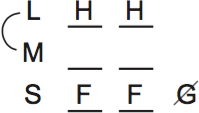
Next, consider the remaining rules:
- We need a photographer in common between Lifestyle and Metro (rule 2)
- We need to place Gagnon
That means that Hue must have one photograph in Metro and Gagnon must have one photograph in Metro:
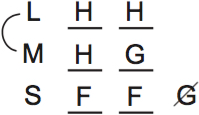
This process of deduction should be very fast. It probably took me 20 seconds total to draw the new diagram. Using the diagram, it’s clear that C is CORRECT.
Question 9
This question says that one Lifestyle photograph is by Gagnon, and the other is by Hue. When a question gives you a new rule, you should draw it:
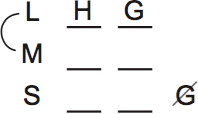
Next, you should combine the new rule with existing rules. We know from rule 4 that Fuentes’ Sports photographs must match Hue’s Lifestyle photographs. Hue has one Lifestyle photograph, so that means Fuentes’ must have one sports photograph:
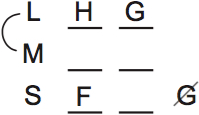
Who can have the other Sports photograph? Not Gagnon (rule 1). And not Fuentes, we already took care of them. Therefore, Hue has the other sports photograph:
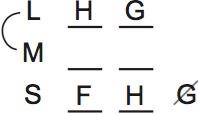
We can’t say much about the metro section, except that one of H/G must be there (rule 2). Since this is a “must be true” question, we should only draw what is definitely true.
On a “must be true” question, once you make a major deduction, such as “Hue has one photo in sports”, you should check the answers and see if that deduction solves the question.
It does: D is CORRECT.
Question 10
This question is a general “could be true” question about Fuentes. Since the question mentioned Fuentes, you should consider which rules affect Fuentes.
The main rule for Fuentes is that the number of his photographs in sports is the same as Hue’s lifestyle photos (rule 3). So you should look through the answers considering the sports section – three of the four wrong answers directly violate this rule.
A seems plausible. When an answer seems plausible, save it for review later. Eliminate easy answers first.
B violates rule 3. If Fuentes has two in sports, then Hue needs to have both lifestyle photos.
C violates rule 3. If Fuentes has one in sports, then Hue needs one in lifestyle. But this answer puts two of Fuentes’ photos in lifestyle, filling it up.
D puts two of Fuentes’s photos in the sports section, and one in Metro. So that means Hue has two photos in lifestyle (rule 3):
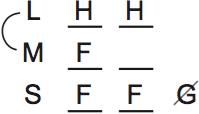
Now we have a problem. We need to put Gagnon somewhere (rule 1). But we also need to put one of Hue’s photos in Metro, so that Metro and Lifestyle share a photo (rule 2). There’s only one open space in Metro, so we can’t put both Hue and Gagnon there. This answer doesn’t work.
E is wrong because it indirectly requires four of Fuentes’ photos, which violates rule 1. Why four? The question directly places three of Fuentes’ photos: one in sports, two in Metro:
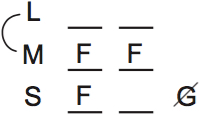
However, rule two says that Lifestyle and Metro need to share a photo. Since Fuentes fills up Metro, that means we’d need to place one of Fuentes’ photos in Lifestyle, for a total of four Fuentes. That’s too many (rule 1).
So A is CORRECT. This diagram does what A says, and obeys all the rules. I made this quick sketch beside A when I was doing this game, it took about five seconds:
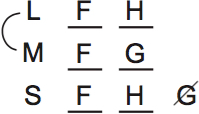
(I left off the L, M, S in my own drawing, for speed)
Question 11
This question places two photographs in the Lifestyle section: one by Fuentes, and one by Hue. When a question gives you a new rule, you should draw that rule beside the question:
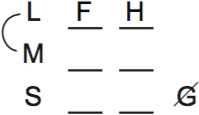
Then consider which existing rules are affected, and start adding deductions to the diagram. Rule 3 says that Fuentes’ sports photos equal Hue’s lifestyle photos. So Fuentes needs exactly one sports photo:
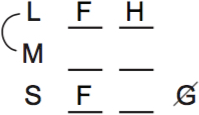
Who can fill the other spot in Sports? Not Gagnon (rule 4), so it must be Hue:
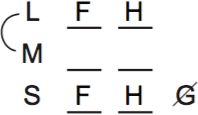
Finally, we need to place at least one of Gagnon’s photos. The only space left is in Metro. The other Metro space must be F or H, to obey rule 2 (At least one photographer in common between Lifestyle/Metro):
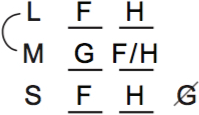
This diagram lets us solve this “could be true” question. C is CORRECT, because it’s possible.
Note that the deductive process here is virtually identical to the process in question 9.
Question 12
This question says that Gagnon fills up one of the sections. Which section could that be? Not Sports, thanks to rule 4. So we can start building two scenarios: One with Gagnon filling Lifestyle, the other with Gagnon filling Metro. Let’s start with Lifestyle:
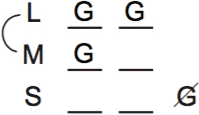
Rule 2 says there must be overlap between Lifestyle and Metro, so I placed one of Gagnon’s photos in Metro as well.
Next, rule 3 says Hue’s lifestyle photos equals Fuentes’ sports photos. Since Hue has no lifestyle photos, Fuentes can’t be in Sports. And Gagnon can’t go in Sports, so both must be Hue:
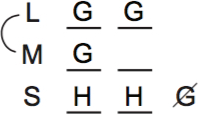
Fuentes needs to go somewhere (rule 1), so we must place Fuentes in the other Metro space:
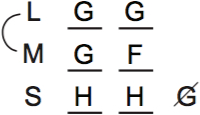
So we’ve made one working diagram. This is a could be true question. So at this point it’s a good idea to quickly scan the answers and see if any are possible in this diagram. E is possible, so E is CORRECT.
(Note that explaining the diagram takes space, but drawing it should take less than 10 seconds.)
That’s all the work you need to do. However, for completeness you can also draw the other possible diagrams and make sure the other answers don’t work.
In the first diagram, we placed Gagnon in Lifestyle. If we instead place Gagnon in Metro, there are two possibilities. I’ve drawn them side by side below:
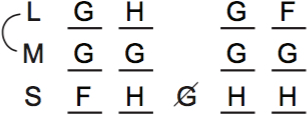
Gagnon has one photo in Lifestyle so that we have Metro/Lifestyle overlap (rule 2). Then the only difference between the two diagrams is whether Fuentes has one photos in sports, or none.
These two diagrams and the Gagnon in Lifestyle diagram above are the only possible scenarios. None of the other answers are possible in these scenarios, and these are all the scenarios, so we can be sure that E is CORRECT.
Question 13
This question fills up Metro with two photos: One by Fuentes, the other by Hue. When a question gives you a new rule, you should draw it, then check the other rules to see what you can deduce. Here’s the new rule:
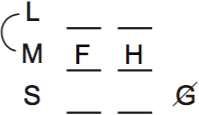
Now consider the remaining rules. By this point in the game you should know that Gagnon can only go in Lifestyle or Metro, because he can’t go in Sports (rule 4). Now Metro is full, so one of Gagnon’s photos must go in Lifestyle:
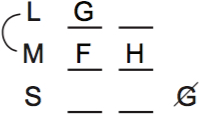
When you make a deduction, you should check the answers. This deduction actually eliminates all of the wrong answers.
There is only one free space in Lifestyle. So A and D are wrong because they place two of Fuentes’ and Hue’s photos there, respectively.
E is wrong for the same reason. If we place two of Fuentes’ photos in Sports, we’d need to place two of Hue’s in Lifestyle. But we can’t do that, since Gagnon already has a photo in Lifestyle.
B is wrong because it places two of Gagnon’s photos in Lifestyle. That leaves no photographs in common between Lifestyle/Metro, which violates rule 2.
C is CORRECT. We can put one Hue in Lifestyle as long as we put one Fuentes in Sports. This scenario works:
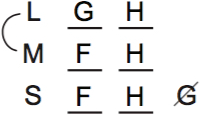
Game 3: Gallery
Game 3 Setup
This is an explanation of the third logic game from Section III of LSAT Preptest 76, the October 2015 LSAT.
There will be a special art exhibit at a campus which will run from Monday through Friday (M, T, W, T, F). Each day is divided into two shifts and with five students working two shifts each. The students are Grecia, Hakeem, Joe, Katya, and Louise (G, H, J, K, L). You must determine who works the shifts based on the rules.
Game Setup
Time on second attempt: 3:52
See “repeating games” at bottom of section
Note: I did well the first time I did this game, but then I botched my first repeat. I tried to do upfront deductions, and it really, really didn’t work. I tried again about a week afterwards, using the method in the explanation below, and got the very fast time above. I believe the method below is far superior and faster than using upfront scenarios.
—————
People sometimes ask me how much work to do upfront on logic games. It used to be the case that you could deduce a lot before you even started.
But on new games, I find I rarely deduce anything. I tried to deduce stuff on my 2nd run through this game, and botched it. I did far better, and faster, on my first run through when I just listed the rules.
So unless deductions are really obvious, you probably shouldn’t be making any or many on new LSAT logic games. Instead, you want to focus on three things:
- Making a clear diagram
- Making a clear list of rules
- When possible, putting rules directly on the diagram instead of into a list
Here’s how I set up my main diagram:
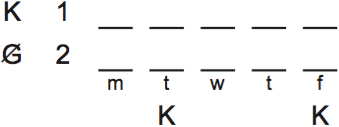
(Note that on my actual page, I left off the MTWTF. It’s cleaner and faster to avoid them. But I draw them on these explanations for clarity.)
I already drew a few rules on the diagram: No L in shift 1, no G in shift 2, and K must be on Tuesday and Friday.
Here’s the other rules:

A couple notes:
The XX is shorthand for the same person can’t go twice on the same day.
G + G means that there’s at least one space between the two G’s.
1+ beside H/J means there’s at least one place where they’re together.
On older games, I used to have to explain the setup and make deductions. But increasingly I find there’s little to do except list the rules and memorize them.
You should be memorizing the rules. If you forget them, you’ll go slow and make mistakes. Not forgetting rules is the single biggest factor that allows people to score perfect on logic games.
Note for efficiency: On my own page, I drew a line between the rules numbered 2 and 3, and put an x through it. This was to remind me that L and G couldn’t go together. Then I didn’t draw the rule numbered 5.
This is somewhat more efficient, but I thought it would be less clear for the explanation, so I went with the version I drew above.
—————
Repeating Games
I’ve written elsewhere about the benefits of repeating games, to solidify your intuition for deductions. Note that the purpose of repeating games is to prove the answers right, so it doesn’t matter if you remember the right answer.
I repeated this game about three days after I first saw it, by which time I had forgotten the answers. I’ve written how long it took me on the second attempt. That time, or a couple minutes above it, is roughly the standard you should be aspiring to – a lot of people take 8-9 minutes on a repeat attempt, get everything right, and pat themselves on the back. But that’s too slow. The faster you go when repeating, the faster you’ll learn to go the first time you see a game.
(I say “a couple minutes above” my time because, after years of teaching the LSAT, I’m really, really fast. You should be almost as fast as me, but you don’t exactly need to match my pace to score -0.)
Time on second attempt: 3:52
Note: I botched my repeat. I tried to do upfront deductions, and it really, really didn’t work. So I’m not sure how long I’d repeat. However, my initial attempt was 9 minutes or less, I think.
Game 3 Main Diagram
These diagrams show the rules used to determine the possible work schedules (M, T, W, T, F) of the five students (G, H, J, K, L).
Refer to these diagrams when solving this game. Copy them on your own page, and on each question make a new version of them in order to follow along with my explanations. You’ll learn much more if you draw along.
The setup section explains how to build this diagram.
Main Diagram
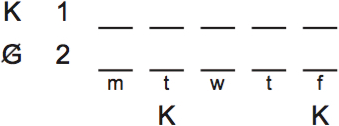
(Note that on my actual page, I left off the MTWTF. It’s cleaner and faster to avoid them. But I draw them on these explanations for clarity.)
Rules
Note: On my own page, I drew a line between the rules numbered 2 and 3, and put an x through it. This was to remind me that L and G couldn’t go together. Then I didn’t draw the rule numbered 5.
This is somewhat more efficient, but I thought it would be less clear for the explanation, so I went with the version I drew above.
Question 14
For acceptable order questions, go through the rules and use them to eliminate answers one by one.
Note that I use the rules themselves. I don’t use my diagrams for these questions. Reading the rules again for this question will help you memorize them, and it’s also more efficient.
Note that there are three things that are unique about this question:
- There are a lot of rules on this game, so some rules don’t eliminate anything.
- To eliminate one answer, you have to make a drawing and think about multiple rules.
- Normally, the correct answer serves as a useful, correct scenario. Here, to achieve that effect you have to fill in first shift.
There are a lot of rules on this game, so some rules don’t eliminate anything. And
Rule 2 eliminates C and D. Louise needs to go twice in a row.
Rule 3 eliminates B. Grecia has to go twice in shift 1. Here, she goes once during shift 2.
E is tricky to eliminate. It helps to try drawing shift 1 as well. Let’s start with K, since they have to go Tuesday and Friday:
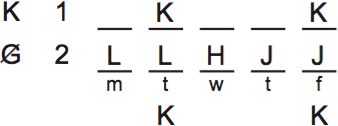
Next, you need to put H with J. Only Thursday is open:
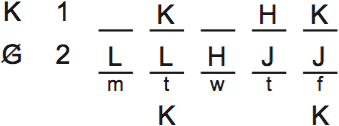
Now we need to place the two G’s. But only Monday and Wednesday are open, so G and L would be on the same day. That violates rule 6, so E is wrong.
A is CORRECT. It violates no rules. Unusually, on this question it’s worth drawing out a working scenario for A. This serves two purposes: you’re sure you’re correct, and you have a full working scenario that lets you eliminate answers on the other questions:
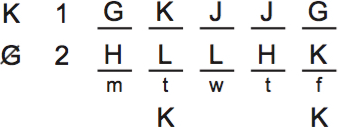
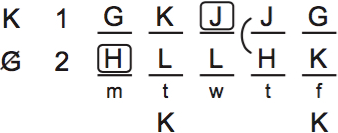
Note that H/J on Thursday are reversible. We can also exchange H and J between Monday and Wednesday. Keeping this flexibility in mind will help you use this diagram for future questions.
The diagram above solves half the game, if you remember that H and J are reversible.
It’s true. You can do a lot if you have a correct scenario and know which elements can be moved around.
Here’s a version of the diagram drawn that emphasizes what’s interchangeable. You can add notes like this if it helps you visualize:
Question 15
Note: If you’re coming to this explanation from a later question, see the note at the bottom of the page. This game is unusual in that the diagrams discussed in this question solve every question.
————
This question asks what must be true. So if you can find a single scenario where an answer isn’t true, then that answer is wrong.
The first question is useful. If you drew in the other half of the correct answer, you have a full, valid scenario. I’ve drawn it here, noting which variables are interchangeable:
H and J in Monday/Wednesday are interchangeable. And likewise, H and J are interchangeable between the first and second shifts on Thursday. We’ll be using this diagram on later questions.
It’s extremely important to know which variables are interchangeable. The fact that H and J are largely interchangeable makes this game very easy.
On this question, the above diagram eliminates D and E. Joe can work Thursday, and Louise can work on Tuesday.
After eliminating those two answers, I didn’t know where to start. So I just decided to make a scenario where A was true. If it worked, I’d disprove A, and the scenario might disprove other answers too.
So I placed Grecia Tuesday and Friday. This was to leave space for Louise to go twice in between (rules 2, 3 and 6):
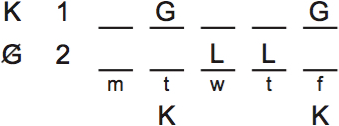
Next, we have to put Katya on Tuesday and Friday (rule 4) and Hakeem and Joe together on one day (rule 5):
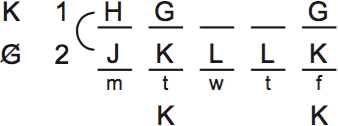
Note that there was only one way to place Katya and H/J. However, H and J are reversible Monday because it doesn’t matter who has the first shift.
Finally, one more H and J are left to place. These go in the only space left, and they’re interchangeable:
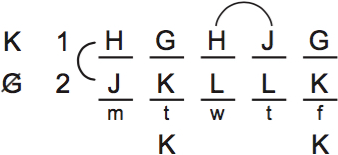
It’s important to note who is interchangeable: H and J, where joined by curves. Knowing what can be changed will let you use this diagram on other questions.
Also note that I’ve used curved lines, rather than the traditional H/J, J/H. The lines make for a simpler diagram which is easier to read. If your diagram is cluttered, your thinking is cluttered.
This diagram eliminates A and B. It’s possible for Grecia to work Tuesday, and for Hakeem to work Wednesday.
C is CORRECT.
On review, it’s worth thinking about why C doesn’t work. If you try drawing Joe Tuesday, you’ll see why. First, Katia must also go Tuesday:
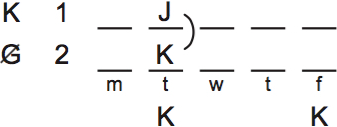
Next, we have to place Louise and Grecia somewhere. Anywhere is fine as long as you obey rules 2, 3 and 6:
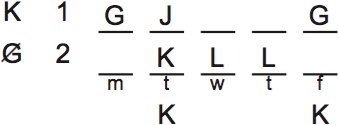
And now we see the problem. There’s no way to put Hakeem and Joe on the same day (rule 5).
If you’re coming from a later question
This game is unusual in that the two diagrams I discussed in this question solve every question. So I’ll be referring back to this question frequently on later questions. If you are at all confused about how to draw the diagrams, do them again now, as you’ll need them on later questions.
Here are the two diagrams. The first is the right answer from question 14, the second was drawn for this question.
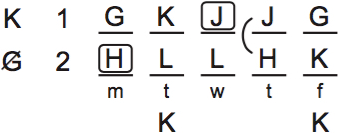
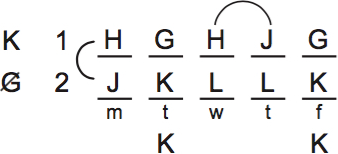
On both diagrams I’ve indicated where H and J can change positions, with boxes in the first diagram, and with lines in the first and second.
Question 16
This is an interesting setup. It says that if Hakeem works Wednesday, then the days Joe is working are the days Joe must work.
This means that if you draw a single correct scenario where Hakeem is on Wednesday, then the days that Joe is working are the answer to this question. Because Joe must work those days.
On questions 14 and 15 we saw working scenarios. I described them both on question 15; refer to that if you aren’t familiar with the diagrams.
This diagram from question 15 lets you put Hakeem Wednesday:
If Hakeem is Wednesday, then Joe is Monday and Thursday. So B is CORRECT.
There’s nothing else to do for this question. Don’t make things more complicated than they are.
Question 17
This question asks what could be true if there’s a day where Grecia and Joe work together. I have a lazy approach to logic games. On a question like this, I’ll first see if any past scenarios put Grecia and Joe together, and then see if that scenario solves the question.
The correct answer to the first question had the following order. I’ve filled in the first shift (it’s the only possible order):
I’ve highlighted what’s interchangeable. As I mentioned in question 15, H and J are interchangeable in this diagram. So we can switch H and J between Monday and Wednesday to match what this question is asking:
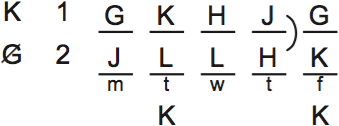
Now let’s look through the answers to see if any could be true in this diagram. Note that J and H are still interchangeable on Thursday.
A-D aren’t true in this diagram. But E could be: we could place Joe in the first shift on Tuesday. So E is CORRECT.
Question 18
This question places Katya in the second shift on Tuesday, and asks what could be true.
In question 15, we drew a scenario where Katia was second on Tuesday:
Hakeem and Joe are interchangeable between the shifts on Monday, and between Wednesday and Thursday.
Let’s look through the answers and see if any of them can be true. B is CORRECT. Hakeem can work the first shift on Monday in this diagram.
None of the other answers are possible in the diagram. And if you’re sure that the diagram you drew is right, then that’s the end of it. No need to conclusively disprove the other answers.
(Though it can be a helpful exercise to practice doing quickly, on review.)
Game 4: Cookbooks
Game 4 Setup
This is an explanation of the fourth logic game from Section III of LSAT Preptest 76, the October 2015 LSAT.
A publisher is planning to publish six cookbooks over the course of a year: K, L, M, N, O, and P over a course of a year. Each of them will be published in either fall or spring (F, S). You must determine the possible publishing schedules based on the rules.
Game Setup
Time on second attempt: 5:10 See “repeating games” at bottom of section for details.
—————
This is a grouping game, and a fairly simple one. You can make three scenarios upfront that determine everything. Normally, I don’t split games with more than two options, but I’ll make an exception for three-option games if they seem fairly restricted.
Here I initially planned to split the game on “M in the fall” and then “M in the spring”. But upon drawing those scenarios I saw that the “M in the spring” scenario split neatly into two, so I drew those. The point being, you don’t need to know in advance how many scenarios there will be: often there will be two major scenarios you can draw. Upon drawing them, it may become clear that one of those scenarios can be split further. At that point, you can do so if it makes sense. In this case it did.
(People ask: how do you know if it makes sense? Do it if the resulting scenarios are both very restricted and clear to read)
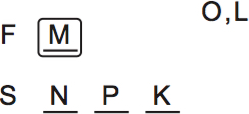
For this game (like all games), I read all the rules before I started drawing. That let me start with the most determinative rules: those that affect M. I saw M was in two rules, which means M has a big effect. So I first tried out the last rule: M in the fall.
That has two effects:
- N goes in the spring (rule 4)
- P goes in the spring (rule 1)
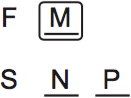
Next, look over the rules to see what else is affected. Rule two says that K and N must go together. So we must place K in the Spring:
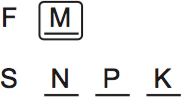
Then check rule 3 to see if it applies. It doesn’t, since K isn’t in the fall. So this diagram is almost complete. We just have to figure out who hasn’t been placed. O and L are left. I draw them to the top right of the diagram, for a quick visual reminder of who needs to be placed. They can go in either fall or spring:
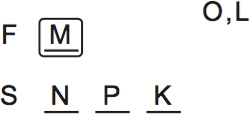
Note that I don’t draw a list of letters: K, L, M, N, O, P. What’s the point? In that format, they have no rules attached. You can’t do anything with them, it clutters up the page, and drawing them prevents you from thinking.
Scenarios with M in the Spring
So that scenario above is what happens if M is in the fall. For our other scenarios we’ll have to place M in the spring. If M is in the spring, P must go in the fall (rule 1):

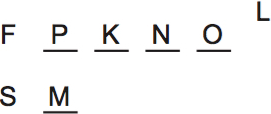
We could just leave it there, and start the game. But K also has two rules attached to it. So we should try placing K, because we may end up with two very restricted scenarios. First lets place K in the fall. That means N must also be in the fall (rule 2):

Next, rule three says that if K is in the fall, so is O:
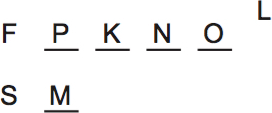
I also drew L above the diagram, to the right. L is a floating variable in this scenario: they’re the only cookbook left to place, and they can go in either season.
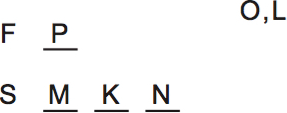
So that’s M in the spring, K in the fall. Finally, lets place M in the spring, and K in the spring:

Of course, since K is in the spring, then so is N (rule 2). O and L are floating variables that can go in either season.
That’s it: these three scenarios determine everything. To answer the questions, just check the relevant scenario.
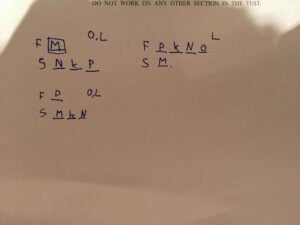
I took a photo of my own drawings for this game, so you can see what it looked like on the page. I draw my main diagrams just below the questions, on the second page. That’s so I can easily locate them, without wasting precious working memory on eye tracking. Note that I also never touch that – drawing over them also scrambles your brain.
Photo of diagrams on page:
—————
Repeating Games
I’ve written elsewhere about the benefits of repeating games, to solidify your intuition for deductions. Note that the purpose of repeating games is to prove the answers right, so it doesn’t matter if you remember the right answer.
I repeated this game about three days after I first saw it, by which time I had forgotten the answers. I’ve written how long it took me on the second attempt. That time, or a couple minutes above it, is roughly the standard you should be aspiring to – a lot of people take 8-9 minutes on a repeat attempt, get everything right, and pat themselves on the back. But that’s too slow. The faster you go when repeating, the faster you’ll learn to go the first time you see a game.
(I say “a couple minutes above” my time because, after years of teaching the LSAT, I’m really, really fast. You should be almost as fast as me, but you don’t exactly need to match my pace to score -0.)
Time on second attempt: 5:10
Game 4 Main Diagram
These diagrams show the rules used to determine the possible schedules (F, S) for the publications of the cookbooks (K, L, M, N, O, P).
Refer to these diagrams when solving this game. Copy them on your own page, and on each question make a new version of them in order to follow along with my explanations. You’ll learn much more if you draw along.
The setup section explains how to build this diagram.
Main Diagram
There are three scenarios in this game. See the setup section for how to build them:
Scenario 1: M in fall
Scenario 2: M in spring, K in fall
Scenario 3: M in spring, K in spring
Question 19
For acceptable order questions, go through the rules and use them to eliminate answers one by one.
Note that I use the rules themselves. I don’t use my diagrams for these questions. Reading the rules again for this question will help you memorize them, and it’s also more efficient.
Rule 1 eliminates B. M and P can’t be in the same season.
Rule 2 eliminates A. K and N need to be in the same season.
Rule 3 eliminates C. If K is in the fall, O has to be published in the fall too.
Rule 4 eliminates D. If M is published in the fall, N has to be in the spring.
E is CORRECT. It violates no rules.
Question 20
In the setup, I showed how the rules lead to three very restricted scenarios. This was the scenario with M in the fall:
For how to build this, check the setup section. But basically, rules 1, 2 and 4 lead to this diagram. O,L are floating to the upper right to show they can go in either season.
C is CORRECT. Only O and L can be placed in the fall.
Question 21
This question places N in the fall. In the setup, I showed how the rules lead to three very restricted scenarios. There was only one scenario with N in the fall:
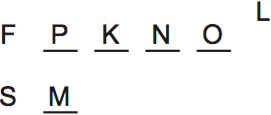
B is CORRECT. L is the only cookbook that can go in either season, so L could be published in fall. All the other answers contradict the diagram.
Question 22
In the setup, I showed how the rules lead to three very restricted scenarios. This question is asking how to completely determine placement, so we should start from the most restricted scenario. That was this scenario, which happens if you place K in the fall:
Only L is left flexible. So A is CORRECT. If you place K in the fall, and then also place L, everything is determined.
Question 23
Everyone hates rule substitution questions, but I actually think they’re pretty easy, once you practice a bunch and get an intuition for what they’re asking.
The key is to look for the other rules that also affect the rule. Here, there are two other rules that affect M and N:
- Rule 1: M and P can’t go together
- Rule 2: K and N must go together
The answer has to involve two of those four variables. Only answers B, C and D do.
B looks like a good candidate.
C is a lousy candidate. It tells us something that rule 1 already tells us.
D is a lousy candidate. It just uses the same variables from the original rule. You can never replace a rule merely by repeating the same variables.
So only B is left for serious consideration. In fact if you were pressed for time I’d just pick B and be done with it. But let’s examine why B is CORRECT.
The original rule, in it’s full effects, looked like this:
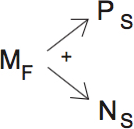
And if you take the contrapositive, you get this:
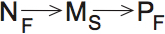
It changed form slightly, because it’s M(spring) that leads to P(fall). So we can see that if N is in the fall, a result is P in the fall. That’s exactly what B says, so it effectively replaces the original rule.

Leave a Reply