
LSAT Preptest 77 LG Explanations
Full explanations for every question from the logic games section of LSAT Preptest 77.
Archived Logic Games explanations
Logic Games are no longer part of the LSAT. LSAC removed the Logic Games section beginning with the August 2024 LSAT. If you are studying for the current LSAT, you can skip this section.
These explanations remain available for students, tutors, and readers using old-format PrepTests. For current guidance, see Logic Games and the current LSAT.
Table of contents
Game 1: Festival
Game 1 Setup
This is an explanation of the first logic game from Section III of LSAT Preptest 77, the December 2015 LSAT.
Six entertainers are scheduled to perform on the opening day of a community festival. The performers are Robinson, Shahpari, Tigay, Wu, Yeaton, and Zane (R, S, T, W, Y, Z). Each entertainer will perform, and there are six times available, three in the morning, and three in the afternoon.
Game Setup
This is a linear game with very minor grouping elements. I wouldn’t call it a hard game, but it’s also the sort of game you should learn to do fast. If it takes you 8:30 to do the game, and you could have done it in 5:25, then you lost over three minutes you could have used for a harder game.
As with most modern games, there are no major upfront deductions. A couple of rules fit on the diagram directly. You should always draw rules directly on the diagram when possible; this makes the game more efficient. But beyond that there’s nothing to this game but knowing the rules and drawing them clearly.
Here’s the best way to draw the diagram:

Normally I don’t number my diagrams on my own page, but I do number them in explanations for clarity. However on this game I numbered the diagrams even on my own page, because the time slots are easy to forget. I’ll be adding a symbol to mark off morning/afternoon later.
Rather than draw the rules 1-by-1 in order, it’s best to read everything and draw things in the simplest order. For instance, Zane is mentioned in both rules 1 and 4: R is before Z, and Z is in the morning.
So you can combine these rules and put them both on the diagram. The vertical line in the middle separates morning and afternoon:
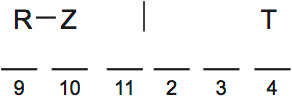
Note that I’ve also drawn the third rule: Tigay is in the afternoon. Also note that the fact that R – Z and T are floating above the diagram means that those variables must go in morning/afternoon, respectively, but that their placement isn’t fixed beyond that.
Also, I didn’t label anything “morning” or “afternoon”. Why bother? It should be obvious from the diagram as drawn where they are. And every extra detail will clutter your thinking and slow you down.
Only rule 2 is left: Wu is immediately before Yeaton. This can’t go on the diagram, so I just drew it to the right, also noting that S is random. These are the only three entertainers not on the diagram. The comma indicates they aren’t connected by any rules:

Normally I number the rules I can’t place on the diagram, but this time I found it clearer to indicate that “WY, S” are the only variables left to place on the diagram.
Note that it’s possible to make a major error on this game: incorrectly assuming that WY have to go in the afternoon. I made this error the first time, and some students I talked to also made it.
W can go in the morning, at 11 a.m. Then Y can go at 2 pm. Y is next after W, satisfying rule 2. The error depends on incorrectly assuming that WY can’t be separated by any length of time – but they can, as long as there’s no other entertainer between them.
Note that this is an example of an error that doesn’t have to cause a problem. As soon as I got to question 2 I saw that Wu could be scheduled in the morning (the question literally said so). So I drew a scenario for Wu in the morning (you’ll find it on question 2), saw that it was the only scenario with Wu in the morning, and finished the game without issue. I even finished quite quickly.
Everyone makes logic games errors, including me. The question is whether you know you will, and if you have plans to catch errors and recover from them if they happen.
—————
Repeating Games
I’ve written elsewhere about the benefits of repeating games, to solidify your intuition for deductions. Note that the purpose of repeating games is to prove the answers right, so it doesn’t matter if you remember the right answer.
I repeated this game about three days after I first saw it, by which time I had forgotten the answers. I’ve written how long it took me on the second attempt. That time, or a couple minutes above it, is roughly the standard you should be aspiring to – a lot of people take 8-9 minutes on a repeat attempt, get everything right, and pat themselves on the back. But that’s too slow. The faster you go when repeating, the faster you’ll learn to go the first time you see a game.
(I say “a couple minutes above” my time because, after years of teaching the LSAT, I’m really, really fast. You should be almost as fast as me, but you don’t exactly need to match my pace to score -0.)
Time on second attempt: 3:17
Game 1 Main Diagram
These diagrams show the rules used to determine the possible orders of performance of the six community festival entertainers (R, S, T, W, Y, Z).
Refer to these diagrams when solving this game. Copy them on your own page, and on each question make a new version of them in order to follow along with my explanations. You’ll learn much more if you draw along.
The setup section explains how to build this diagram.
Main Diagram

I normally number my remaining rules, but in this case I found that drawing “WY, S” as a list of all the variables left to place was clearer.
Question 1
For acceptable order questions, go through the rules and use them to eliminate answers one by one.
Note that I use the rules themselves. I don’t use my diagrams for these questions. Reading the rules again for this question will help you memorize them, and it’s also more efficient.
Rule 1 eliminates E. Zane is supposed to be after Robinson.
Rule 2 eliminates D. Wu is supposed to be directly before Yeaton.
Rule 3 eliminates C. Tigay must be in the afternoon.
Rule 4 eliminates B. Zane must be in the morning.
A is CORRECT. It violates no rules.
Question 2
This question places Wu in the morning. When a question gives you a new rule, you should draw it and see how it combines with existing rules.
There’s only one way to draw W in the morning:

We can’t place W earlier than that, because then Z would be pushed into the afternoon, which violates rule 4.
Now, only S and T are left to place. Their only rule is that T goes in the afternoon, so we can place them in either order:

That diagram covers all possibilities. Only B is possible in that diagram, so B is CORRECT.
Note: before doing this question, you may have thought Wu had to go in the afternoon (I did!). If a question contradicts your diagram, don’t panic – the test makers did you a major favor by pointing out your error, early. When I saw this question I just drew the diagram above, and then finished the game as usual.
Question 3
On this question, you can use past scenarios to eliminate answers. Also, note that Shahpari has no rules, so it’s easy to move them around.
The first three answers all place S in the morning. If you look at the correct answer to the first question (A), you’ll see that S is in the morning, between R and Z. That makes it very unlikely that any of the “S in the morning” answers are correct. When I was doing this, I skipped immediately to D and E.
But let’s conclusively disprove the first three answers. The only rule for R and Z is that R goes before Z, and Z goes in the morning. So we can rearrange the answer to the first question to place S first, second or third: before, in the middle of, or after R – Z.
This shows that S can go anytime in the morning, and disproves A, B and C.
Next, look at this diagram from question 2:
This proves that S can go at 3 p.m., which eliminates E. So D is CORRECT, by process of elimination.
As a review exercise, it’s helpful to figure out why S can’t go at 2 p.m. Let’s try it and see:
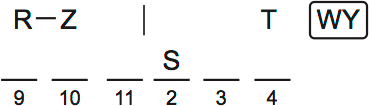
As soon as I drew the diagram above, I saw why D couldn’t be true. Since R–Z are in the morning, there’s only one space for WY. And since T also has to go in the afternoon, there’s only one afternoon space. WY need two spaces, so there’s nowhere to put them.
Question 4
This question is merely a repeat of question 2. For question 2 we drew this diagram:
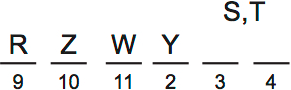
There’s no way to put WY earlier. Otherwise, we would push Z into the afternoon, violating rule 4.
So C is CORRECT.
Question 5
This question asks for a complete list of everyone who must perform in the afternoon. All of the answers have T, so we must only decide between W, Y and S.
In questions 2 and 4, we saw that W can go in the morning, with this diagram:
This diagram also shows that Y must go in the afternoon, because there’s no way to place WY any earlier without pushing Z into the afternoon, which violates rule 4.
The right answer to the first question, A, showed that S can go in the morning. So S, W, R and Z don’t have to go in the afternoon.
We’re left with: T and Y must go in the afternoon, and only T and Y. C is CORRECT.
Game 2: Ceramic Bowls
Game 2 Setup
This is an explanation of the second logic game from Section III of LSAT Preptest 77, the December 2015 LSAT.
Six out of eight ceramic bowls will be displayed in a row and will be numbered one through six (1, 2, 3, 4, 5, 6). Each of the bowls was crafted by one of eight potters: Larsen, Mills, Neiman, Olivera, Park, Reigel, Serra, and Vance (L, M, N, O, P, R, S, V).
Game Setup
This is a linear game. It’s not an easy game, but it’s not the hardest sort of game, either. The most important thing is having a clear list of the rules, and not forgetting them. There are five rules in this game, and forgetting even a single rule will prevent you from solving questions.
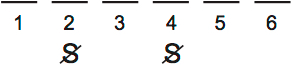
You should start by drawing the simplest rules directly on the diagram. Rule 4 is the simplest, it says that S can’t go second or fourth:
The fifth rule can also go on the diagram. It says that N doesn’t have to be placed, but if they are placed they’re in slot 5. One way to draw it would be to put “N” under slots 1-4 and 6. But that’s too visually cluttered. Instead, I made up a new symbol for this game: N with a box around it, under slot 5.
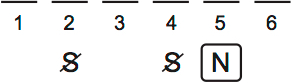
To me, this box means “If N goes anywhere, it goes here. But N doesn’t have to go here.”
As you gain confidence in your diagrams, I encourage you to come up with new versions like this for situations where the normal diagrams don’t work so smoothly. You’ll probably come up with different diagrams than me, which is fine, as long as you keep them clear and easy to draw.
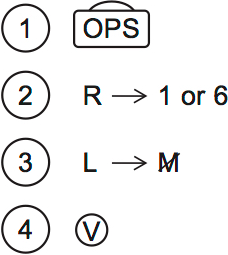
The other rules I couldn’t fit on the diagram. Here they are. Note that rule two really means “P is in between O and S”:

Note that OPS is reversible. It can also be SPO. Also, note that V with a circle just means V is random.
I always number the rules that I can’t fit on the main diagram these numbers don’t necessarily correspond to the game rules. They’re just for easy visual reference.
I would normally draw two diagrams, one with R in 1st and one with R in 6th. But in this game, there’s a third possibility: no R. So the situation isn’t constrained enough to warrant making scenarios.
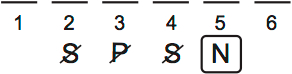
The final step should be to see if there are any deductions. There’s one: P can’t go third. That’s because P has to go between O and S, and S can’t go second or fourth. (S would have to go in one of those spots if P were 3rd).
So we can draw that on the diagram:

A couple other notes:
- Numbers are important on this game. There are are eight potters total, and six spaces. Many questions force two people out. That means everyone else is in. See question 8 for an example.
- On some questions I use a line and a comma to indicate where OPS/SPO go. Here’s an example:

That’s from question 7. The purpose of this diagram is to more quickly represent that OPS/SPO fill slots 1-3, in either order. I could draw them in a box with a reversible handle, but this method is faster, and that’s important.
—————
Repeating Games
I’ve written elsewhere about the benefits of repeating games, to solidify your intuition for deductions. Note that the purpose of repeating games is to prove the answers right, so it doesn’t matter if you remember the right answer.
I repeated this game about three days after I first saw it, by which time I had forgotten the answers. I’ve written how long it took me on the second attempt. That time, or a couple minutes above it, is roughly the standard you should be aspiring to – a lot of people take 8-9 minutes on a repeat attempt, get everything right, and pat themselves on the back. But that’s too slow. The faster you go when repeating, the faster you’ll learn to go the first time you see a game.
(I say “a couple minutes above” my time because, after years of teaching the LSAT, I’m really, really fast. You should be almost as fast as me, but you don’t exactly need to match my pace to score -0.)
Note that I had only done part of this game prior to repeating, so my time is probably a bit higher than it normally would be. This game is medium difficulty, rather than hard.
Time on second attempt: 6:12
Game 2 Main Diagram
These diagrams show the rules used to determine the possible display orders of the ceramic bowls (L, M, N, O, P, R, S, V).
Refer to these diagrams when solving this game. Copy them on your own page, and on each question make a new version of them in order to follow along with my explanations. You’ll learn much more if you draw along.
The setup section explains how to build this diagram.
Main Diagram
Rules
Question 6
For acceptable order questions, go through the rules and use them to eliminate answers one by one.
Note that I use the rules themselves. I don’t use my diagrams for these questions. Reading the rules again for this question will help you memorize them, and it’s also more efficient.
Rule 1 eliminates A. If Larsen is in, then Mills shouldn’t be in.
Rule 2 eliminates D. Park has to be between Serra and Olivera.
Rule 3 eliminates C. Reigel can’t go fifth. They have go first or sixth.
Rule 4 eliminates no rules. (Technically, rule 4 eliminates C, but we already eliminated that, so this is superfluous)
Rule 5 eliminates B. Neiman can only go fifth.
E is CORRECT. It violates no rules.
Question 7
This question places both N and P. When a question gives you a new rule, you should draw it. N is easiest to draw first, because N only can go in one place:
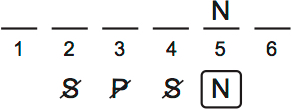
Next, think where P goes. P has to be between O and S. And S can’t go second or fourth. So in this diagram, there’s only space for P to go second:
The O,S and the vertical line are another improvisation. I’ll be using that in this game to indicate that OPS fill an area, in either order.
I could draw them in a box with a reversible handle, but the way I drew above is faster. And that makes all the difference on logic games.
The question is asking who could go in position 1. From this diagram, only P or S could, so D is CORRECT.
Question 8
This question places Larsen in position 6 and Olivera in position 2. Your first step should be to draw that:

I’ve drawn “M and P” above right of the diagram as a reminder that they can’t be placed. That’s because of rule 1 (L ➞ M) and because of rules 2 and 4 (P between O and S, and S can’t go fourth).
Numbers are important on this game. If M and P are out, then that means that every other bowl has to go in. So, for instance, now we know N has to go fifth (rule 5) and R has to go 1st (rule 3):

To be clear, that’s because those are the only open places those bowls can be placed, and this question forces them to be placed.
The only other bowls left are S and V. Since S can’t go fourth, we must place S and V like this:

C is CORRECT. S must be third.
Question 9
This question places P in fourth. That gives us this diagram, with O and S on either side of P:
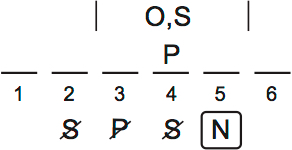
This question is asking who could go second.
- O, P and S are out; they’re already placed, and not in second.
- N is automatically out, since N can only go fifth.
- R is automatically out, since R can only go first or sixth.
So only V, L and M are left. A is CORRECT.
Question 10
This question places L in 1st and O in 4th. You should draw that:
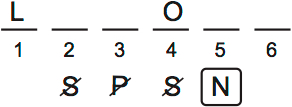
This question is asking who can’t be displayed. You should ask which existing rules are affected by L and O. I can think of three:
- Obviously, M is out (rule 1). But that’s not an answer
- L fills 1st. So if R can go, it would have to be 6th.
- P is tricky. They have to go beside O (rule 2).
I’d try P first, since P is unusually hard to place, and has often determined the right answer for questions. We can’t place P 3rd. As we saw in the setup, that would force S to be 2nd, which violates rule 4.
What happens if we place P 5th? We get this diagram:
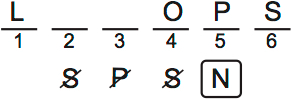
This doesn’t work. R is out, because 1st and 6th are full. N is out, because 5th is full. And M is out, because L is in. So there aren’t enough bowls to fill the remaining two places: only V is left.
So B is CORRECT.
What about R? This diagram proves that R can be placed:
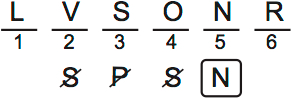
So C is wrong. This diagram also proves that A, D and E are wrong, as it also displays N, S and V. You can often eliminate multiple answers with a single diagram.
Question 11
This is a tricky question. I first skipped it, and finished question 12. I then used the diagram from question 12 as well as other past diagrams to eliminate answers. That may actually have been the most efficient approach. I often skip a single question and then come back, better prepared.
(I did figure out how to solve this question by logic alone. To see that, skip down to the bottom of the explanation. The main explanation is intended as an example of how to intelligently brute force a question.)
This was the diagram from question 12; see that explanation for a walkthrough of how I built it. In this diagram, O, S and P fill the first three slots, and one of L/M or V will fill slot four. So since we don’t need V in this diagram, E is wrong:

That diagram was based on the constraints of question 12, which forced R to be placed. But for this question, R doesn’t have to be in. So I saw that, on the diagram above, we could swap R for either one of L/M or V. So D is wrong.
(It’s very useful to take a diagram you know is correct, and make a single, allowable change to disprove an answer)
I then looked at this diagram from question 8:
It shows that we don’t need P. So C is wrong.
The correct answer to question 6, E, shows that we don’t need N. So A is wrong.
So by process of elimination, B is CORRECT.
I only figured out the reason for this afterwards. The game needs 6 out of 8 bowls. We already are missing one of L and M. And if O is out, then P is out (rule 2). That means three bowls are out, which is too many. (By this logic, S could also have been the correct answer – P needs both S and O.)
Obviously, figuring out the logic above would be the fastest way to solve the question. But it’s not fatal if you don’t see it. It’s quite fast to eliminate answers using past scenarios. If you’re slow at it, practice! It’s something you can learn to be much faster at. Repeating games and drilling how fast you can prove answers is a helpful exercise.
Question 12
This question places N, P and R. We saw the first bit of this in question 7. If N is placed, they’re in 5th, and that forces P to go second:
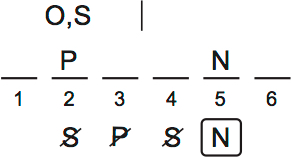
This is because there’s no other place to put OPS/SPO while keeping S out of 2nd and 4th.
Now that N and P are placed, let’s place R. R can only go first or 6th (rule 3). One of OPS/SPO is first, so only 6th is open for R:
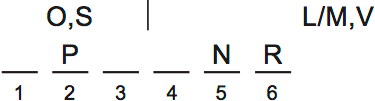
Above the diagram, I drew “L/M, V”. Those are the three bowls left to place; we can place one in slot 4. (I used this diagram to solve question 11, too)
This question is asking what must be true. N is always beside R, so A is CORRECT. B, D and E merely could be true, and C must be false.
Game 3: Four Offices
Game 3 Setup
This is an explanation of the third logic game from Section III of LSAT Preptest 77, the December 2015 LSAT.
Four offices – W, X, Y, and Z are to be assigned to four employees – Jackson, Larabee, Paulson, and Torillo (J, L, P, T) via random drawing.
Game Setup
This is an unusual game. The best strategy is not to make diagrams. Or just to make very minimal notes as a memory aid. But there’s no sense drawing the rules.
You might consider recopying the chart on the second page, so that there’s less distance for your eyes to move. Reducing eye tracking time/effort has a surprisingly big impact. After repeating the game, I think that recopying might be a better strategy. But I’d have to test it to see, and to wait a couple weeks before I test it because the game is too fresh now. I can say that while writing the explanations for the individual questions, I recopied the diagram and it helped. I timed it: it took me 38 seconds to recopy the diagram, which is probably a good trade-off for the increased access speed.
I was actually fastest at this game when I first did this game. When repeating it, I went slower. It’s that sort of game – there are potential pitfalls if you take a wrong path.
Overall, however, this game isn’t particularly difficult relative to others. People new to the LSAT don’t find it to be the hardest of this section. Why does game three seem hard? It’s because, superficially, it doesn’t use the same skills you’ve been training for with other games. Your diagrams and game types are no use to you here.
However, this game does use the same kind of deduction and short term working memory skills that logic games test generally. This game is only hard because it’s unfamiliar.
Get used to these “weird” games. LSAC probably noticed that people were getting too good at logic games, and it was breaking the LSAT. So they upped the difficulty in order to make sure the section remained a useful way of differentiating people who are excellent at games from people who are merely good at games.
When you see an unusual game, don’t panic! You’re not doing anything wrong. You didn’t forget to study something. And it’s absolutely within your capability to do the game well, and on time.
Just take a deep breath, and think. A bit of time thinking about how to approach the game will pay off.
How to approach this game
Ok, that’s enough intro. How should you do this game? Just….count forwards from offices that are chosen. And use some common sense.
For example, question 14. I don’t know if most of those answers need to be true or not. But I know that C will be true. Obviously the person who gets first choice will choose their first choice office! That’s just common sense.
If you waste time testing the other answers, 14 will be hard. But if you just read them all and think, C should jump out as the obvious choice.
Question 15….answers C, D and E are hard to think about. So don’t. It seems pretty improbable that three employees would choose the same ranking level. So A or B are vastly more likely. If you just focus on them, you can solve the question quickly and move on.
Likewise, for question 16, A, B and C are hard to think about. So you shouldn’t. Just test D and E. The first time I did the game, I did this: D was pretty clearly wrong, and E was pretty clearly right.
The second time I tried the game, I tried thinking about A, B and C on 16. That was a mistake. I lost about two minutes and made no headway.
I think LSAC is starting to test your sense of whether an answer is probable or not. Some answers are meant to be skipped over. If one of the more probable answers is correct, then pick it and move on.
(You still have to judge that, say, A, B and C are improbable, D is wrong, and E is correct. You can’t say “I don’t understand whether A, B and C are wrong, but E looks good”. That’s winging it too much. I’m talking about educated guessing, not plain guessing.)
I’ll discuss the questions in more detail on their own pages. But just know that the right way to approach this game is to develop an intuition for what’s most probable, and then to use the rules to check.
Some Guiding Principles
- The first person will choose their first choice. Start from there.
- Someone going 2nd will never get worse than their second choice. Likewise, 3rd will never get worse than their third choice.
- So, on average someone chosen, say, 3rd, will get their 3rd choice or better.
There are no contradictions in this game. Everyone will always have a valid choice: everyone has four offices to choose from, and at most three offices will be taken before that person chooses.
These principles let you eliminate many wrong answers. For instance, three people will never get their third choice, because at least one of them could get their second choice.
I drew no diagrams for this game. However, in the explanations, you’ll see some diagrams. This is because you can’t see inside my head, so I need to draw something to show my thought process. However, these are not what I would use during the test.

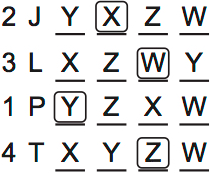
The numbers on the left show the order of choosing. The boxes on the right show what the person chose.
—————
Repeating Games
I’ve written elsewhere about the benefits of repeating games, to solidify your intuition for deductions. Note that the purpose of repeating games is to prove the answers right, so it doesn’t matter if you remember the right answer.
I repeated this game about three days after I first saw it, by which time I had forgotten the answers. I’ve written how long it took me on the second attempt. That time, or a couple minutes above it, is roughly the standard you should be aspiring to – a lot of people take 8-9 minutes on a repeat attempt, get everything right, and pat themselves on the back. But that’s too slow. The faster you go when repeating, the faster you’ll learn to go the first time you see a game.
(I say “a couple minutes above” my time because, after years of teaching the LSAT, I’m really, really fast. You should be almost as fast as me, but you don’t exactly need to match my pace to score -0.)
Note that I was unusually slow on this repeat. I actually did the game faster the first time I tried it.
Time on second attempt: 8:12
Game 3 Main Diagram
These diagrams show the rules used to determine the possible matchings of employees (J, L, P, T) with the offices they select (W, X, Y, Z).
Refer to these diagrams when solving this game. Copy them on your own page, and on each question make a new version of them in order to follow along with my explanations. You’ll learn much more if you draw along.
The setup section explains how to build this diagram.
Main Diagram
None. There’s no drawing that’s useful for this game. Note that in many questions, you’ll see diagrams like this:
The numbers on the left show the order of choosing. The boxes on the right show what the person chose.
These diagrams are only for the sake of explanation. You can’t see inside my mind, so the diagram is easier to follow than text.
However, for solving the game yourself, I think this kind of drawing would take too long to make. Though it’s probably useful to recopy the main diagram onto the second page for easier access.
Question 13
This question is unusual in that you can’t use a list of rules to eliminate answers. Instead you have to consider each scenario.
I found it easier to go answer by answer, see who got their first choice, and then check if the remaining choices make sense from that point.
This method eliminates two answers right off the bat: in A and C, nobody got their first choice. That violates the rules.
In D, Jackson gets their first choice. But then no one has their second choice (or better).
E is tricky. Jackson has their first choice. And Larabee has their second, so this looks good….except, Larabee could have had X, their first choice! So this answer isn’t consistent with the rules.
B is CORRECT. Larabee is first, Torillo is second, Jackson is third, Paulson is fourth.
Question 14
This is a common sense question. I scanned through the answers and saw that C obviously had to be true. Of course the person who goes first will take their first choice (it’s the 3rd rule). So at least one person gets their first choice. C is CORRECT.
I read the other answers to make sure none of them jumped out, and went to the next question, sure I was right. This it the best strategy for this type of “unusual” game – LSAC is testing your ability to judge which answers are improbable and ignore them.
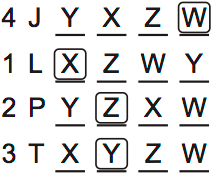
However, for the purposes of explanation, I made a couple of scenarios to disprove the wrong answers. Note that I did not draw these. They’re just illustrate the flow of choices. These drawings would take too long in timed conditions.
This diagram disproves A and D. J and L have their first choice, and neither P nor T have their second choice.

This diagram disproves B and E. P and T both have their second choice. And no one has their third choice (L has their first, and J has their fourth).
Question 15
In the setup, I wrote three principles for this game:
- The first person will choose their first choice. Start from there.
- Someone going 2nd will never get worse than their second choice. Likewise, 3rd will never get worse than their third choice.
- So, on average someone chosen, say, 3rd, will get their 3rd choice or better.
That lets you eliminate some answers. B, D, and E are out. At most one person will get their fourth choice: the rest will have a better choice available. Same with third. At least two people will get the chance to choose their 1st or 2nd choice.
C is impossible if you count. The second choices are X, Y and Z. But everyone has X or Y as a first choice, so someone will choose X or Y first. That only leaves two second choices left: one of X/Y and Z. So there aren’t enough for three people to get their second choice.
A is CORRECT. Here’s a scenario that show’s it’s possible. Note that I did not draw this on my page. This is just a way to represent the information to make it clearer for the explanation.
Question 16
This question says that Paulson selects W. That’s Paulson’s final choice, so they must have chosen last.
Answers A-C are hard to think about because they’re less concrete. It’s best to skip them to think about the concrete answers.
D isn’t possible. If Jackson selects X, they don’t go first. So only L and T are left to go first, and both of them would select X – meaning Jackson couldn’t select X.
E is CORRECT. This diagram shows how the order could work.
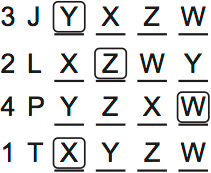
(Note that I did this in my head in timed conditions – I’m only showing this drawing in order to make the explanation clear.)
Now, I’ll explain why A-C are impossible. But on timed conditions, it’s probably better just to skip them.
A: We’re only looking at J, L and T, since the question says Paulson selects W. Look at each of J, L and T in turn, and you’ll see it’s impossible for two people to get their second choice:
- J first, picks Y. Only L can get their second choice.
- L first, picks X. Only T can get their second choice.
- T first, picks X. Only L can pick their second choice.
B is impossible. If you look at the third choices of J, L and T, they’re Z, W and Z. W can’t be chosen, because P has W. So only Z is left, and only one person can take Z.
C is impossible. Only X and Y are possible first choices, so it’s not possible for three people to have their first choice.
Question 17
This is a general “must be true” question. It’s easiest to solve this by process of elimination. All the answers are in the form “does not select”. So if you prove the person in the answer can select the office, then that answer is wrong.
It’s important to note that you just need a partial order to know an answer works. It’s impossible to have a contradiction in this game, as long as you don’t pick an office that has already been assigned. Everyone has four offices to choose from, so they will always have an unassigned choice they can take.
So these answers go in order of first choice, second choice, etc. up to the point of the office in question. Once you’ve proven that can happen, you don’t have to bother with the rest, since there’s always a possible scenario. e.g.
A: P picks Y, Jackson picks X.
B: J picks Y, P picks X, L picks W.
C: T picks X, L picks Z.
D: T picks X. (No reason someone can’t get their first choice if they go first).
(To verify these answers, just look at the overall chart, and follow the choices I listed, step by step. You’ll see they’re possible.)
E is CORRECT. For Paulson to pick X, the following would have to happen:
- Two people go before Paulson and take Y and Z.
- No one takes X.
There’s no way to do this. For example, J could take Y first, but then either L or T would take X, so Johnson couldn’t have it. And leading with L or T obviously doesn’t work, because they’d take X.
Game 4: Volunteers
Game 4 Setup
This is an explanation of the fourth logic game from Section III of LSAT Preptest 77, the December 2015 LSAT.
Three volunteers out of five people will be assigned to three community committees (X, Y, Z). The volunteers are Haddad, Joslin, Kwon, Molina, and Nash (H, J, K, M, N). Each of the volunteers will have one of three positions – leader, secretary, or treasurer.
Game Setup
This one of the most “classic” games I’ve seen in recent years. If you approach it using only the rules, it’s extremely difficult. However, if you make a few upfront deductions, it’s very easy. This kind of game used to be very, very common. Now they’re rare. The first three games from this test are more typical: two rules based games, and a “weird” game.
However, it’s useful to practice the old games because they’ll let you breeze through classic games like this. Let’s look at how to set up the game.
First, and this comes from experience, it’s most useful to set this game up vertically. There are many past games that follow this format. You’ll see why this is best as we add deductions:
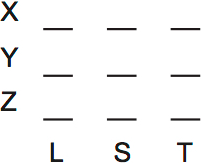
Next, don’t just go through the rules in order. Start with the easiest, clearest rules, and draw them directly on the diagram. Rule 1 says that Nash must be in leadership. We can draw this on the diagram by putting a N below S and T:
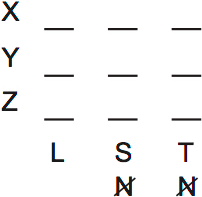
Next, the fourth rule is clearest. It says that Joslin is the secretary for Y, but can’t be on committee X or Z:
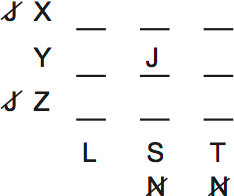
Next, rule 3 places Kwon somewhere in Y, and says that Kwon can’t be in Z:

I’ve drawn K to the right of Y to indicate that they must go somewhere there. I’m saving the spots on the left for people who can’t go on a committee.
The final rule, rule 2, is that Molina can only be assigned to one committee. At first glance, it doesn’t seem like we can draw this on the diagram. But let’s stop and think about all the rules.
It’s always important to count numbers on logic games. Look particularly at the most restricted places. There are only five volunteers on this game, and each committee needs three volunteers.
Z is the most restricted committee: K and J can’t go there. That knocks 2/5 volunteers off the committee, so all the other three volunteers have to go to Z:
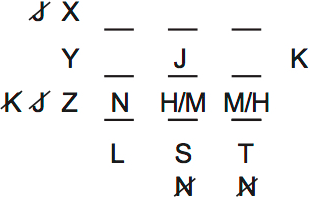
N, of course, goes in leadership. M and H are interchangeable between the other two roles. And we’re not done yet. Remember how rule 3 said that M can only go in one group? Since M is in Z, that means M can’t go in X or Y:
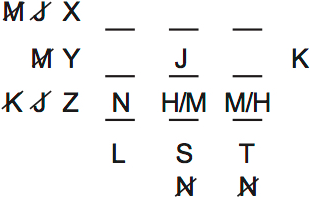
Now both M and J can’t go in X. This means that the other three all have to go in X: N, K and H

Once again, N is in leadership, H and K are interchangeable between the other two spaces. We’re more or less done, all that’s left is to note who goes in Y. Along with J, it will be K and one of N/H:

J is already in Y. K has to go in Y as well. M can’t, so the other space will be N or H. If N goes, obviously N goes in L. If H goes, then H and K can go in either spot.
So almost everything is determined in this game.
—————
Repeating Games
I’ve written elsewhere about the benefits of repeating games, to solidify your intuition for deductions. Note that the purpose of repeating games is to prove the answers right, so it doesn’t matter if you remember the right answer.
I repeated this game about three days after I first saw it, by which time I had forgotten the answers. I’ve written how long it took me on the second attempt. That time, or a couple minutes above it, is roughly the standard you should be aspiring to – a lot of people take 8-9 minutes on a repeat attempt, get everything right, and pat themselves on the back. But that’s too slow. The faster you go when repeating, the faster you’ll learn to go the first time you see a game.
(I say “a couple minutes above” my time because, after years of teaching the LSAT, I’m really, really fast. You should be almost as fast as me, but you don’t exactly need to match my pace to score -0.)
Time on second attempt: 5:01
Game 4 Main Diagram
These diagrams show the rules used to determine the possible assignments of volunteers (H, J, K, M, N) to committees (X, Y, Z).
Refer to these diagrams when solving this game. Copy them on your own page, and on each question make a new version of them in order to follow along with my explanations. You’ll learn much more if you draw along.
The setup section explains how to build this diagram.
Main Diagram
Almost everything is determined in this game. See the setup for how to create this diagram.
Question 18
For acceptable order questions, go through the rules and use them to eliminate answers one by one.
Note that I use the rules themselves. I don’t use my diagrams for these questions. Reading the rules again for this question will help you memorize them, and it’s also more efficient.
Remember that all the answers are describing committee Z. This is relevant for rules 2 and 4.
Rule 1 eliminates D. If Nash is in a group, they have to be leader.
Rule 2 eliminates C. Kwon can’t be assigned to Z.
Rule 3 eliminates no rules.
Rule 4 eliminates A and B. Joslin can’t be assigned to Z.
E is CORRECT. It violates no rules.
Question 19
In this game, we could figure almost everything out in the setup. Here’s the main diagram:
This question makes Kwon treasurer, twice. That means Kwon must be treasurer of X and Y:
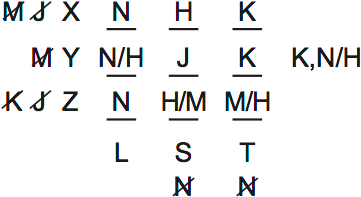
Almost everything is determined; one of N or H fills the leader position for Y. All that’s left is finding which answer contradicts the diagram. C is CORRECT.
Question 20
In this game, we can figure almost everything out in the setup. Here’s the main diagram:
All that’s left is seeing which answer doesn’t have to be true. B is CORRECT. We could assign N, J and K to Y, with no H.
Question 21
In this game, we can figure almost everything out in the setup. Here’s the main diagram:
This question makes Kwon a leader for one committee. The only committee where that’s possible is Y. If we do this, then N can’t be in Y, because N needs to be leader. So Y looks like this:
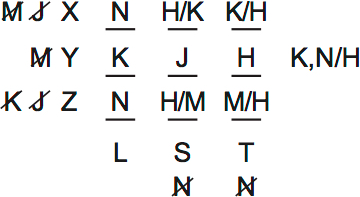
This has no impact on the other committees. So only committee Y is fully determined. B is CORRECT.
Question 22
In this game, we could figure almost everything out in the setup. Here’s the main diagram:
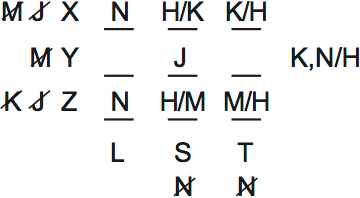
This question asks how to fully determine the order. That’s difficult: there are no links between the groups. So on a question like this, you should look at the main diagram, and think.
Haddad is in groups X and Y, and can be placed in Z. So if we place Haddad in all three groups, then that would determine everything.
C is CORRECT. Here’s what the diagram looks like if we place Haddad in all three committees:

Question 23
Normally, rule substitution questions are somewhat difficult. However, I don’t think this one is as challenging as most. All of the answers are in the form of: “One person is assigned to more/less committees than Molina”.
The original rule restricts Molina to one committee. So obviously, any answer that places Molina on more committees than someone else is out. That eliminates D.
Next, to restrict Molina to one committee, we need someone who can go two times at most. This eliminates A and E: both H and N can be assigned to three committees. (This would let Molina go twice).
Finally, we need someone who does go twice. This eliminates B. Joslin can only go once. If B were true, Molina would go zero times.
C is CORRECT. Kwon goes in X and Y but not Z, so Kwon goes exactly twice. If Kwon is on more committees than Molina, then Molina can go once, at most. And because both J and K can’t go on committee Z, then Molina must go there. So Molina goes exactly once according to this new rule.
(Note that we needed the bit about J and K, which comes from rules 3 and 4. There’s no rule forcing a volunteer to be placed on at least one committee).

Leave a Reply