
LSAT Preptest 88 LG Explanations
Full explanations for every question from the logic games section of LSAT Preptest 88.
Archived Logic Games explanations
Logic Games are no longer part of the LSAT. LSAC removed the Logic Games section beginning with the August 2024 LSAT. If you are studying for the current LSAT, you can skip this section.
These explanations remain available for students, tutors, and readers using old-format PrepTests. For current guidance, see Logic Games and the current LSAT.
Table of contents
Game 1: Animal Rescue Organization
Game 1 Setup
This is an In-out Sequencing Game. We know there are five pens, each animal taken from either four kittens or four puppies.
Rule 1 says the first and fifth pens hold kittens.

Rule 2 says T (puppy) can’t be next to any kitten. This means T, if included, can only be third.

Rule 3 says we must include either G or H, but not both.

Rule 4 gives us a condition: if W is included, then G must be in the second pen. Remember this means G can be in the second pen, without W being included.

We can essentially divide this game into three scenarios.
First, we’d have W in. This means G (kitten) is second. Rule 1 tells us that first and fifth are all kittens, meaning that T cannot be in, since it would then be next to kittens in spots three or four.
So basically, if W ➔ T. Since G is in, Rule 3 says H is out. So F and J will have to be one and five, and W and one of R or S will fill spots three and four.
Scenario 1

In scenario 2, T is in. Since it can only go next to puppies, T will have to be third, and second and fourth are both puppies. In this scenario, we know that W is out, so R and S are second and fourth. We can infer that if T is included, then T is third.
Scenario 2

In scenario 3, we can have both W and T out. This doesn’t tell us too much, but we know that R, S, F, J and one of G or H will be in.
Scenario 3

Game 1 Main Diagram
The setup section explains how to build this diagram.
Main Diagram
The setup section explains how to build this diagram.
Rules and Scenarios:

Question 1
For acceptable order questions, go through the rules and eliminate answers one by one. You can also refer to your main diagram if you need help visualizing this.
Rules and Scenarios
A is CORRECT.
B violates Rule 2
C violates Rule 4
D violates Rule 2
E violates Rule 1
Question 2
W is included, so we’re looking at scenario 1. We know that if W is in, G is in, and T is out. If G is in, then H is out. The correct answer is either T or H.
Scenario 1

B is CORRECT as it says H cannot be included. All the other answer choices could be included.
Question 3
If three puppies are in, then we’re looking at scenario 2, where T is third, surrounded by R and S while W is out. In this case, T must be third so D is CORRECT.
Scenario 2

A is wrong since G (a kitten) can’t be second in this scenario.
B and C can’t be right since S and R are interchangeable in pens 2 and 4, so neither of them “must be true”.
We can eliminate E since W is out in this scenario.
Question 4
F and J are both kittens. Only scenario 3 allows for them to be next to one another. In scenario 3, both T and W can’t be included.
Scenario 3

E is CORRECT as it says W can’t be included. The incorrect answer choices can all be included.
Question 5
Jaguar must be included in scenarios 1 and 3, so we’re looking at scenario 2. T must be third in scenario 2, and R and S are second and fourth. What “could be true” is which kittens are in spots one and five. The correct answer choice will talk about a kitten in these two pens.
Scenario 2

B is CORRECT. H could be in the fifth pen.
A is incorrect since a kitten can’t be in the fourth pen.
C and D are incorrect since T must be third.
E is incorrect since W is out.
Question 6
S must be included in scenarios 2 and 3, so we’re looking at scenario 1. The only must be true element in scenario 1 is that G must be in second since W is included.
Scenario 1

C is CORRECT since if W is displayed, then G must be second.
A and B are wrong since F can be in either the first or fifth pens.
R can be either third or fourth so D is incorrect.
E is incorrect since T cannot be displayed in this scenario.
Game 2: Seven Museum Artifacts
Game 2 Setup
This is a circular sequencing game. You could either draw this on spokes or draw it linear, like we will in our explanation. If you choose to use a linear diagram, keep in mind that 1 and 7 are next to each other. We’re told there are 7 artifacts to be displayed in cases.
Rule 1 says either H or J is seventh.
Rule 2 says the necklace is displayed in a lower numbered case (before) the mask.

Rule 3 says H and M are next to each other (either order).

Rule 4 says P isn’t next to S
Rule 5 says neither P nor S are next to J. In other words, combining this with Rule 4, we can see that P, S, and J can’t be next to each other.

In our first scenario, let’s put J in seventh. This means that P and S can’t be first or sixth. Taking into account the HM block, and that N needs to be lower than M, that means one of P/S must be second, and the other one is either forth or fifth, depending on where the HM block goes.
Scenario 1

In our second scenario, H is in seventh. Because N needs to be lower than M, M is sixth. Here’s where the P/J/S relationship comes in handy. Since they can’t be next to each other, they will go in cases 1, 3, and 5. N/G will go in cases two and four.
Scenario 2

Game 2 Main Diagram
The setup section explains how to build this diagram.
Main Diagram
Refer to setup to see how to make this diagram.
Rules and Scenarios:

Question 7
For acceptable order questions, go through the rules and eliminate answers one by one. You can also refer to your main diagram if you need help visualizing this.
Rules and Scenarios:

B is CORRECT. This order fits into the second scenario where H is in case 7.
A violates Rule 2. (N needs to be lower than M)
C violates Rule 1 (G can’t be seventh)
D violates Rule 3 (H and M not together)
E violates Rule 5 (J/P/S can’t be next to each other)
Question 8
If G is sixth, that means that J is seventh. We’re looking at scenario 1. We want to figure out what must go first. We know that neither P nor S could be first. One of them will be second, meaning that the HM block can’t be first and second. We also know that N is lower than M, so that means N must be first, and thus, next to J. This means C is CORRECT.
Scenario 1

A is wrong since H can’t be in case 1. P/S need to be in case 2, meaning now H and M can’t be next to each other.
B is wrong for the same reason as A: H and M need to be next to each other.
D is wrong because P can’t be next to J.
E is wrong since S can’t be next to J.
Question 9
S could be in case 3 in scenario 2. In scenario two, the only “must be true” elements are M in sixth, and H in seventh. Thus, C is CORRECT since it puts M in the sixth case.
Scenario 2

A and D are wrong since N can be either second or fourth.
B is wrong since J can also be third or fifth.
E is wrong because P can also be first or third.
Question 10
For this question, you can just check each answer choice against your main diagrams and see which one would be possible.
Rules and Scenarios:
Scenario 2 shows us that P can be first, so D is CORRECT.
A, B, and C are wrong. J can’t be in the even-numbered cases.
E is wrong since that wouldn’t give there any space for H and M to go together.
Question 11
Now we’re looking for a pair of artifacts that can go in cases 1 and 3. Again, refer back to your two diagrams and check each answer combination to see which could be correct.

E is CORRECT. Our diagrams show that J and S cold be in cases 1 and 3.
A is wrong since there wouldn’t be space to keep P and S apart.
B is wrong since one of the two need to be in case 7.
C is wrong since H can’t be in case 1.
D is wrong since if J is in case 1, then H must be in case 7. In this case, M must be sixth.
Question 12
If P is second, then we’re looking at the first scenario. There are quite a few things that could be true so you might need to make a few hypothetical diagrams to see which one of the answer choices works.
Scenario 1

D is CORRECT. With P second, we must have J seventh to avoid them being next to each other. We can then put M in sixth and H in fifth. G can then go first, and N third so that S is fourth and not next to P. It would look like this:
G – P – N – S – H – M – J
The wrong answers would all place two of J, P, or S next to each other, which isn’t allowed.
Game 3: Flower Arrangements
Game 3 Setup
Five people each use three different types of flowers to form arrangements. Each arrangement is exactly four flowers.
Rule 1 says that no one else can have Solomon’s RR combination.
Rule 6 says that only one person uses two lilies. Who could this person be? It couldn’t be S or W since each person must use three types of flowers. S and W currently only have one type of flower filling two spots, so they can’t use two lilies.
Rule 5 also tells us that other than Zepi, no one else can use exactly one H and one R. This means that Ursula has one more R or H so that she doesn’t have the same one H one R combo as Zepi. But since she can’t have Solomon’s RR combo, she needs to have another H and then one of G or L. I put boxes around Solomon and Zepi’s combos to show that no one else can have those combos.
At this point, all you need to know is that if the person currently has two different types of flowers, then the missing combination is two of the same flower. If they currently have two of the same flowers, then they need two different flowers. Altogether, they each need to end up with three different types of flowers.
Knowing this, we can see that only Tabitha or Zepi can have the LL combo.

Game 3 Main Diagram
The setup section explains how to build this diagram.
Main Diagram
Refer to setup to see how to make this diagram.

Question 13
We know that Ursula has R, two H’s, and one of either G or L. Find the answer choice that matches this.

D is CORRECT. Ursula can have on G, two H’s, and one R.
A is wrong because Ursula needs to use one H. This one doesn’t have any.
B is wrong because Ursula can’t have two G’s. Ursula needs another H since Zepi is the only person who can have a single H.
C is wrong because Ursula can’t use two roses.
E is wrong because Ursula can’t use two L’s since only one person can have two L’s, and we said it would be either Tabitha or Zepi.
Question 14
We’re looking for two people who can have identical arrangements. Therefore, Zepi is out, as no one else can have the one H one R combo. Looking at our diagram, we can see that no one can have Solomon’s RR combo, so he’s out too. Now we can eliminate any answer choice that mentions Solomon or Zepi. Ursula and Will can’t have the same arrangement since Ursula does’t have space for Will’s GG combo. Thus, answer choice C is CORRECT.

A is wrong since Solomon needs two R’s and Tabitha can’t use any R’s. Thus they can’t have identical arrangements.
B is wrong since Ursula can only use one R so she and Solomon can’t have the same arrangement.
D is wrong since Ursula can’t have two G’s so she and Will (two G’s) can’t have the same arrangement.
E is wrong since Zepi is the only one who can have one R and one H so no one can have the same arrangement him.
Question 15
Only two people could use lilies, and only one of them could use hyacinths. First, let’s recall who could use the LL combo: Tabitha and Zepi. But the pair can’t be them, since both of them use H. So the correct answer choice would be one of the two plus another person who uses 1 L and no H.

C is CORRECT. Will and Tabitha can have the same arrangement since they both must use at least one L. If Tabitha’s last two flowers are GL and Will’s last two are HL, then they’d have the same arrangement.
A and B are wrong since no one can have Solomon’s RR.
D is wrong since no one else can have Zepi’s RH arrangement.
E is wrong since the correct answer would include either Tabitha or Zepi.
Question 16
For this question, you have to check each answer choice against the rules and our diagram to see which one is correct. Be sure to pay attention to the possible combinations listed.

B is the CORRECT answer. Tabitha’s arrangement can’t include R
A is incorrect since Tabitha must use Ls in her arrangement.
Solomon could use Lillies, so C is incorrect.
D and E are incorrect since Will can use both hyacinths and roses.
Question 17
We’re changing the game’s rules here. Now we’re told Zepi and at least one other person uses exactly one H and one R. Who could this person be?
It can’t be S, since S still has two Rs.
It could be T, since the rule now allows T to have Rs.
It could also be U. Under this new rule, U could have 2 Gs or 2 Ls.
It could also be W. We’d just add one R and one H.
What is the overall effect? If the other person also has the HR combo, then to get overall 3 types of flowers, they must use two Gs since only one person in the game can use two Ls. So what must be true is that at least one person doesn’t use any Ls! Therefore E is CORRECT.

A is incorrect since Tabitha would need two Rs under the new rules.
B is incorrect. Looking at our new diagram, we can see that everyone uses at least one R.
C is incorrect. In this new diagram, Zepi, Will, and Ursula can all have one rose and one hyacinth.
D is incorrect. While Solomon could use no hyacinths, but he doesn’t have to.
Game 4: Five Meetings
Game 4 Setup
In this question, we have six meeting slots taking place across Wednesday, Thursday, and Friday. There are two meetings a day, one in the morning, one in the afternoon.
Rule 1 says H and L’s meetings are in the morning
Rule 2 says J is scheduled for the day before G
Rule 3 says there can be at most one other person scheduled between G and K’s meeting. This means that they can be next to each other, or just separated by one person.

We can split the game into 4 diagrams based on the J-G block:
First, J is Wednesday afternoon; G is Thursday morning. This one is easy. H and L will go in the other two morning slots, and K will go right after G in the afternoon.
Scenario 1

Second, J is Wednesday morning or afternoon; G is Thursday afternoon. K can go either on Wednesday (when J isn’t meeting) or Friday.
Scenario 2

Third, J is Thursday afternoon; G is Friday morning. K has to go on Friday afternoon, and H and L will be Wednesday and Thursday morning.
Scenario 3

Fourth, J is Thursday morning or afternoon; G is Friday afternoon. K can either go on Thursday afternoon or Friday morning.
Scenario 4

Game 4 Main Diagram
The setup section explains how to build this diagram.
Main Diagram
Refer to setup to see how to make this diagram.
Rules and Scenarios:

Question 18
For this question, we can check the diagrams and cross out the wrong answers as we go along.
Rules and Scenarios:
Looking at our four scenarios, we can see that Scenario 3 permits us to have L, H, G in the mornings, and then J and K on Thursday and Friday afternoons. So E is CORRECT.
A is incorrect since J needs to go before G.
B is incorrect since H needs to go in the morning.
C is incorrect since L needs to go in the morning.
D is incorrect since only one person can be scheduled between K and G.
Question 19
This question can also be answered by checking out the scenarios. Remember, K has to either be right before or after G, or there’s one other meeting between them.
Rules and Scenarios:
A is CORRECT. K on Wednesday morning means that H and L would go on the other two mornings, which would cause there to be too many clients between K and G (since both would have to be afternoons).
B is incorrect since K on Wednesday afternoons is permitted in Scenario 1.
C is incorrect since K can go on Thursday mornings in Scenario 2.
D is in correct since K can go on Thursday afternoons in Scenario 1.
E is incorrect since K can go on Friday mornings in both Scenarios 2 and 4.
Question 20
We need to look at scenario 2 for this question. K can be the only meeting on Friday if J meets on Wednesday afternoon, and G goes on Thursday afternoon. This way, H and L meet Wednesday and Thursday morning. Thus, B is CORRECT.
Scenario 2

A is incorrect because if G is in on Thursday morning, H and L would have to take the other two morning slots, and K wouldn’t be able to be the only client on Friday.
C and D are incorrect. J on Thursday (morning or afternoon) would take us to another scenario where K can’t be along on Friday.
E is incorrect. We need K to be the only client scheduled on Friday.
Question 21
For this question, we’d need to check each answer choice against our diagrams. The correct answer choice would give a situation that cannot exist in any of our diagrams. However, if you noticed that either J or G meet on Thursdays in every single diagram, then you should be very wary of any other person being the only meeting on Thursday.
Rules and Scenarios: 
C is CORRECT. Either J or G must go on Thursday due to Rule 2, so H can’t go by himself on Thursday.
A is incorrect since then J and G could go on Thursday and Friday. This would also ensure that K and G have the right gap between them. This is possible in Scenarios 3 and 4.
B is incorrect since G can go by himself on Thursday in Scenario 2.
D is incorrect. We saw in Question 20 that K can be the only client on Friday.
E is incorrect. Scenario 2 says that L can go on Friday morning.
Question 22
Lemmon can be scheduled on Friday in scenarios 1 and 2. Check each answer choice against these two scenarios.
Scenarios 1 and 2

D is CORRECT. K and H can’t go on the same day if L is on Friday. If K and H are together on Wednesday, J would be on Thursday and G would be on Friday. This would cause there to be more than one client between G and K. If K and H go together on Thursday, J would have to go on Wednesday. In this case, G needs to go on Thursday because of Rule 2, but there’s no space.
A is wrong. G and K can go together on Thursday in both Scenarios 1 and 2.
B is wrong. H and G can go together in Scenario 2.
C is wrong. J and K can go together in Scenario 2.
E is wrong. L and G can go together on Friday.
Question 23
H and K can only go together on Friday. If they were together on Wednesday, then J would be on Thursday, and G would be on Friday. This is too many clients between K and G.
If they were together on Thursday, we can’t have out JG block.
Okay, so H and K are on Friday, and H is in the morning due to Rule 1. Then, to make sure there’s at most one client before G and K, G will have to go on Thursday afternoon.
We know J has to go on the day before G. Now we can have two configurations. In the first one, J goes on Wednesday morning, so L has to go on Thursday morning.

In the second configuration, J goes on Wednesday afternoon, and L can go on either Wednesday or Thursday morning.
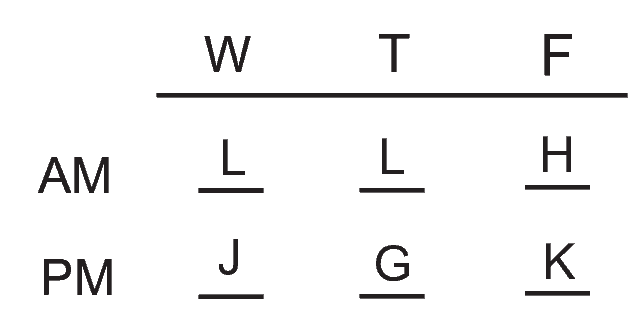
Thus, C is CORRECT. J can go on either Wednesday morning or afternoon.
A is incorrect. G can’t be on Friday since H and K fill all the slots.
B is incorrect since H must go on Friday.
D is incorrect. K must be on Friday.
E is incorrect. L can’t be scheduled on Friday since H and K are there.