
LSAT Preptest 34 LG Explanations
Full explanations for every question from the logic games section of LSAT Preptest 34.
Archived Logic Games explanations
Logic Games are no longer part of the LSAT. LSAC removed the Logic Games section beginning with the August 2024 LSAT. If you are studying for the current LSAT, you can skip this section.
These explanations remain available for students, tutors, and readers using old-format PrepTests. For current guidance, see Logic Games and the current LSAT.
Table of contents
Game 1: Aisles
Game 1 Setup
This is an explanation of the first logic game from Section IV of LSAT Preptest 34, the June 2001 LSAT.
Six clerks are responsible for stocking nine aisles of a supermarket. The six clerks are Jill, Kurt, Larisa, Manny, and Olga (J, K, L, M, O). You need to assign clerks to aisles based on the rules.
Game Setup
This is a linear game. There’s nothing particularly devious about it, but there are a lot of rules to keep track of. Make sure to have them all clear in your head before moving on to the questions: it will pay off.
We can arrange this with the regular setup of horizontal slots (drawn below, except there are nine instead of seven. It’s important to note that each clerk can only go twice, at most. That means that four clerks will go twice and one (Olga, first rule) will go once.
Rule 1
There’s no single best way to represent the first rule. I prefer to simply memorize it. You can draw something like this if it helps you:

(That’s the letter O, not a zero, in case I offended any mathematicians)
You could also make a list of variables, as follows: JJ, MM, KK, LL, O
The method doesn’t really matter, as long as it achieves the goal: don’t let yourself forget that O only appears once.
Rules 2 and 3
You should draw the next two rules directly onto your diagram. There’s no chance of forgetting that way. Kurt is placed second, and you can draw M with a line through it underneath the first slot to show that Manny can’t go there.

Rule 4
J can’t go beside itself. You can draw this as a box with a line through it.
(Also: This should tip you off that other variables can go beside themselves, in case you weren’t sure)

Rule 5
This is the kind of rule I like: it helps pin down variables. You already knew one K has to go in the second slot. Now you know the second K is wedged in between both Mannys. That takes out two variables at once.
Here’s how you can draw this rule. The box indicates the three variables have to be beside each other, in that order:

We know that this MKM bloc can’t go in slots 1-3 because M can’t go in slot one.
Rule 6
This is another great rule type. It split the game into two scenarios: one where Larissa is on the left and one where Larissa is on the right. If a game is split into two scenarios, you should almost always draw both. Usually that lets you make additional deductions, and it always helps you visualize the game and draw local rules.
In this game, the two scenarios don’t add as much as they usually do, but they’re still useful.


Rule 7
Another good rule. Olga has to come after Kurt. We can combine this with rule five to see that Olga also has to come after Manny.
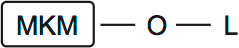
As long as there is at least one L after O, everything’s fine.
Game 1 Main Diagram
These diagrams show the rules used to determine the assignments of the clerks (J, K, L, M, O) to the nine aisles.
Refer to these diagrams when solving this game. Copy them on your own page, and on each question make a new version of them in order to follow along with my explanations. You’ll learn much more if you draw along.
The setup section explains how to build this diagram.
Main Diagram
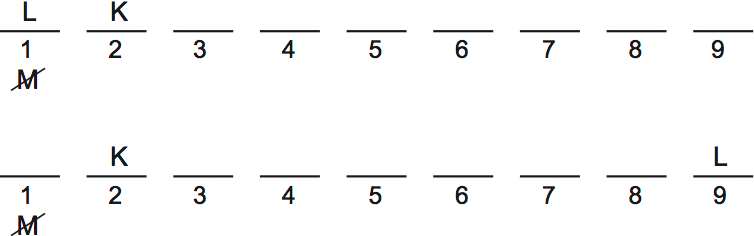
Bringing everything together, we get the following:

Before Moving On To The Questions
It’s always a good idea to review your rules, and commit any to memory that aren’t clearly captured in the diagram.
- Olga only goes once.
- O has to go before one of the Ls.
Also try to see which variables are the most restrictive. We can see that the block of MKM-O-L is five variables long. That’s hard to fit in. Visualize where this block can go (though don’t waste time drawing every single place it could go.)
Know the rules. Success on this game depends on being able to make scenarios quickly and accurately.
Lastly, you should always look for random or flexible variables. L and J are the most flexible variables. They’re the only two with a “spare” placement. Manny and Kurt are tied up together, and Olga can only go once.
Fast sketches are very important for this game. Practice making sketches quickly and accurately (even if the lines aren’t straight and you’ll move confidently through the game section. I’ve drawn neat little computer diagrams, but I normally solve logic games with drawings that look like they were drawn by a kindergartner.
Question 1
For this question, you must remember that each person can only go two times, at most. It turns out that Larissa is the only person who can go twice. C is CORRECT.
Jill: Rule four says Jill can’t go twice.
Kurt: Kurt is wedged between Manny, so he can’t.
Manny: Manny has Kurt stuck between him.
Olga: Olga can only go once.
The following scenario proves that Larissa can go consecutively:

Question 2
This right answer has two clerks that both can’t go in slot five. Manny is in three answer choices. If we can eliminate him, then we can eliminate answers A, C and D.

Voila. Manny can definitely go in slot five.
Next we see that Olga is in both B and E. So Olga must be part of the right answer. That means we only have to test whether K or L can go in slot five.

Kurt fits easily.
E is CORRECT.
This next diagrams shows why Larissa can’t go in slot five. We need four spots to fit MKM-O in front of L. There are only three spaces in the second case, and only two spaces in the first.

O can’t go in slot five for the same reason. There’s not enough space to fit MKM in front.
Question 3
Want to go faster on this type of question? Check which variables are in multiple answer choices. Jill and Larissa are in every answer choice! Clearly they can both go in slot three.
That leaves Olga, Manny and Kurt to test. Olga definitely doesn’t fit in slot three.
She needs MKM in front of her.

Kurt doesn’t fit either. We already figured out in the first question that Kurt can’t go beside himself. There’s no space for Manny.

So it’s only Jill, Larissa and Manny who can go in slot three. B is CORRECT.
Question 4
Aisles three and five are in every answer choice. You don’t have to test those.
A is wrong because it says Manny can be in the first slot. The third rule says that can never happen.
B is wrong because it says Manny can be in the
ninth slot. That leaves no room for Olga to come after Manny.
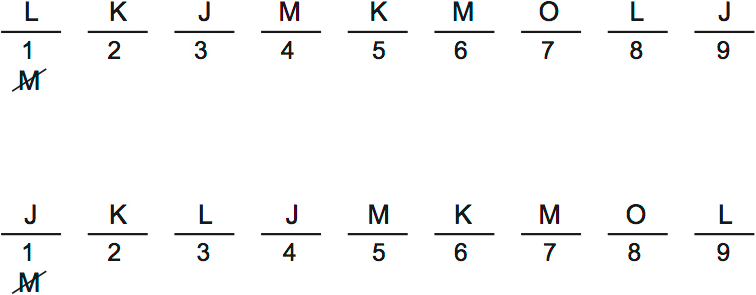
So you have to see if Manny can go in 4, 6 and 7. Turns out he can go in all of those places, so D is CORRECT. Here are a couple of diagrams that prove he can go in those spots:
Question 5
You need to put Larissa’s aisles as far apart as possible. That means putting Larissa’s non-end aisle at one off of the end (the 6th rule says Larissa can’t go in both end slots).
So Larissa goes either in 1 and 8, or 2 and 9. But, Larissa can’t go in 2, since Kurt is there. So we need to put Larissa in slots 1 and 8.
MKM-O all have to come before Larissa. So we have to put a J in slot nine: there’s nothing else left to go after L. We get the following diagram:

I drew the remaining variables above the diagram, separated by a comma to show that the J could go before or after (or in between) the other variables. M can’t go directly before L in slot 7 because then there would be no space for O.
Turns out A is CORRECT. This diagram proves it:

B is out because Manny can’t be in seven. There’s no room for Olga.
C and D are gone because one J has to come in spot nine (after O, and in an odd numbered spot.)
E is out because both L and J have to come after Olga.
Question 6
Always draw local rules. On this question I drew both scenarios, and then put J in slot three. There’s no immediate further deduction (there usually is on most games), but this still makes it easier to visualize.
I went through the answer choices, and visualized whether they seemed restrictive. You should do a quick pass through each answer choice before trying them seriously…sometimes E is correct, and you don’t want to waste a lot of time on A-C without at least glancing at E.
Look at what happens when I try to put O in six in both of those diagrams. It’s clear there’s no space for MKM in front of O:
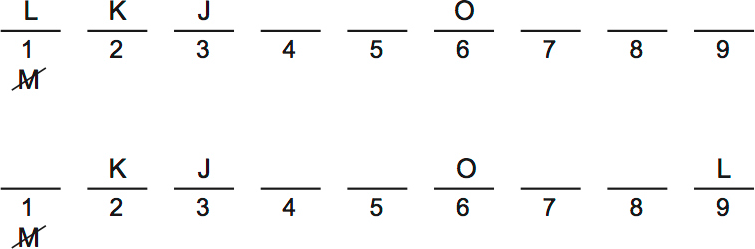
Done! E is CORRECT.
Students underestimate how much time they spend thinking about questions. It’s usually a lot quicker to make a simple sketch and then pencil in a scenario that tests each answer choice (start with one that seems more restrictive, such as O.) You’re also less likely to make a mistake when you put your thoughts on paper.
You can disprove the other answer choices by making a couple of quick sketches. LKJMKMOLJ eliminates answer choices A and D. And then another example JKJLMKMOL eliminates answer choices B and C.
Thanks to reader John for the fix below! My second example originally violated a rule.
Question 7
A new rule! Don’t think about it: draw it, then think about it. The rule says that Larissa stocks both end aisles:
(Scroll down for diagram + explanation)

It can pay off to scan the answer choices to see which one to try first. We saw in the last question it can sometimes be tricky to stick O in slot six. We couldn’t do it there, and it turns out we can’t do it here, either. B is CORRECT.
Why? Take a look.

The two Js are side by side. Normally we could put L between them, but L is stuck on both ends and can’t help.
The following scenario proves answer choices A and E wrong. O and L can be beside each other, and J can go in 3.

And this scenario proves answer choices C and D wrong.

Game 2: Philosophy
Game 2 Setup
This is an explanation of the second logic game from Section IV of LSAT Preptest 34, the June 2001 LSAT.
Five philosophy lectures will be given each week for five consecutive weeks. The five lectures will focus on six philosophers, namely: Kant, Lock, Mille, Nietzsche, Ockham, and Plato (K, L, M, N, O, P).
Game Setup
This is another linear game, but it plays out differently from most linear games. We’re trying to determine the lecture topic for each of five days. The topics can’t repeat. This is the major limiting factor.
There are five lecturers. Each can only lecture about certain philosophers. They lecture in order, one each day for five days. We can draw the speakers horizontally. Underneath we can put the possible lecture topics they can cover.
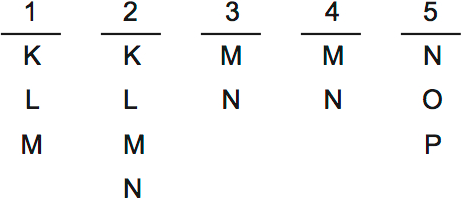
Take a look at 3 and 4. They don’t have many options: only M or N. If 3 lectures about M, then 4 can only speak about N, and vice-versa.
This means that 3 and 4 have to talk about M. No one else can lecture about M and N!
So 1 and 2 can only lecture about K and L. 5 can only lecture about O or P.
It doesn’t matter which of 1 and 2 lectures about K or L. The speakers are quite interchangeable. It’s the same for 3 and 4. The key to the game simply lies in knowing what each speaker’s (limited) options are. This next diagram shows which topics each speaker can lecture about.
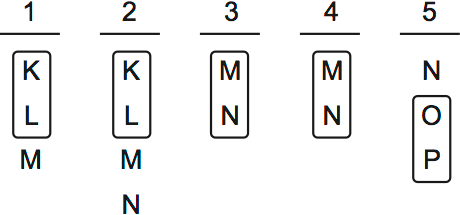
There’s nothing else to do. This diagram will let us answer every question with ease.
Game 2 Main Diagram
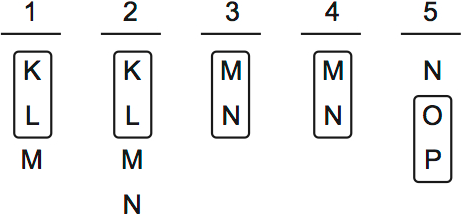
These diagrams show the rules used to determine which philosopher (K, L, M, N, O, P) will be discussed by the philosophy lecturers.
Refer to these diagrams when solving this game. Copy them on your own page, and on each question make a new version of them in order to follow along with my explanations. You’ll learn much more if you draw along.
The setup section explains how to build this diagram.
Main Diagram
Question 8
Speakers 1 and 2 can’t lecture about M. That gets rid of A and B.
Speakers 2 and 5 can’t lecture about N. That gets rid of C and D.
But there’s nothing to stop speaker 5 from lecturing on Ockham. E is CORRECT.
Question 9
Alphabetical order…don’t feel bad if you had to recite the alphabet to answer this one (I did!) It’s better to feel silly than to be wrong.
K-L-M-N is the only alphabetical order for the first four speakers. Then five can lecture about either O or P, since both letters come after N. That gives us two options, so A is CORRECT.
Question 10
Think about who we have to pin down. We need to know who lectures about one of either M and N, one of the pair K and L, and we also need to know who 5 lectures on.
Answer C lets us do that. C is CORRECT. If we know when M is lectured about (for example, on day 3) then we know N must be lectured about on the other day (day 4.)
If we know where half of a pair goes, then we can also say where the other half goes.
This type of question can take a long time, without the right method. So before wading through the answers on this type of question, ask yourself which variables you need to pin down.
A and B don’t let us choose between O and P.
D and E don’t let us know when to place K and L.
Question 11
This new rule about British and German philosophers doesn’t really change anything. It’s just LSAC’s way of disguising what they are asking. The wrong answer violates the master diagram, reproduced below:
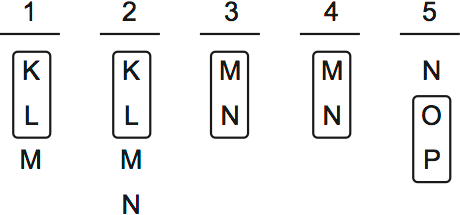
German = K and N
British = L, M and O
Take a minute to memorize who is German and British before starting.
A could be true because L can be first and M can be fourth. (first and fourth British)
B could be true because K can be first and N can be fourth. (First and Fourth German)
C could be true because L could be second and M could be third. (Second and Third British)
D is CORRECT. There’s only one German philosopher split between 3 and 4: Nietzsche. They can’t both lecture about a German.
E is wrong because M could go fourth and O could go fifth. (Fourth and Fifth British)
Question 12
This new rule changes everything. The limiting factor on the game was that 3 and 4 had to lecture about M and N. So nobody else could ever lecture about M and N. But now that 3 can lecture about S, then (for example) 4 could lecture about N. That lets 1 0r 2 lecture about M.
The possibilities are now quite open. Do not try to figure them all out, it’s wasted effort. Just try to get a feel for the new situation.
Since almost anything can happen, the only good way to violate a rule is to have 3 not lecture about S. If 3 doesn’t use the new option, then the game will work as before.
The new diagram looks like this. There are virtually no restrictions as long as 3 does choose S.
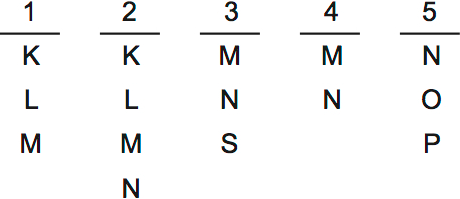
A could work, because 3 could lecture about S. (All of the wrong answers will have this same dull explanation.)
B doesn’t work because 4 can only lecture on M and N. This answer choices places M and N with other speakers. So 4 has no one left to lecture about.
B is CORRECT.
C doesn’t work, because 3 could lecture about S. That frees up M and N to be used elsewhere.
D doesn’t work, because 3 could lecture about S. That frees up N to go in 5.
E doesn’t work, because 3 could lecture about S. That frees up N to go in 2.
Game 3: Train Station
Game 3 Setup
This is an explanation of the third logic game from Section IV of LSAT preptest 34, the June 2001 LSAT.
Seven trains arrive at Middlebrook Station on Saturday. The trains are: Quigley, Rockville, Sunnydale, Tilbury, Victoria, Wooster, and York (Q, R, S, T, V, W, Y). The rules allow you to determine what orders the trains can arrive in.
Game Setup
This is another linear game. They’re my favorite type. I like this game in particular because the game can be split into two clear scenarios that let you deduce a lot.
The seven trains arrive one at a time. This is the same seven-slotted setup you’ll find on so many logic games.
The first rule immediately lets us split this into two scenarios. You should always draw two scenarios when a rule this clearly divides the game.
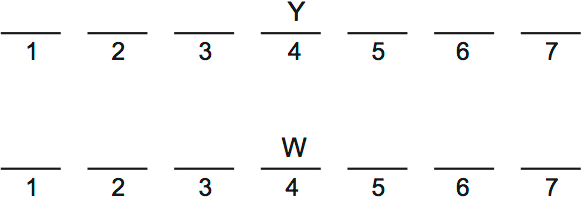
You might wonder why you should make two separate diagrams. The rule itself is obvious, and it seems like a lot of work to make more drawings.
Well, it lets you more easily visualize the game. And there are usually many deductions unique to each diagram. The second rule has different effects in each scenario.
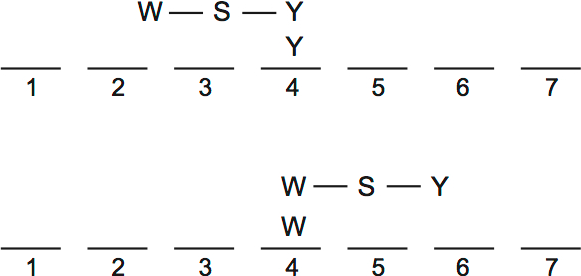
In the first scenario, the W-S-Y ordering goes before 4. In the second scenario, it goes after 4.
The next rule is just straightforward sequencing.
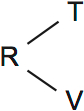
But it becomes a bit more interesting when we add in the fact that T can’t go beside V. Here’s how I draw that type of rule:

Pretend that box is a suitcase. Imagine you can pick it up by the handle and flip it around. You can’t have either TV or VT.
So T and V come after R and they can’t come beside each other.
Q is our only random variable: it has no rules attached to it.
Putting It All Together
You should never move onto the questions without at least trying to combine rules. It’s true that on some games there aren’t many deductions. But on many games you can make some very important deductions that strictly limit what can be true.
This game is like that.
Take a look at our first scenario:

Where can you put R, T and V? R has to go before them.
If you put R in 5, then T and V will be in 6 and 7…beside each other. That doesn’t work. And there’s no space for T or V to go before Y.
You need to put T and V in 5 and 7. R will go in front of Y somewhere, along with W and S. And there’s only one spot left for Q, in slot 6.
The end result looks like this:

I placed the first three variables overhead to indicate that they go in the first three slots, but I don’t know where. I use the comma between R and W-S to indicate that R is in the same region as W and S, but I have no idea where it is in relation to them.
We know the first three variables are before Y, and W is before S. That’s all.
You don’t have to draw R, “W –S “ the same way I did. It makes sense to me, but you might think of some other method that makes more sense for you.
But make sure you represent it somehow. If you don’t draw a deduction, there’s a good chance you’ll forget it. Even I forget if I don’t draw my deductions.)
The T/V and V/T mean that one of them goes in 5 and the other goes in 7.
The second scenario is similarly restricted. Take a look and try to think about where you can put R, T and V. Remember, R goes before V and T, and V and T aren’t beside each other:

Did you figure it out? There is only one space free after W, and one of T/V has to go there.
If you put R, T and V in spots 1-2-3, T and V will be beside each other. So one of T/V goes with S-Y after W.
That leaves R, the other V/T and Q to go before W. It looks like this.

The variables are placed overhead to indicate which region they go in. The commas show that Q can go before or after (or in between) R-V/T.
Game 3 Main Diagram
These diagrams show the rules used to determine the order of the trains (Q, R, S, T, V, W, Y) that arrive at Middlebrook Station on Saturday.
Refer to these diagrams when solving this game. Copy them on your own page, and on each question make a new version of them in order to follow along with my explanations. You’ll learn much more if you draw along.
The setup section explains how to build this diagram.
Main Diagram
Scenario 1

Scenario 2

The entire game reduces to these two little diagrams. Neat.
Study them well before trying the questions. And make sure to think a little about how the variables can be placed (without drawing all of the possibilities). It’s important to understand the possibilities your diagrams represent.
The explanations for this game are a lot more mechanical than for some games. That’s because once you understand the two scenarios, this is a very easy game. If you’re still a little confused by them, try to draw them on your own using the rules, and go over my set-up again.
Question 13
For the first question, I like to start with an easy rule such as “Y or W must be 4th.” Check each answer choice to see if it violates the rule.
(Don’t use your scenarios for the first question. Rules are faster.)
D has Sunnyvale 4th. Wrong.
Next, let’s try R before T and V. You can also check if T and V are beside each other at the same time.
A has T and V beside each other. It’s out.
E has T before R. Oops.
Two answers left. I had to look at my rules again, because I forgot the other rule. I didn’t look at the answer choices, that would have been a waste of time. Don’t waste time.
The other rule is that S is between W and Y. B violates that rule.
C is CORRECT.
Question 14
This is a local rule question. The first step is to check which scenario we are in. The first scenario is the only one that allows us to put W before R. And we have to put W in slot 1, because S also has to go after W.

You have two ways to place R and S. R can be second and S third, or vice versa.
There are also two ways to place T and V. T in 5 and V in 7, or vice-versa.
2 possibilities times 2 possibilities equals 4 possibilities. A is CORRECT.
The math works, but if you don’t believe me, try drawing out the possibilities. It will save you from making a mistake:
RS TV
RS VT
SR TV
SR VT
Such a drawing doesn’t take long. It’s the best way to solve this if your math teacher never taught you how to calculate permutations.
Question 15
This must be true question is testing for a general deduction we should have made. The more “must be true” questions you see that don’t involve a local rule, the more likely it is that you should have made deductions during the setup.
A could be true, but it doesn’t have to be. In the last question, we figured out W could be first.
B is disproved by the first scenario, when Q is in slot 6.
C is disproved by question 14, just like A. R can go first, but it doesn’t have to. W can go first in scenario 1, and Q can go first in scenario 2.
D is disproved by scenario 1, where V has to arrive after the York.
E is CORRECT. W is before S and S is before the Y. This answer choice is a reward for getting through the others.
Sometimes the LSAC makes the correct answer easy, but puts it at the end. It can pay to go quickly through the answers you’re not certain you can disprove. Don’t eliminate them, but looking through all the answers lets you check if LSAC has hidden an easy answer choice right at the end.
Question 16
I’m reproducing the scenarios so you don’t have to look back to the setup.
Scenario 1

Scenario 2

This general question shows that the LSAC expected us to make deductions in our general setup.
A is wrong because in both scenarios Q and S are on opposite sides and can’t go beside each other.
B is CORRECT. In scenario 1 S could be 2 and R could be 3. We saw this could be true in question 14. Try to remember what you’ve done on previous questions.
C is wrong because in scenario R always has to come before T.
D is wrong because in both scenarios Q and S are on opposite sides.
E is wrong because in scenario 1 Q and W are on opposite sides and in scenario 2 Q is before W.
Question 17
One train between W and Y. That could only be S, because S has to be somewhere between them in all scenarios.
This new rule is pretty restrictive. Here are the diagrams:


A can’t work, S has to be 3 or 6.
B is no good, because the sixth train is either Q or Y.
C can’t be true. R is in 1 in the first scenario and in the second scenario R has to go before V/T, so it is second at the latest.
D can’t be true because S is either 3 or 5.
E is CORRECT. In the first scenario, R has to go first. In the second scenario, R could be first, in front of V/T and Q.
Question 18
This question puts Q before R…that can only be the second scenario.
(Scroll down for diagram + explanation)

Q now has to be in front of both V/T and R, so Q must be first.
The question is asking us where W must arrive. In the second scenario, W arrives fourth. C is CORRECT.
Game 4: Doctors
Game 4 Setup
This is an explanation of the fouth logic game from Section IV of LSAT 34, the June 2001 LSAT.
There are six doctors, namely: Juarez, Kudrow, Longtree, Nance, Onawa, and Palermo (J, K, L, N, O, P). Each of them must be in one of two clinics: Souderton or Randsborough (S, R). You must decide which clinic the doctors are in.
Game Setup
This is a grouping game. Every doctor is at one of two clinics. This means you can treat the game as an in-out grouping game, like the birds in the forest game from test 33. “You’re either in or out” is the same as “you’re either at S or R”.
We’re going to draw all the rules, then recombine them into two chains of sufficient and necessary conditions. This will let us figure out a lot.
The first two rules can be easily confused if you don’t read them carefully. LSAC placed the sufficient condition second. The first rule would mean the same thing if it read:
“If Juarez is at Souderton, Kudrow is at Randsborough.”
Always focus on words such as “if” “only if” etc. Word order doesn’t always change much. Like Yoda be.
Here are the rules drawn out. The subscripts indicate the clinics:
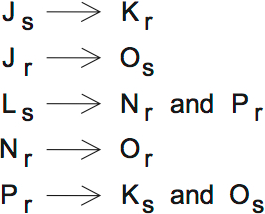
When you’ve finished drawing the rules on this sort of game, look back over the game’s written rules to make sure you haven’t made any mistakes. I always do. Any mistake is a disaster, especially when you’re combining rules.
I’ve also drawn the contrapositives below. Remember that you have to change “and” to “or.” For example, since L being at S requires both N and P to be at R then either one of them being at S is sufficient to show that L must be at R.
In a two group game, the negation of L being at S is L being at R. There’s no need to put a line through the variables. There are only two groups, so if you aren’t at one then you must be at the other.
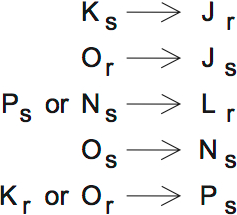
Now it’s time for a game of mix and match. If the same variable is both a necessary and a sufficient condition for two separate statements, you can join the two. It’s like lego!
For example, Or leads to Js. And Js leads to Kr. So we get:

For in-out or two group games, it’s often the case you can connect everything. So let’s build on that and see if we can fit all of the variables.
For example, Nr leads to Or.

Next, Kr leads to Ps. And Ps leads to Lr. Done!

(Note: we also know Or leads directly to Ps. You can draw that separately if you want, but it’s not necessary since Or leads to Ps indirectly through Kr.)
Now we can take the contrapositive. Be very careful when you do this, you don’t want to misinterpret your AND/OR statements. I always reread my rules once I’ve drawn a contrapositive chain, to make sure I didn’t make a mistake.
L actually can’t be in S
I start with Ls leads to Pr. Then Pr leads to Ks. Ks leads to Jr.

Next, Jr leads to Os, and Os leads to Ns.

(I took a shortcut. Pr leads to both Ks and Os. I didn’t draw Pr ➞ Os, because Ks leads to Os.)
Lastly, Ns leads to Lr.

(The diagram is smaller only because it’s very long and too big for the page)
Huh? Yes, you read that diagram right. Ls leads to Lr.
Obviously, that doesn’t work, L can’t be in two places at once. A hidden deduction is that L always has to be at R.
This is very weird, since they gave us a rule that tells us what happens if L is at S. But it’s true: L can’t ever be at S.
If you’re not convinced, here’s a diagram of what happens when we take the Ls rule and combine it with other rules:
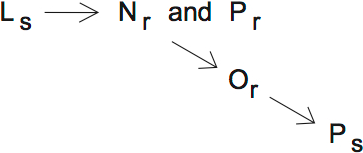
Clearly, we can’t have Ps and Pr at the same time. L has to be in R.
And we’re done! Combining rules really is just like lego. Or dominoes.
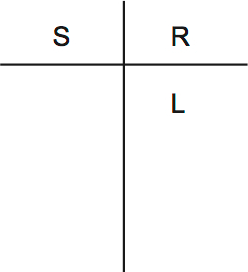
We can set up the deduction about L in a table.
There’s a bit more we can add. Consider these rules:
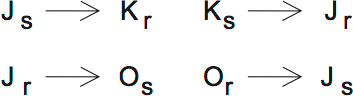
If J is at S, K is at R, and vice versa. J and K can’t both be at S; one of them has to be at R.
Both could be in R. This may look confusing. Try putting J in R.
Jr is the necessary condition in the rule above. Knowing that J is in R can’t tell us anything about K. You can only read the diagrams left to right, not backwards.
This is the most confusing relationship on in-out grouping games, so make sure you understand it.*
O and J have a similar relationship. One has to be in S. You can add both relationships to the table.
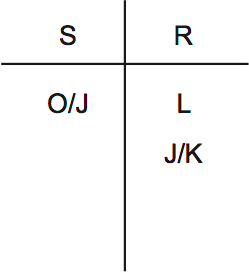
* Here’s an example of the “at least one” relationship. If you’re a parent, you have a boy or a girl. You could also have both. So we no that if someone is a parent, and:
no boy ➞ girl
no girl ➞ boy
Parents always have at least one, and maybe both.
Whenever the sufficient condition is negated, and the necessary condition is positive, you must have at least one, and could have both.
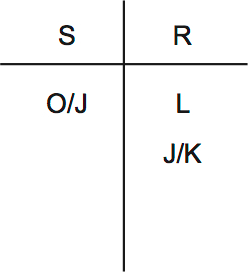
Game 4 Main Diagram
These diagrams show the rules used to determine which clinic (S, R) the doctors are in (J, K, L, N, O, P).
Refer to these diagrams when solving this game. Copy them on your own page, and on each question make a new version of them in order to follow along with my explanations. You’ll learn much more if you draw along.
The setup section explains how to build this diagram.
Main Diagram


Question 19
Use the rules one by one to eliminate answers.
C is out, because L can’t go in S. Ok, this wasn’t a rule, this was a deduction from our diagram.
If J is in S, then K is in R. So A is wrong.
B doesn’t violate any rules. B is CORRECT.
D is wrong because Pr leads to Ks. (You need to consider which variables go in R)
E is wrong because Jr leads to Os.
Question 20
If Palermo is at Randsburough, then we know everything. This scenario was one of our diagrams from the setup. See how easy these are once you get the diagram right.
(Scroll down for diagram)

A is CORRECT. Juarez has to be at Randsborough. All of the other answers always have to be false, based on this diagram.
Question 21
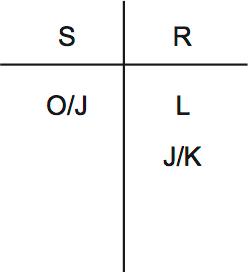
We need to find the lowest number at Souderton. Let’s start with the diagram above. We definitely need one of O or J at S.
This eliminate A. We can’t have zero people at S.
Let’s try the diagrams. If we put P in R, then K, O and N are at S. Three people are at S. So E is wrong.

Let’s see if we can do better, and try Nr instead. That only causes 2 people to be in S.

We can’t get that number any lower. J has to be at S, because one of O/J has to be there. And if we moved P into R, we’d be in the scenario from the first diagram.
C is CORRECT. Two is the lowest number of doctors we can have at S.
Question 22
Nance and Onawa must be kept apart. That means N has to go in S. Why? Look what happens if we put them in R.

O goes in R! So Ns, Or is how we set this up.
(Just start from Or on the top diagram and move right, and start from Ns on the lower diagram and move right)

So what can we deduce? Ns just leads to Lr, which we knew already. Or leads to Js and Kr.
We can see that P must be in S. If P were in R, then O would be in S.
So: R = L, K, O
S = P, N, J,
This answers our question; J must be at S. A is CORRECT.
Local rule questions are that simple. Draw the local rule, make deductions, check if those deductions give you the right answer.
Question 23
This question isn’t too hard either. We need two doctors who can’t both be at Randsborough.
So just look to see where one of the doctors listed is a sufficient condition for the other doctor to be at S. Scan the diagrams left to right. For example, for A, look for Jr and Kr.
Kr leads to nothing, so that’s fine. And Jr doesn’t lead to anything involving K. So there’s no obvious reason these two couldn’t be at R together.
Try it yourself. Look for Jr and Pr. See if either of them being at R causes the other doctor to be at S.
(It doesn’t. Pr leads to Jr. So those two can definitely be together at R.)
E is CORRECT. P at R leads to N at S.
Question 24
What happens if K is at S? It’s this diagram, starting from K.
(Scroll down for diagram)

Our deductions are: Jr, Os, Ns and Lr.
We don’t know anything about P, they could go in either clinic. You can only go right to left on the diagrams, not left to right).
Now that we’ve made a few deductions, we should check if they give us the right answer. They do; B says N has to be at S.
B is CORRECT.
A and C must be false, and D and E are just things that could be true.
Local rule questions are often dead simple. If your diagram is correct, there’s no need to second guess it. The LSAC is rewarding you with easy points for figuring out how everything fits together.

Leave a Reply