
LSAT Preptest 37 LG Explanations
Full explanations for every question from the logic games section of LSAT Preptest 37.
Archived Logic Games explanations
Logic Games are no longer part of the LSAT. LSAC removed the Logic Games section beginning with the August 2024 LSAT. If you are studying for the current LSAT, you can skip this section.
These explanations remain available for students, tutors, and readers using old-format PrepTests. For current guidance, see Logic Games and the current LSAT.
Table of contents
Game 1: Dormitories
Game 1 Setup
This is an explanation of the first logic game from Section III of LSAT Preptest 37, the June 2002 LSAT.
A boarding school needs to assign male and female students (F, M) to occupy its dormitories. There are four dormitories: Richards, Tuscarora, Veblen, and Wisteria (R, T, V, W). Each dormitory has a North wing and a South Wing. You need to figure out students’ assignment to dormitories based on the rules.
Game Setup
This is a grouping game. We have to figure out how to arrange females and males between eight dormitories. There are five females and three males. Here’s how to set it up:
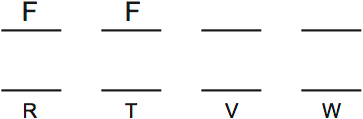
North is on the top and South is on the bottom. I’ve added in the rule that says that R and T north are filled with females.
Rules 2 and 4 are important to remember. There are only three males (rule 2). If a male is in a dormitory, then the other wing is female (rule 4).
There’s no single best way to diagram that. The main thing is to commit them to memory somehow. Here’s what I drew:
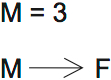
We can combine these rules to figure out that three of the four dormitories will have one male and one female, and one dormitory will be all female. This means that one of either R south or T south will be male.
Why? Well, look what happens if they’re both female:
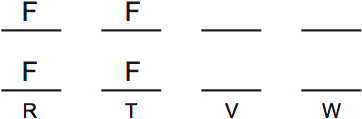
We have no space to spread the men out across 3 dormitories. So we can draw our diagram like this to remind ourselves that at least one of them must be male.
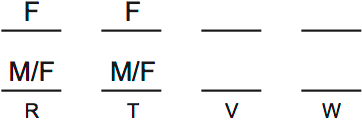
The final rule lets us split our setup into two scenarios. It says that if males is in V south, then males are also in W north.
So we can see what happens if V south is male, and we can see what happens when it’s female.
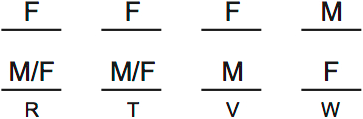
Here I’ve made Veblen South Male. That means V north and W south are female, according to rule 4.
The other scenario is more boring. But should draw it to remind yourself that you can’t put males in V south unless your diagram follows rule 5 and looks like the diagram up above.
Drawing a way to keep yourself from forgetting the M in Vs ➞ M in W north rule.
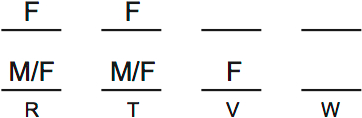
You might think we need to put F in W north as well. But we’re not drawing the contrapositive. We’re just trying two options: males in V south (rule 5 triggered), or no males in V south (rule 5 not triggered).
Game 1 Main Diagram
These diagrams show the rules used to determine the assignment of male and female students (M, F) to the north and south wings of the dormitories (R, T, V, W) to .
Refer to these diagrams when solving this game. Copy them on your own page, and on each question make a new version of them in order to follow along with my explanations. You’ll learn much more if you draw along.
The setup section explains how to build this diagram.
Main Diagram
Scenario 1 (where M is in V south)
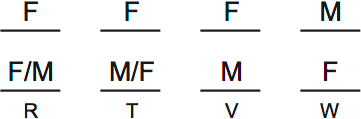
Scenario 2 (where F is in V south. i.e. all other situations)
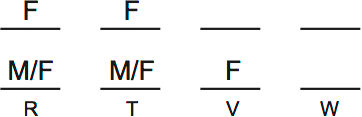
Rules:
- If M is in a dormitory, then F is in the other wing.
- Five F, three M.
- If M is in V south, then M is in W north.
Question 1
The first thing to do is to try diagramming the new information.
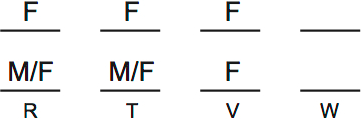
We’ve used four of our five available females. We only have one left. But the questions asks for two places where females can be assigned.
So the right answer must include one of the two females already placed in R and T north.
It’s also important to check where males have to go. We have to put one male in each of R, T and W. So the full diagram actually looks like this:

A is wrong because it says females go in Tuscarora South.
B is wrong because R south has to be male.
C is wrong because R south has to be male.
D is CORRECT. We know there are definitely females in T north. Females could also go into W south…it doesn’t really matter as long as Males are in one spot in W.
E is wrong because T south has to be male.
Question 2
I’m looking at the main diagram in order to think about this question.
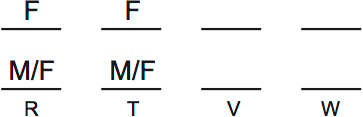
Where couldn’t we put two females? Well, the only obvious place is in R and T south. Then there would be no place to split up the three males in across three dormitories.
That’s why B is CORRECT.
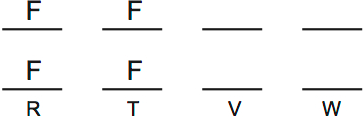
That’s a much faster method than the alternative, which is to draw out each scenario and see what works.
A and C both have females in R south and one other place. That’s fine. There are no rules associated with females being in any of the places mentioned, and all setups leave room for three males in three separate dorms.
D and E both involve females being in Wisteria South and one other place. Again, there are no rules telling us what to do if females are in those places. Both setups leave space for three males to go in three separate dorms.
Question 3
The first step with a local rule question is to draw the local rule in our diagram.
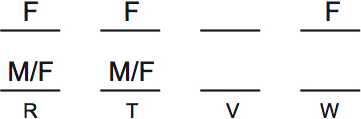
The second step is to ask if we can make any new deductions by combining the rule with our existing rules. The last rule mentions Wisteria North. If men are in V south then M also has to be in V north.
Hmm. We don’t have M in Wisteria North. So we can’t put M in Veblen South. We must put females there. Therefore D is CORRECT.
Question 4
Like the last question, the first step here is to draw the local diagram.
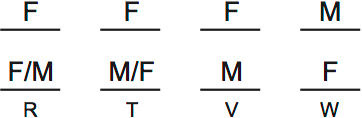
We saw this in our setup; it’s scenario 1. Males go in W north because of the last rule. Females go in V north and W south because men can’t fill both spots in a dormitory.
Males could go in either R or T south (in fact, they have to go in one). So the places men can’t go are the places marked F on our diagram.
D is CORRECT, because it lists all of those places.
Question 5
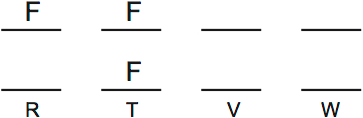
I’ve drawn the local diagram above. You can see that the major constraint is that males have to be assigned across all three of the open dormitories. We need an M in R, V and W. That means we must put M in R south, so really the diagram looks like this:
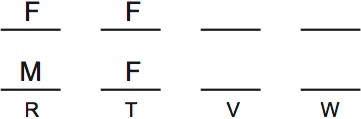
So we need one male in V and W.
A and B are wrong because they put an M in R south.
C is tricky to eliminate. But if you put F in Veblen North and Wisteria North, then M goes in Veblen South and Wisteria South.
This answer choice violates the last rule. M in Veblen South means M in Wisteria North. This answer choice puts F in Veblen North.
D is CORRECT. There’s no rule against putting Females in Veblen and Wisteria South. We can put males in the North, so we’ll have males spread across three dormitories.
E is wrong because Veblen is completely filled up. Now only Wisteria is left for the two males, and we can’t put two males in the same dormitory.
Game 2: Trucks
Game 2 Setup
This is an explanation of the second logic game from Section III of LSAT Preptest 37, the June 2002 LSAT.
Seven trucks – S, T, U, W, X, Y, and Z arrive at a warehouse in a single day. Each truck is colored green or red (G, R) and no truck arrives more than once that day. You must use the rules to determine their possible orders of arrival.
Game Setup
This is a linear game with a twist. Not only do we have to figure out the order of the trucks, we also have to figure out which colors they are. Fortunately, the rules about color let us figure out almost everything about this game.
The first rule tells us we can’t have two reds in a row. That means we always need a green between two reds (green is the only other color.) Here’s how I drew that:

The variables go on top of the slots, and the colors go on the bottom.
The next rule is straightforward sequencing. Y comes in front of T and W. We’ll put it directly on our diagram later, but for now here’s how to draw it.
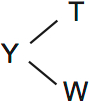
The next two rules are interesting. If exactly two trucks before Y are red (rule 3), then Y must come at fourth at the earliest. There are two red trucks and a green truck in front of Y. Y could go fifth if there is more than one green truck in front of Y.
But…we also know S is sixth (rule 4). Y can’t go last (because T and W come after Y), so S must come after Y.
T, W and S all come after Y. That means Y has to go fourth at the latest.
If Y has to go fourth at the latest and fourth at the earliest…then Y just has to go fourth!
S, T and W fill up spots 5, 6 and 7. Here’s to draw all that:

The three trucks in front of Y are r, g and r because that’s the only way to fit in two red trucks. So Y must be green, since we can’t have two reds together.
S is in sixth. T and W come after Y in 5 and 7, in either order. We don’t know anything about the colors of trucks 5, 6 and 7: they could even all be green.
Lastly, Z comes before U (rule 5). X wasn’t mentioned in any rule, so it could go anywhere in spots 1-3. I’ve drawn these directly onto the diagram:
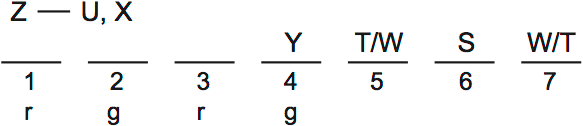
Z –U and X are drawn overhead and separated by a comma to indicate that they all must go before Y. The comma indicates that we don’t know if X comes before Z and U, after them, or even in between.
As far as I know, I invented this style of drawing. It’s an easy way to keep track of all remaining variables. This frees up mental space and lets you focus on the question.
Game 2 Main Diagram
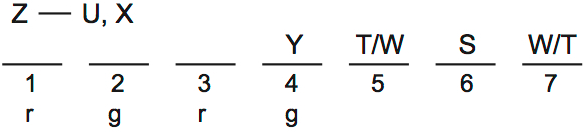
These diagrams show the rules used to determine the order the trucks (S, T, U, W, X, Y and Z) arrive at the warehouse, and their colors (r, g).
Refer to these diagrams when solving this game. Copy them on your own page, and on each question make a new version of them in order to follow along with my explanations. You’ll learn much more if you draw along.
The setup section explains how to build this diagram.
Main Diagram
Question 6
As with all list questions, take one rule and go through the answer choices in turn to see what can be eliminated.
A is CORRECT, by process of elimination.
B is wrong because Y needs to be fourth.
C is wrong because Y needs to be fourth.
D is wrong because T needs to be after Y.
E is wrong because Z needs to come before U.
Question 7
Two trucks can’t both be red if they come beside each other. From our diagram, the only trucks that are definitely beside each other are T/W and S.
B is CORRECT. T and S are always beside each other (even though T could be in 5 or 7.) Therefore at least one of them has to be green.
A is wrong because X could go in 1 or 3 and therefore be red. And there’s no rule stopping S from being red.
C is wrong because U could go in 3 and therefore be red.
D is wrong because T and W could both be red if S is green.
E is wrong because Z could go in 1 and X could go in 3. Then they would both be red.
Question 8
If X is in 3, then Z and U must be in 1 and 2 respectively. The truck in 2 is always green, so U must be green.
Therefore answer C is CORRECT.

Question 9
If three trucks are green then there’s only one way to set things up. The last three trucks have to be red, green, and red. Here’s how it looks:
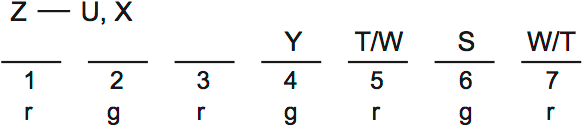
S must be green. A is CORRECT.
We can’t do something like green, red, red because then two reds would be together. (We already have the first two greens in 2 and 4).
Question 10
For ten, just look at your main diagram and see how many trucks are in fixed positions. Y is in 4 and S is in 6.
They’re they only ones we can be sure about. T and W can switch places with each other. Z, U and X don’t have a fixed order.
B is CORRECT.
Question 11
A is wrong because U comes after Z. U could go third and be beside Y, if X went before U.
B is wrong because X could go third, after Z and U. There are no rules for X.
C and D are wrong because both W and T can go in 5 or 7. If either goes in 5, then it’s beside Y.
E is CORRECT, because Z has to go before U. U will always be between Z and Y, since Z and U come before Y.
Game 3: Bookshelves
Game 3 Setup
This is an explanation of the third logic game from Section III of LSAT preptest 37, the June 2002 LSAT.
Three shelves of a bookshelf (1, 2, 3) has six books on them. The first shelf has one book, the second shelf has two, and the third has three books. The books consist of two grammar books- one in Farsi and one in Hausa (F, H); two monographs – about phonology, and semantics (P, S); and the remaining two books are novels – one written by Vonnegut, and the other by Woolf (V, W)
Game Setup
This is a grouping game. It’s also one of my favorite games, because it lets you figure out almost everything before you start. I love those games.
[Note: The LSAT has changed since I first wrote this. Games like this are now rare, and up front deductions are less common. But the skills involved in making this up front deduction still directly apply to the questions newer games ask. Most questions on newer games will give you a single new rule that allows you to make a series of deductions like this.]
But it isn’t always obvious how to do that, so I’ll show you how to approach this sort of game.
First, the basic diagram looks like this:
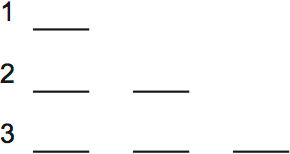
If you’re unsure how to set up a game, take a look at the first question. Notice they’ve set it up the same way I have.
Next, you should draw the variables. This is important whenever variables are split into groups.
Once you’ve finished your setup, you should look back at this diagram and remember which variable is a novel, a monograph, etc. On logic games, it’s very important to load that type of information into your short term memory.
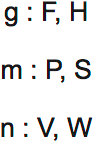
The game can be split into three scenarios
Now, I said something about splitting the game into three scenarios. You can do that with the second and third rules (I’m going to ignore the first rule for a moment.)
The monographs, P and S, can’t go with each other (rule 2). And they can’t go with V, either! (rule 3)
V, P and S must all be kept separate. So there is one for each group.
For instance, one of P/S could go in 1, the second could go in 2, and V could go in 3. It looks like this:
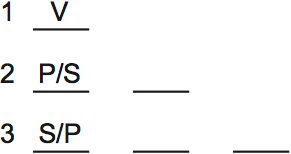
You may find it tough to see this type of deduction during a game. The trick is to look for rules that mention the same variable. Rules 2 and 3 both mention monographs.
There are only two other ways of arranging that, shown below.
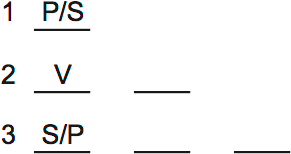
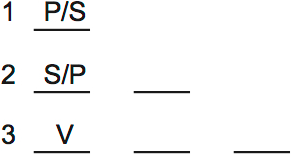
I’ll call them scenarios 1, 2 and 3, in order. (I’m numbering the scenarios based on where Vonnegut appears)
V, S and P must always be keep separate. Always. This is the cardinal rule of this game. If you remember it, the game is easy. If you forget it, the game is hard.
Now we can look at the first rule. You must always put at least one of the novels (V or W) on the same shelf as F. So F needs two spots: one for F and one for the novel.
Remember these two things:
- V, P and S are separate
- F always goes with V or W
Did you memorize the two things from the previous page? Seriously, that’s all you need to follow along and do this game. V, P and S are separate. F always goes with V or W.
Scenario One
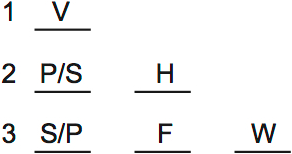
In the first scenario, V is already in group 1. So W has to be the novel that accompanies F. Only group two has the two spaces to fit them in. That leaves H to go in group 2.
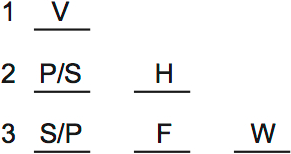
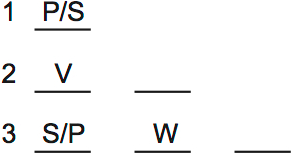
Scenario Two
In the second scenario (when V is in 2) we have more options. F could go in 2 with V, or F could go in group 3 with W. The only thing we can’t do is put W in 2. Then both V and W would be together and there would be no novel left to go with F.
So W has to go in 3, and then F and H are split between the other two groups.
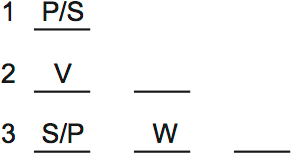
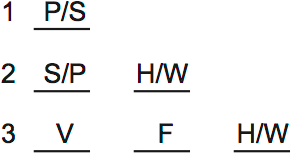
Scenario Three
In the third scenario (when V is in 3), there’s only space for F to go in group 3. V is already in group 3, so the novel requirement is satisfied. That leaves H and W go fill the other spots in groups 3 and 2.
F can’t go in group 2 because there would be no novel there.
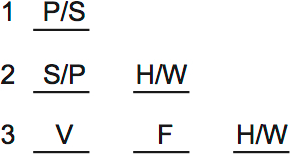
Game 3 Main Diagram
These diagrams show the rules used to determine the possible placement of the books (F, H, P, S, V, W) on bookshelves (1, 2, 3).
Refer to these diagrams when solving this game. Copy them on your own page, and on each question make a new version of them in order to follow along with my explanations. You’ll learn much more if you draw along.
The setup section explains how to build this diagram.
Main Diagram
Scenario 1
Scenario 2
Scenario 3
Notice that I’ve kept P, S and V in the first column on each scenario. They divide the scenarios. Little details like this make your diagrams clearer.
Question 12
For the first question, pick a rule and use it to eliminate answer choices. Repeat for each rule.
A is wrong because the semantics monograph and the Vonnegut novel are together on the second shelf.
B is CORRECT.
C is wrong because F doesn’t have V or W on the same shelf.
D is wrong because P can’t go with S.
E is wrong because P can’t go with S.
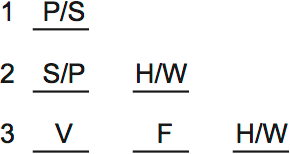
Question 13
We can use the three scenarios to figure out this question. The main deduction is that P, S and V all have to be on separate shelves.
A is CORRECT. If a grammar were on the first shelf then we can’t keep P, S and V separate.
B could be true in the first scenario.
C could be true in the first scenario.
D could be true in the third scenario.
E could be true in the first scenario.
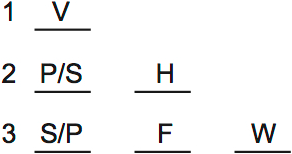
(First scenario)
(Third scenario)
Question 14
This is just a general must be true question. Think about the three scenarios.
A doesn’t have to be true in the second scenario: V is on the second shelf and the monographs are elsewhere.
B doesn’t have to be true. In two of our scenarios the second shelf has a monograph.
C doesn’t have to be true: in the third scenario Vonnegut (and no monographs) are on the third shelf.
D is CORRECT. Why? Lack of space elsewhere. After we place P, S and V, we only have three open spaces to place F, H (two grammars) and W (a novel).
One possibility is that F goes with V in scenario 2, in which case the only space left for F and H is the third shelf.
The other major possibility is that F goes with either W or V on the third shelf.
In both cases at least one novel and grammar are on the third shelf.
E is wrong because in scenario 3 there is no linguistics monograph on the third shelf.
Question 15
We must be in scenario 3 if both grammars are on the same shelf. It’s the only way to fit F + H + a novel (in this case, Vonnegut.) Remember, F always has to go with a novel.
Here’s scenario 3 again, with H on the third shelf:
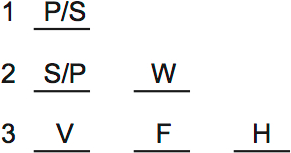
We can see A is wrong because no monographs can be on the third shelf.
B is wrong because the first shelf has to have a monograph on it.
C is wrong because V has to be on the third shelf.
D is wrong because F has to be on the third shelf. If we put F on the second, there would be no room to fit H as well as a novel.
E is CORRECT. Either S or P can be on the first shelf.
Question 16
Another must be true question. When a game has many of these, it’s a sure sign you need to have made many deductions.
A doesn’t have to be true. In scenario 1, V is on the first shelf.
Scenario 3 proves B doesn’t have to be true. We could fit V, W and F on the third shelf.
C doesn’t have to be true, the scenario from question 15 proves both grammars can be on the same shelf.
D doesn’t have to be true. The scenario from question 15 proves we can put W on the second shelf with either monograph (S or P.)
E is CORRECT. If we put W on shelf one then we can’t put P, S and V on separate shelves.
Question 17
If the Farsi grammar isn’t on the third shelf then it must be on the second. That means V must go on the second shelf so that F goes with a novel. We’re in a version of the second scenario.
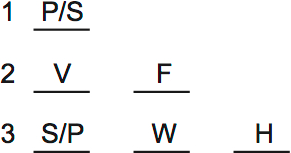
We can’t put a monograph on the second shelf. So A is wrong.
We can’t put H on the second shelf, so B is wrong.
S could go on the third shelf. C is CORRECT.
V has to go on the second shelf, not the third. F has to go with a novel. But if we put W on the shelf instead of V, we couldn’t keep P, S and V separate. D is wrong.
E is wrong. W can’t go on the second shelf. Then P, S or V would have to go together.
Question 18
If P and H are together, then they must be on the second or third shelves (we can’t both fit on the first).
F must be on the other shelf, because F needs an open space to go with a novel. There are two ways this could go:
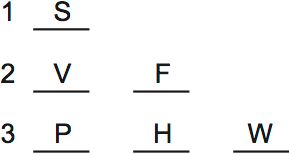
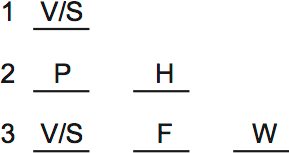
In the first case, V has to go in second, because F needs to go with a novel.
In the second case, V and S are interchangeable. F already has W, so the novel requirement is satisfied (W can’t fit anywhere else.)
A is wrong because P could go in 2.
B is wrong because in the 2nd case, V goes in 3.
C is wrong because S can go in 1 or 3 in the second scenario.
D is wrong because S could go in 3 in the second scenario.
E is CORRECT. In both scenarios there is no space for W to go anywhere else.
Game 4: Swimmers
Game 4 Setup
This is an explanation of the fourth logic game from Section III of LSAT Preptest 37, the June 2002 LSAT.
Five swimmers swim a ten-lap relay. They are Jacobson, Kruger, Lu, Miller, and Ortiz (J, K, L, M, O). They swim two laps each. One is assigned to swim lap 1 and 6, one to lap 2 and 7, one to lap 3 and 8, one to lap 4 and 9, and one to 5 and 10. You must use the rules to determine the possible orders of the swimmers.
Game Setup
This is a linear game. It’s slightly different from a standard linear game. We have ten spots, but really it’s just two lines of five spots that each repeat once.
Since the swimmers all repeat, we can just draw two horizontal rows over top of each other:
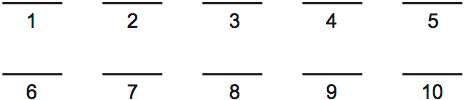
Any swimmer that goes in 1 goes in 6. If they’re in 2 they’re also in 7, and so on.
K isn’t before directly before L (rule 1). We can draw it like this:

It’s important to remember that spot 5 is directly before 6. So K can’t be in 5 if L is in 1 and 6.
Next, we’re told that J can’t go in 9 (rule 2). Since swimmers repeat laps, this means that J also can’t go in 4.

Next, Ortiz is somewhere after Miller (rule 3). This is a normal sequencing rule:

The rule gets more interesting because we can combine it with the final rule. O has to come directly before J, once. So we get this:

Note that the rule said that J only has to come after at least one of O. That means that O could be in 5 and J could be in 1 and 6. It’s not worth drawing these exceptions separately – just keep this in mind.
We can add this rule onto our main diagram by showing that O can’t go in 3 and 8 (because J can’t go in 4 and 9). We can also say that O can’t go first and M can’t go last (because M has to go before O.)
Lastly, J can’t go second (because O can’t go first, and J has to go directly after O). This comes in handy on question 23.

Game 4 Main Diagram
These diagrams show the rules used to determine the order of the five swimmers (Jacobson, Kruger, Lu, Miller, Ortiz – J, K, L, M, O) during the ten laps.
Refer to these diagrams when solving this game. Copy them on your own page, and on each question make a new version of them in order to follow along with my explanations. You’ll learn much more if you draw along.
The setup section explains how to build this diagram.
Main Diagram

Question 19
Eliminate the answers one by one using the rules.
A is CORRECT.
B is wrong because J can’t be in 4. That would cause J to also be in 9.
C is wrong because O has to be in front of J.
D is wrong because M has to go in front of O.
E is wrong because K can’t go in front of L.
Question 20
This is a fun question. If J is in 8, we have to place O right before J, in 7. That means M has to go in 6 (and 1) in order to be before O.


So we’ve placed those three variables. We’ve got K and L left to place in 4 and 5. K can’t go before L, so K must go in 5. L goes in 4.
That means we’ve placed all 10 variables! A is CORRECT.
Question 21
If O is in 4 then J must be in 5, because J has to come right after O. The only other restriction will be that K can’t come before L.
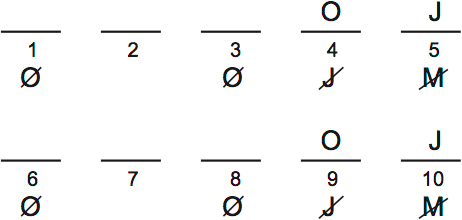
C and E are wrong because they don’t have J in lap 5 – other people are placed there.
A and B are wrong because they don’t place J in lap five.
Often, local rule questions can be quickly solved once you make a single deduction: J must be in five.
D is CORRECT. I’ve shown it by process of elimination, but as further proof, this order works: K-M-L in spots 1, 2 and 3, O-J in spots 4 and 5.
Question 22
A is wrong because J can’t go in lap 9. Laps 4 and 9 are the same.
B could be true. The following order proves it: MOJLK. B is CORRECT.
For C, L can’t be in 5 because there’s no place to fit M-O-J without placing K right in front of L. If you put M-O-J in 1, 2, 3, you would get MOJKL.
And OJ can’t go in 3 and 4, because J can’t go in 4.
D is wrong because M has to go before O.
E is wrong because if O is in 6 then O is also in 1. That doesn’t work because M has to go before O.
Question 23
Jacobson can’t swim lap 2. If J is in 2, then O is in 1 (because O has to be directly before J). That leaves no room for M to come before O.
Answer B is CORRECT.
It might seem like D is also right. Two problems. First, if J is in 6, then O could be in 5. Then O would come directly after J. Second, D and A are really the same answer choice: If J is in lap 6 then J is also in lap 1. Two answer choices can’t be right.
Question 24
This is another process of elimination question.
A is wrong because J needs to be directly after O.
B is wrong because K can’t be before L.
C is CORRECT.
D is wrong because J can’t go in 9.
E is wrong because M has to be before O.

Leave a Reply