

RC Passage 3 Explanation
PASSAGE TEXT: Until the 1950s, most scientists believed that the geology of the ocean floor …
This is an explanation for passage 3 of LSAT preptest 63, the June 2011 LSAT. This passage is about ocean magnetism. Scientists developed a new theory of the ocean floor by studying changes in magnetic patterns.
This section has paragraph summaries and an analysis of the passage, links to the explanations for the questions are below.
Paragraph Summaries
- The ocean floor has magnetic variations. Newly formed magma on the ocean floor takes its polarity from the Earth’s magnetic field, and this magnetic field has changed over time.
- The mid-ocean ridge has rows of rocks with alternating polarity. Scientists theorize this is because the ocean floor is being pulled apart and new magma continually rises from the ridge.
- The young rocks near the crest have normal polarity. The rock gets older as it is further from the crest. Scientists are able to judge the age of the ocean rock from samples of land rocks. The stripes of polarity of the rock appear to have reversed whenever the Earth reversed its magnetic field in the past.
Analysis
Many students find this passage very difficult. I suspect there are two major errors:
- Moving too fast, without trying to understand the passage.
- Not visualizing what the passage is describing.
This is a complex, technical passage. You should read it slower than other passages. You absolutely have to understand what it’s talking about in order to do well.
This isn’t like university, where you can skim the course readings and do fine. You need to know what this passage is talking about.
Visualization helps. This passage is describing magma coming out of the ocean floor, and forming a crest over time. The polarity reverses in stripes.
I imagined a crest rising from the ocean floor, and stripes of rock in different colors (I saw purple and black). This image of reversing polarity helped immensely. (I draw it for you later on)
Visualization is a learnable skill. Just….try imagining things, and you’ll get better at imagining things in the future. When you review a passage, try to form an image in your head.
This may be slow at first, but soon it becomes instinctive. For me it happens simultaneously with reading.
For instance, the previous passage was partly about “women’s culture”, the period when women were confined to the home. I had flashes of women reading, strolling in the garden, knitting, talking in the parlor, and other common activities of the era. This imagery helped me retain information and answer questions.
Here, while writing this explanation, I can still imagine the crest with colored stripes. I remember exactly what the passage is talking about, thanks to this image in my head.
For some passages (such as this one) you can make a drawing instead. But other passages are easy to visualize but not to draw. I use this process of visualization on all reading comprehension passages and logical reasoning questions, and it speeds me up immensely.
Alright, time to talk about the passage itself. First, if you have any confusion about the passage itself, I suggest you go back and reread it and try to understand it.
Did you reread it? Good. Let’s talk about it. The author is discussing magnetic patterns on the ocean floor. Here are the important actors:
Earth’s magnetic field: This reverses over time. Compasses will either point north or south, depending on which way the magnetic field goes.
Magma: This is like lava, under the Earth’s crust. It is very hot, and liquid. Eventually, it solidifies into rock.
While magma is liquid, it picks up the polarity of the Earth’s magnetic field. Once magma becomes rock, it keeps this polarity even if the Earth’s polarity changes.
Mid Ocean Ridge: A big ridge under the sea. Sort of like an undersea mountain.
At this point, the earth’s crust is weak and being pulled apart by tectonic forces. As the crust is pulled apart, magma comes up from under the Earth’s crust.
The ocean cools the magma, and it turns into rock. This process keeps happening. So the rock furthest from the top of the ridge is oldest.
The ridge has a series of reversing polarities
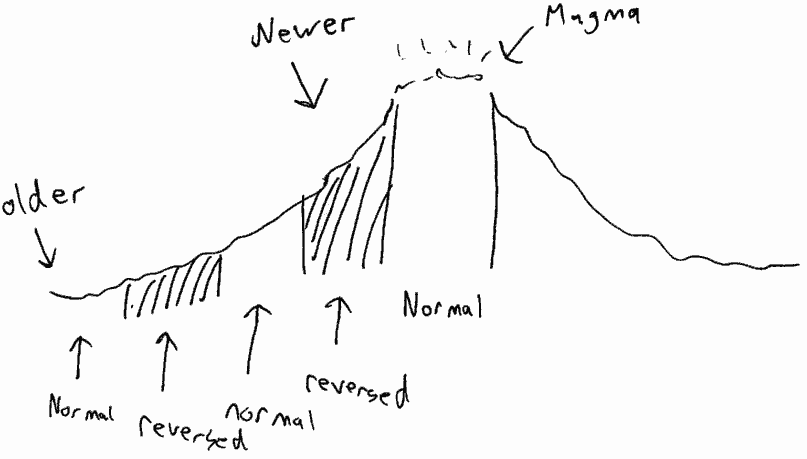
Click to enlarge, by LSATHacks
I’ve drawn a diagram to illustrate this. The newest rock and magma is in the center. This is normal polarity. Moving away from the center, the rock gets older. Some of it is reversed: that means it formed during a time when the Earth’s polarity was reversed.
Earth’s polarity switched back and forth over time, which is why there are stripes of rock with different polarities. The rock doesn’t change its polarity once it has formed.
Polarity, by the way, refers to whether Earth’s magnetic field points towards the North or South pole. Currently, our polarity is North.

Leave a Reply