
LSAT Preptest 67 LG Explanations
Full explanations for every question from the logic games section of LSAT Preptest 67.
Archived Logic Games explanations
Logic Games are no longer part of the LSAT. LSAC removed the Logic Games section beginning with the August 2024 LSAT. If you are studying for the current LSAT, you can skip this section.
These explanations remain available for students, tutors, and readers using old-format PrepTests. For current guidance, see Logic Games and the current LSAT.
Table of contents
Game 1: Speeches
Game 1 Setup
This is an explanation of the first logic game from Section III of LSAT preptest 67, the October 2012 LSAT.
Five students are delivering speeches. The five students are Manolo, Nadia, Owen, Peng and Rana (M, N, O, P, R), and the topics for the speeches are friendship and liberty (F, L).
The students have one of three majors: geology, history, or journalism (G, H, J). There are two geology majors, two history majors and one journalism major.
Game Setup
This is a grouping game, with two sets of variables. The students are grouped into making speeches on friendship and liberty. You also must assign majors to each of the students.
I read this setup a few times before drawing anything, as there were many variables to consider. If a game confuses you, it’s worth taking your time to decide on the best way to draw it. A diagram you draw while confused is a bad diagram.
I decided it was best to represent the two groups of speeches horizontally. Friendship has two slots because of the first rule:
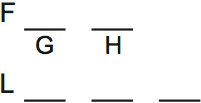
I also added in the second rule: G and H are the majors of the students making friendship speeches. The order doesn’t matter, since this is not an ordering game.
Next, it’s easy to add rules 3 and 4. I’ve drawn M floating above F, because we don’t know which major M is.
Rule four says R makes a liberty speech. Again, order doesn’t matter, so I put R directly in the first spot of L.

The fifth rule says R isn’t a Geology major, so I added that too.
Lastly, P is not a Geology major, and N is a Geology major.


I didn’t include the part about R from rule 5, as I already drew that directly on the diagram. O has no rules.
We can list majors for the other two spaces. Remember that there are two geology majors, two history major and one journalism major.
So liberty needs one G, one H and one J:
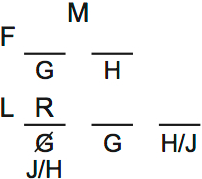
R can only be J/H since they can’t be G. G and H/J fill the other spots.
N, P and M are the most restrictive elements
This game seems pretty open ended. However, the last rule is actually pretty restrictive. (The rule about N and P)
N can only be a geology major. If she speaks on friendship, she forces M to be a history major.
Likewise, P can’t be a geology major. If P speaks on friendship, M must be a geology major.
Many of the questions use local rules to restrict where N, P and M can go.
Game 1 Main Diagram
These diagrams show the rules used to determine which speeches the students give (M, N, O, P, R), and what their majors are (G, H, J).
Refer to these diagrams when solving this game. Copy them on your own page, and on each question make a new version of them in order to follow along with my explanations. You’ll learn much more if you draw along.
The setup section explains how to build this diagram.
Main Diagram

Rules


O is random
Question 1
For list questions, apply the rules one by one to eliminate answers.
This question is a bit different, because we can’t use the first four rules. They deal with the groups, friendship and liberty. This question is about majors.
The fifth rule eliminates D. P can’t be a geology major.
The sixth rule eliminates E. N has to be a geology major, not a history major.
Another rule is in the setup paragraph: there are two geology majors, two history majors and one journalism major.
A is wrong because it has two journalism majors.
B is wrong because it has three history majors.
C is CORRECT.
Question 2
For this question, P speaks on friendship. Whenever a question gives you a new rule, think how it affects or is affected by existing rules.
P can’t be a geology major, and M always speaks on friendship. So that means M must be the geology major, and P is the history major.
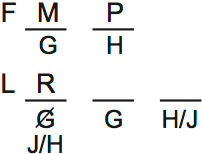
N has to speak on geology, so she takes that spot in the liberty speeches. I put O in the only spot left.
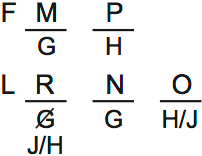
As you can see, the only points of uncertainty are R and O. They can each major in journalism or history.
This disproves A, B, C, and E.
D is CORRECT.
Question 3
First, fill in the local rule. O speaks on friendship and majors in geology. Since M always speaks on friendship, that means M must major in history.
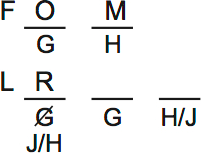
N and P are left and they will have to speak on liberty. N is a geology major (rule 6).
P and R can major in either journalism or history:
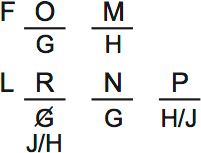
And that’s all we know. A is CORRECT. M must be a history major.
So we solved a bit more than we needed too, but it’s good practice to get all the deductions you can if they flow naturally. You never know which one will be the right answer.
Question 4
N is a geology major. So if she speaks on friendship, M must be a history major, because M always speaks on friendship:
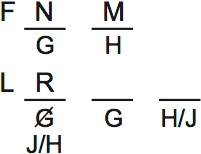
O is a geology major because P and R can’t be.
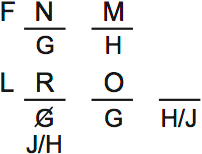
However, we didn’t need to go that far. A is CORRECT. M can’t be a geology major, so A must be false.
Question 5
All the answers on this question list two things happening. That should tell you that both things need to have a big effect for an answer to be correct.
In several wrong answers, only one of the two elements has an effect. That’s not enough to force R to be a journalism major.
For instance, D and E are wrong. We already knew that M speaks on friendship, so half of these answers add no information.
A makes M a geology major. That has little automatic effect on the setup. It just makes N a geology major in liberty. There are two history major spots left, so P can fill one without forcing R to be a journalism major.
The first part of B is good. If O is a geology major, then O and N fill both geology major spots. This forces M to be a history major:
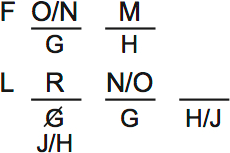
But, the second part of this answer just repeats this deduction. It says M is a history major. We already knew that, based on the first part. This answer doesn’t force R to be a journalism major.
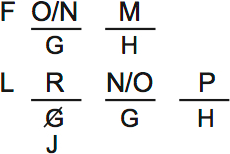
C is CORRECT. Let’s extend the diagram I made for B. If P is a history major, then they must be in L. This forces R to take the journalism major:
Game 2: Professors
Game 2 Setup
This is an explanation of the second logic game from Section III of LSAT preptest 67, the October 2012 LSAT.
Seven professors are giving guest lectures in a literary theory course. The seven professors are Powell, Shihab, Taylor, Vaughan, Wood, Young, and Zabel (P, S, T, V, W, Y, Z). The professors give their lectures in order, from first to seventh.
Game Setup
This looks like a simple linear/sequencing game, but it’s a bit complex due to the fourth and sixth rules.
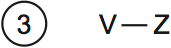
The first three rules are straightforward ordering rules, though they can’t be combined:


The fourth rule combines with the second rule. It says S can be 3rd at the latest.
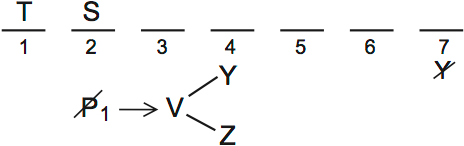
So, S can only be 2nd or third since T goes before S. I prefer to make two scenarios, one with S in third and one with S in second.
This allows you to make separate deductions for each diagram, and it takes two rules out of your head and puts them directly on the diagram.
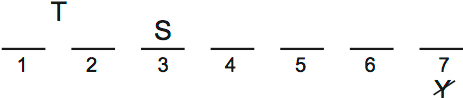

I drew the 5th rule directly on the diagram as well (Y is not last).
Instead of making two scenarios, you could draw ‘not S’ under spaces 4-7. Which option you go with is a personal choice, pick whichever feels more natural.
Remember that S can’t go later third
This rule about S going third at latest is one that you should internalize though. It’s the rule most students forget, and the reason they don’t make deductions. I keep space in my head to memorize one crucial rule for every game, and things go faster and much smoother.
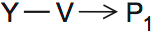
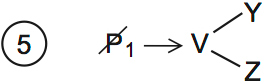
The final rule is complicated. If Y is before Z, then P is first:
Here’s the contrapositive:
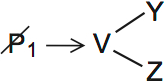
(The V-Z rule fits well on the contrapositive, so I included it as a reminder.)
Note in the second scenario, P can’t be first, so this contrapositive applies.
Game 2 Main Diagram
These diagrams show the rules used to determine the order of the professors’ lectures (P, S, T, V, W, Y, Z).
Refer to these diagrams when solving this game. Copy them on your own page, and on each question make a new version of them in order to follow along with my explanations. You’ll learn much more if you draw along.
The setup section explains how to build this diagram.
Main Diagram
Rules



Question 6
For a list question, go through the rules one by one to eliminate answers.
The first rule eliminates C. P must be before W.
The fourth rule eliminates A. S can’t be later than third.
The fifth rule eliminates D. Y can’t be seventh.
The sixth rule eliminates E. Since Y is before V, P should have been 1st.
B is CORRECT.
Question 7
S can’t lecture first, because T goes before S. So A is wrong.
B is CORRECT. This scenario shows one possibility that obeys all the rules.

W can’t lecture first, because P comes before W. So C is wrong.
D is wrong. Y can’t lecture first, because of the sixth rule. Here it is again:
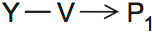
If Y is first, they are before V. So then P must be first, not Y.
E is wrong because V must be before Z.
Question 8
E is CORRECT. W can’t give the second lecture.
The first three spaces are very limited. We already have to put T-S there. And P goes before W.
So if we put W second, then P goes first and there are four lectures for the first three spaces: T-S, P-W
None of the other answers force two variables into the first three spots. Those letters only have lectures that come after, not before.
Question 9
First, draw the local rule: Z is fourth and S is second. I’ve added in the rule that T goes before S:

Then, ask yourself what other rules apply. Rule 3 says V goes before Z, so they must go 3rd.
That leaves P-W and Y to go after Z:
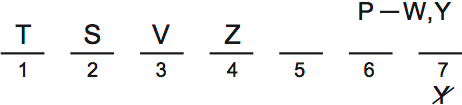
Answers B-E don’t work based on this scenario. They all violate a rule.
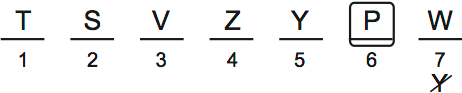
A is CORRECT. P could be sixth, as shown by this scenario. It’s one possibility that works based on the diagram above:
Question 10
E is CORRECT. V can’t go seventh because of the third rule. Z must go after V.
Question 11
First, draw the local rule:

Then ask yourself what other rules apply. V must go before Y, because P isn’t first. That’s rule 6. So V goes 2nd or 3rd.
And S must be 3rd at the latest. That’s rule 4. So V and S fill the 2nd and 3rd slots, in either order.
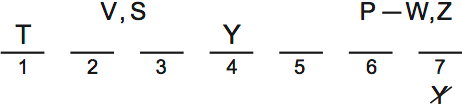
P-W and Z will fill the slots after Y.
C is CORRECT. V now has the same restriction as S, they are interchangeable in this scenario.
All the other answers are possible. The final three variables are very flexible, as long as P is before W.
(I’ve departed from the two scenarios for this diagram, because it seemed clearer. Always feel free to modify a setup if it doesn’t make sense in context)
Question 12
Place Z fourth, and then ask what other rules apply. T-S must be third at the latest (2nd and 4th rules) and V must be before Z (3rd rule).
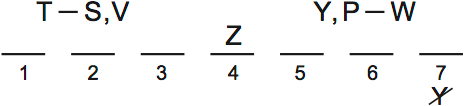
P-W and Y fill the remaining spots after Z. The only restriction is that Y can’t go last.
(As in question 11, I’ve departed from the two scenarios for this diagram.)
A and C are wrong because P-W must be after Z in this case.
B is wrong because W must come after P.
D is wrong because Y must come after Z in this case.
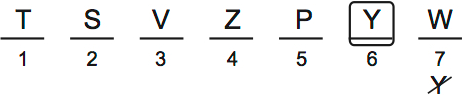
E is CORRECT, as shown by this scenario:
Game 3: Toy Aisles
Game 3 Setup
This is an explanation of the third logic game from Section III of LSAT preptest 67, the October 2012 LSAT.
A toy retailer is opening a small satellite store. There will be three aisles (1, 2, 3) and six sections: Fantasy, Hobbies, Music, Puzzles, Reading, and Science (F, H, M, P, R, S). Each aisle will have at least one section.
Game Setup
This is a grouping game with sequencing elements. I found it easiest to represent vertically. You can draw it horizontally if you prefer. These things are just a matter of taste.
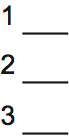
The first rule:

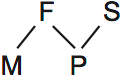
The second and third rules:
The fourth rule:
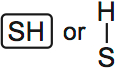
Just memorize the fourth rule
The fourth rule is harder to draw. H can be before S OR in the same group as S. That’s why you can’t just attach this to the diagram I drew with F, S, M, P.
Since it’s a hard rule to draw, I prefer to just memorize it. I try to keep space in my head for at least one rule to memorize. It makes things go much smoother.
Try it, it’s easier than you think to memorize rules. Just take 20-30 second pre-game to load them into your head and repeat them mentally.
There are no deductions to make in this game (apart from combining rules 2 and 3). Instead, you’ll have to know the rules well and apply them quickly.
If you can’t memorize the rules, then at least make a list like I’ve drawn in the main diagram section, and refer to it for each question.
Rules 2 and 3 present the main limit in this game. There are only three groups, and many questions artificially block off one group. That means that F-M&P or S-P will be split between the remaining groups.
Game 3 Main Diagram
These diagrams show the rules used to determine which aisles (1, 2, 3) sections (F, H, M, P, R, S) will appear in.
Refer to these diagrams when solving this game. Copy them on your own page, and on each question make a new version of them in order to follow along with my explanations. You’ll learn much more if you draw along.
The setup section explains how to build this diagram.
Main Diagram

Rules


Question 13
H blocks off the first group. The second rule says F goes ahead of M and P. So That means that F goes 2nd and M and P go third.
The third rule says S goes ahead of P, so S is also second.
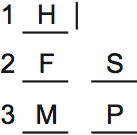
That’s all we know. R can go in either group, their rules are satisfied either way.
D is CORRECT.
Question 14
P blocks off the third group. That means that F has to go first and M has to go second (second rule):
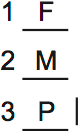
This is a routine deduction. When a question gives you a local rule, you should run through your main rules and see which of them are affected.
That’s all we can deduce for this question. Fortunately, it answers the question.
A is CORRECT.
Question 15
This is an unusual question. You may have felt paralyzed at first. There seem to be many possibilities, it’s hard to figure out what must be true.
Here’s the trick. The question tells you that S must be in the same aisle as one other variable. So all you have to do is make a scenario that obeys the rules.
Whoever you place S with is the variable they must be beside, because any scenario would place S with that same variable.
This question has given you prior knowledge that S can only be with one person on this question. That’s rare on logic games.
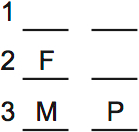
Here’s the first scenario I tried. I put F second, and MP third (rule 2):
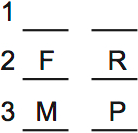
Then I put R with F (rule 1)
Then I put HS first (rules 3 and 4)
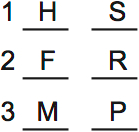
This diagram obeys every rule. B is CORRECT.
Question 16
This question tests your understanding of how the rules interact.
The possibilities in the answers are: H, M, R, and S
You could try drawing all of them. But it’s best to decide which are hard to place in the middle.
If you’re unsure about these explanations, try drawing the diagrams yourself, and including the rules that apply. For example, place S in them middle, and put H above S.
Ok, let’s talk about those four letters. R and S are easy to include in the middle. R can go anywhere as long as it is with F or M.
S has to be above P and at the same level or below H, so the middle is a natural place for S.
Likewise, M only has to be below F, so the middle is a normal place for M.
H is difficult to place in the middle. If H does go in the middle, they must go with S.
Why? Rule 4 says S must go below H or be in the same group. S can’t go third because rule 3 says S is before P.
So is H is middle, then S has no option but to go with H.
A is CORRECT. For the reasons above, H and M can’t be the only ones together in the middle. H has to go with S if H is in the middle.
Question 17
As with all other local rules, you must check which of the rules relates to S.
S comes before P, so P is last (rule 3):
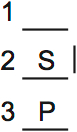
F comes before P (rule 2), so F comes first. There is no space in group two; the question says S is the only one there.
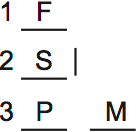
F comes before M (rule 2) so M goes in group three.
H must go first, due to rule three. There is no space for H to go with S in group two, due to this question’s restrictions.
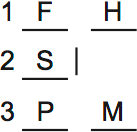
R can go either first or third. Either order meets the conditions of the first rule.
E is CORRECT.
Game 4: Zones
Game 4 Setup
This is an explanation of the fourth logic game from Section III of LSAT Preptest 67, the October 2012 LSAT.
There are three newly developed zones (1, 2, 3) in Milville. You can place subzones – housing, industrial, retail (H, I, R) – in each zone. You can only make designate up three subzones of each type.
Game Setup
If you found this game very hard, don’t worry: you’re not alone. This game truly confused many LSAT students.
I’ve thought about it, and decided it’s mainly a problem of language. Zones, subzones, designate? What the hell are those?!
Well, here are the three zones:

That’s not so complicated. They’re really just the places you out variables. That’s something you’ve seen on dozens of other games.
‘Subzones’ are just the variables. Here’s an example of the zones with some subzones filled in:
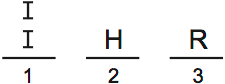
There are no limits to the number of subzones you can put in a zone, except those limits which we’ll see in the rules.
Zones are just groups, subzones are just normal letters
I won’t be using zones/subzones again for the rest of the walkthrough. I feel they make this game unnecessarily complicated. The Zones are just groups! And the subzones are just normal letter you put in groups. I’ll call them variables.
In some ways, this game has few restrictions. There are no rules that force you to place any variables in the diagram. A completely blank diagram is acceptable!
All the answers depend on catching violations of the game’s four listed rules, and the restriction that you can have at most three of R, H or I.
The first rule is simple. R can’t go first.
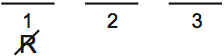
The rest of the rules are a bit unique. There’s no standard way to draw them, so you can just make up whatever drawing works best.
I often use the word ‘max’ in these situations. The specific form you choose doesn’t matter, as long as the rules are clear. Standard diagrams are only important for rule types that repeat.
Here are rules 2-4, as I drew them:



Here are the contrapositives of rule 3 and 4. I don’t normally draw these when doing games myself, but if you haven’t yet mastered seeing contrapositives in your head, you should draw contrapositives for rules.


That’s it. There’s no way to make deductions. Instead, you should make a clear list of the rules, and commit them to memory if possible.
Game 4 Main Diagram
These diagrams show the rules used to determine how to place subzones (H, I, R) within the three zones (1, 2, 3).
Refer to these diagrams when solving this game. Copy them on your own page, and on each question make a new version of them in order to follow along with my explanations. You’ll learn much more if you draw along.
The setup section explains how to build this diagram.
Main Diagram
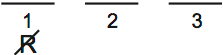
Rules
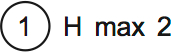
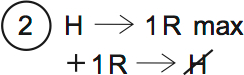
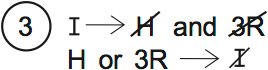
(If you’re comfortable with contrapositives, you only have to draw the first half of 2 and 3.)
Question 18
For list questions, use the rules to eliminate answers one at a time.
The third rule eliminates A. H can’t go with more than 1R.
The fourth rule eliminates B. H and I can’t go together.
The first rule eliminates C. R can’t go in group 1.
The second rule eliminates D. There can only be max 2H in a group.
E is CORRECT.
Question 19
There’s no obvious answer for a must be false question that has no local rule.
Don’t get bogged down considering each answer. You should read through them all first, and start with the 1-2 answers that seem most restricted.
Answers A-C violate no rules. They were unlikely candidates to be correct, since they use small quantities.
D and E are most likely, as they have four variables.
E is fine though. Only rule 4 restricts retail and industrial going together: you can’t have 3R with any I’s. 2R is fine though. You could even have 3I and 2R in the same group.
D is CORRECT, because of rules 2 and 3.
rule 2: We can have at most 2H in a group.
rule 3: When there is H, we can only have 1R.
There are no I’s in this answer choice. Since we’re stuck with only H and R, we can have three of them at most: 2H and 1R.
Question 20
Approach this question with the mindset that you want to put as many variables in as you can.
Unless a rule tells you not to put in a variable, you can put it in.
H and R don’t mix very well (rules 1 and 2). And rule 4 says H’s and I’s can’t mix at all.
So R and I are the best candidates.
Rule 4 says that you can have at most 2R in a group that has I. We can include 3I, as you can always do that unless a question says otherwise.
So you can have 2R and 3I = 5
D is CORRECT.
Question 21
There aren’t many possibilities when we have all nine variables included.
Remember, R can’t go in group 1 (first rule).
We also can’t have three houses together. But we can’t put three houses across all three groups, because H’s and I’s can’t mix.
So we need to put 2H and 1H in two groups. We’d better put at least some of them in group 1, because having H in a group restricts R (rule 3).
R is already blocked from group 1, so putting H there adds no further restriction.
I’m going to build a diagram with 2H in group 1 for now:
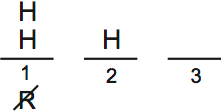
Since I’s can’t go with H’s, we have to put all 3I in group 3.
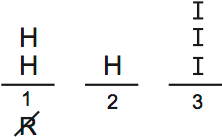
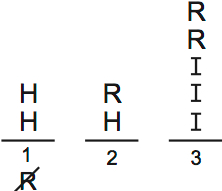
We can put at most 2R with the 3I (rule 4), and at most 1R with any of the H (rule 3).
R can’t go in group 1. So we end up with this diagram:
The only possible alternative would be to put 2H in group 2 rather than group 1:
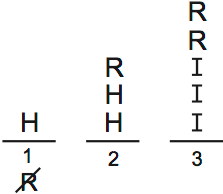
So the answer will involve H and how we place them.
B is CORRECT. 2H could go in group 2.
Question 22
Having an I in each group restricts things quite heavily.
First, there are no H in this scenario. H’s and I’s can’t go together (rule 4). This eliminates B.
Second, there can be at most 2R in any group in this scenario. I’s and 3R can’t go together (rule 4). This eliminates E.
Third, this means that the only possible variables left to place are 3R, split between groups two and three. There are a total of six variables in this question, at most.
(Note that we don’t need to place any R: it’s possible to place no variables in this game.)
Here’s our base scenario:
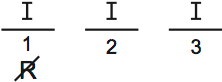
A is CORRECT. Here’s how it looks:
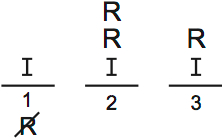
C is wrong because R can’t go in group one. So there’s no way to put anything there apart from the single I we already have.
D is wrong because there are only 3R left to place in those two groups. We have a max of five variables to put in groups 2 and 3.
Question 23
This question says we use 3R, and there is an H in group 2.
The H in group 2 restricts where we can place our three R. We can put at most 1R there (rule 3)
And we can’t place R in group 1 (rule 1). So either we place 1R in group 2 and 2R in group 3, or we place all 3R in group 3:
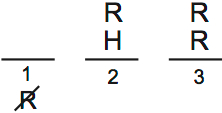
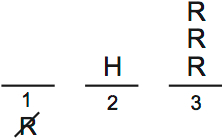
Remember that we don’t have to place other letters. We don’t have to place any I’s, for example.
We could place I’s, but we don’t have to. This is not a game where every variable has to be used, or where every group must be filled.
There’s nothing stopping us from putting 2H in group 1. A is CORRECT.
B is wrong because no I’s can go in group 2, since H is there (rule 4)
C is wrong because there can only be 1R in group 2, since H is there (rule 3)
D is wrong because we’re including 3R, and R can’t go in group 1. So there’s no way to put 1R in both groups 2 and 3. One group has an odd number.
E is wrong because if H were in group 3, then we could only have 1R there. We wouldn’t have space to put 3R.

Leave a Reply