
LSAT Preptest 72 LG Explanations
Full explanations for every question from the logic games section of LSAT Preptest 72.
Archived Logic Games explanations
Logic Games are no longer part of the LSAT. LSAC removed the Logic Games section beginning with the August 2024 LSAT. If you are studying for the current LSAT, you can skip this section.
These explanations remain available for students, tutors, and readers using old-format PrepTests. For current guidance, see Logic Games and the current LSAT.
Table of contents
Game 1: Radio Station
Game 1 Setup
This is an explanation of the first logic game from Section IV of LSAT Preptest 72, the June 2014 LSAT.
Every morning, a radio station airs hourly news updates. There are two segments (1, 2) and a total of five reports during each update. There are two general interest reports: international and national (I, N); and three local interest reports: sports, traffic and weather (S, T, W). You must use the rules to determine the possible placements of the reports.
Game Setup
This game tests your ability to apply the rules and make deductions on the spot. There are a few very restricted points in this game. If you know the rules + these restricted points, you can do this game very, very fast. I did it in less than five minutes.
If you don’t know the rules, it will be a slow, hard game. You should always try to memorize the rules before you start, and look to see what points have more restrictions than others.
For example, the first and last points are restricted. First is restricted because N always goes first. Last is restricted because S always goes last. We’ll see this in the rules below.
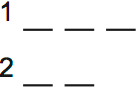
First, we need to figure out how to draw the two news updates. I looked at the first question to see how the testmakers represented this game and I decided this was the best way:
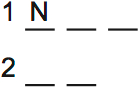
Next, I read all the rules. I decided to draw the fourth rule first. We know national is always first within its group. So there are two options. National in group 1, and national in group 2:
Scenario 1
Scenario 2

On the second diagram, International must be in group 1. That’s because each group needs at least one segment of local interest (rule 3), and International/National are both general. I’ve drawn International up and to the right in scenario 2 as a reminder of this deduction.
Drawing these two scenarios may seem like a small, obvious deduction, but it greatly simplifies the game.
Next, I drew the two remaining rules on their own. Sports is always last in its group, and if international and weather are in the same group, then international is before weather:


Finally, Traffic has no rules:

Restricted spaces determine this game
It’s important to pay attention to the restricted spaces. Many questions place a variable in last place; for example, question two places traffic last in the first segment.
If traffic is last in one group, then sports must be last in the other group – because sports always has to be last. This is a huge deduction, and it applies to any scenario where a question places someone last (that isn’t sports).
This game is very open ended in the setup, but it’s made in such a way that it becomes very restricted once one of the first or last spots is filled. Since national is always first in its group, then if someone fills the first spot in one group, you know national is first in the other group.
It’s important that you memorize a few things:
- Who is general (I, N) and who is local (T, W, S)
- Who must go last: S
- Who must go first: N
- The rule about I before W
If you know these four things, the game is incredibly easy. If you struggled with it, I suspect you didn’t know all four as well as you should.
Game 1 Main Diagram
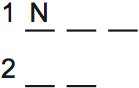
These diagrams show the rules used to determine the possible placements of the local and general news reports (I, N, S, T, W) between the two segments (1, 2).
Refer to these diagrams when solving this game. Copy them on your own page, and on each question make a new version of them in order to follow along with my explanations. You’ll learn much more if you draw along.
The setup section explains how to build this diagram.
Main Diagram
Scenario 1
Scenario 2
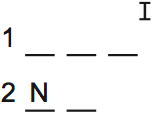
Note: Scenario 2 has International above and to the right of group one as a reminder that International can’t go in group 2. Rule 3 says each group needs at least one report of local interest. National and International are both general.
Rules
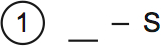


Question 1
For acceptable order questions, go through the rules and use them to eliminate answers one by one.
Rule 3 eliminates E. Segment two needs a report of local interest.
Rule 4 eliminates A. National is the longest report in its segment.
Rule 5 eliminates C. Sports is always the shortest segment in its group.
Rule 6 eliminates D. International is earlier than weather if they’re in the same group.
B is CORRECT. It violates no rules.
Question 2
This question places the traffic report last, in the first segment. First, draw that:
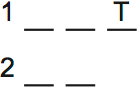
Then, think about who must go last. S must go last. So that means S goes last in group 2:
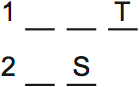
Whenever you make a deduction, you should check if it’s the answer. It is. E is CORRECT.
Question 3
This question says national is last in the second segment. That’s scenario 2 from our setup:
International has to be in group 1, because the second segment needs a report of local interest. National and International are both general.
The question is asking how many people can go first in the first group. It’s best to go by elimination.
- National can’t go first, because it’s in the second group on this question.
- Sports also can’t go first, because it’s always last in its group.
That leaves: traffic, international and weather.
Weather can’t go first in the first group, because weather is always after international.
So only traffic and international are left. They have no restrictions about going first, so that this point I’d be comfortable picking B: two.
But just to be safe, I”ll draw two scenarios that prove each can go first. If you know your rules, it should take less than ten second to draw each scenario. If you can’t draw these quickly, you need to practice. Drawing rapid, correct diagrams is an essential games skill.
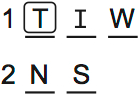
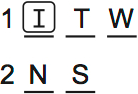
These two diagrams prove that both international and traffic can go first in the first segment.
So B is CORRECT.
Question 4
This question asks what CANNOT be true. You should use past scenarios to eliminate answers. Anything that worked on another question can be true.
A and C were possible on question 3. They’re both in this scenario:

B happened in the right answer on the first question.
D is CORRECT. Weather can’t go first in group 1. I’ll explain why this can’t happen. National is the other report that has to go first, so it’s the restricting factor.
We’re trying to place weather first in group 1, so we’d have to place national in group 2. That was scenario 2 in our setup:
By placing national in group 2, we must place international in group 1. That’s because rule 3 says every group needs a report of local interest, and N/I are both general.
So weather and international are both in group 1. And rule six says International is before weather if they’re in the same group.
This answer proves E is possible and therefore incorrect:

Question 5
This question asks us which answer will fully determine the order of the reports.
I didn’t know how to approach this question. But I looked through the answers to see which ones were harder to do.
I’ll explain what I mean by harder. The rules says sports has to be last, for example. So if an answer places sports last (like D does) then that answer is satisfying a rule, and therefore it is easy to do.
An answer like E is a bit harder, because it places something last that isn’t sports.
B and C are not hard, because they both place national first, and national has to be first.
A is hard. The rules say international is before weather. So if international is last in the first group, then weather must not be in the first group. Also, since Sports must go last, placing international last forces Sports into the second group.
So using two separate rules to measure this answer choice, A is hard.
(The rules are: “S last” and “I before W”.)
Applying the hard/easy test, we’re down to A and E to try first. Let’s try A. I’m going to draw it step by step:
Place international last in group 1:
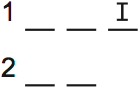
This forces Sports to be last in group 2:
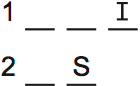
Weather also has to be in group 2, since weather has to go after international if they’re in the same group:
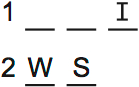
National always has to go first, so national goes in group 1:
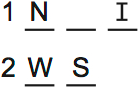
This leaves T to go second in group 1:
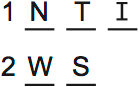
So, A is CORRECT; placing International last in group 1 determines the entire order.
But let’s make sure that E doesn’t also fully determine everything. I do check the other plausible answer just to make sure I didn’t make a mistake.
Placing weather last in the first segment does force Sports to be last in the second segment:
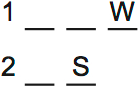
But that’s all we get. We can put international, traffic and national wherever we want, as long as we put national first in the group it’s in. There are no rules restricting traffic and international now that weather is last. In fact, placing weather last means that answer E is partly an “easy” answer to do.
If I correctly predict hard answers and think one solves the question, then I don’t test the other answers. There’s no need.
I already partly tested them by checking that they obeyed a rule. There’s never going to be a crazy, Rube-Golberg-esque reason why obeying a rule forces everything else to fall into place.
Question 6
This question places traffic first in the first segment. You should draw that:
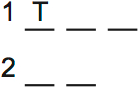
Next, ask yourself how this affects the existing rules. In the setup, we saw that national has to be first. So if national isn’t first in group 1, it must be first in group 2:
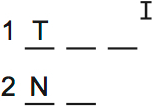
I’ve also drawn International in group 1. We saw this in the setup, though I’ll remind you again why this has to happen: rule 3 says that each segment needs a local report. National and International are both general. So they can’t both go in group 1.
There’s nothing else that must be true in this scenario. So at this point, you should stop and eliminate a few answers that contradict the diagram. Any answer that can’t be true on the diagram is wrong.
The diagram contradicts A–D! None of them are possible on our diagram. This is why I always draw a diagram of what must be true – typically this eliminates all or almost all of the wrong answers.
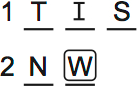
(There’s only one answer that might not seem obviously wrong: C. The reason weather can’t go second in the first segment is because weather has to be after international. If weather is in group 1, then the order it T – I – W.)
This diagram proves that E is CORRECT.
Game 2: Five Houses
Game 2 Setup
This is an explanation of the second logic game from Section IV of LSAT Preptest 72, the June 2014 LSAT.
A realtor will show five houses to a client in a single day. Each house will be only shown. The houses are from five different neighborhoods: Quarry, Riverton, Shelburne, Townsend, and Valencia (Q, R, S, T, V). You must determine the orders in which the houses can be shown based on the rules.
Game Setup
This game is unusual in that you can draw four scenarios that cover absolutely every possibility. This used to be common on older games, but I don’t see it much on new games.
Typically, I don’t draw more than two scenarios, because the possibilities are too open ended. But in this case, the four scenarios were very, very useful.
When I made them it was obvious the game was quite restricted, that’s why I drew more than four. When I redid this game I timed myself, and with the scenarios I finished in 3 minutes 30 seconds!
Let’s talk about how to draw the scenarios. You need a good grasp of the rules and how they interact.
- R is first or second.
- T is first or fifth
So if R is first, T is fifth. And if T is first, R is second. That’s one major restriction. Next major rule:
- Q or V is third
Again, a major restriction. If one isn’t third, the other is. Final major restriction:
- Q cannot be beside S.
This often determines whether Q or V is third.
Look over those rules to make sure you know them. Now, let’s make some scenarios, using R and T as limiting factors. The first scenario has R first. The second third scenarios have R second and T fifth. The fourth scenario has T first.
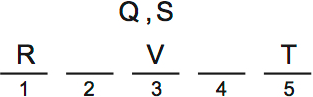
Scenario 1: R first, T fifth

Next, we need to place Q, S and V. Q can’t be third, because then it would be beside S no matter where S went.
So V is third, and Q/S are split between second and fourth:
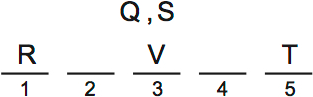
(Q, S comma indicates they fill the remaining slots and are reversible. I often prefer this to drawing Q/S)
Scenario 2: R second, T fifth, Q third
If R is second, there are two possibilities: T first or T fifth. This scenario is T fifth.

Next, either Q or V can be third. For this scenario, we’ll put Q third

Q and S can’t be together, so this means S is first and V is fourth.

Scenario 3: R second, T fifth, V third
If R is second, there are two possibilities: T first or T fifth. This scenario is T fifth.

In scenario 2, we placed Q third. In this scenario, we’ll place V third (either Q or V has to go third):

Now Q and S are interchangeable:

Note: I’ve drawn the interchangeability differently than I did in scenario 1. For some reason, the Q/S method felt more natural here. Choose whichever method you like, they mean the same thing.
Scenario 4: R second, T first
If R is second, there are two possibilities: T first or T fifth. We already drew the two T fifth scenarios. This scenario is T first.

Now we have to place Q, V and S. Q or V has to go third. We can’t put V third, because then QS would be in fourth and fifth, and they can’t go beside each other.
So Q is third, V is fourth and S is fifth:

Those are all the scenarios. If any of them don’t make sense, reread the rules, and try drawing them yourself. Probably you’ve missed one of the rules.
The key to logic games is that everything happens for a reason, and the rules are the reason. To truly understand a game you must know the rules like the back of your hand.
Mind you, it’s a good idea to try building the four scenarios yourself anyway, even if you understand them. These scenarios are excellent practice for the kind of sequential deductions that are tested again and again on logic games.
Note: On the questions, I’ll expect you to be aware of the four scenarios. I’ve listed them more close together in the main diagram section. I’ll reference scenarios in the questions by number.
Game 2 Main Diagram
These scenarios show the possible orders in which the houses from the five neighborhoods (Q, R, S, T, V) can be shown.
Refer to these diagrams when solving this game. Copy them on your own page, and on each question make a new version of them in order to follow along with my explanations. You’ll learn much more if you draw along.
The setup section explains how to build this diagram.
Main Diagram
Scenario 1
Scenario 2

Scenario 3

Scenario 4

Note: draw these scenarios yourself before reading the explanations, and make sure you understand them. I’ll be referencing them by number in the explanations for the questions. If you not sure how I made one of the scenarios, go back to the setup section.
Question 7
Unusually, this first question is not an “acceptable order” question. Whenever that happens, it’s a strong sign you were supposed to make upfront deductions.
Quarry can be fourth in scenarios 1 and 3. Here they are:
Scenario 1
Scenario 3

You can use these scenarios to eliminate answers. Any answer that doesn’t have to be true in both scenarios is wrong.
Scenario 3 eliminates A, C and D.
Scenario 1 eliminates B.
E is CORRECT.
Question 8
This question asks what answer fully determines the order. I used the scenarios to eliminate answers. For example, A asks whether placing Quarry third determines everything.
Q can be third in both scenarios 2 and 4. So clearly, placing Q third doesn’t determine everything, as those two scenarios are different. A is not right.
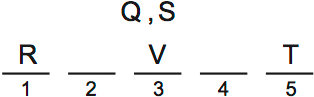
B is also wrong. R is first in the first scenario, yet there are two possibilities: Q and S are interchangeable between second and first:
Scenario 1
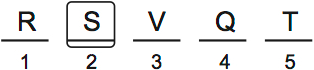
C is CORRECT. S can be second only in the first scenario. And if S is second, Q is fourth, so everything else is determined:
D is wrong. T can be fifth in the 1st, 2nd and 3rd scenarios.
E is wrong. V can be fourth in both the 2nd and 4th scenarios.
Remember, an answer is wrong if there are multiple possibilities. That means the placement in the answer doesn’t completely determine the order.
Question 9
This question says S is earlier than Q. You should check what scenarios this is possible in. Scenarios 1, 2 and 3 allow S to be earlier than Q:
Scenario 1
Scenario 2

Scenario 3

This question says S is before Q. So really the three scenarios look like this:
Scenario 1

Scenario 2
Scenario 3

Now you’re looking for what must be true in all scenarios. Let’s eliminate answers.
Scenario 2 disproves A. Q isn’t fourth in that scenario.
Scenario 1 disproves B. R is not second in that scenario.
Scenario 1 disproves C. S is not first in that scenario.
D is CORRECT. T must be last in all three scenarios.
Scenario 2 disproves E. V is fourth in that scenario.
Question 10
This is a could be true question. One answer will be possible in at least one scenario. The other four answers will be impossible in all four scenarios.
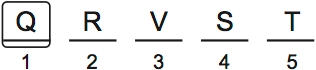
A is CORRECT. Q can be first in scenario 3:
B-E are impossible in all scenarios. If you look at the four scenarios, it’s clearly impossible to do any of the last four answers. I’ll give a bit more detail though. I’ll expect you to know the rules to follow how I’m making deduction on these answers.
B: Placing Q fifth forces T first, and R second (rules 1 and 3). V has to go third because V or Q goes third. That leaves S to go fourth, beside Q, which isn’t allowed (rule 4).
C: If V is first, R is second and T if fifth (rules 1 and 2). Q has to go third because one of V/Q goes third. That leaves S to go fourth, beside Q, which isn’t allowed (rule 4).
D: If V is second, Q is third (rule 3) and R is 1 (rule 1). This forces T fifth (rule 2). That leave S to go third, beside Q, which isn’t allowed (rule 4).
E: If V is fifth, T is first (rule 2). That makes R second (rule 1). Q is third (rule 3). That leaves S to go fourth, beside Q, which isn’t allowed (rule 4).
If you’re not clear on any of these answers, review the four scenarios from the main diagram section, and reread the rules. Then try to draw the answer yourself. These answers are excellent practice for the kind of sequential deductions that logic games ask you to make.
Question 11
This question asks what must be true if V is third. V is third only in scenarios 1 and 3. We’re looking for something that must be true, so you need to find something that doesn’t change.
R, Q and S can all change places between the two scenarios. Only T doesn’t change: it’s always fifth.
E is CORRECT.
Question 12
Rule substitution questions are harder than other questions, but they’re not as hard as you think. The key is to eliminate silly answers. Remember, four of the answers are wrong. You don’t have to give them any respect. They’re mostly stupid answers. Your goal should be to prove they’re stupid.
An answer can be wrong for two reasons on a rule substitution question:
- It allows something not allowed under the normal rules.
- It restricts something allowed under the normal rules.
I go through each answer and try to disprove it, applying those tests. If an answer seems plausible and doesn’t violate either test, then I keep it as a contender. Once I’ve eliminated some answers, I can test the remaining answers more thoroughly.
A isn’t restrictive enough. It only blocks R from being fourth, and therefore it allows this scenario:

(It’s wrong, because R can’t be fifth normally.)
B seems plausible. Let’s skip it.
C describes something that has to be true (V is always 3rd or 4th), but that’s not what we’re looking for. We want a rule that matches the effects of the original rule, but this new rule allows this possibility:
V is third (like the rule says), but R is fifth, which isn’t allowed.
D isn’t true. In the 1st scenario, Q doesn’t have to be beside R: Q can be fourth. So this answers prevents possibilities that are normally allowed.
E allows possibilities that normally aren’t allowed, like this:

T is shown fifth, so the rule in E is obeyed. But R is no longer 1st or 2nd.
So let’s look at B again. It says that R must be earlier than V. If you look over all four scenarios, you’ll see that V can only be 3rd or 4th.
If V is 3rd, then R must be 1st or 2nd. This obeys the old rule.
If V is fourth, the Q must be 3rd, since Q or V always has to be third (rule 3). So this means that once again R must be 1st or 2nd to be earlier than V.
Therefore, the rule is replaced either way. B is CORRECT.
Game 3: Artifacts
Game 3 Setup
This is an explanation of the third logic game from Section IV of LSAT Preptest 72, the June 2014 LSAT.
Five artifacts (V, W, X, Y, Z) originated in Iceland, Norway, or Sweden (I, N, S). The artifacts were recovered from a sunken ship. You must determine the possible country origins of the artifacts.
Game Setup
This is a rules based game. If you know the rules like the back of your hand, this game is easy. If you struggle to remember the rules, this game is hard.
The key to most modern games is to slow down on the setup, and memorize the rules. If you know all the rules, you’ll go much faster through the questions.
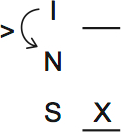
There are three groups in this game: Iceland, Norway and Sweden. The first question shows you the best way to set them up:

These are three vertical groups. There are no lines beside them for artifacts, because it’s possible for a country to have no artifacts.
I drew the third rule first. We need more artifacts in Iceland than Norway:
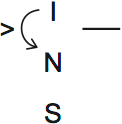
The arrow and the “greater-than” sign are an improvised reminder of this. Note that now we also need at least one artifact in Iceland, so I’ve drawn a line there for that artifact.
I then drew the second rule directly on the diagram. X is from Norway or Sweden. I put this in two scenarios:
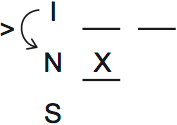
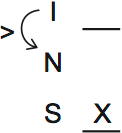
In the first scenario, Iceland must have at least two artifacts, due to rule 3.
Note that Norway can have at most two artifacts (in either scenario), in which case Iceland would have three.
Often, drawing dual scenarios leads to extra deductions. In this game, there were no new deductions. However, I do find the dual scenarios are useful for a few reasons:
- They serve as a reminder of the rule about X’s origin.
- They make it easier to visualize possibilities while looking at them.
- They remove one rule from the list of rules.
I find removing one rule from the list of rules significantly simplifies the game. The more rules you have directly on the diagram, the easier it is to remember the remaining rules.
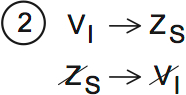
Next, there are two rules that can’t be added to the diagram. WY must be together, and if V is in Iceland, then Z is in Sweden:


If you ever make a mistake with contrapositives, you should also draw the contrapositive of the rule:

However, once you master contrapositives at an intuitive level, you no longer need to draw them.
There’s no major deductions on this setup. So you should memorize the rules before moving on, as the game is going to test you on your mastery of the rules.
Game 3 Main Diagram
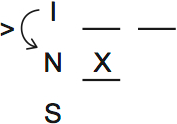
These diagrams show the rules used to determine the country of origin (I, N, S) of the five artifacts (V, W, X, Y, Z).
Refer to these diagrams when solving this game. Copy them on your own page, and on each question make a new version of them in order to follow along with my explanations. You’ll learn much more if you draw along.
The setup section explains how to build this diagram.
Main Diagram
Rules

Question 13
For acceptable order questions, go through the rules and use them to eliminate answers one by one.
Rule 1 eliminates A. W and Y must come from the same country.
Rule 2 eliminates E. X has to come from Norway or Sweden.
Rule 3 eliminates C. Iceland needs to have more articles than Norway.
Rule 4 eliminates D. If Iceland has V, then Sweden must have Z.
B is CORRECT. It violates no rules.
Question 14
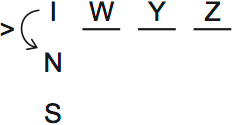
First, you should draw the local rule. Y and Z originated in Iceland. Actually, this means that WYZ came from Iceland, because WY are always together:
The question is asking for the minimum number of artifacts that come from Sweden. Let’s see if we can do zero. VX are the remaining artifacts. Can we put them both in Norway?:
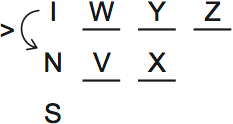
There’s nothing wrong with doing this. It violates no rules. So it’s possible zero artifacts originated in Sweden. A is CORRECT.
Remember, if a diagram doesn’t violate any rules, it’s allowed.
Question 15
This question asks what cannot be true. You want to look for answers that are hard to do. By “hard” I mean answers that make it harder to obey a rule. “Easy” answers are those that obey a rule.
For instance, A is hard because it places two artifacts in Norway (meaning we’d need three in Iceland) but easy because it places X in Norway (obeying rule 2).
B and C are easy because they place at least two artifacts in Iceland. That helps obey rule 3 (Iceland has more than Norway).
D makes things easy because it meets the necessary condition of rule 4. Since Z originated in Sweden, it now doesn’t matter where V goes.
E is places two artifacts in Norway. This means we’d need three in Iceland (rule 3). That’s hard. E also doesn’t place X in Norway. So to obey rule 2 we’d have to put X in Sweden.
That means only Z and V are left to go in Iceland. So we don’t have enough to put more in Iceland than Norway, and E is CORRECT. (Actually, it’s not even possible to put both Z and V in Iceland, due to rule 4).
So there should be a method to your madness on CANNOT be true questions. Ask if an answer obeys a rule (easy) or makes a rule harder to obey.
I said A was hard too, so let’s disprove it. It’s true that A puts two artifacts in Norway. But it’s definitely possible to put the remaining three artifacts in Iceland. Matter of fact, we saw this diagram in question 14:
When I did this question on timed conditions I followed the exact same process. I kept A, I fast-eliminated B, C and D, and then I saw E was hard so I tried it. E worked, then I eliminated A to make sure. Didn’t take long because I didn’t pay much attention to the answers that seemed easy.
Question 16
This question says that W and X originated in Sweden. Actually, this means that WYX originated in Sweden, since W and Y always go together:
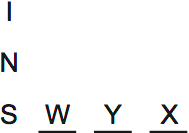
The next most restrictive rule is that Iceland must have more than Norway. And there are only two artifacts left to place.
If we place one artifact in Iceland and one in Norway, they’ll each have an equal number of artifacts.
So we can’t put any artifacts in Norway. We have to put either V or Z in Iceland, and the other will go in Sweden.
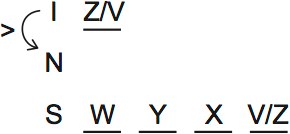
(V and Z can’t both go in Iceland because of rule 4)
A is CORRECT.
Question 17
I looked at past questions to answer this. This diagram from question 14 proves that V and X can originate in Norway:
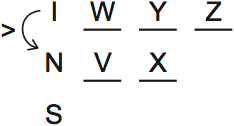
The right answer to question 15 shows that neither W nor Y can originate in Norway.
This is because WY always go together. That means there are two in Norway, so we’d need three in Iceland. But X has to go in Norway or Sweden, so there aren’t three artifacts to originate in Iceland if WY are in Norway.
If that didn’t make sense, look carefully at the rules and try to draw WY in Norway without violating a rule. You can’t.
Only Z is left. Can Z go in Norway? This diagram proves that it can:
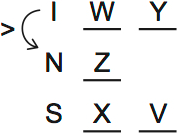
C is CORRECT. X, V and Z can go in Norway.
Question 18
On question 15, I talked about using a hard/easy test to judge which answers to try first on CANNOT be true questions.
“Hard” is an answer that doesn’t work with a rule and makes it harder to obey a rule. “Easy” is an answer that conforms with a rule.
For instance, putting V in Iceland is “hard”. That’s because it restricts the game by forcing Z into Sweden. So not putting V with Iceland is “easy” because it removes a potential restriction.
Therefore A is easy. We should skip it and try other answers.
B and C are a mix. B does remove the fourth rule (because V isn’t in Iceland). And C does place WY together.
But on the other hand, both answers force X to be in Norway, because X isn’t in Sweden (rule 2), and they both take up two artifacts, so that makes it harder to put more artifacts in Iceland than Norway. We should try both answers.
D is easy. It complies with rule 2 (X in Norway or Sweden) and with rule 4 (Z is in Sweden, so now it doesn’t matter where V goes).
E seems hard because it has four artifacts in Sweden, but there’s nothing wrong with it. We can just put Z in Iceland:
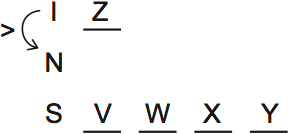
This obeys all the rules. So let’s try B and C.
This diagram shows B is possible:
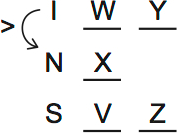
C is CORRECT. If only WY are in Sweden, X must go in Norway:
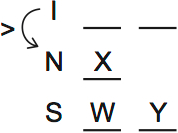
Now, we need to place more artifacts in Iceland than in Norway (rule 3). Only V and Z are left. But they can’t both go in Iceland, because of rule 4. If V is in Iceland, Z goes to Sweden. So C is impossible.
Note: it took a lot of writing to judge whether all five answers were “easy” or “hard”. But that’s because it takes a lot of words to explain things out loud. If you know the rules, you can see these answers as hard/easy almost instantly.
It’s that process I’d like you to try to practice. Ask if answers answers conform with a rule, or make it harder to obey a rule?.
Game 4: Workpieces
Game 4 Setup
This is an explanation of the fourth logic game from Section IV of LSAT Preptest 72, the June 2014 LSAT.
Four company employees (J, K, L, M) work from Monday to Thursday (1, 2, 3, 4). Each of them starts to work on a raw workpiece on Monday and then transfer it to another employee each day for the next three days. You need to determine the possible transfers based on the given conditions.
Game Setup
This is an unusual game. I’ve never seen one quite like this.
However, the principles underlying this game are not different from other logic games. I was able to finish it quite quickly.
If you had trouble with this game, I recommend two steps:
- Try some older games. They’re different, but the principles are similar. That means they’re good practice for testing your ability to handle unfamiliar games.
- Repeat games. You want an intuition for the patterns in games. That’s what will let you solve unique games like this.
What are the principles underlying this game? Two main ones:
- Knowing the rules.
- Seeing the most restricted point.
The most restricted point is J. L and K can’t transfer to J. So only M can, and therefore M must transfer to J every turn.
It turns out the four rounds don’t matter. This game is all about seeing what’s possible within a single round.
Here’s the diagram I made. I did draw the four rounds, but they’re not important.
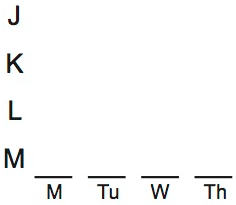
Here’s the main diagram with the rules added. The arrows with a cross indicate a transfer is impossible between those two variables:
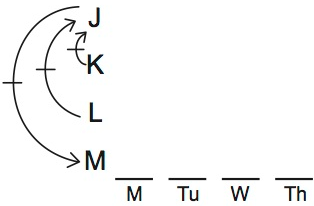
I just looked at this diagram for every question. There’s not really much more to this game, as long as you notice that M has to transfer to J every round.
Game 4 Main Diagram
These diagrams show the rules used to determine the possible orders of the transfer of the workpieces to each employee (J, K, L, M).
Refer to these diagrams when solving this game. Copy them on your own page, and on each question make a new version of them in order to follow along with my explanations. You’ll learn much more if you draw along.
The setup section explains how to build this diagram.
Main Diagram
Question 19
For acceptable order questions, go through the rules and use them to eliminate answers one by one.
Rule 1 eliminates E. J can’t transfer to M
Rule 2 eliminates D. K can’t transfer to J.
Rule 3 eliminates C. L can’t transfer to J.
You have to do a bit of work to choose between A and B. Everyone needs to send and receive a transfer.
I went through both answers and looked at who received. I saw that in B, K receives twice. That can’t happen.
Therefore, A is CORRECT. It violates no rules.
Question 20
This question tests a deduction you can make in the setup. Look at the arrows from the main diagram:
Both K and L can’t transfer to J. So only M can transfer to J. And since J has to receive something, M has to transfer to J every workday after Monday.
E is CORRECT.
Question 21
This question asks which two employees can share a workpiece during the whole week. Basically, they’ll have to pass it back and forth, without giving it to anyone else.
First, you can eliminate D and E. M can only pass to J (we saw this on question 20).
Next, you can eliminate A and B. Both K and L can’t pass to J. So it’s impossible for J and K/L to pass a workpiece back and force without involving a third employee.
Therefore, C is CORRECT. K and L have no restrictions about passing a workpiece between the two of them.
Question 22
This question asks what must be true if L works on the same piece on Tuesday and Thursday.
That means that L passes the workpiece to someone else on Wednesday, and that person passes it back to L for Thursday.
First of all, you can eliminate A, B and C. It doesn’t matter what happens on Monday. It only matters who has L’s workpiece on Wednesday, between Tuesday and Thursday. The first day order does not matter on this game.
Now, we have to choose between D and E. Fortunately, D is impossible. L can’t pass it to J; that’s rule 3.
E is CORRECT. Note that this is basically the same question as 21. Only K and L can pass a piece between the two of them. And that’s what is happening on this question. L passes to K, who passes back to L. No other two people can do that.
Question 23
This was the hardest question, I found. It was the only one where I found drawings useful (besides the main drawing).
This question asks about Tuesday, but the day doesn’t matter. This would be the exact same question if it was talking about any other day with transfer. On this game the days are just a distraction.
First, you can eliminate a couple answers. C is wrong because J can’t transfer to M (rule 1).
D is wrong because K and L pass back and forth between them. This leaves J and M to transfer between each other. But J can’t transfer to M (rule 1), so this doesn’t work.
For the other three answers, I had to make drawings of what was happening. Note that M always transfers to J (we saw this in question 20) so I drew that as well.
I’ll repeat that last line because it’s important. M always has to transfer to J. We saw this in the setup. So all the drawings include this transfer.
Note also that everyone must send and receive a transfer. Two answers are wrong because they leave one employee without a transfer partner.
A has transfers from J to K, K to M, and M to J:
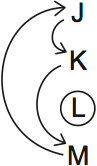
This left L without anyone to transfer with.
B has transfers from J to L, L to M and M to J:
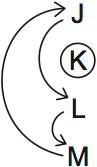
This leaves K without anyone to transfer with.
E is CORRECT. It has transfers from K to L and L to M. There’s also the routine transfer from M to J:

Finally, I drew a transfer from J to K, because J hadn’t transferred and K hadn’t received. That was just to prove to myself that this answer allowed all four people to make and receive transfer.
So E doesn’t violate any rules and it has everyone making a transfer and everyone receiving a transfer.

Leave a Reply