
LSAT Preptest 73 LG Explanations
Full explanations for every question from the logic games section of LSAT Preptest 73.
Archived Logic Games explanations
Logic Games are no longer part of the LSAT. LSAC removed the Logic Games section beginning with the August 2024 LSAT. If you are studying for the current LSAT, you can skip this section.
These explanations remain available for students, tutors, and readers using old-format PrepTests. For current guidance, see Logic Games and the current LSAT.
Table of contents
Game 1: Instrumental
Game 1 Setup
This is an explanation of the first logic game from Section III of LSAT Preptest 73, the September 2014 LSAT.
A record produce will feature five instrumental pieces on a CD. The pieces are Reciprocity, Salammbo, Trapezoid, Vancouver, and Wisteria (R, S, T, V, W). You must use the rules to determine the possible sequences of the instrumental pieces.
Game Setup
This is a pure sequencing game. Modern pure sequencing games are a bit different from traditional sequencing games, but not much. In the past, you could join all the rules together into one big diagram. But now, you usually have to draw the rules separately. Answering the questions quickly depends on your ability to retain these rules and apply them quickly.
You should aim to be very fast at these games, as they tend to be easy. I finished this one in five minutes on my first try. That leaves extra time for harder games.
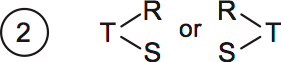
Here are the three diagrams:


I didn’t have any deductions beyond just drawing the rules. To answer the questions, I just quickly applied the rules to whatever situation the question presented.
The key is noticing that questions usually place a variable somewhere in a way that affects one of the rules. So each new rule on the questions allows deductions. Deductions lead to more deductions.
This is a step by step process that can and should be practiced. If you hesitate to apply rules, then you’re not doing games as well as you can. Those who do best on games make deductions automatically, without thought.
Game 1 Main Diagram
These diagrams show the rules used to determine the possible sequence of the instrumental pieces on the CD (R, S, T, V, W).
Refer to these diagrams when solving this game. Copy them on your own page, and on each question make a new version of them in order to follow along with my explanations. You’ll learn much more if you draw along.
The setup section explains how to build this diagram.
Main Diagram
Question 1
For acceptable order questions, go through the rules and use them to eliminate answers one by one.
Rule 1 eliminates D. Salammbo has to be before Vancouver.
Rule 2 eliminates A and E. Trapezoid has to be before or after both Reciprocity and Vancouver.
Rule 3 eliminates C. Wisteria has to be before or after both Reciprocity and Trapezoid.
B is CORRECT. It violates no rules.
Question 2
This question places Salammbo fourth. Your first step should be to see which existing rule is affected by this, and draw it. Rule 1 says that Salammbo has to be earlier than Vancouver, so Vancouver goes last:

Next, check which rules involve S or V. Rule 2 says that T has to be before both R and S, or after both R and S.
T can’t be after S, since there’s no space. That means that T is before S and before R. You can draw that on the diagram

Note: the floating T-R is just a reminder that T – R exist, somewhere on the open spaces they’re drawn floating above.
Once you make a deduction, check if that solves the question. It usually does. C is CORRECT.
Question 3
This question is good practice for making deductions. It places R first. This in turn leads to a massive chain of deductions that affects every variable. The deductions are about ordering, so I’m going to go step by step to create a sequencing diagram that applies to this question.
Let’s go step by step. Rule 2 says that R + S are either both before or both after T. If R is first, then R + S must both before T:

Rule 1 says that V also comes after S:

Rule 3 is affected too. W has to be before or after both R and T. Since R is first, then both R and T are before W. So we can add W after T on the diagram:
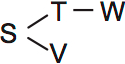
There are only four open spaces for these four variables. Since S has to be in front of all the other remaining variables, S has to be second.
We can draw the full diagram like this:
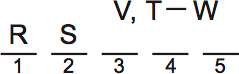
This diagram shows us the rules that govern V, T and W. T is somewhere before W, and V could go anywhere.
You can use this framework to eliminate answers. The diagram above contradicts A, C, D and E.
B is CORRECT. This diagram proves that it’s possible:

Question 4
Just like question 3, this question allows step by step deductions. This question places Trapezoid second, so you must think precisely about the rules involving T.
Rule 2 says that R and S must both be either before or after T. On this question, T is second, so there’s only one space before T. Therefore, R and S must go after T.

We also know that V is after S (rule 2). So there are a total of three people after T: R, and S – V.
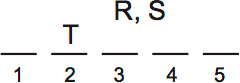
W is the only CD left to place, and first is the only spot open:
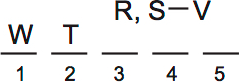
You can use this diagram to eliminate answers.
A and B are wrong because W must go first.
C is wrong because V can go fourth at latest, since V is after S.
D is wrong because W must go first.
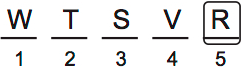
E is CORRECT. This diagram proves it:
Question 5
At first, I thought this question would be very difficult. But each wrong answer is easy to eliminate if you use the rules. So take each rule and see what answers it eliminates.
Remember, the CDs in the answer choices refer to the first and second slots.
S needs to be before V (rule 1). So A is wrong.
The third rule proves B wrong. If W is after R, then W needs to be after both R and after T. In this answer W is only after R.
The second rule proves C wrong. T needs to be after both S and R. In this answer, T is only after S.
The third rule proves D wrong. W needs to be after T and R. In this answer, W is only after T.
I’ll admit that B, C and D are a little hard to visualize. The key is knowing that on B, for example, R and W are mentioned in rule 3, and so is T. Never let go of that idea. If an answer (e.g. B) mentions both R and W, you also need to ask where T can go while obeying the rule. Look at rule 3 until you see how the answer violates it, because if it mentions variables from a rule it almost certainly violates that rule. Draw sketches if they help visualize.
A lot of people look at an answer, say “oh, B mentions things from rule 3, interesting”, but then they let that thought drift out of their head. Always focus on the rules – if you make an observation, follow it till the end.
E is CORRECT. This diagram proves it is possible:

Question 6
Once again, this question gives us a new rule: V is second.
This affects rule 1. That rule says S is before V:
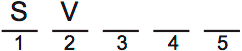
Don’t stop there. S is also mentioned in rule 2: T has to be before or after both R and S.
Since S is first, that means T has to be after R and S:
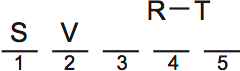
W could be anywhere, as long as it’s before or after both R and T.
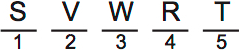
You can use the diagram above to eliminate all the wrong answers. C and E are the least obvious to eliminate. They’re both wrong because they indirectly place T before R.
D is CORRECT. This diagram proves it.
Question 7
This question says that W is first. That actually doesn’t lead to any new deductions. But it’s still helpful to sketch all of the remaining variables:
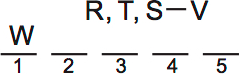
However, this diagram is a bit misleading. You also need to remember that T is either before both R and S, or after them. So really there are two possibilities. Either T is second:
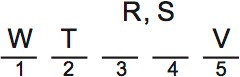
Or T is after R and S, and therefore, fourth or fifth. (I have no good diagram for this scenario).
In either case, T can’t go third so A is CORRECT.
All of the other answers are possible. For practice, it is useful to try quickly sketching scenarios on your own that prove these answers are possible. If you think one of the other answers is impossible than you’ve likely misread or forgotten a rule.
Game 2: Symposium
Game 2 Setup
This is an explanation of the second logic game from Section III of LSAT Preptest 73, the September 2014 LSAT.
Five speakers will deliver speeches at a business symposium. The five speakers are: Long, Molina, Xiao, Yoshida, and Zimmerman (L, M, X, Y, Z). Each speaker will give a speech in either the Gold room or the Rose room (G, R). One speech will be delivered in each room at 1 P.M and one speech at 2 P.M. The last speech will be delivered at 3 P.M. in one of the two rooms.
Game Setup
I don’t know how to classify this game. It’s not like any other I’ve seen. It has grouping and linear elements, but frankly, it’s not useful to think of this game in those terms.
The main difficulty on this game is viewing the rules from the right perspective. Particularly the second rule. The second rule says something like this:
Xiao and Yoshida can’t be before Zimmerman.
But actually, once you consider all the rules, this actually mean: Zimmerman must speak at 1pm. Once you figure that out, the game is easy. (Question 13 actually directly tests this deduction.)
I can’t give you a magic bullet for finding this kind of deduction. The game is essentially testing your ability to visualize all five variables, and ask yourself who can go before Z (no one).
Rule 2 says that X and Y can’t be before Z. And rule 1 says that M and L are in the same room.
So only M could go before Z. But if you did put M before Z, then one of X/Y would have to go first in the other room, like this:
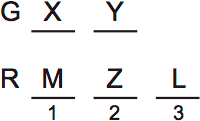
This still violates rule 2. So we can conclude that Z has to go at 1pm.
The rest of the setup is just drawing these rules:



Remember, anything that isn’t forbidden is allowed. Any diagram is fine as long as it doesn’t violate these rules.
Game 2 Main Diagram
These scenarios show the possible assignments of the speakers (L, M, X, Y, Z) to rooms (G, R).
Refer to these diagrams when solving this game. Copy them on your own page, and on each question make a new version of them in order to follow along with my explanations. You’ll learn much more if you draw along.
The setup section explains how to build this diagram.
Main Diagram


Question 8
For acceptable order questions, go through the rules and use them to eliminate answers one by one.
Rule 1 eliminates D and E. Molina and Long have to be in the same room, and Molina has to be before Long.
Rule 2 eliminates B. Xiao can’t be before Zimmerman.
Rule 3 eliminates C. If Long is in the gold room, then X must be in the Rose room.
A is CORRECT. It violates no rules.
Question 9
I skipped this question my first time through the game. I eventually came back and solved it by brute force. I drew diagrams disproving all the wrong answers.
This isn’t the best approach, but it works perfectly fine if you have time for it. I did have time on this question since I finished the first game quite quickly.
The short way to solve this question is to have made the deduction that Zimmerman must go at 1pm.
If you know that, then it’s obvious that B is CORRECT. This is because Long always go at 2pm or later (rule 1).
Here are diagrams proving the other answers are possible.
This diagram proves that A is possible:

This diagram proves that C is possible:

This diagram proves that D is possible:

This diagram proves that E is possible:

You don’t need to draw these brute force diagrams. I’m only drawing them in case you thought one of the wrong answers wasn’t possible.
Question 10
If Xiao speaks at 3 pm, then there are three possibilities. They depend on where ML speak. The third rule says that if ML are in the Gold room, then X is in the Rose room:
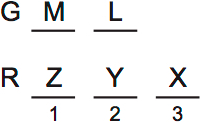
If ML are in the Rose room, then X could speak in either room. In both scenarios, ZY must be first in their room:
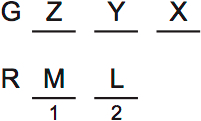
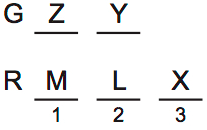
The three diagrams prove that A is CORRECT. Long can’t be in the same room as Yoshida in any scenario.
All of the other answers are possible in one or more diagrams.
Question 11
You can use the rules to eliminate answers.
Rule 1 eliminates A and B. M and L have to be in the same room, in that order.
Rule 2 eliminates D. Y can’t be before Z.
Rule 3 eliminates E. If L is in the Gold room, then Z should be in the Rose room.
C is CORRECT. It violates no rules.
Question 12
This question places Y at 1 pm. We know from rule 2 that Z has to be first. (See the setup for a full explanation of that meaning of rule 2).
So Y and Z fill both 1pm slots. Their order doesn’t matter. I’ve drawn Y in gold, but you could reverse Y and Z:
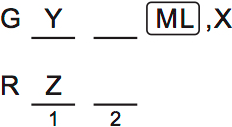
ML and X are interchangeable between the Gold and Rose rooms in the above scenario. If ML goes in one room, X goes in the other.
The question is asking what could be true. It’s possible to put ML with Y, so C is CORRECT.
None of the other answers are possible.
Question 13
I’ll confess that I took a while to answer this question. When I first did the game, I hadn’t realized that rule 2 meant that Z had to be in 1pm.
If you already made that deduction up front, the question is easy: E is CORRECT.
Otherwise, you can use process of elimination to eliminate the answers. There are two ways to eliminate an answer:
- If it allows something that can’t happen.
- If it forbids something that normally can happen.
Many scenarios contradict A. Long doesn’t have to be at 3pm. For example, this scenario is fine according to the normal rules:
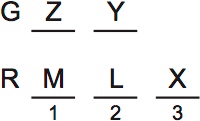
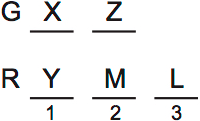
B is true, but you’re not just looking for an answer that is true. You’re looking to replace the rule. B allows (wrong) scenarios like this:
C is also true, but doesn’t actually replace the rule. It allows wrong scenarios like this:
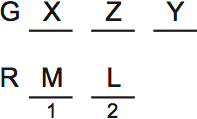
D is also something that must be true, but doesn’t actually replace the rule. It allows wrong scenarios like this:
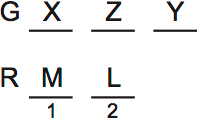
I’ll expand on why E is CORRECT. The only speaker that can go before Z is M. But to place Z at 2pm we need two speakers to go before Z. That’s because there are always two speakers at 1pm.
Since there aren’t two speakers who can go before Z, we can’t put Z at 2pm. Therefore Z always speaks at 1pm.
Game 3: Buildings
Game 3 Setup
This is an explanation of the third logic game from Section III of LSAT Preptest 73, the September 2014 LSAT.
Five buildings – the forge, the granary, the inn, the mill, and the stable (F, G, I, M, S) was once part of a village center. The said buildings were owned by three families – the Trents, the Williamses, and the Yandells (T, W, Y). Each building was owned by exactly one of the families and each family owned at least one of the buildings. You must determine the ownership of the buildings based on the rules.
Game Setup
This is a grouping game. I set it up vertically, like the first question does:
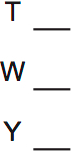
The first rule is very important. It says that the Williamses owned more than the Yandells.
On the surface, you can’t do much with that. But, you should always dig deep into rules to see their implications. There are five buildings. Be specific: how many could the Yandells own?
Not three. Then the Williamses could have two at most. The Yandells couldn’t own two buildings, either. To have more, the Williamses would need three buildings. And that leaves none for the Trents (every family needs at least one building).
So the Yandells can only have one building, and the Williamses need at least two. You can draw this on the diagram:
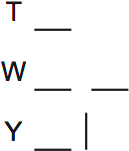
This may seem like a small deduction, but it makes the game far easier.
The other two rules I couldn’t place on the diagram. I just drew them, and made sure I memorized them. Going fast depends on your ability to memorize the rules and know them automatically:


Note that in the second rule, I know that the “or” is an inclusive or: both are possible. Some details I simply commit to memory if there’s no good way to draw them.
There’s nothing else to say about the setup. Speed depends on applying these rules quickly.
Game 3 Main Diagram
These diagrams show the rules used to determine the ownership of the buildings (F, G, I, M, S) by the families (T, W, Y).
Refer to these diagrams when solving this game. Copy them on your own page, and on each question make a new version of them in order to follow along with my explanations. You’ll learn much more if you draw along.
The setup section explains how to build this diagram.
Main Diagram

Rules

Question 14
For acceptable order questions, go through the rules and use them to eliminate answers one by one.
Rule 1 eliminates D and E. The Williamses need to own more buildings than the Yandells.
Rule 2 eliminates C. The forge and the mill can’t have the same owner.
Rule 3 eliminates B. Either the Trents own the stable or the Yandells own the inn.
A is CORRECT. It violates no rules.
Question 15
At first glance, this question was difficult. There’s no obvious way to eliminate answers. It feels like you must use brute force.
But there is always a short way. The trick is to look at what rules affect the Trents. Only the final rule:
- Trents need stables, OR Yandells need the inn.
Next, think of the answers in terms of “easy” and “hard”. Does the answer make it easier to fulfill the rule, or harder? Easy and neutral answers are unlikely candidates to be correct, whereas hard answers are usually correct.
Easy answers give the Trents the stable. They help fulfill the rule.
Neutral answers don’t give the Trents the stable, but leave the inn alone. They don’t affect the rule.
Hard answers don’t give the Trents the stable, and they do give the Trents the inn. This contradicts the rule.
D is CORRECT. If the Trents have the inn, then the Yandells don’t have it. So this answer violates rule 3.
I’ll explain my approach from a different perspective. I knew that rule three was important, since the question mentions the Trents. I knew that rule three mentioned S and I. So I looked for answers that affected those variables. D was the likely candidate, since it mentioned I, and also didn’t give the Trents S.
This is a bit hard to explain since it’s an intuitive process, but basically you want to approach the answers from the perspective of the rule and whether the answer helps or hurts the odds of fulfilling the rule. Then once you identify a good candidate you can examine it more closely.
Question 16
This question gives you a new rule: the Yandells owned the mill. You should draw that:

The Yandells can only have one building, because the Williamses need more buildings than the Yandells (see the setup for a full explanation). So only two groups are left.
Consider how this affects the existing rules. M was in rule 2. The rule in full was that F can’t go with I or M.
F and I are left, and they can’t go together. Only two groups are left. So one of F and I goes in each group:
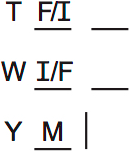
This type of deduction comes from focussing on one rule at a time, and thinking through the implications.
Now let’s look at the remaining rules. Rule 3 says that the Yandells need the inn or the Trents need the stable. Since the Yandells can’t take more buildings, we need to give the Trents the stable:

Finally, the Williamses need another building so that they have more buildings than the Yandells. Therefore, we need to give them the granary:
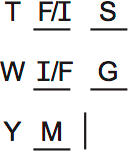
Usually, the final deduction is the right answer, and that’s true on this question. D is CORRECT.
Question 17
This question says one family owned the granary and the inn. You should ask: who can do that. The Yandells can’t, because they can only have one building.
So it’s got to be the Trents or the Williamses. Let’s try the Trents:
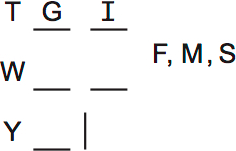
This doesn’t work: it violates rule 3. Either the Trents need the stable, or the Yandells need the inn. Here the Trents have the inn.
(The Trents can’t take the stable because the Yandells need one building, and the Williamses need two. There are only three buildings remaining.)
So the Williamses need to take the granary and the inn. Note that the Williamses now can’t have the forge (rule 2):
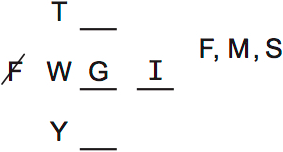
Next, apply the remaining rules. The Yandells don’t have the inn, so the Trents need the stable (rule 3):
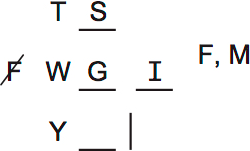
The forge and the mill are left. The Yandells take one, and the other building can go with either the Trents or the Williamses. As long as you don’t place the forge with the Williamses (rule 2).
You can use the diagram above to eliminate answers. It disproves A, C, D and E.
B is CORRECT.
Question 18
This question says the Trents owned exactly one building. We also know from the setup that the Yandells own one building. So this question has this distribution:
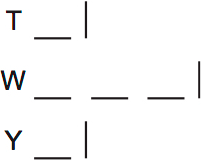
The question is asking what buildings the Trents can own. Given this, you should consider what rules affect the Trents. Either they need the stables, or the Yandells need the inn. It’s pretty probable the Trents can own the stables, so lets see if we can make a working scenario:
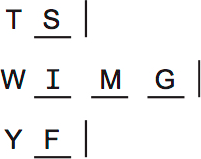
(Note: this is not the only scenario where the Trents can own the stable. But it doesn’t need to be. We’re just trying to prove that it’s possible for the Trents to own the stables.)
Since it’s possible for the Trents to own the stables, we’re left with only C and E as potentially correct answers.
C doesn’t work. If the Trents have the inn, then rule 3 is broken. The Trents don’t have the stables, and the Yandells don’t have the inn.
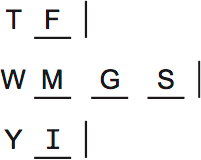
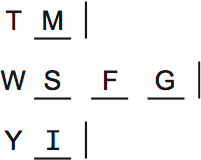
E is CORRECT. There’s no need to prove that the Trents could have the forge and the mill, since we know for sure all the other answers are wrong. But for completeness, here are two scenarios that prove E:
Game 4: Bouquets
Game 4 Setup
This is an explanation of the fourth logic game from Section III of LSAT Preptest 73, the September 2014 LSAT.
Three floral bouquets are being prepared by a florist, in response to a customer’s order. Each bouquet should include one or more of these kinds of flowers: lilies peonies, roses, snapdragons, and tulips (L, P, R, S, T). You must determine the flower combinations based on the rules.
Game Setup
This is a grouping game, oddly similar to the third game. I drew it vertically, like the first question:

I drew a unique diagram to add the rules to this diagram. When a game presents something you’ve never seen before, you need to innovate. The goal is to make a diagram that’s clear and reminds you of the rule. It doesn’t need to be “correct” (there is no one correct diagram); your innovated diagram just needs to be useful. Here’s what I drew:

This represents the idea that bouquets 2 and 3 need exactly two flowers in common, and bouquets 1 and 3 cannot have any bouquets in common.
In practice, I memorized these two rules. The lines are just a memory aid. If you go into a game like this without memorizing the rules, you’re at a severe disadvantage.
Note: I drew these lines on my main diagram, but I did not draw them on the diagrams I drew beside each question. In these explanations, I’ve kept the lines to the left on most diagrams for clarity. But generally your new diagrams should be simpler than the main diagram.
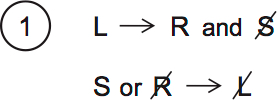
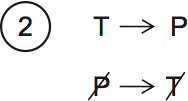
I’m going to draw rules 4 and 5 before rule 3:
Rule 4:

Rule 5:

I’ve drawn the contrapositives. On my own game sheet, I did not do this. When you get to an advanced level, you’ll be able to see contrapositives in your head. But until that point, you should draw contrapositives.
Finally, rule three says that bouquet 3 has snapdragons. If we combine this with rule 4, we can say that bouquet 3 cannot have lilies:

I’ve also drawn that bouquet 1 cannot have snapdragons. That’s due to rule 1: bouquets 1 and 3 cannot have any flowers in common.
Those are all the deductions. As with most modern games, the key to success is simply knowing the rules well and applying them when the questions give you new rules.
Game 4 Main Diagram
These diagrams show the rules used to determine the possible flower composition (L, P, R, S, T) of the bouquets (1, 2, 3).
Refer to these diagrams when solving this game. Copy them on your own page, and on each question make a new version of them in order to follow along with my explanations. You’ll learn much more if you draw along.
The setup section explains how to build this diagram.
Main Diagram
Rules
Question 19
For acceptable order questions, go through the rules and use them to eliminate answers one by one.
Rule 1 eliminates B. Bouquets 1 and 3 cannot have any flowers in common.
Unusually, rule 2 eliminates no answers.
Rule 3 eliminates E. Bouquet 3 must have snapdragons.
Rule 4 eliminates D. A bouquet can’t have lilies and snapdragons.
Rule 5 eliminates C. If a bouquet has tulips, then it needs peonies too.
A is CORRECT. It violates no rules.
Question 20
This question places lilies in bouquet 1. Whenever a question gives you a new rule, your first task is to think about how this affects the other rules.
Rule 4 says that if there are lilies, then there are roses:

Rule 1 says that bouquets 1 and 3 can’t share flowers. So bouquet 3 can’t have roses:

The next deduction is tricky. Bouquets 2 and 3 must share two flowers. So bouquet 3 needs at least one more flower. Who else can go in bouquet 3? T and P are left. We can either place:
- P, or
- T and P (rule 5: if there’s T, there’s P).
So either way, bouquet 3 has P. B is CORRECT.
Question 21
This question places tulips in bouquet one. You should ask what other rules that affects. Rule 5 says that if a bouquet has tulips, it needs peonies:
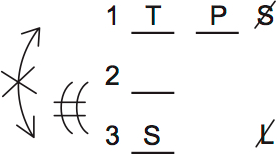
(Note: I’ve left off some “not” rules for simplicity. But you should be aware that, due to rule 1, bouquet three can’t have T or P, and bouquet 1 can’t have S. That’s what the double arrow with the X represents)
Rule 1 says that bouquets 1 and 3 don’t share flowers. So therefore bouquet 3 can’t have tulips or peonies:
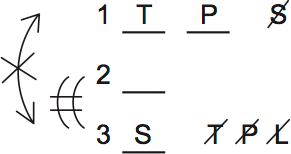
Bouquet three now has a lot of restrictions. Whenever that happens, you should ask what variables can go in a group. S is already in bouquet 3, and T, P and L can’t go there. There are just five flowers, so only roses are left.
Bouquets 2 and 3 must share two flowers each. Bouquet 3‘s second flower can only be roses, and we must give the same two flowers to bouquet 2:
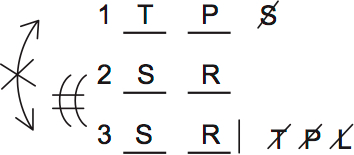
(The vertical line on group three is just a reminder that that group is full.)
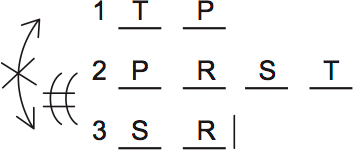
The deduction that bouquets 2 and 3 need S and R answers the question. Only E has snapdragons and roses, therefore E is CORRECT. Just for the sake of completeness, this diagram proves that E is possible:
Question 22
When a question mentions a specific group, you should ask what rules apply to that group. This question mentions bouquet 2. From the rules, we know that bouquet 2 needs to share two flowers with bouquet 3.
Therefore, A is CORRECT, it can’t be true. If bouquet 2 only has lilies and roses, then there aren’t two flowers that bouquets 2 and 3 can share. That’s because bouquet 3 can’t have lilies, because it has snapdragons (rule 4).
Question 23
This was a tricky question. I had to solve it by brute force elimination. We’re looking for something that can’t be true. So any answer that’s possible is wrong. To eliminate an answer, you just need to construct a working scenario that shows it’s possible.
I first checked past questions to see if they proved any answers were possible. The correct answer to question 19 proves that A is possible.
This diagram from question 21 proves that B is possible:
This scenario proves that D is possible:

This scenario proves that E is possible:
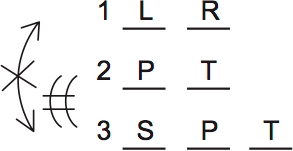
Note: Brute force is slower, but it doesn’t have to be slow. Practice making scenarios quickly. The biggest danger is hesitation. If you know the rules, and draw without hesitating, you can draw a correct scenario in 5-10 seconds.
C is CORRECT. Bouquet 2 can’t have only L, P and R. This is a little tricky to prove. Let’s go step by step. First, place LPR in bouquet 2:

Next, apply rule 2: bouquets 2 and 3 need two flowers in common. Bouquet 3 can’t have lilies, so it must have peonies and roses:

Next, apply rule 1: Bouquets 1 and 3 can’t share flowers. So bouquet 1 can’t have S, P or R:

But, bouquet 1 needs at least one flower. And this is why C doesn’t work. The only flowers left are tulips and lilies. But neither work: tulips require peonies, and lilies require roses.
So C is impossible, and therefore CORRECT.

Leave a Reply