LSATHacks
  • Explanations
  • Tutoring
  • Courses
  • Login
  • Cart
  • Explanations
  • Tutoring
  • Courses
  • Login
  • Cart
LSAT Explanations › Preptest 79 › LSAT Preptest 79 Logic Games Explanations › Question 22

LSAT 79, Logic Game 4, Question 22, LSATHacks

LSAT 79 Explanations

LG Game 4 Question 22 Explanation, by LSATHacks

To solve a “completely determined” question, you should look for the variable that’s in the most rules. It stands the best chance of affecting other things.

Here’s the setup for reference: 
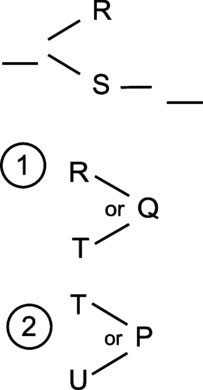
LSAT Preptest 79, Game 4, Question 22, Diagram 14

You can see that T is in both rules above. So, as we saw in question 20, if T doesn’t transmit to Q or P, we can make two deductions:

  • R transmits to Q
  • U transfers to P

So, T is a promising candidate. Only B and C mention T. And B is not good: it has T transmit to Q. That means we only get one additional deduction.

Picking the answer that says T to Q means we only know two things: T to Q, U to P

But in C, where T transfers to S, we know three three: T to S, R to Q, U to P. So, let’s try C:

LSAT Preptest 79, Game 4, Question 22, Diagram 15

I’ve drawn the two additional deductions to the right. Let’s fit them on the diagram. Q obviously attaches to R. As for U – P, we need to put something after S, so U goes there:

LSAT Preptest 79, Game 4, Question 22, Diagram 16

So, C is CORRECT. 

Previous Question
Table Of Contents
Next Question
Quick Jump PT Section Que

Hi, I'm Graeme Blake

I scored a 177 on the LSAT. I founded LSATHacks and created the LSAT Mastery Seminars to help students succeed.

I’ve personally written explanations for 5,000+ LSAT questions. If you find these explanations helpful, you'll definitely like our courses.

Join my email list for LSAT study tips and resources.

Comments

  1. Thom says

    November 1, 2020 at 2:49 pm

    Why doesn’t E work for for PT 79, Sec 3, Que 23?

    Reply
  2. Emily says

    November 23, 2019 at 12:08 am

    And I just realized my mistake. Please disregard. Thanks!

    Reply
  3. Emily says

    November 23, 2019 at 12:07 am

    Hi Graeme,

    Quick question for you! I understand how you got to the T-S-U-P set up; however, I am unsure how this doesn’t break the T/U->P rule? Does this mean that T or U does not have to directly transmit to P, but that T/U simply must be earlier in the sequence?

    Reply
  4. Chloe says

    November 17, 2019 at 3:01 pm

    I thought that only one computer can be infected after S so how can the S-U-P (answer choice C) option be correct?

    Reply

Leave a Reply Cancel reply

Your email address will not be published. Required fields are marked *

Free LSAT Email Course

My best LSAT tips, straight to your inbox

Increase Your Score

LSATHacks Courses Aiming For The 170S? See exactly how a top scorer thinks INCREASE YOUR SCORE
“The seminars teach you how to think like a high-scorer so that you can choose the correct answer quickly.” — Jay
“Not only did my score improve but I was able to approach LR with utter confidence” — Kacie L.

Resources

  • Articles
  • Blog
  • Free Email Course
  • LSAT Preptest Converter
  • Experimental Section Checker
  • LSAT Prep Books

About LSATHacks

  • About/Contact
  • Courses
  • Free Trial

Community

  • Discord
  • Social Media
  • Webinars
Disclaimer: Use of these explanations requires official LSAT preptests. LSAT is a registered trademark of LSAC.
LSAC does not review or endorse specific test preparation materials or services and has not reviewed this site.

© Copyright 2026 LSATHacks. All Rights Reserved. | Privacy | Terms
