
LSAT Preptest 80 LG Explanations
Full explanations for every question from the logic games section of LSAT Preptest 80.
Archived Logic Games explanations
Logic Games are no longer part of the LSAT. LSAC removed the Logic Games section beginning with the August 2024 LSAT. If you are studying for the current LSAT, you can skip this section.
These explanations remain available for students, tutors, and readers using old-format PrepTests. For current guidance, see Logic Games and the current LSAT.
Table of contents
Game 1: Research Teams
Game 1 Setup
Time on first attempt: 5:00
—————
This is a fairly straightforward two-group grouping game. If you found this difficult, don’t worry. By repeating this game until you’ve mastered it, you can gain a very solid skill-base for this type of game. They’re quite standard.
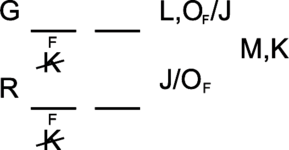
Each group has at least two students. One of the groups will have three, but we don’t know which one. However, you should draw the two slots as a reminder that two is the minimum:

I’ve also added the first, second and fourth rules:
- L is in green
- one of O/J is in each group.
- O must be a facilitator, so I’ve marked that as well.
I’ve further marked the facilitator as the first spot. This is optional. Personally, this just makes it easier for me to track.
Here’s how to read the diagram above: Letters hovering to the right of a group mean that those letters must be in that group, but we don’t know where. So:
- L and one of O/J must be in group G
- One of J/O must be in group R
The only thing left is the draw the remaining variables. Those are K and M. K is not a facilitator (rule 3), and M is random:

On my own page, I drew those off the right of the diagram. Sort of like this:

That’s it! This is a fairly simple game. Note that since L and O/J take up two spaces, group G is near full. So if you also put, for example, M in group G, then K would have to go in the other group. This mechanic comes up on a few questions.
Splitting The Game Board
There’s an alternate way to set this up: you could split the game into two scenarios: one with O as facilitator in the green group, and one with O as facilitator in the red group. I did this on my second go through. It was mildly useful, but led to no big deductions. On games like this, you can often decide to split based on whether you feel like doing it: it can help if that’s the way your mind is working based on the rules, or it can get in the way if you have a good grasp of the rules and don’t feel the need to split. On edge case games like this I sometimes split, sometimes don’t.
But, one advantage of splitting in this case is that it becomes obvious that O and J are apart, and that group G always has at least two people (O/J + L). If you found yourself forgetting these rules, consider splitting when redoing this game.
Game 1 Main Diagram
The setup section explains how to build this diagram.
Main Diagram

Question 1
For acceptable order questions, go through the rules and use them to eliminate answers one by one.
Note that I use the rules themselves. I don’t use my diagrams for these questions. Reading the rules again for this question will help you memorize them, and it’s also more efficient.
Rule 1 eliminates A. Juana and Olga must be assigned to different teams.
Rule 2 eliminates D. Lateefah must be assigned to the green team.
Rule 3 eliminates E. Kelly cannot be a facilitator.
Rule 4 eliminates B. Olga must be a facilitator.
C is CORRECT. It violates no rules.
Question 2
I was puzzled by this question, as I had made no upfront deductions that would let me solve a general must be true question. And almost everything is possible on this game.
When stuck, read through each answer and look for one that seems impossible. Don’t brute force every answer and try to disprove it. Just look for the one which seems the least possible and start on that answer.
In this case, that’s D, which is CORRECT. Olga must be a facilitator, so Juana and Mei can’t both be facilitators too. (We only have two facilitators).
Briefly, on the other answers:
- A. It doesn’t matter which team J is on, as long as O is on the other team.
- B. L can be a facilitator. Anyone can be a facilitator except K.
- C. Same as A. It doesn’t matter which team O is on, as long as she isn’t with J.
- E. This is fine. K can’t be a facilitator, so this answer helps us obey the rules. As for J, there will always be three non-facilitators.
Question 3
Almost anything is possible in this game. So, the right answer will violate one of the rules. Just keep them in mind:
- Olga must facilitate
- Kelly can’t
- Olga and Julia must be separate
A and B are fine. L and M can be facilitators, and K has no special effect on the game, so L and M can be assigned with them.
C and E are also fine. They don’t break any of the rules above. In particular, they both allow O to be a facilitator. C actually saying she O facilitates, and E allows O to facilitate by placing M (the second facilitator) on a different team from O.
D is CORRECT. It says L is on a different team from J. That means L is on the same team as O, since J and O are on different teams.
O is a facilitator (rule 1), and this answer also makes L a facilitator. That violates the rules: only one person can be facilitator.
Question 4
We know O has to be a facilitator. This question says that L also has to be one. So, we have our two
facilitators:

I’ve placed J in the green team as well, since they can’t be in the same group as O. This leaves only M and K left to place. They can go anywhere, as long as you don’t put both in G. (Groups have three students max)
So, E is CORRECT, because it could be true. The other answers contradict the diagram.
Question 5
We know the green team already has two people: L, and one of J/O. M makes three, and three is the max a group can have. So, we must put K in the empty space in the other group:

So, B is CORRECT.
Game 2: Mystery Novel
Game 2 Setup
Time on first attempt: 9:43
—————
This is a linear game. I usually find these easy, but I thought this one was harder than most. You can draw the seven chapters of the novel like this:

I’ve also added the first rule: T can’t go first.
The next rule also involves T. It must go exactly two spaces in front of W:

This rule adds new restrictions on where T can go. Since T must have three spaces after it (two blanks and W), then T can’t go fifth, sixth or seventh:

It’s optional whether to draw these “not” rules. But when one variable is particularly restricted, I think it’s helpful. My first time through the game I hadn’t consciously realized that T _ _ W can only be placed in three positions.
The next three rules interact heavily with this. They are as follows:

I’ve also drawn R with a circle around it as random, as it’s the last remaining variable.
T _ _ W creates a gap of two spaces. This is hard to fill, as there aren’t that many clues that can go together in that space. We can’t put both SZ there, for example (rule 3). You can put U and X, but only in the XU order, to keep W and X separate.
Here’s a diagram to illustrate how easy it is to make mistakes. At first glance, this may seem a possible placement:

But, this diagram won’t work. There’s no way to both put UX together and also to keep SZ separate. Any diagram that places R and has two spaces of two will fail, for the same reason. So while R is technically random in this game, it’s surprisingly hard to place.
Watch out for this interplay during the game, and you’ll handle it with ease. It’s the main constraint the questions use.
Game 2 Main Diagram
The setup section explains how to build this diagram.
Main Diagram


Question 6
For acceptable order questions, go through the rules and use them to eliminate answers one by one.
Note that I use the rules themselves. I don’t use my diagrams for these questions. Reading the rules again for this question will help you memorize them, and it’s also more efficient.
Rule 1 eliminates B. T cannot be mentioned in the first chapter.
Rule 2 eliminates A. There are more than 2 chapters separating T and W.
Rule 4 eliminates E. X and W cannot be mentioned in adjacent chapters.
Rule 5 eliminates C. U and X must be mentioned in adjacent chapters.
D is CORRECT. It violates no rules.
Question 7
Rule 5 says that X and U must be together. So, if X is in slot 1, then U must be in slot two:

This means T _ _ W can only start in 3 or 4. When a question gives you only two possibilities, it’s good to draw a scenario for both. One with T_ _W starting in 3, and one with them starting in 4:
Scenario 1

Scenario 2

I’ve filled in the remaining variables in each diagram. The space of two will be filled with R and one of S/Z. The other of S/Z will go in the single space. (This is because S and Z can’t go beside each other.)
You might think “I have no time to draw that!”. I suggest practicing doing it quickly. You can leave off certain details. For example, I don’t draw numbers on my local diagrams, and I don’t draw the “not T” under the diagram.
I just timed myself, and it took me 25 seconds to draw both diagrams. But then it only took me 13 seconds to look through the answers, conclusively eliminate the wrong ones and definitively prove the right one.
If you never practice a skill, of course you’ll be slow at it. But if, when you review, you practice quickly splitting scenarios, you will get fast at them. And pretty much every time you can split a diagram two ways, you’ll find it solves the question, so you can draw it without thinking.
Of course, it may not occur to you to split, which is not a problem – you can also solve this question just by doing the first XU drawing. You don’t have to find every efficiency on test day to do a game well. But practicing efficiencies on review makes you more likely to spot at least some of them in timed conditions.
Anyway, E is CORRECT. Z can go third in the second diagram above. All of the other answers contradict the diagrams.
Question 8
We know that U and X go beside each other, in either order. This question places U third, so we can make one diagram with X 2nd and another with X fourth:

I added in the rule that X and W can’t be beside each other (rule 4).
Next, you should see how to place T _ _ W, since they’re the most restrictive element. Normally, T can only go in 2, 3 or 4.
The second diagram actually doesn’t work at all. If we place T 2nd, then W would have to go fifth in order to be two spaces apart from T. But that doesn’t work, as W and X can’t be together (rule 4)
So, we’re left with the first diagram. In that one, we have to place T fourth:

Only R, and SZ are left to place. SZ can’t go together, so one goes 1st, and the other goes in 5 or 6 with R:

This maps out the only possibilities, so now we can simply pick the right answer from the diagram.
B is CORRECT. All the other answers contradict the diagram.
Question 9
This question places Z 7th. This restricts T _ _ W. Normally, they can go in 2/5, 3/6 or 4/7. This question eliminates that last possibility. Since there are only two possibilities, we can instead draw scenarios for both: one with T in 2, and one with T in 3:

The first scenario is quite restricted. We need to put XU together. The only place to do that is between T and W:

Only R and S are left to place. Rule 3 says SZ can’t go together, so S has to go in slot 1, leaving R for slot 6:

The next diagram is more open ended. XU can either go 1st and 2nd (in either order) or 4th and 5th (as XU).
RS will fill the other two slots, in either order.

(As I said above, XU must be in that order in slots 4/5, but could be UX in slots 1/2. The restriction in 4/5 is to keep X away from W)
Looking through the answers you can see D is CORRECT. It’s possible in the second scenario. (Remember, XU are reversible in slots 1 and 2, when away from W.)
None of the other scenarios are possible in either diagram.
Question 10
Unlike the previous questions, this one gives no prompt. So, you have to figure out which answer seems most plausible. There are two ways:
- Searching for answers that seem easier.
- Eliminating clearly wrong answers
It should be a quick pass in either step. If you can’t instantly figure out if an answer is easy or wrong, skip it. T _ _ W will be the easiest source of elimination. Let’s do that first.
- B is wrong. T goes fourth at the earliest.
- D is wrong. W can only go 5th to 7th.
That leaves us with A, C and E. To decide which is most likely possible, consider which restrictions the variables face. If a variable has few restrictions, then is it easier to place, and answer is more likely something that “could be true”.
A, C and E have R, U and X. R is comparatively easy as it has no rules. X is hard, because it has two rules: it can’t be beside W, and it must go beside U. In C, U is middle difficulty. It has one restriction: it must be beside X, so placing U 7th forces X 6th.
Therefore, A looks like the easiest answer, and we should try it first. I want to be very clear. If E had said “R is mentioned in chapter 7”, I would have tried E first. I’m doing A first because it seems easiest: you should often ignore alphabetical order on logic games and focus on plausibility.
So let’s try A. Start by placing T _ _ W away from R:

Why placing T _ _ W away from R? In the setup I showed how creating two open blocs of two spaces doesn’t work: XU and SZ are left to place. They’d each have to go in one bloc, but SZ can’t go together.
With T _ _ W away from R, we can place XU in the middle of T _ _ W, and place one of SZ in in first and the other in sixth. Note that the XU order keeps X away from W:

This diagram obeys all the rules!
So, R can go seventh. A is CORRECT.
As for the other two answers:
- E: X can’t go 6th because of W. W can only be 5, 6 or 7, and can’t be beside X. So, if X were 6th, then W would be beside X.
- C: is the same as E. Placing U 7th forces X 6th.
Question 11
On rule substitution questions, you should think about other rules that affect the variable in question. The rules which affect T are:
- T can’t go first.
- T must be exactly three spaces in front of W.
If we want to replicate the first rule, we’ll have to use W. If we say W can’t go fourth, then that would stop T from going first (since T has to be three spaces in front of W.)
B is CORRECT. Frankly, this was the easiest rule substitution question I’ve seen – they’re usually more elaborate.
D is the trap answer. It’s true that this rule forces T not to be in first. But the question isn’t asking “how do we make T not first”. It’s asking “how do we replicate the rule”. That means leaving all other rules the same. And U normally can go after T, so this answer contradicts the regular rules of the game.
C is a funny answer. It’s actually something which already can’t be true, as we saw in question 10. So it adds nothing.
And further, C doesn’t make anything else happen. I really can’t figure out how A or C could help with the goal of preventing T from being first. They don’t force anything else to be first, or force T to be somewhere else.
E might make you think that X goes before T, and therefore blocks T from going first. But, E is consistent with this scenario: “T X _ W”
Placing X before W doesn’t place X before T! Further, if X were forced before T, that would also be wrong, because in the normal rules X can go after T.
Game 3: Oil and Watercolor Paintings
Game 3 Setup
Time on first attempt: 8:30
—————
This is a grouping game with two elements: a painter, and a type of painting. It’s also a rare type of game where a lot can be determined in advance. These used to be extremely common on logic games from preptest 50 or earlier.
Games where you can determine a lot upfront have become quite uncommon on recent tests. However, their occasional presence shows that mastering the old skills is still valuable. It can flip a hard game into an easy one. Once you master the basics of newer games, it is worthwhile to work on some “classic” LSATs in order to build a wide skillset.
You can draw the game like this:

I’ve drawn rule 5 directly on the diagram: Isaac’s oil is in the lower position of wall 4.
I don’t bother numbering the walls. It’s easy to see which is upper/lower, and which is wall 1, wall 3, etc.
I use the space under the slot to mark the type of painting, and the space above for the painter. This makes for a cleaner, more efficient diagram, which is nonetheless still clear.
The first two rules I simply memorized:
- You can’t put only watercolors on a wall, and
- You can’t put both of student’s oil and watercolor paintings on the same wall.
It’s worth thinking about the first rule. We know there are four watercolors, and four oil paintings. The first rule says you can’t fill a wall with watercolors.
What does that meant for the distribution of the painting types? Think about this a moment if you haven’t, and try drawing it.
Done? Let’s try putting two oils on wall one. Remember, we can’t place two watercolors on the same wall, so avoid that as long as you can:

Oops. No matter how you try to work it, you end up with two watercolors on wall 4, which doesn’t work.
It turns out that each wall must have one watercolor and one oil painting. There’s no other way to obey rule 1.
So we can say, for example, that the upper painting on wall four is a watercolor:

Rule 3 says that Franz and Isaac don’t share walls. Here’s how to draw it. The curved line indicates they’re reversible:

You should always see if new rules can be combined with the diagram. Since F and I can’t go together, that means F can’t go above I on the fourth wall. You should draw that as a not rule:

Next, rule 4 says that Gw is above Fo:

You should also draw that as a not rule on wall 4. Upper wall 4 is a watercolor, but it can’t be Gw, because the bottom of wall 4 is Isaac instead of F. This greatly restricts wall 4’s watercolor:

Whenever not rules start accumulating, you should think who can go there. Only I and H are left. And I can’t go, because they have the bottom position (rule 2, students can’t fill a whole wall).
So, wall 4’s upper section must be H’s watercolor!

This deduction greatly restricts the game, because we know that one other wall is Gw above Fo (rule 4). That leaves only two “open” walls left. It’s worth thinking who can go there:
- Go, Ho, Iw, Fw
That’s really quite limited, especially since you have to match the watercolors with the oils. So, making that deduction about H in wall 4 really narrows the game.
Also, one key insight is that for these four remaining variables, upper/lower doesn’t really matter unless a question specifies it. If you look at the answers for question 9, 13, 14 and 16, they talk exclusively about walls – they don’t mention upper or lower. And more than half the answers on questions 15 and 18 also don’t mention upper/lower.
So, when sketching scenarios, if a question tells you to put H’s O on wall 2, just stick them on that wall, and don’t worry whether you place them upper or lower. The only important thing is who you match them with, not whether they’re up or down.
Game 3 Main Diagram
The setup section explains how to build this diagram.
Main Diagram




Question 12
For acceptable order questions, go through the rules and use them to eliminate answers one by one.
Note that I use the rules themselves. I don’t use my diagrams for these questions. Reading the rules again for this question will help you memorize them, and it’s also more efficient.
This question is a bit different, however. Usually, for most questions of this type, each rule will eliminate one answer.
But on this question, no single rule eliminate B or E. Instead, you have to use the combined setup diagram to eliminate them. See the setup section for how to construct these deductions, but basically you can deduce this:

So B and E are wrong because H’s watercolor needs to be in the upper position on wall 4, and yet those answers place it elsewhere.
I actually don’t think I’ve ever seen this happen on a logic game. Usually, if an upfront deduction is required for the first question, then that question won’t be an acceptable order question. On newer LSATs the test makers seem prepared to slightly break longstanding rules. I think this is part of an effort to throw off people who are only getting questions right due to rote memory rather than underlying skill.
Further, if a first question on a game seems unusually hard, it’s a strong sign to go back to your diagram and see if there’s a missing deduction.
Rule 4 eliminates D. Franz’s oil must be displayed on the lower position of one of the walls.
Rule 5 eliminates C. Issac’s oil must be displayed on the lower position of wall 4.
A is CORRECT. It violates no rules.
Question 13
This game really requires the setup deduction to do well. Here’s the setup for reference:

This diagram question places I’s watercolor on wall two, and F’s oil on wall 3.
Rule 4 mentions F’s oil. We know it has to have G’s watercolor above it.
But, for I, it doesn’t really matter whether they go up or down. The answers just specify walls. It’s who we match them with that’s important.
So, let’s put Isaac’s oil on the lower position. It’s important not to get paralyzed. You can always come back and make a scenario with them on the upper position if that turns out to be important (though, it isn’t):

Next, look at the rules. The only other remaining rule is that F and I can’t go together. So, this means F’s other painting must go on wall 1:

The question is asking about who must go on wall 1. So, A is CORRECT.
Question 14
This question places H’s oil on wall 2. Let’s draw that. There are no rules for whether to place H up or down; it only matter who we match them with. Here I’ll draw them up, in order to leave more space for drawing “not” rules below

Here’s somme things we can deduce about the lower painting:
- Since H is an oil, the lower painting must be a watercolor (rule 1).
- It can’t be H’s watercolor, since that is already on wall 4. (Also, H can’t go with H, rule 2)
- It can’t be G’s watercolor, since that’s already placed with F’s oil (rule 4)
So, only I’s or F’s watercolor can go on wall 2 with H’s oil. This is a could be true question, so E is CORRECT.
Question 15
In the setup, we saw that H’s watercolor and I’s oil were on wall 4. And rule 4 places G’s watercolor with F’s oil.
That leaves only four variables left to place, which must be matched together. And of this group, this question already accounts for G’s oil and F’s watercolor by placing them together:

That leaves H’s oil and I’s watercolor to go together.
D is CORRECT.
Question 16
This question places F’s oil on wall 1. Rule 4 says that G’s watercolor must go with F’s oil. So, we can draw both of those:

As we saw in the setup, there are only four variables left to place:

Only A and B mention these variables. And A is wrong, because wall 4 is already full.
So, B is CORRECT. G’s oil can go on wall 2.
All the other answers mention variables already placed on the diagram above.
Question 17
You can use the setup to eliminate answers on this question. The setup deduction was that H’s watercolor must be above I’s oil on wall 4:

And rule 3 places G’s watercolor above F’s oil. So, we already know the placements of these four paintings:

These deductions let us eliminate four answers:
- G’s watercolor must be upper.
- F’s oil must be lower.
- F’s oil must be lower.
- G’s watercolor must be upper, and so must H’s oil.
E is CORRECT. H and G’s watercolors must be upper, and there are no restrictions on their oils. This scenario shows a way they can both be upper:

Question 18
This question is easy if you made the setup deduction. There, we saw that H’s watercolor must be in the upper position on wall 4. To see why this must be true, review the setup section. Here’s the setup diagram:

D is CORRECT.
As for the other answers, they all mention variables from this list. These were the free floating variables who can go anywhere. They only have to be matched with each other. It’s hard to make a “cannot be true” statement about such flexible variables:

Game 4: Real Estate Companies
Game 4 Setup
Time on first attempt: 6:08
—————
I think this was supposed to be a hard game. It’s certainly an unusual one: I’ve never seen another LSAT game like this.
But it’s actually incredibly easy, once you notice there’s a simple mathematical trick. You can assign each of the buildings a number value.
To explain this, I’ll first give an analogy. Let’s say someone is trading iphones. They have iPhone X’s, iPhone SE’s, and iPhone 4’s.
- The X is fairly new, and worth $800
- The SE is semi new, and worth $400
- The 4 is old, and only worth $200
You can trade iphones in any combination, as long as the values as equal. So, an iphone X can be traded for two SE’s, or four 4’s.
Rather than using money, we could simplify things by saying that
- The iPhone 4 has a value of 1
- The iPhone SE has a value of 2
- The iPhone X has a value of 4
So, let’s say someone starts with an iPhone X, and two iphone 4’s. Their iPhone stock has a total value of 6.
They make some phone trades. What kinds of phones can they end up with? For example, can they end up with two iPhone X’s?
No, that’s too much: two iphone X’s = 8, and this person only started with 6.
So, you can use the number 6 to see if a set of phones is the correct amount. If someone starts with 6, they must end to 6.
You may have figured out that I was making an exact analogy to the buildings. Instead of thinking “Two class 3’s for a class 2”, I want you to think of buildings as having number values. These sets are all equal:
Four class 3 = two class 2 = one class 1
If you make a class 3 worth 1, then each set above is worth 4 in total.
Let’s look at R’s actual holdings. They have one class 1 (worth 4), and two class 3’s (each worth 1). So, here’s the value of R’s holdings:

Diagram 3
They’re worth 6. But, it will be cleaner to combine the value of the two group three buildings, since they’re always traded in sets of two:

Let’s look at the value of everyone’s set of buildings:

Every group is worth six! This gives us a new rule:
After all trades, each group must still be worth six
Once you know this, it’s easy to see which answers are right or wrong. People can trade as many buildings as they want, but they can never increase or decrease the value of their holdings.
I don’t think any question requires you to think about all the trades that had to happen to produce a new set of buildings. Instead, you only have to think: does this new set of buildings add up to 6?
Note that the letters have an alphabetical order of value. An early alphabet letter is worth 4 (F, G) a middle alphabet letter is worth 2 (K, L, M, O), and a late alphabet letter is worth 1 (Y, Z). This makes the answers faster to calculate.
You may be thinking “I could never come up with this system! I’m going to law school to get away from math!”. There are two things I can saw to that:
- Repeat this game over and over, without reference to the explanation, trying to replicate this system. This will help make it intuitive.
- This skill is relevant to law. Lawyers deal with business transactions, and need to be able to do at least some basic, quick mental calculations.
Game 4 Main Diagram
The setup section explains how to build this diagram.
Main Diagram
See the setup section for an explanation of the value systems. Each set must add up to a value of six.

Question 19
Unlike most acceptable order questions, on this one you should use the setup diagram. That’s because, in the setup, we figured out each group must be equal to 6. So, any answer with a group not equal to six is wrong. Here’s the setup diagram again:

To understand this explanation, you need to read the setup section. So do that if you haven’t yet. All of the answers below are wrong because they don’t sum to 6.
A Realcorp has a value of 8.
B Realcorp has a value of 8.
D Realcorp has a value of 7.
E Southco has a value of 4.
C is CORRECT. It violates no rules.
Question 20
To understand this explanation, you need to read the setup section. So do that if you haven’t yet. Here’s the setup diagram again:

In the setup, we saw that each group must have an ending value of six. Class 1 buildings are worth four, class 2 are worth two, and class 3 buildings are worth one.
So, just look for the answer that doesn’t add to six. That’s A, which is CORRECT. It adds to eight.
All the other answers add to six, so it’s possible to get to them after enough trades.
Question 21
To understand this explanation, you need to read the setup section. So do that if you haven’t yet. Here’s the setup diagram again:

In the setup, we saw that each group must have an ending value of six. Class 1 buildings are worth four, class 2 are worth two, and class 3 buildings are worth one.
In this question, Realprop now has three class two buildings. Which means, effectively, that they have taken all of Trustcorp’s buildings, and given away all of their own. (Technically, they could have L instead of one of Trustcorp’s buildings, but this doesn’t matter.)
So, we have to distribute the following between Southco and Trustcorp:

Note that L is arbitrary. It could instead be any of K, M or O, in which case Realprop would have L.
And the value of each group must be six. Clearly, the only way to do that is to give each group a class 1 building. You can’t put the two class 1’s together, or you’d have a value of eight.
So, the right answer will be either “Trustcorp has a class 1 building” or “Southco has a class 1 building”. A is CORRECT.
B and E are wrong because specific class 2 and class 1 buildings are interchangeable. So they can end up anywhere.
C and D amount to the same answer. In the group above, the two class 3 buildings and the one class 2 building are interchangeable. So, either Southco or Trustcorp could have them.
Question 22
To understand this explanation, you need to read the setup section. So do that if you haven’t yet. Here’s the setup diagram again:

In the setup, we saw that each group must have an ending value of six. Class 1 buildings are worth four, class 2 are worth two, and class 3 buildings are worth one.
This question says Trustcorp has no class 2. That means it must have a value of six, using only class 1 and class 3 buildings.
The only way to do that is to have one class 1, and two class 3’s, like Realprop has. Trustco could have either G or F, but they need to have both Y and Z.
E is CORRECT.
Question 23
To understand this explanation, you need to read the setup section. So do that if you haven’t yet. Here’s the setup diagram again:

In the setup, we saw that each group must have an ending value of six. Class 1 buildings are worth four, class 2 are worth two, and class 3 buildings are worth one.
This is like question 20. Any group which adds to six is fine. Any group which doesn’t is the right answer.
D is CORRECT. F + Y = 5.

Leave a Reply