
LG Game 2 Question 11 Explanation, by LSATHacks
Edit: diagram and explanation below are incorrect. The answer is B. However, due to the impending removal of logic games, this explanation is unlikely to receive a correction due to the difficulty of making new diagram images. Some explanations in the comments have answered this.
———–
This question gives us a new rule. To draw it, you should look at our original scenarios and expand on them. These were the scenarios:

This question’s new rule is that LO are together. So in scenario 1, MLO go third, and fill up the group.
Scenario 2 is slightly more complicated. In scenario 2, KLO go together and fill up a group. Which group can they go in? Only 1st. If O goes 2nd, rule 2 says that JK must be together. So we’d have JKLO. But there’s only space for three variables in a group.
So in scenario 1 we have MLO filling group 3, and in scenario 2 we have KLO filling group 1:
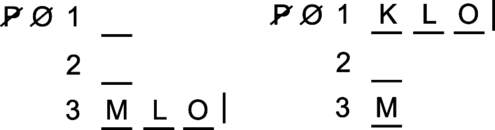
In scenario 1, J, K and P are left to place (and JK can’t go together, rule 4). One of J/K must go 1st, because P can’t.
In scenario 2, J and P are left to place. At least one goes 2nd, because every group needs at least one ranger. The one of P and J can go either 2nd or 3rd:
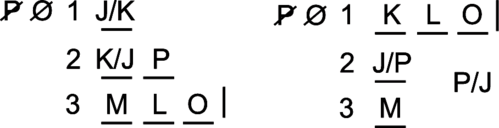
E is CORRECT. P can be third, in scenario 2. (The P/J floating to the right of the diagram indicates it could go in either open group).

I would love to see a corrected explanation for this question, because I don’t understand why E isn’t possible. I don’t see any rules broken by the following:
Area 1 – J/K
Area 2 – K/J
Area 3 – M, L, O, and P
Graeme, this answer is wrong and your explanation doesn’t make sense.
You posted the answer to question 10 for question 11
Correct answer is B! O cant be in group 1.
Hi Graeme,
Actually, the answer I got, and according to LSAC, the answer is B
the answer is b
this is incorrect, the answer key gives the correct choice as B. Since O cannot be assigned to area 1 (as Christopher points out below), the LO group must fill area 3 with M. This rules out all answer choices except B.
my book says that the correct answer to this question is “b”
The answer is actually B, Koguchi in area 2.
Hello, I also think your answer to 11 is not right. O cannot go in 1 and it cannot go in to, O and L have to go in 3, with M. Since P cannot go in 1 and we know that the max number of people has been reached in 3, then P has to go to 2. Since P goes in 2, we know that either K or J also has to go there, but we know for a fact that they cannot both be in 2 because they cannot go together, since O is in 3. Therefore, B (K could be in 2), is the correct answer.
FLAG.
This is not the correct answer. The 10 ACTUAL pt guide for PTs 72-81 states in the answer key the correct answer is B.
Your set up is violating rule 2, O cannot be assigned to group 1.
The only scenario O and L can be together places them into group 3, since M is there, the only place for P to go is group 2, either with K or J.
B: K is assigned to area 2.
Answer to Question 11 is B.
This one is wrong because O can’t go in group 1, disproving your scenario 2. The answer is B (K in area 2), as you can see in your scenario 1. First and only mistake a came across on this website so far
As the previous person stated, O can’t go in 1 per the rules. It also can’t go into 2 (b/c it triggers a cascade that ultimately would force too many people into group 2) therefore group 3 consists of MOL; P then must go in 2 (since it can’t go in 1) and J/K can go anywhere btwn groups 1&2. Therefore B is correct (confirmed with the answer key)
yeah this explanation on 11 is wrong and so is the answer
The correct answer to this question according to the answer key is B.
B is correct. You put KLO in row one, which breaks the rule that O and P cannot go in Group 1.
In LG 2, Q11 you have “O” in group 1 which is not allowed via the rules, and you have E as the established answer but B is the answer according to every book I have…. can you explain more
Hey, just wanted to let you know that you actually got this answer wrong. The answer is B. O can’t go in area 1…
In logic game 2, question 11 you have “O” in group one, but one of the rules forbids “O” from being group 1.
I was wondering the exact same thing.
yes and the correct answer is B.
yeah this dude is definitely wrong. The Correct answer is B…..
Hey Graeme, I love your explanations they have been helping me so much over the last few months. But I am still a little bit confused on this question. I thought according to rule 2 of this problem O cannot go in area 1, so wouldn’t that make scenario 2 impossible. Also in the answer section of the book it says “B” is the correct answer. Any further explanation would be amazing!
My book states that B is correct for this question. I got E as well, but looking at your diagram, can’t A, per your second diagram, B, per your first diagram, AND E, per your second diagram ALL be true?
What am I missing?J can go in 3, K can go in 2, AND P can go in 3? Is there some reason that the second diagram is not valid at all? That’s all I can think of for the book’s answer, but I don’t see it…
I see it now. Second Diagram is INVALID because O CANNOT go in 1. ONLY B is available with this.
Answer for Prep Test 79, Logic game 2 Question 11 is incorrect. You placed K, L, and O in Area 1, however, O cannot be placed in Area 1 as per the rules-
Correct answer is B, not E. Other than that, this is a fantastic website and an amazing help. Only error I’ve encountered during my studies. Thank you-
LSAT 79, Logic Game 2, Question 11
Answer is B.