

RC Passage 1 Explanation
PASSAGE TEXT: A major problem facing industrial societies is their exponentially increasing production of toxic …
Paragraph Summaries
- There’s more toxic waste and regulations makes old solution such as landfills more costly. Industries are turning to deep-well injection to dispose of hazardous waste because injection is cost efficient. In deep well injection, liquid wastes are injected into permeable rock layers already filled with salt water. These layers are at least 300m deep, and thus below aquifers. However, deep-well injection has become controversial since more communities are relying on underground sources of drinking water. There are three serious problems related to getting rid of waste via deep-well injection.
- In good conditions, wastes are put into rock strata with: salt water, and impermeable rock strata above. But, wells can leak, leading to the first problem: noxious chemicals mix with drinking water. The second problem is that personnel mistakes can pollute aquifers. Because the waste is underground, these errors can expose people to waste material for a long time before the problem is discovered.
- The third problem is that we can’t predict how the area’s geological features will affect the injected wastes. Underground water (including wastewater) doesn’t follow gravity: the water can slowly move upwards, sideways, and in unexpected directions into other geological formations. (This could allow it to reach aquifers).
- The aforementioned problems make deep-well injection a risky method. But industries will still use it because it is cheap and efficient.
Analysis
This passage is pretty straightforward. It introduces a method of waste disposal that’s become popular with many industries since it saves time and money. It then describes the conditions under which it can work (how deep the wells need to be drilled etc.) This background information becomes important later on in the passage when the author reveals that the design of the method itself can produce bad consequences.
In the next few paragraphs, the author outlines three main problems, and it’s clear in the concluding paragraph that the author doesn’t think deep-well drilling is a safe method of disposing waste. However, industries will continue to use it for its few benefits.
There is one point that is tricky to understand: paragraph 3 describes how water moves. Underground, water can move against gravity and flow upwards, sideways, etc. Remember, wastes are injected into salt water, so that means the wastes can flow upwards and sideways! This could lead them up to aquifers.
Two questions rely on paragraph 3, so it is important to understand what it is saying. Underground, water can move against gravity, going upwards, and going great distances. So, water placed under aquifers could move up and sideways and get back into aquifers.
See this diagram I made, the squiggly arrow on the right shows how wastes could travel upwards and sideways into an aquifer:
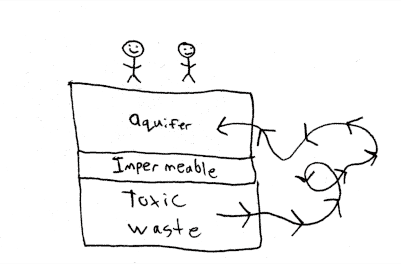
(I’ll explain the layers below)
The other thing that is tricky to understand is how injection sites are selection. The criteria are in the middle of paragraph 1, and the start of paragraph 2. It’s unusual to split the criteria: normally RC articles keep all criteria in one place.
Paragraph 1 says:
- Inject into porous, permeable rock strata (porous and permeable mean: water can flow through)
- at least 300 m deep
- filled with saltwater
- Not deeper than 1800m, else the well will be too costly.
Paragraph 2 adds:
- The area must have an impermeable layer above. This is to get between the waste and any aquifers which are higher up.
So, we get this diagram:
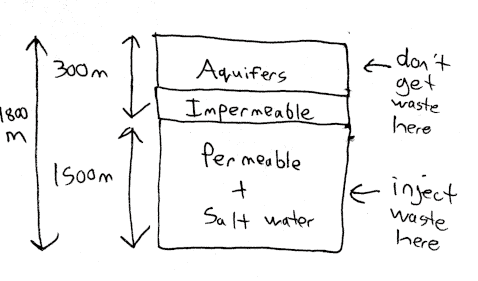
From 0 to 300 metres, there are aquifers, so we don’t inject wastes. Then, below 1800m, it is too costly. So we inject in the middle later between 300m and 1500m.
Above this layer there should be an impermeable layer, which prevents the waste from directly mixing with the aquifer above. In the waste site, the layers are permeable, and there is salt water.
The arrow on the side illustrates the problem discussed in paragraph 3: water (and the waste within) can defy gravity and travel sideways and upwards and through differential geological formations, potentially mixing with aquifers.

Leave a Reply