

RC Question 7 Explanation
DISCUSSION: This is by far the trickiest question of the passage. Usually, specific detail questions are answered in one part of the passage. But here, the author explains deep well injection site criteria in two places: the middle of paragraph 1, and the start of paragraph 2. It’s easy to get this question wrong if you only look at paragraph 2.
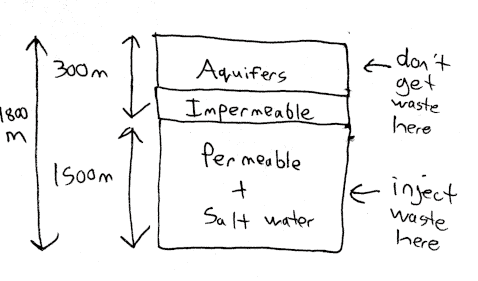
The criteria for an injection site are as follows:
- Lower than 300m so as to be below aquifers (paragraph 1)
- Above 1800m so as to be cheap enough (paragraph 1)
- In an permeable layer full of salt water (paragraph 1, 2)
- This layer should have an impermeable layer above, so that water can’t flow between the injection site and aquifers above. (paragraph 2)
I’ve summed it up in this diagram below:
___________
- The first part of this is correct: the injection site must be 300m deep or below. The second part is wrong: the start of paragraph 2 says that injection sites must be “separated by impermeable rock strata from aquifers”. Aquifers are above 300m (middle of paragraph 1), so this means that the impermeable layer must be above the injection site.
So what’s the problem? The problem is the injection site needs permeable layers (look at the diagram above). These permeable layers are below the impermeable layer which separates the injection site from aquifers.
But what does this answer say? It says there is an impermeable layer below which there are no permeable layers. So this answer directly contradicts a major requirement. We instead need permeable layers below that impermeable layer. - CORRECT. We know waste is injected at minimums of 300m, and has to be injected into a layer of permeable rock. We also know that above 300m is where the drinking water is. Sentence 1 of paragraph 2 says that impermeable rock separates drinking water from the waste. So that means the impermeable layer is above the injection site.
- This has the depth all wrong! Paragraph 1 says that aquifers are from the surface down to 300m, and so therefore injection sites must be below 300m.
But this answer says that the injection site it above 300m! This puts the injection site square in the middle of aquifers. That’s an awful idea, it would inject deep well wastes directly into drinking water. This answers directly contradicts the central point of the passage, so if you picked it you need to slow down and read more carefully and actually try to picture or draw what they’re describing to you. - The entire point of site selection in the passage was to get the injection sites away from aquifers. Whereas this answer implies that we need an aquifer near the toxic waste injection site. That’s bonkers! Aquifers are indeed found at depths of 300m or less, but we don’t need to go seek them out.
- The 1,800 number is only relevant to tell us that beyond that depth, deep-well drilling is no longer cost-effective. This answer suggests the sites should be at or below 1800m, which is wrong: that’s way too deep.

Would it be possible to go more in depth on why E is wrong? I chose E originally, and B totally makes sense when you take into account the information from paragraph 1 and 2, and the visual is very helpful.
Why does the answer have to be practical tho? Like based on the tone of the passage, it seemed like the author would be for any method that places the toxic waste as far away from the aquifer as possible with an impermeable layer above it. Like there’s nothing to suggest that the author cares about economic feasibility? The author’s main concern is the impact on the aquifers.
Is “suitable” the key word in the question stem that suggests practicality should be considered? Thanks
I think you might be approaching the question wrong. It is asking us “based on the passage” – that means that you should answer based on the information given to us about the practice of deep-well injection, not necessarily what characteristics you think the author cares more or less about.
We know that cost is a consideration, in fact, a significant one. Paragraph 1 explicitly says that wells are rarely deeper than 1,800m specifically because at such depths it is more cost-efficient to consider alternative methods of disposal. That must mean economic feasibility is an important consideration.
Meanwhile, the question asks us for the “ideal characteristics” and “suitable”. If wells deeper than 1800m are rare because they’re cost-inefficient, that is neither ideal nor suitable. Basically, I think you might be getting tripped up because you’re answering from a perspective of “what do I think the author would want” versus “from the information given in the passage about deep-well injections, what do I know about the ideal characteristics?”. Hope that helps!
Hi, there’s a typo : “Above 1800m** so as to be cheap enough (paragraph 1)”
i really appreciate these explanations! typos make me nervous tho
Fixed, thanks for letting us know!
I truly enjoy reading your explanation for PT90, RC1,Q7. The diagram makes me feel you were an engineer before.
Thank you :) Wasn’t, but perhaps could have been haha